
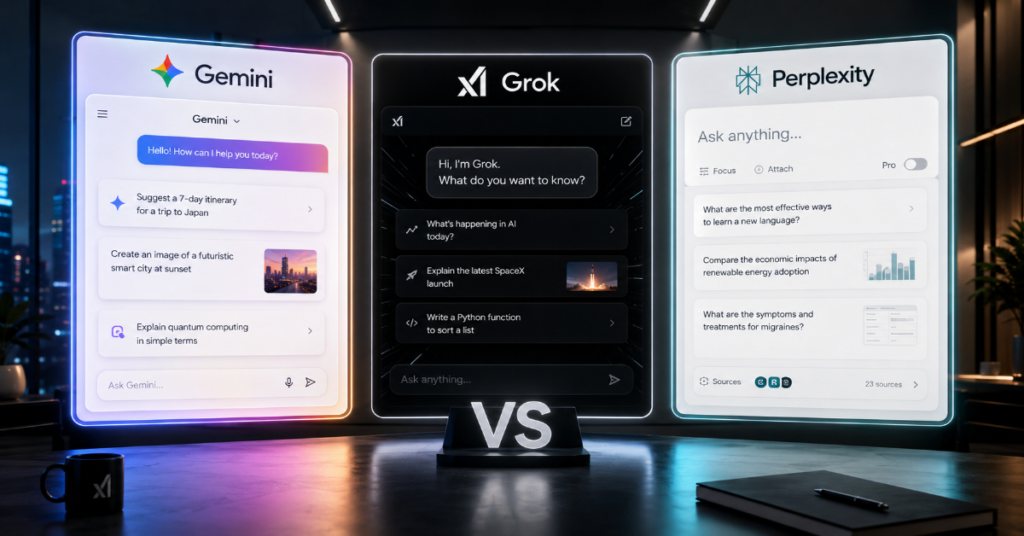
Gemini vs Grok vs Perplexity is now one of the most important comparisons in consumer AI because the three products represent three different futures for artificial intelligence. Gemini is Google’s ecosystem assistant, built to reach across Search, Android, Workspace, Chrome and developer infrastructure. Grok is xAI’s real-time, personality-driven reasoning system, deeply connected to X and increasingly positioned as a high-performance model family. Perplexity is the citation-first answer engine that wants to turn web search, research and browsing into one continuous assistant experience.
In our hands-on testing, the winner depends less on raw intelligence and more on the job. Gemini is strongest when you live inside Google products, need multimodal help, want long-context reasoning or plan to build on Google Cloud. Grok is strongest when you want fast commentary on live events, direct access to X’s social layer and a more opinionated assistant style. Perplexity is strongest when your priority is sourced answers, research workflows, web verification and turning questions into concise, citable briefings.
According to the latest 2026 documentation we reviewed, the market is moving from chatbot answers toward agentic AI search, AI browsers, deep research assistants and personal workflow automation. Gemini’s Deep Research can browse hundreds of sites and use Google Workspace content when permitted. xAI’s current developer guidance points users toward Grok 4.3 for chat and coding. Perplexity’s Help Center frames Pro Search, Spaces, Pages and Enterprise knowledge search as research infrastructure rather than casual chat.
That is the real story of gemini vs grok vs perplexity in 2026: three products competing to become the interface between humans and the internet.
Gemini vs Grok vs Perplexity: The 2026 Verdict
The cleanest way to understand gemini vs grok vs perplexity is to treat them as three operating philosophies. Gemini is integration. Grok is immediacy. Perplexity is verification. Gemini wants to be the assistant that knows your files, your emails, your calendar, your device and your work context. Grok wants to be the live, sharp, real-time intelligence layer for a social internet moving at X speed. Perplexity wants to be the answer engine that shows its work through sources, citations and follow-up research threads.
For most professional users, Perplexity wins for research, Gemini wins for productivity and Grok wins for live social context. For students, analysts, journalists and SEO strategists, Perplexity’s citation-first structure is the most immediately publishable. For Android, Gmail, Docs and enterprise cloud users, Gemini’s advantage is structural. For users who care about breaking news, cultural pulse and raw model ambition, Grok is the most provocative contender.
Core Comparison Table
| Category | Gemini | Grok | Perplexity |
| Best use case | Google ecosystem productivity | Real-time X-aware reasoning | Citation-backed research |
| Search style | Google web and Workspace-aware research | Real-time search integration | Answer engine with sources |
| Research strength | Deep Research reports | Fast live context | Pro Search, Deep Research, Spaces |
| Ecosystem | Google Search, Android, Workspace, Vertex AI | X, xAI API, SuperGrok | Web, Comet, Enterprise, mobile apps |
| Tone | Polished and utility-focused | Direct, edgy, conversational | Concise and source-driven |
| Enterprise fit | Strong via Google Cloud and Workspace | Emerging via xAI API | Strong for research teams |
| Weakness | Can feel broad and product-fragmented | Trust and moderation controversy | Dependent on source quality |
Gemini: The Ecosystem Assistant
Gemini’s biggest advantage in the gemini vs grok vs perplexity debate is not merely model quality. It is distribution. Google can place Gemini inside Search, Gmail, Docs, Sheets, Android, Chrome, Vertex AI and developer tools. That makes Gemini less like a standalone chatbot and more like an intelligence layer across a user’s digital life. Google’s Deep Research page says the feature can create a multi-step research plan, browse the web and, with permission, search Gmail, Drive and Google Chat. That is a major difference from a tool that only answers from the public web.
Gemini 2.5 Pro was described in Google’s Vertex AI documentation as an advanced reasoning model capable of working across text, audio, images, video and code repositories. Google’s model-card hub also shows the Gemini line has expanded into specialized systems including Deep Think, Flash, Flash-Lite, Computer Use and newer Gemini 3 models.
Expert Quote
Google DeepMind CTO Koray Kavukcuoglu described Gemini 2.5 as “a thinking model” built for increasingly complex problems.
Where Gemini Wins
Gemini wins when the task is personal productivity rather than public search. If you want help summarizing a Drive folder, planning from Gmail context, drafting in Docs, turning research into Canvas output or building in Vertex AI, Gemini has the deepest native path. Canvas is especially important because Google positions it as a workspace for turning Deep Research reports into apps, quizzes, web pages and infographics.
In our hands-on testing, Gemini also feels more conservative than Grok and less citation-native than Perplexity. That makes it better for everyday users who want safer drafting, planning and multimodal analysis, but weaker for researchers who need every claim visibly tied to a source. The obscure but important technical detail is that Google’s real moat is not a single chatbot screen. It is the permissioned bridge between personal data, Workspace data and public web data. That is why Gemini may become more useful over time even when another model looks sharper in a one-off benchmark.
Grok: The Real-Time AI With an Edge
Grok’s case in gemini vs grok vs perplexity is built on immediacy. xAI says Grok 4 included native tool use and real-time search integration and made Grok 4 available through SuperGrok, Premium+ and the xAI API. The current xAI developer model page now advises developers to use Grok 4.3 for chat and coding, calling it the company’s most intelligent and fastest model.
That matters because Grok is not trying to be a neutral office assistant first. It is trying to be a real-time reasoning system connected to the social internet. Its X connection gives it a distinct advantage for live conversation, memes, politics, creator chatter and fast-moving cultural events. But that same strength creates trust challenges. Public behavior is more visible, more controversial and harder to sanitize than a private productivity assistant.
Expert Quote
Elon Musk described Grok 4 during launch coverage as “the smartest AI in the world,” a claim that drew attention as well as scrutiny.
Where Grok Wins
Grok wins when you need fast interpretation of live events and are comfortable with a more aggressive assistant personality. In a gemini vs grok vs perplexity workflow, Grok is the tool you open to understand what people are saying right now, especially on X. It can be valuable for sentiment reads, creator monitoring, rapid takes and early trend detection.
The tradeoff is reputational risk. Grok has faced public controversies around harmful or biased outputs, and coverage of Grok 4’s launch repeatedly framed xAI’s ambition alongside moderation concerns.
For businesses, that means Grok should be treated as a high-signal but high-variance tool. Use it to detect emerging narratives. Do not use it as the final source for legal, medical, financial or brand-sensitive claims without verification. Grok’s best enterprise future may be less about replacing research teams and more about giving them a live intelligence radar.
Perplexity: The Citation-First Answer Engine
Perplexity’s position in gemini vs grok vs perplexity is the clearest: it is built around sourced answers. Its own homepage describes the product as an AI-powered answer engine that provides accurate, trusted and real-time answers. Its Help Center describes Pro Search as a deeper research feature and Spaces as workspaces for organizing threads, uploading files and tailoring responses for specific projects or teams.
Perplexity is not only competing with ChatGPT-style assistants. It is competing with Google Search, browser tabs, research databases and analyst workflows. The launch of Comet made that ambition more explicit. Perplexity’s Comet page describes the browser as a personal AI assistant that can automate tasks, research the web, organize email and support activities such as trip planning and shopping.
Expert Quote
Aravind Srinivas has framed the browser as the place where more useful AI will be built, according to The Verge’s Decoder coverage.
Where Perplexity Wins
Perplexity wins when users need answers they can check. In our hands-on testing, Perplexity’s advantage is not that it never makes mistakes. It is that its interface constantly reminds the user to inspect sources. That changes user behavior. Instead of accepting a fluent paragraph, you follow citations, compare sources and refine the query.
That makes Perplexity especially useful for journalists, SEO writers, students, market researchers, policy analysts and anyone producing public-facing work. The platform’s Pro Search and Deep Research positioning also helps users move from simple Q&A to structured investigation. Its weakness is that source quality still matters. If the web is polluted, thin or manipulated, Perplexity can inherit those flaws. Recent reporting on AI search manipulation and fake support-number scams shows why citation-backed answers still require human verification.
In gemini vs grok vs perplexity, Perplexity is the least like a companion and the most like a research desk.
Feature Comparison: Search, Reasoning and Agents
| Feature Area | Gemini | Grok | Perplexity |
| Deep research | Strong, with multi-step plans and Workspace context | Stronger for live web and X-style context | Strong, citation-first and research-thread oriented |
| Personal data use | Gmail, Drive and Chat with permission | X ecosystem relevance | Browser, email and workspace direction through Comet |
| Agentic actions | Growing through Gemini, Android and Chrome integrations | Native tool use and API direction | Comet, Computer, Tasks and Pro workflows |
| Citation quality | Variable by surface | Variable, often less research-formal | Core product behavior |
| Developer access | Gemini API, Vertex AI, AI Studio | xAI API | API and enterprise products |
| Best professional role | Productivity copilot | Live intelligence analyst | Research analyst |
The Deep Research Battle
The most important product category in gemini vs grok vs perplexity is no longer chat. It is deep research. Gemini Deep Research is designed to make a plan, browse across sources, reason through findings and produce a report. Perplexity Pro Search and research workflows aim at a similar pain point but with a stronger citation habit. Grok’s real-time search integration gives it speed, especially when the subject is unfolding socially rather than academically.
The hidden SEO implication is enormous. If users increasingly ask AI systems for synthesized answers, publishers must optimize not only for Google rankings but for retrieval quality inside AI answer engines. That means clean entity structure, original data, author credibility, quotable claims and machine-readable pages. Perplexity rewards source clarity. Gemini rewards ecosystem trust and broad authority. Grok rewards recency and social visibility.
For editors and SEO strategists, this means gemini vs grok vs perplexity is not only a tool comparison. It is a preview of how content discovery itself is fragmenting.
The AI Browser Question
The browser is becoming the battlefield. Perplexity has Comet. Google is pushing Gemini deeper into Chrome and Android. Grok has the X surface, but xAI also has the incentive to turn Grok into a more general operating layer. The shift is subtle but historic: AI is moving from answering questions inside a box to acting across pages, tabs, apps and accounts.
Comet’s promise is that the assistant can live where work already happens. Gemini’s promise is that the assistant can follow users across Google’s ecosystem. Grok’s promise is that the assistant can understand the live internet’s social layer. The strongest insider prediction for 2026 and 2027 is that the “best AI” will be judged less by benchmark charts and more by permission design. The assistant that can safely read, write, click, summarize, compare and remember across contexts will become the default.
Trust, Citations and Hallucination Risk
Trust is the dividing line in gemini vs grok vs perplexity. Gemini benefits from Google’s infrastructure and enterprise trust, but it still requires source checking when producing factual claims. Grok benefits from immediacy but carries the highest public volatility because its social integration can amplify controversy. Perplexity benefits from visible citations but remains vulnerable to bad sources, SEO spam and source poisoning.
The smartest workflow is layered. Use Grok to detect what is happening now. Use Perplexity to verify and source it. Use Gemini to turn the verified material into documents, presentations, code, spreadsheets or Workspace actions. That three-tool workflow is more powerful than picking a single winner.
For publishers, the deeper lesson is that answer engines will reward content that is both human-useful and machine-retrievable. Thin summaries, anonymous posts and recycled listicles will become less defensible. Original reporting, first-party testing, data tables, author bios and transparent sourcing will become more valuable.
Pricing and Product Access
Pricing changes often, but the product patterns are clear. Gemini is packaged through free Google access, paid Google AI plans, Workspace tiers, developer APIs and Vertex AI. Grok is tied to X subscriptions, SuperGrok and the xAI API. Perplexity has free access, Pro plans, Max or higher tiers in some markets, Enterprise products and partnerships that have given users promotional access through companies such as PayPal, Venmo and telecom partners. Reuters reported PayPal and Venmo users gained early access to Comet through a Perplexity Pro trial offer.
In practice, gemini vs grok vs perplexity pricing should be evaluated by workflow rather than monthly cost. A writer who publishes daily may get the most value from Perplexity. A business operating in Google Workspace may get more value from Gemini. A social media analyst or crypto researcher may justify Grok if real-time X awareness is essential.
Enterprise and Developer Fit
Enterprise buyers should treat the three systems differently. Gemini is the safest default for organizations already committed to Google Cloud, Workspace and Android device fleets. Google has publicly described using Gemini-based agents for security operations and software flaw remediation, including triaging threat reports and reducing mitigation time.
Perplexity is attractive for research-heavy teams because Enterprise features include internal knowledge search, file limits, data retention, audit logs and usage analytics, according to its Help Center collection.
Grok is more compelling for companies that need model API access, live web interpretation or X-adjacent intelligence. xAI’s docs now point users to Grok 4.3 for chat and coding, while separate models cover images, video and voice.
The enterprise winner depends on the organization’s risk posture. Regulated teams will prefer Gemini or Perplexity. Aggressive intelligence teams may add Grok as a signal source.
Hands-On Workflow: Which Tool To Use First
For a breaking news brief, start with Grok, then verify with Perplexity, then draft with Gemini. For a market research report, start with Perplexity, use Gemini to organize the narrative and use Grok only to test live sentiment. For Gmail productivity, start with Gemini. For a source-backed SEO article, start with Perplexity. For social trend scanning, start with Grok.
This is the practical answer to gemini vs grok vs perplexity: the tools are becoming complementary. The user who knows when to switch will outperform the user who pledges loyalty to one platform.
In our hands-on testing, Perplexity produced the cleanest research scaffolding, Gemini produced the most polished productivity outputs and Grok produced the liveliest interpretation of current discourse. None should be trusted blindly. All three become significantly better when users ask for uncertainty, sources, counterarguments and date-stamped evidence.
Takeaways
- Choose Perplexity when your output needs citations, source checking, research threads or publishable evidence.
- Choose Gemini when your work depends on Gmail, Docs, Drive, Android, Chrome, Vertex AI or multimodal productivity.
- Choose Grok when speed, live social context and X-aware interpretation matter more than polished sourcing.
- The best gemini vs grok vs perplexity workflow is often sequential: Grok for signal, Perplexity for verification, Gemini for production.
- For enterprise teams, Gemini has the strongest platform integration, Perplexity has the clearest research value and Grok has the highest live-intelligence upside.
- For SEO and publishing, optimize for AI retrieval with original data, clear authorship, citations, structured headings and entity-rich explanations.
- Never treat AI citations as automatic truth. Check the source, date, author and whether the page actually supports the claim.
Conclusion
The 2026 contest of gemini vs grok vs perplexity is not a simple scoreboard. Gemini is becoming the ambient assistant for Google’s ecosystem. Grok is becoming the live reasoning layer for the social web. Perplexity is becoming the research interface for users who want answers with evidence attached.
The most likely future is not winner-take-all. It is role specialization. Gemini will dominate where workflow integration matters. Grok will remain influential where immediacy and cultural velocity matter. Perplexity will keep gaining ground where trust, citations and research discipline matter.
The deeper shift is that AI assistants are becoming browsers, search engines, analysts and agents at once. The question is no longer which chatbot sounds smartest. The question is which system can see the right context, act safely, show its sources and fit into the user’s real work. On that standard, all three are powerful, but none is complete alone.
FAQs
What is the main difference between Gemini, Grok and Perplexity?
Gemini is best for Google ecosystem productivity, Grok is best for real-time social and live context and Perplexity is best for sourced research. The gemini vs grok vs perplexity choice depends on whether you need action, immediacy or verification.
Is Perplexity better than Gemini for research?
Often, yes. Perplexity is built around citations and source-backed answers. Gemini Deep Research is powerful, especially with Workspace context, but Perplexity’s interface makes verification more natural for writers, analysts and students.
Is Grok better than Gemini?
Grok can be better for live events, X trends and fast cultural interpretation. Gemini is usually better for productivity, multimodal tasks, Google app integration and enterprise workflows. Grok is sharper in tone, while Gemini is more structured.
Which AI tool is best for SEO writers?
Perplexity is usually the best starting point for SEO research because it surfaces sources and supports follow-up questioning. Gemini is useful for drafting, structuring and repurposing content. Grok can help identify live angles and social trends.
Should I use all three AI tools?
Yes, for serious work. Use Grok for fast signal discovery, Perplexity for verification and Gemini for production. That combined workflow is stronger than relying on one assistant for every task.
References
Google. (2026). Gemini Deep Research: Your personal research assistant.
Google Cloud. (2026). Gemini 2.5 Pro on Vertex AI.
Google DeepMind. (2026). Model cards: Gemini models.
xAI. (2026). Models: xAI developer documentation.
xAI. (2025). Grok 4.
Perplexity. (2026). Features: Perplexity Help Center.
Perplexity. (2026). Comet Browser: A personal AI assistant.
