
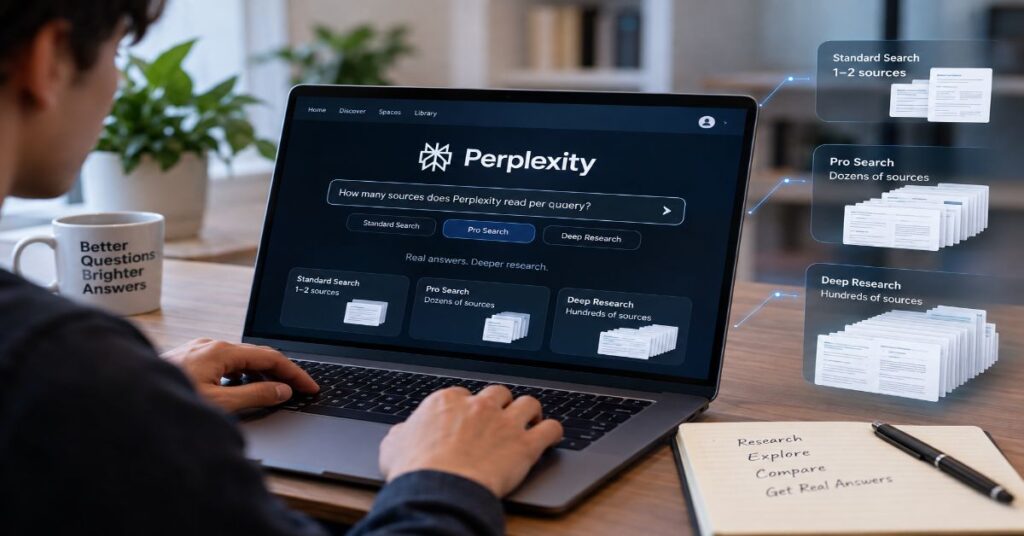
The current 2026 answer to how many sources does Perplexity read per query is mode-dependent: Standard Search typically uses 1-2 sources, Pro Search reads dozens, and Deep Research can read hundreds. That spread is unusually large, and it explains why two users can ask what looks like the same question yet see radically different citation panels, response times and levels of evidence.
The sharpest mistake in current coverage is to look for one universal number. Perplexity is no longer a single retrieval setting wrapped around a chatbot. Its consumer product now routes questions through different search modes, model choices and research workflows. The July 2026 Help Center explicitly contrasts Standard Search with Pro Search, describing the former as surface-level and based on 1-2 sources while saying Pro Search performs multiple web searches and synthesises information from dozens of sources. Perplexity’s current Search product page goes further for Deep Research, saying that it performs dozens of searches across hundreds of sources.
Those numbers describe retrieval depth, not necessarily the number of links a reader sees. Independent 2026 measurements commonly find roughly eight to nineteen visible sources per Perplexity answer, depending on the prompt set and test surface. That is not a contradiction. The system can retrieve a broad candidate pool, rank and extract evidence from part of it, use only some of that evidence in the final synthesis, and then display a still smaller set of citations. The rest of this article separates those layers, shows where the published numbers come from, and explains what source count does – and does not – tell you about answer quality.
How Many Sources Does Perplexity Read per Query by Mode?
Perplexity’s own documentation supports a three-tier answer rather than a single average. Standard Search is the lightest path. Its Pro Search comparison table describes Standard Search as using 1-2 sources for fast, basic answers. Pro Search is explicitly described as conducting multiple searches, drawing from articles, academic papers, forums, videos and other source types, then reading and analysing dozens of sources. Deep Research is positioned above both: the product page says it runs dozens of searches across hundreds of sources before checking findings and writing a report.
The wording matters. Perplexity does not promise that every Standard Search will always use exactly two documents, that every Pro Search will read a fixed number such as 32, or that every Research run will inspect the same number of pages. Its public language is deliberately categorical: 1-2 for standard depth, dozens for Pro, hundreds for Deep Research. Query complexity, source availability, selected focus, recency and the model’s own research plan can all change the final count.
That makes the safest answer a range by mode. If a page elsewhere claims that Perplexity always reads 10, 20 or 30 sources, it is describing a measured sample, a visible citation panel or an older product state – not a universal platform rule. The official 2026 distinction is broader and more useful because it maps source depth to the workflow the user actually selected.
| Mode | Official 2026 Source Depth | Search Behaviour | Best Interpretation |
| Standard Search | Typically 1-2 sources | Fast answer with basic retrieval | A small evidence set for straightforward questions |
| Pro Search | Dozens of sources | Multiple searches plus synthesis across source types | Broad retrieval for complex or multi-part questions |
| Deep Research | Hundreds of sources | Dozens of searches, iterative checking and report generation | Research-scale coverage rather than a normal answer panel |
Why Sources Read and Sources Cited Are Different Numbers
A source can participate in the research process without appearing as a visible citation. This is the most important conceptual distinction in the topic. Retrieval systems usually begin with a candidate set that is intentionally wider than the evidence eventually passed to the language model. Ranking stages then remove stale, duplicated or weakly relevant material. Passage extraction may keep only one useful span from a page. During generation, the model may use some evidence directly, use other evidence only to resolve ambiguity, and omit material that never becomes part of the written answer.
Perplexity’s 2026 Search API architecture makes that funnel unusually visible. The company describes hybrid lexical and semantic retrieval, prefiltering, multiple ranking stages and cross-encoder reranking. It also says the system retrieves and scores at both document and sub-document levels so that downstream models receive compact, precise context instead of whole pages full of irrelevant material. In other words, ‘the system found this page’ and ‘this page became a displayed citation’ are different events.
The distinction also helps explain Perplexity Pro’s marketing statement that Pro provides 10x as many citations per answer. Ten times as many citation markers is not necessarily ten times as many unique sources, because one source can support multiple claims and one claim can carry multiple citations. Nor does it prove that the engine read only the sources ultimately displayed. For practical auditing, it is useful to track four denominators separately: candidates retrieved, sources whose passages reach model context, unique sources cited, and citation markers displayed.
That is also why our companion guide on how Perplexity decides which sources to show is a better mental model than a fixed-count theory. Source selection is a pipeline, not a single lookup.
| Measurement | What It Counts | Why It Can Be Larger or Smaller |
| Retrieved candidates | Pages or passages considered by early search stages | Designed for recall, so many candidates are later discarded |
| Context sources | Evidence passed to the generation model | Ranking and token budgets remove weaker or repetitive material |
| Unique cited sources | Distinct URLs shown as evidence | Only sources supporting final claims need visible credit |
| Citation markers | Inline citation instances in the answer | One source may appear several times; one claim may cite several sources |
What Standard Search Actually Uses
Standard Search is easy to misunderstand because Perplexity’s interface still looks like a citation-first answer engine even when it is using a small evidence pool. The July 2026 Pro Search Help Center is unusually specific: in the Standard-versus-Pro comparison, Standard Search is described as ‘Surface-level, 1-2 sources’. That is the closest thing Perplexity currently publishes to a simple per-query source count for ordinary search.
A one- or two-source answer can be entirely appropriate for a narrow factual question. If the user asks for a current company headquarters, a release date, a documented product limit or a simple definition, breadth can add latency without adding much value. In these cases the primary task is often to identify the most authoritative source quickly rather than to create a literature review. This is also consistent with Perplexity’s broader product message that not every question needs the same model or the same search depth.
The weakness appears when a seemingly simple query hides several claims. A question such as ‘Is this software secure and worth the price for a small legal team?’ is not one fact. It contains security, pricing, suitability and possibly regulatory sub-questions. A shallow answer can look polished while resting on a narrow evidentiary base. When our editors test questions of that kind, we treat a one- or two-source response as an orientation layer, not a decision-ready analysis.
The practical implication is not that Standard Search is unreliable. It is that its design objective is speed. Users who need source diversity, contradictory evidence, academic literature or multiple market perspectives should switch to Pro Search or Research rather than trying to force a basic mode to behave like an investigative workflow. The broader Perplexity AI accuracy benchmarks reinforce this point: accuracy depends on the task, mode, source environment and definition of correctness, not one universal percentage.
What Pro Search Does Behind the Interface
How Many Sources Does Perplexity Read per Query in Pro Search?
Pro Search is where the phrase ‘dozens of sources’ becomes meaningful. Perplexity says the workflow conducts multiple web searches and can draw from articles, academic papers, forums, videos and other material depending on the selected focus. It then reads, analyses and compiles insights before producing a structured answer. This is not merely a longer response setting; it is a wider retrieval process.
The company’s technical disclosures help explain why the final source list is still selective. Q2D-Web, released in September 2026, evaluates first-stage retrieval using 69,721 agent-reformulated queries over a 190 million-document corpus. Perplexity’s production search architecture separately describes a web index tracking more than 200 billion unique URLs, with hybrid retrieval and increasingly expensive ranking stages narrowing the candidate set. The point of scale is not to dump hundreds of links into the model. It is to make it more likely that the right passages survive the funnel.
This is also where query rewriting matters. Agentic search systems often reformulate the user’s question into several machine-written searches. One user prompt may therefore trigger a set of narrower retrieval tasks, each with its own candidates. That helps explain why two prompts of similar length can produce different source breadth: a question that decomposes into five independent claims may need more searches than a long but narrowly scoped request.
Aravind Srinivas described this broader design logic in a 2026 FF Global conversation: ‘investors are investing in Perplexity for accuracy and orchestration.’ The word orchestration is useful here. The system is coordinating models, tools and retrieval steps rather than applying one immutable source-count rule. Perplexity chief business officer Dmitry Shevelenko made the same point from another angle in June 2026: ‘Our structural advantage is we are the multi-model orchestrator.’
For readers who want to use that breadth deliberately, our research workflow guide shows how to specify source type, date window and verification requirements instead of simply asking for ‘more sources’.
Deep Research Expands From Dozens to Hundreds
Deep Research changes the unit of work from answer generation to investigation. Perplexity’s product page says the mode runs dozens of searches across hundreds of sources, checks its findings and then writes a report. The original Deep Research announcement similarly described dozens of searches and hundreds of sources. Those are the strongest official numbers available for the upper end of Perplexity’s consumer research depth.
The difference is more than scale. A deep-research agent can search, inspect what it found, identify gaps, search again and change direction. That creates a recursive process in which the source count is partly an output of the research plan. A poorly documented question may require many searches just to establish that evidence is scarce. A well-documented technical question may find strong primary documentation quickly but still read secondary sources to test competing interpretations.
Our earlier Deep Research research workflow explains that process as iterative searching, comparing and synthesis rather than one oversized search. The more recent 2026 Deep Research accuracy evidence adds an important caution: broad retrieval improves coverage but does not make every citation correct. A polished report can still carry weak, inaccessible or mismatched evidence.
That caution is supported independently. Haus Research’s 2 September 2026 audit tested 310 factual questions about 210 technology companies and inspected 1,826 citation rows attached to numerical claims. It found that 34.7% of those rows pointed to a page that either could not be opened by an ordinary reader or contained none of the figures in the attached sentence. At claim level, 14.4% of 872 numerical claims had no passing citation. The sample is narrow and should not be generalised to every topic, but it demonstrates why source quantity and source support are different quality dimensions.
A useful way to think about Deep Research is therefore: hundreds of sources increase the opportunity to find the right evidence, but they also increase the verification surface. Research depth is a capability; auditability remains a responsibility.
The Retrieval Funnel From Billions of URLs to a Few Citations
Perplexity’s 2026 engineering material gives enough detail to describe the retrieval funnel without inventing a secret ranking formula. The company says its Search API infrastructure tracks more than 200 billion unique URLs and uses a multi-stage pipeline that combines lexical retrieval with embedding-based semantic retrieval. Early stages favour completeness. Later filters remove clearly stale or non-responsive material, and progressively stronger rankers narrow the candidate set. Cross-encoder models are used near the end to perform more precise query-document scoring.
Q2D-Web adds a benchmark view of that architecture. Its 190 million-document corpus and roughly 70,000 agent-reformulated queries are designed specifically to study first-stage retrieval for agentic RAG. The benchmark’s relevance signals include agent citations, production rankings and additional judgements for previously unlabelled pairs. That design itself reveals an important point: a single ‘correct source’ is often too simplistic for modern web research. Multiple documents can be relevant to one query, and relevance varies by topic, language and query type.
Perplexity also says it ranks sub-document units, not only whole pages. That means the source-count question can miss the granularity that matters most. A model may effectively ‘read’ a small passage from a long report rather than the entire report, or several passages from one domain. For factual reliability, the decisive question is whether the selected passage supports the generated claim, not whether the answer displays a large number next to Sources.
Richard Socher, founder and CEO of You.com, made the infrastructure point succinctly at DLD Munich in January 2026: ‘AI search infrastructure actually is the most important thing’ when the goal is to reduce hallucination. His company competes with Perplexity, so the statement is not an endorsement of Perplexity’s implementation. It is useful because it identifies the same systems-level reality: source quality begins before generation, with the search and ranking stack feeding the model.
That is why the source-selection discussion in how AI chooses sources to cite focuses on retrieval, extraction and generation as separate stages. Counting final citations alone observes only the last stage of a much larger process.
Why Independent Studies Report Different Citation Counts
Third-party measurements are useful, but only when the denominator and prompt set are visible. In 2026, published studies have reported Perplexity citation averages ranging from the high single digits to nearly twenty sources per answer. That spread is large enough that quoting any one figure as ‘the Perplexity source count’ is misleading.
Ansengine’s 2 September study is one of the stronger current measurements because it publishes its corpus details. Across 2,224 valid Perplexity answers collected from 11 July to 2 September, it measured 9.5 sources per answer and a 100% source-citation rate. It also found 88.7% source overlap across repeated Perplexity runs of the same prompt, much higher than several competing surfaces in that experiment. Linkeddit’s Answer Radar reported 9.87 sources per answer across 67 completed Perplexity answers measured to 6 September. Greater Than Services reported 7.8 sources per answer in a 50-question buying study. Other August measurements, including Novastacks and Yogoo AI, reported much higher averages around 18-19 sources per answer.
These numbers should not be averaged together. The studies used different prompts, dates, interfaces, sample sizes and definitions. Some count cited URLs, some count attributed sources, and some operate on buying-intent questions that naturally invite comparison across many sites. They may also capture different Perplexity modes or model rollouts. Search systems change rapidly enough that a number measured in July can be materially different by September.
Samanyou Garg, founder and CEO of Writesonic, offers a useful warning about counting citations as a visibility metric. In August 2026 he wrote, ‘A citation without a name is evidence, not recognition.’ His study with Nikki Lam found a substantial gap between a source being linked and the source brand being named in generated prose. For our question, the analogous lesson is that a citation is evidence of visible attribution, not a complete record of everything the model retrieved or read.
| 2026 Measurement | Sample / Window | Perplexity Sources per Answer | Important Limitation |
| Ansengine | 2,224 answers; 11 Jul-2 Sep | 9.5 | Measures cited sources, not all retrieved evidence |
| Linkeddit Answer Radar | 67 completed answers to 6 Sep | 9.87 | Small, commercial buyer-query sample |
| Greater Than Services | 50 buying questions; Jul 2026 | 7.8 | Focused on commercial recommendation queries |
| Novastacks | Aug 2026 multi-engine study | 18.9 | Perplexity covered a smaller subset than other engines |
What Makes the Source Count Rise or Fall?
The first driver is query complexity. A single factual lookup can be answered from one authoritative page; a comparative question about five products may need several primary product pages plus independent evidence. A legal, medical or academic prompt may require both primary material and interpretation. Perplexity’s own Pro Search documentation says the system can draw from articles, academic papers, forums and videos, and users can narrow the search to Web, Academic, Finance or their own files. Changing the source universe changes the likely count before ranking begins.
The second driver is decomposition. Agentic systems rewrite broad questions into narrower searches. A prompt asking for a market size, growth rate, leading vendors, regulation and regional differences is effectively several research tasks. The source count rises because each sub-question needs its own evidence. This is one reason long answers do not always have many sources and short answers do not always have few: the number of independent claims matters more than word count.
The third driver is source availability. A breaking event may have only a handful of reliable primary sources even if hundreds of derivative pages exist. An established academic topic may have thousands of papers but a smaller set of systematic reviews. The system can search broadly while still converging on a narrow citation list if many pages repeat the same information.
The fourth driver is filtering. Perplexity’s Agent API allows domain allowlists or denylists of up to 20 domains or URLs and supports date, recency and location filters. These controls can intentionally shrink or reshape the candidate pool. Premium-source integrations, files and connectors can expand it in other directions. A user who restricts a query to government domains should expect fewer sources than a user searching the open web, but potentially higher institutional relevance.
Finally, model and mode choices change how aggressively the system searches. Perplexity’s Help Center lists Best, Pro Search, Reasoning Search and Research as distinct modes and says the model roster can change. This is why reproducible testing should always record the mode, date, prompt and account tier rather than publishing a source count with no context.
Pricing, Plans and the Source-Depth Trade-Off
Source depth is partly a product-access question. Core Search is free, while Pro, Max and Enterprise tiers provide higher access to advanced search and research features. As of September 2026, Perplexity’s main product page lists Pro at $20 per month or $200 per year. Max is $200 per month or $2,000 per year. Enterprise Pro is $40 per seat per month or $400 per year, while Enterprise Max is $325 per month or $3,250 per year. Education Pro is listed at $10 per month for verified students and educators.
The limits are less tidy than the prices. Perplexity’s 2 September plan matrix says Free includes 3 Pro Searches per day, Enterprise Pro 400 per week and Enterprise Max 4,000 per week. For consumer Pro and Max, however, the table uses phrases such as ‘weekly limits (average use)’ and ‘weekly limits (advanced use)’ rather than a fixed public number. The separate Pro Help Center similarly describes a high volume of daily searches without one hard cap. This means copied articles that present a permanent fixed consumer allowance can age badly.
There is also a documentation inconsistency worth flagging. The Education Pro page describes unlimited Pro Searches, while the broader plan comparison describes average-use weekly limits. As of 19 September 2026, those two official pages do not resolve the difference. For anyone whose workflow depends on exact quotas, the account interface and current billing screen should therefore take precedence over a static article.
The pricing decision should not be reduced to ‘more money equals more sources’. What the paid tiers buy is access to deeper modes, advanced models, higher usage ceilings and richer tools. A user can still get a poor research result from a high-tier mode if the prompt is vague or the evidence is weak. Conversely, a free Standard Search can be perfectly adequate for a fact that has one authoritative source.
| Plan | Current Public Price | Relevant Search / Research Access | Published Limit Signal |
| Standard | $0 | Core Search; limited Pro access | 3 Pro Searches/day in Sep 2026 matrix |
| Pro | $20/month or $200/year | Extended Pro Search, Research, advanced models | Dynamic average-use limits; no fixed public weekly number |
| Education Pro | $10/month with verification | Pro features plus education tools | Official pages conflict: ‘unlimited’ vs average-use weekly limits |
| Max | $200/month or $2,000/year | Highest consumer access to advanced models and research tools | Advanced-use limits; no single public weekly number |
| Enterprise Pro | $40/month or $400/year per seat | Extended enterprise search and research | 400 Pro Searches/week; 50 Research queries/month |
| Enterprise Max | $325/month or $3,250/year per seat | Highest enterprise access | 4,000 Pro Searches/week; 500 Research queries/month |
How to Get Broader and Better Sources Without Chasing a Number
A useful research prompt should optimise for evidence quality, not simply ask Perplexity to ‘use 20 sources’. Fixed-count prompting can create perverse incentives: the system may pad the answer with marginally relevant pages to satisfy the requested number. A better method is to define the evidence classes the answer must cover and allow the search process to scale to the task.
Start by asking for primary sources first. For a product question, request official documentation, pricing and release notes before reviews. For a research question, ask for peer-reviewed work, major systematic reviews and the strongest contrary evidence. For a market question, distinguish audited filings, regulator data and company statements from analyst estimates. Then specify a date window and jurisdiction where freshness matters.
Next, ask the system to separate confirmed facts, estimates and disputed claims. This produces a more useful evidence map than a single prose block with twenty citations. If two high-quality sources disagree, ask Perplexity to quote the exact conflicting proposition in a short form and explain the methodological reason for the difference. The goal is not consensus at any cost; it is traceable disagreement.
For high-stakes work, add an explicit verification pass: ‘For every numerical claim, open the source and confirm that the page contains the number and supports the sentence.’ That instruction targets the failure mode documented by Haus Research. Our guide on whether cited facts can still be wrong explains why a citation marker is not proof of entailment. If citations disappear or the source panel looks unusually thin, the troubleshooting steps in fixes for missing citations can help distinguish retrieval failure from interface or prompt issues.
Finally, stop when the evidence saturates. Ten independent sources that repeat the same press release are not stronger than three sources with distinct evidentiary roles. A productive stopping rule is: primary source for the fact, independent source for verification, and a credible contrary or limiting source where the claim is contested. More material is valuable only if it adds information rather than citation decoration.
What Source Count Can and Cannot Tell You
Source count is a useful diagnostic, but it is a weak quality score. A very low count on a complex query can signal under-retrieval. A much higher count can indicate broader exploration. Yet neither tells you whether the sources are current, independent, accessible, authoritative or actually supportive of the text generated beside them.
The Tow Center’s 2025 study remains a useful caution because it tested attribution rather than general factuality. Across 1,600 news-source identification queries, the eight generative search tools were wrong more than 60% of the time collectively; Perplexity had the lowest error rate in that specific test but still answered 37% incorrectly. That result should not be turned into a universal Perplexity error rate. It shows that source attribution can fail even in a system built around citations.
The 2026 Haus audit tests a different layer: whether a cited page can be opened and whether it contains the figures attached to it. Ansengine tests another layer again: how often engines cite, how many sources appear and how stable those sources are across repeated runs. These studies are not contradictory because they answer different questions. The correct reading is multidimensional: retrieval breadth, citation density, source stability, source credibility and claim support all need separate measurements.
For users, that leads to a simple hierarchy. First ask whether the mode is deep enough for the task. Then inspect whether the source mix includes the right evidence types. Then verify the claims that matter. Only after those checks should the total citation count be treated as a positive signal. The number of sources can tell you how wide the search appears to have gone; it cannot tell you, by itself, whether the conclusion deserves your confidence.
Our Content Testing Methodology
This explainer was researched on 19 September 2026 as a feature-and-behaviour guide. We first attempted to fetch the publication’s specified sitemap.xml, sitemap_index.xml and post-sitemap.xml endpoints. Those XML endpoints did not render through the available browsing layer, so no sitemap inventory was fabricated. Internal links were instead selected from live indexed Perplexity AI Magazine pages with direct semantic relevance to Perplexity source selection, Deep Research, citation reliability, research workflow and missing citations.
For the search-result review, we examined the first ten relevant results returned for the target question and close variants. The result set included Perplexity’s official Help Center, current product documentation and independent measurement pages from Ansengine, GeoReady, Linkeddit, Greater Than Services, Yogoo AI, Machine Relations and other AI-search research publishers. The recurring gap was structural: many pages reported a single visible citation average or discussed ranking behaviour, while few separated Standard Search, Pro Search and Deep Research using Perplexity’s own 2026 mode-specific source-depth language. That gap determined this article’s independent structure.
Official product facts were cross-checked against Perplexity’s Pro Search Help Center updated 21 July 2026, the subscription-plan matrix updated 2 September 2026, the current Search product page, Q2D-Web released 9 September 2026, the Search API architecture article and Agent API filter documentation. Independent measurements were treated as samples rather than platform constants. We used Ansengine’s 10,639-answer cross-engine corpus for citation-density context, Haus Research’s 1,826-citation audit for claim-support risk, and the Tow Center’s 1,600-query 2025 study for historical citation-attribution evidence.
Named quotations were checked against 2026 source material from Aravind Srinivas, Dmitry Shevelenko, Richard Socher and Samanyou Garg. Quotations were kept short and used only where they clarified retrieval orchestration, search infrastructure or the difference between evidence and visible recognition. Pricing and limits were taken from current first-party pages. Where official documentation conflicted – notably on Education Pro search allowances – the inconsistency is stated rather than resolved by guesswork.
This article was researched and drafted with AI assistance and reviewed by the Sami Ullah Khan editorial desk at Perplexity AI Magazine. All data, citations, pricing figures, and named quotes have been independently verified against primary sources before publication.
Conclusion
There is no single defensible answer such as ‘Perplexity reads ten sources per query’. The platform’s own 2026 documentation describes a ladder of evidence depth: Standard Search is typically based on 1-2 sources, Pro Search reads dozens, and Deep Research can work across hundreds after running dozens of searches. That is the most reliable current answer because it reflects how the product is actually segmented.
The harder lesson is that source count is only the beginning of evaluation. Independent studies show that visible citation panels can average anywhere from the high single digits to nearly twenty sources depending on the test, while separate audits show that some citations may be inaccessible or fail to support the precise claim beside them. Breadth, therefore, should be read as opportunity for better evidence rather than proof of correctness.
Perplexity’s retrieval stack is also becoming more sophisticated and more variable. Agentic query reformulation, hybrid lexical and semantic search, passage-level ranking, premium sources, files, filters and changing model routes all make a fixed source number less meaningful over time. The open question for the next generation of AI search is not how many pages an answer engine can read. It is how reliably it can identify the best evidence, represent it faithfully and make the path from claim to source easy for a human reader to audit.
Frequently Asked Questions
How many sources does Perplexity read per query?
Perplexity does not use one fixed source count. Its July 2026 documentation says Standard Search is typically based on 1-2 sources, Pro Search reads and analyses dozens, and Deep Research can run dozens of searches across hundreds of sources. The visible citation panel may show fewer links than the system actually retrieved or inspected.
How many sources does Perplexity Pro Search use?
Perplexity’s current Help Center does not publish one exact Pro Search number. It says Pro Search conducts multiple searches and reads, analyses and compiles insights from dozens of sources. The exact count can vary with query complexity, source availability, search focus, filters and the research plan chosen by the system.
Does Perplexity cite every source it reads?
No public documentation says every retrieved or read source must appear in the final citation panel. Perplexity uses multi-stage retrieval and ranking, so many candidates can be discarded before generation. A source can also help resolve a question without supporting a sentence that ultimately appears in the final answer.
Why do some Perplexity answers show only a few citations?
A narrow question may need only one or two strong sources, particularly in Standard Search. Citation count can also fall because the system deduplicates evidence, filters weak candidates, restricts the source universe or produces a concise answer with fewer claims. Switching to Pro Search or Research is more appropriate when the task genuinely needs broader evidence.
How many sources does Perplexity Deep Research read?
Perplexity’s current Search product page says Deep Research runs dozens of searches across hundreds of sources before checking findings and writing a report. This is an order of magnitude broader than ordinary Standard Search, but the number of visible citations in the final report may still be smaller than the total evidence pool explored.
Does more sources mean a more accurate Perplexity answer?
Not automatically. More sources can improve coverage and reduce dependence on one page, but weak or repetitive sources can still produce a poor answer. A September 2026 Haus audit found that 34.7% of figure-bearing citation rows in its technology-company sample were inaccessible or lacked the figures from the attached sentence.
How can I make Perplexity use better sources?
Specify evidence quality instead of a raw count. Ask for primary sources first, set the date range and jurisdiction, request peer-reviewed or official documentation where appropriate, and ask the model to separate confirmed facts from estimates. For important numerical claims, explicitly require the system to open the cited page and verify that it supports the sentence.
Is Perplexity Pro worth paying for just to get more sources?
The main benefit is access to deeper search modes, advanced models and higher usage limits, not a guaranteed fixed citation count. Standard Search can be enough for simple facts. Pro or Research becomes more valuable when the task requires source diversity, multi-step reasoning, academic or market evidence, or repeated professional research workflows.
References
Perplexity Support. (2026, July 21). What is Pro Search?
Perplexity Support. (2026, September 2). Which Perplexity subscription plan is right for you?
Perplexity. (2026). Perplexity Search: Accurate, cited AI answers for every question.
Perplexity Research. (2026). Architecting and evaluating an AI-first Search API.
Ansengine Research. (2026, September 2). How eight AI engines answer the same questions.
Garg, S. (2026, August 6). 40% of the time AI cites you, it never says your name.
