
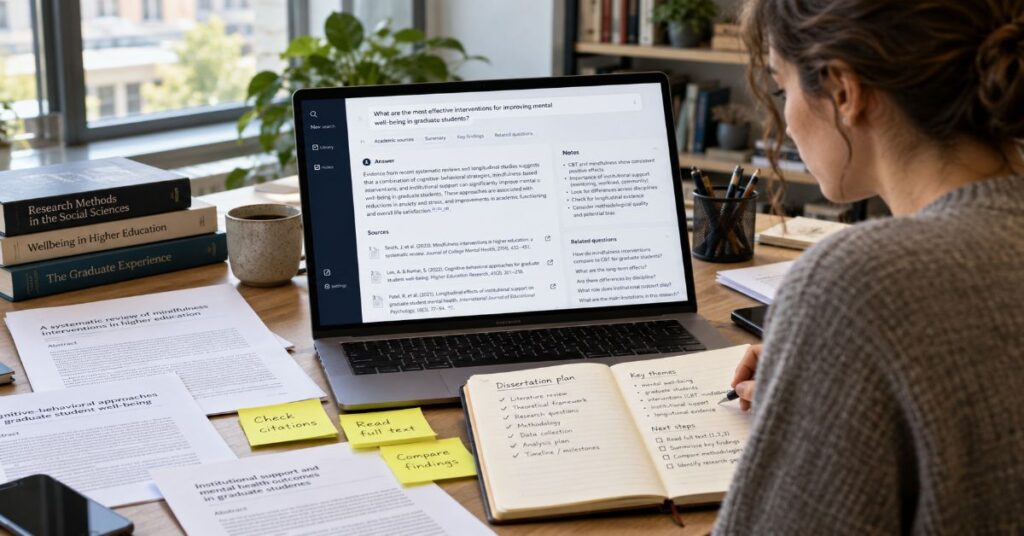
To use Perplexity AI for dissertation research, treat it as a fast discovery and evidence-interrogation assistant, not as the author of your dissertation or the final judge of what counts as reliable evidence. That distinction matters because a dissertation is not a long answer to a question; it is an auditable argument built from sources you have found, read, evaluated and interpreted yourself.
The attraction is obvious. A doctoral or master’s researcher can ask one well-scoped question and receive a cited synthesis, follow-up queries, candidate papers, competing explanations and a quick map of an unfamiliar field. Perplexity’s current research stack also includes Academic search controls, Pro Search, Research mode, file analysis and persistent Spaces. Those tools can compress the slowest early-stage work: vocabulary discovery, concept mapping, finding seed papers, generating search synonyms and locating arguments worth checking.
The danger is just as obvious once the stakes rise. A fluent synthesis can hide missing landmark studies. A citation can point to a real page yet fail to support the sentence attached to it. A review can flatten differences between a randomised trial, a qualitative interview study and a preprint. And a plausible “research gap” can simply be a gap in what the system retrieved rather than a genuine gap in the literature.
This guide therefore uses a different structure from the usual “turn on Academic mode and ask better prompts” advice. It shows how to build a dissertation evidence pipeline: define the policy boundary, map the field, discover sources, verify each claim, compare methods, log contradictions, test research gaps, preserve a reproducible search trail and only then use AI to accelerate analysis. The goal is not to make Perplexity sound indispensable. The goal is to make your dissertation harder to challenge.
1. Put Perplexity in the Right Place in Your Dissertation Workflow
A dissertation workflow has at least four different intellectual jobs: discovering what has been published, deciding which evidence deserves weight, constructing an interpretation, and writing an original argument. Perplexity is strongest at the first job and useful at parts of the second. It becomes progressively riskier when it is allowed to make the interpretive and authorship decisions that your degree is supposed to assess.
This is why the most productive mental model is not “AI co-author”. It is “research navigator”. Ask it to expose the terrain: major theories, recurring variables, canonical authors, recent disputes, technical terminology, datasets, methods and candidate sources. Then leave the interface and inspect the source itself. If a paper matters to your argument, obtain the abstract and ideally the full text through the publisher, DOI, institutional library or a recognised academic database.
Our broader general research workflow makes the same distinction for shorter research tasks, but a dissertation requires a stricter evidence trail. You need to know not only what a source says, but why it belongs in your review, how it was found, what design it used, what population or corpus it studied, what it did not establish and which competing sources disagree.
This division of labour is consistent with current higher-education research. Shomotova and ElSayary’s 2026 faculty study found perceived usefulness around writing, editing, idea generation and data analysis, while also identifying cognitive dependency, superficial output and loss of originality as concerns. Their practical answer was not prohibition; it was human validation, cross-verification and transparent disclosure.
| Dissertation Task | Good Use of Perplexity | Keep Under Human Control |
| Topic orientation | Map concepts, terminology, debates and candidate authors. | Final research question and theoretical framing. |
| Literature discovery | Find seed papers, reviews, synonyms and citation trails. | Inclusion/exclusion logic and coverage claims. |
| Paper interrogation | Ask targeted questions about methods, variables and stated limitations. | Reading the original paper and judging validity. |
| Gap analysis | Generate candidate gaps and contradictory findings to investigate. | Claiming novelty or defining the dissertation contribution. |
| Writing support | Test outlines, expose missing counterarguments and clarify terminology. | Final prose, interpretation and argument unless institutional policy explicitly allows more. |
2. Check Your University’s AI Rules Before You Build the Workflow
The first research prompt should not be about your topic. It should be a policy check outside Perplexity: what does your university, graduate school, department, supervisor and target journal allow? Policies differ on whether AI can be used for brainstorming, language editing, coding assistance, literature discovery, summarisation, translation or drafting. A practice permitted in one programme can be misconduct in another.
This is not bureaucratic caution. Dissertation assessment often evaluates independent scholarly judgement, and the line between assistance and substitution depends on what the assessment is designed to measure. A 2026 review in the Journal of Academic Librarianship argues that AI-era citation literacy must move beyond formatting and plagiarism rules toward “epistemic responsibility, judgment, and accountability”. That is a useful standard for dissertation work: can you defend where every important claim came from and why you trusted it?
Create a one-page AI-use protocol before serious searching. Record which tools you may use, which tasks are allowed, what must be disclosed, whether prompts or outputs must be retained, whether confidential data may be uploaded and whether your ethics approval limits use of external AI services. If you are working with interview transcripts, patient data, unpublished corporate material or identifiable participant information, privacy and research-ethics constraints can matter more than productivity.
Perplexity’s consumer and education plans are not the same as an institutionally governed enterprise environment. The company’s September 2026 plan documentation says Enterprise data is not used for model training, while consumer Pro, Education Pro and Max provide an opt-out control. That difference is material if your dissertation contains restricted material. Do not assume a paid student plan automatically satisfies your university’s data-handling requirements.
What 2026 Researchers Say About the Integrity Boundary
Aizhan Shomotova and Areej ElSayary, reporting faculty perspectives in Higher Education Quarterly, warn of “cognitive dependency, production of superficial outputs, loss of originality” alongside the benefits of AI use. Source
Alireza Maleki argues that generative AI is “transforming the foundations of academic integrity in higher education”, which is why dissertation policy cannot be reduced to plagiarism detection alone. Source
Sunaina Sharma describes GenAI as having “unsettled established approaches to educational integrity”, especially approaches built around proving independent authorship after the fact. Source
Aidan Duane’s 2026 study captures the trade-off neatly: “Gen AI can transform educational praxis”, but it can also enable students to bypass intended learning and assessment. Source
3. Turn the Dissertation Question Into an Evidence Map
The fastest way to get weak dissertation research from an AI system is to start with “Write a literature review on X.” That prompt asks for prose before you have designed the evidence problem. Instead, turn the dissertation question into a map of sub-questions that can be searched and verified independently.
Start with five buckets: constructs, mechanisms, populations or contexts, outcomes, and methodological lenses. A dissertation on remote work and innovation, for example, should not begin with “Does remote work reduce innovation?” It should split the problem into definitions of innovation, team-level versus firm-level outcomes, synchronous versus asynchronous collaboration, industry differences, measurement approaches, causal designs and plausible moderators such as task interdependence.
Then ask Perplexity for terminology rather than conclusions. A strong first prompt is: “Map the vocabulary researchers use for [topic]. Separate formal constructs, common synonyms, older terminology, measurement instruments and adjacent concepts that should not be treated as equivalents. For each term, give two candidate academic sources and explain the distinction.” This produces search language you can reuse in Google Scholar, Scopus, Web of Science, PubMed, EBSCOhost or your university discovery service.
For a dissertation, this vocabulary map is more valuable than an early narrative summary because it reduces retrieval bias. If you search only with the wording in your proposal, you may miss an older literature that uses different terminology. Perplexity’s value is its ability to suggest those bridges quickly; your responsibility is to validate them against actual papers and database indexing terms.
| Evidence Map Layer | Question to Ask | What You Save |
| Constructs | How has the central concept been defined across disciplines? | Definitions, seminal sources, competing operationalisations. |
| Mechanisms | What causal or explanatory pathways have been proposed? | Mechanism list with supporting and dissenting studies. |
| Contexts | Where might the relationship change? | Population, sector, geography, period and boundary conditions. |
| Methods | How has the question been measured or identified? | Study designs, instruments, datasets and common biases. |
| Outcomes | Which dependent variables are actually used? | Outcome definitions and comparability warnings. |
4. Use a Two-Pass Literature Search, Not One Giant Prompt
A dissertation search should be designed for recall first and precision second. The site’s academic research trust test is useful background, but the dissertation version needs a more explicit two-pass protocol.
Pass one is orientation. Use Academic search or Pro Search to identify review papers, meta-analyses, highly cited conceptual papers, standards, landmark datasets and recurring author names. The objective is not to collect everything. It is to understand the field well enough to search it intelligently. Ask for date ranges, source type labels and persistent identifiers such as DOI where available, but treat all returned metadata as provisional until checked.
Pass two is coverage. Take the vocabulary, authors, landmark papers and cited theories from pass one into dedicated scholarly databases. Search forward and backward citations. Run controlled queries with Boolean combinations. Look for studies that Perplexity did not surface. Compare publication years and venues. If your dissertation claims anything close to “the literature shows”, “few studies have examined” or “no prior research has tested”, the burden of proof is much higher than a generative search response can satisfy.
The Perplexity and Google Scholar distinction is especially useful here: one tool synthesises and helps you ask better follow-up questions; the other is built around scholarly discovery and citation relationships. For many dissertations the right answer is not choosing one. It is using Perplexity to orient and interrogate, Google Scholar or disciplinary databases to widen and verify, and a reference manager such as Zotero to preserve the source record.
Where your institution gives Perplexity Enterprise access to licensed material, integrations may expand what can be searched. Perplexity’s education material describes Wiley access for participating institutions, and its education page highlights scholarly content alongside the open web. That improves convenience, but it still does not turn the tool into an exhaustive index of every database your discipline expects.
5. Build a Claim Ledger Before You Build a Literature Review
Most literature reviews are organised around papers: one paragraph on Study A, one on Study B, then Study C. Stronger dissertations are organised around claims and tensions. A claim ledger forces that shift. Each row contains a proposition you might use, the best supporting source, the strongest conflicting source, the method behind each, the population or setting, the limitation and your verification status.
Perplexity is excellent at helping populate the first draft of this ledger because you can ask narrow comparative questions. For example: “Find empirical studies since 2020 that report a positive relationship between X and Y, then find studies reporting null or negative results. Separate cross-sectional, longitudinal and experimental designs. Do not reconcile them; show the conflict.” The instruction not to reconcile matters. AI systems are rewarded for coherent answers and may smooth away disagreements that are exactly what your literature review needs to expose.
The site’s academic citation workflow gives a practical source-quality approach. At dissertation level, add a verification state to every source: discovered, metadata checked, abstract read, full text read, claim verified, method appraised, included or excluded. This turns a conversational search session into an auditable evidence process.
Do not add a source to your reference manager merely because Perplexity cited it. Open the publisher page, DOI record or database record. Confirm the title, authors, year, venue and publication status. Then inspect the paper itself. The central question is not “is this citation real?” but “does this source support the exact claim I am making at the level of certainty I am using?”
| Ledger Field | Why It Matters | Minimum Dissertation Check |
| Claim | Prevents paper-by-paper summary. | Write the proposition in your own words. |
| Supporting source | Shows evidential basis. | Open and read the relevant section. |
| Counter-source | Prevents confirmation bias. | Search deliberately for null or conflicting findings. |
| Method | Determines what the study can establish. | Record design, sample/corpus, measures and identification strategy. |
| Boundary condition | Stops overgeneralisation. | Record context, period, geography and population. |
| Verification state | Creates an audit trail. | Never cite “discovered only” sources in final prose. |
6. Interrogate Methods, Not Just Findings
A dissertation earns credibility by showing why evidence deserves weight. This is where the PhD research guide needs to be made concrete: the key prompt is not “what did the paper find?” but “what design produced that finding, and what alternative explanations survive?”
When you upload a paper or add it to a Space, ask questions that force method detail: What is the unit of analysis? How was the sample recruited? What are the exclusion criteria? Is the outcome self-reported or behavioural? Is the study powered to detect the reported effect? What covariates are included? What assumptions are necessary for causal interpretation? How is missing data handled? Which robustness checks are reported? What limitations do the authors explicitly acknowledge?
Then verify the answers in the methods and results sections. Perplexity’s own file-upload documentation warns that long files may be processed by extracting the most important parts rather than treating every sentence equally. That is convenient for orientation but dangerous for edge details. A dissertation defence can turn on one overlooked footnote, sensitivity analysis, construct definition or sampling limitation.
This is also where discipline-specific appraisal tools should replace generic AI judgement. Clinical research may require risk-of-bias frameworks. Qualitative work may require attention to reflexivity, sampling logic and analytic saturation. Econometrics may require identification assumptions and sensitivity tests. Machine-learning papers may require dataset leakage checks, baseline quality and out-of-distribution validation. Ask Perplexity to locate the relevant appraisal framework, then apply the framework yourself.
A useful stress test is to ask the system to argue against its first summary: “Assume the conclusion of this paper is overstated. Identify the three strongest methodological reasons a sceptical examiner could give, and cite the exact sections that create those concerns.” This does not replace your judgement, but it can reveal where to read more closely.
7. Use Research Mode to Generate Leads, Then Audit the Report
Perplexity’s Research mode is designed for multi-step investigation, and the Deep Research explainer shows why it is attractive for dissertation scoping: it can decompose a question, search iteratively and produce a structured report with citations.
For dissertation work, the best use is a bounded research memo. Give it a question, time period, geographic or disciplinary scope, preferred evidence types and an output schema. Ask it to separate established findings, contested claims, emerging evidence and unanswered questions. Ask for primary studies behind review claims. Ask it to label preprints and to avoid treating a publisher landing page as evidence when the underlying article can be identified.
Then audit the report as if it had been produced by a junior research assistant. Check the most consequential claims first. Open every source behind a number, quotation, causal assertion or “consensus” statement. Look for citation clustering, where several claims ultimately trace back to one review. Look for source substitution, where a news story or university press release is cited instead of the underlying study. Look for scope drift, where evidence from one population is generalised to another.
The current Deep Research accuracy analysis on this site is useful precisely because it refuses to equate polished presentation with verified truth. Independent 2026 work on AI citation systems likewise shows that retrieval-grounded systems can still produce broken, misattributed or weakly supporting citations. The correct response is not to reject research agents; it is to separate retrieval speed from evidential acceptance.
Research mode is therefore strongest at questions such as “What competing explanations should I investigate?”, “Which literatures use different terminology for the same mechanism?”, “Which recent papers challenge this older consensus?”, and “Which methods recur in this subfield?” It is weaker at claims of exhaustiveness, novelty or definitive absence. Those are dissertation claims, not search-engine conveniences.
8. Test a Research Gap Instead of Asking AI to Invent One
“Find a research gap” is one of the most dangerous dissertation prompts because the system can only report gaps relative to what it retrieved and how it interpreted your request. A genuine dissertation gap requires a claim about the state of a literature. That claim must survive broader searching, citation chaining and supervisor scrutiny.
Use Perplexity to generate gap hypotheses, not gap conclusions. Ask for five different kinds of potential gap: population gaps, context gaps, measurement gaps, methodological gaps and theory-integration gaps. For each, require contrary evidence: “What papers would make this gap claim false?” This flips the task from confirmation to falsification.
Next, run a gap audit. Search the proposed gap phrase directly in Google Scholar and at least one discipline-appropriate database. Search the closest synonyms from your evidence map. Search review articles published in the last three to five years. Search dissertations and conference proceedings if they are relevant in your field. Check whether a “gap” is actually a well-known limitation that dozens of researchers have already named.
A strong dissertation contribution can also come from resolving inconsistency rather than occupying an empty box. If the literature produces contradictory findings because studies use different measures, contexts or identification strategies, your contribution may be to explain that heterogeneity. Perplexity is particularly useful here because it can rapidly group studies by the variable you suspect is causing the disagreement, but the underlying classifications still need human checking.
9. Create a Persistent Dissertation Space — With Strict Source Hygiene
Perplexity Spaces can organise threads and project files around one topic, which makes them a natural home for long-running dissertation work. Current documentation says Spaces can combine web, files and links; Pro and Enterprise users can keep files in a Space until they remove them, and Pro users can upload up to 50 files per Space. Use that persistence for organisation, not as a substitute for your reference manager or research archive.
Create one Space for the dissertation, then separate threads by function: theory map, methods, empirical findings, contradictions, datasets, policy or context, and chapter-specific questions. Add custom instructions that force source discipline. For example: “Prefer peer-reviewed primary studies; label reviews, preprints and commentary separately; never create a reference from memory; state when a source cannot be accessed; distinguish what the source reports from what you infer.”
Do not dump hundreds of PDFs into a Space and assume the model will treat them like a systematic corpus. Retrieval systems select fragments they consider relevant. That is useful for question answering but not equivalent to reading every paper end to end. Keep your canonical bibliography, PDFs, annotations and inclusion decisions in a separate research system you control.
If a source becomes central to your argument, move it out of “AI context” and into your verified evidence base: save the official record, store the PDF where permitted, record page numbers or section markers for important claims, and note any corrections, retractions or later updates. The Space is a working surface. Your dissertation archive is the scholarly record.
10. Choose the Cheapest Plan That Removes a Real Bottleneck
For most dissertation candidates, paying more does not solve the hard problem. The hard problem is evidence quality and scholarly judgement. Current Perplexity documentation lists a Free tier, Pro, Education Pro and Max for individuals. Education Pro is the obvious plan to evaluate first if you are eligible because it is listed at $10 per month after student or faculty verification and includes the Pro feature set plus education-oriented access.
Perplexity’s main site lists Pro at $20 per month or $200 per year. Max is listed at $200 per month or $2,000 per year. Those prices can change, and feature quotas are increasingly described as weekly or monthly limits rather than simple permanent caps, so check the live account page before paying. More expensive access can increase search volume, Research usage and file handling, but it cannot make an unverified source dissertation-safe.
The decision should be driven by workload. Free can be enough for occasional topic mapping and citation discovery. Education Pro or Pro makes more sense if you repeatedly analyse files, run deeper searches and maintain a research project over months. Max is hard to justify for a typical individual dissertation unless you are running unusually heavy research workloads or using broader Computer capabilities that genuinely replace other paid tools.
This is where an AI research tools comparison is useful. A dissertation stack may be stronger when budget is split across complementary tools: a university database subscription, Zotero, discipline-specific search, statistical software, qualitative analysis software or a specialist evidence tool can matter more than maximising one general AI subscription.
| Plan | Verified 2026 Price / Positioning | Dissertation Fit |
| Free | No subscription fee; basic search with limited advanced usage. | Topic orientation, occasional source discovery, quick verification leads. |
| Education Pro | $10/month for verified students or educators. | Best value for eligible dissertation researchers who need sustained Academic/Research access and file analysis. |
| Pro | $20/month or $200/year on Perplexity’s main pricing description. | Useful for frequent research when Education Pro is unavailable. |
| Max | $200/month or $2,000/year. | Only rational for unusually high-volume or advanced workflows; unnecessary for most dissertations. |
11. Keep a Reproducibility Log for Every AI-Assisted Search
A dissertation should be defensible months after the search was run. Generative search makes that harder because rankings, models, source access and product behaviour change. A useful answer today may not reproduce exactly next semester. The solution is not to pretend the system is static; it is to log enough context to explain what you did.
For each consequential search, save the date, tool, mode, exact prompt, scope constraints, important returned sources and your verification outcome. If the query contributes to a methods chapter or systematic search claim, also record the academic databases you searched independently and their exact search strings. This prevents a common failure: remembering the conclusion but losing the path that produced it.
Keep AI-generated summaries separate from extraction notes taken from the paper itself. Your notes should clearly distinguish direct source facts, your interpretation and AI suggestions. This is especially important when returning to a chapter months later; otherwise a plausible AI synthesis can become indistinguishable from something you personally verified.
When a supervisor challenges a statement, you should be able to answer with the original source, location in the source, reason for inclusion and any counter-evidence you considered. That level of traceability is the real measure of whether Perplexity improved your dissertation rather than merely accelerated your typing.
A Dissertation-Grade Prompt Sequence
Stage 1: Field Mapping
“Map the scholarly vocabulary for [topic]. Separate core constructs, synonyms, historically older terms, related-but-distinct concepts, common measurement instruments and major theoretical traditions. Do not write a literature review. Return a search map with candidate peer-reviewed sources for each term.”
Stage 2: Evidence Discovery
“Using Academic sources, find peer-reviewed review papers and primary empirical studies from [date range] on [specific relationship]. Separate review articles, observational studies, experiments, qualitative studies and preprints. For each source provide authors, year, study design, population or dataset, main result, stated limitation and DOI or publisher record where available.”
Stage 3: Contradiction Search
“Find credible studies that disagree with the dominant finding on [claim]. Do not reconcile the disagreement. Compare measures, samples, settings, study design and publication period, then identify which differences could plausibly explain conflicting results.”
Stage 4: Method Challenge
“Act as a sceptical dissertation examiner. Based only on this uploaded paper, identify the strongest threats to the authors’ interpretation. Point me to the sections I should read to verify each concern. Distinguish what the paper explicitly admits from your inference.”
Stage 5: Gap Falsification
“The proposed gap is: [gap claim]. Try to disprove it. Find papers, reviews, dissertations or conference work that may already address it. List search terms and adjacent literatures I should check manually before claiming novelty.”
What the Top-Ranking Guides Get Right — and What They Miss
The current search results for this topic and close variants converge on several useful basics. Vertech Academy, Empire Research Press, Educators Technology, CASRAI, student-focused guides and existing Perplexity AI Magazine pages all emphasise some combination of cited answers, Academic search, Deep Research, file analysis and manual citation checking. That consensus is valuable: no serious guide recommends copying AI output directly into a dissertation without verification.
The gap is that most guides are tool-centred rather than dissertation-centred. They explain features and prompts but spend less time on the evidentiary obligations behind claims such as “the literature shows” or “a gap exists”. They rarely separate high-recall scoping from high-precision verification, or force researchers to track contradictory evidence at claim level. Reproducibility is also underdeveloped: a conversational answer is treated as the endpoint rather than one logged step in a longer academic search process.
This article’s information gain is therefore procedural. First, it uses a claim ledger so evidence is organised around propositions and counter-evidence rather than paper summaries. Second, it treats research-gap detection as a falsification task. Third, it introduces a reproducibility log that preserves prompts, modes, dates and verification status. Fourth, it explicitly distinguishes AI retrieval from disciplinary method appraisal. These controls are not glamorous, but they are exactly what makes an AI-assisted workflow more defensible in supervision and examination.
Our Content Testing Methodology
This guide was built from a live October 2026 review of Perplexity’s official Help Center and product documentation for Pro Search, Research mode, plan pricing, Spaces, file uploads and education features. We cross-checked those product claims against recent higher-education research on AI use, research integrity and critical citation practice, and against current independent guides ranking for the target query and close variants.
The search-result review covered ten relevant pages across direct and adjacent queries, including specialist academic-research guides, student guides, dissertation or thesis guidance, and existing Perplexity AI Magazine coverage. The dominant competitor structure was feature-first: explain Perplexity, recommend Academic or Deep Research, provide prompt examples, and warn readers to verify citations. We deliberately did not mirror that sequence. The structure here starts from dissertation evidence obligations and assigns Perplexity a bounded role inside them.
The sitemap.xml, sitemap_index.xml and post-sitemap.xml endpoints specified in the editorial brief did not return parseable XML through the available browsing layer during this research session. We therefore did not invent a sitemap inventory. Eight internal links were selected from live indexed Perplexity AI Magazine pages with direct semantic relevance to research workflow, academic research, PhD use, citation quality, Google Scholar, Deep Research and research-tool comparison.
This article was researched and drafted with AI assistance and reviewed by the Sami Ullah Khan editorial desk at Perplexity AI Magazine. All data, citations, pricing figures, and named quotes have been independently verified against primary sources before publication.
Conclusion
Perplexity AI can make dissertation research faster, but speed is not the standard your dissertation will be judged against. The standard is whether the evidence chain survives inspection. Used well, the platform can help you map unfamiliar literatures, discover search vocabulary, locate candidate papers, compare competing claims, interrogate uploaded documents and identify places where deeper reading is needed.
Used badly, the same strengths become liabilities. A polished synthesis can create false confidence. A dense list of citations can look like comprehensive coverage. A plausible gap can be mistaken for novelty. The defence against those errors is procedural: separate discovery from acceptance, organise evidence around claims, search deliberately for contradiction, appraise methods with discipline-specific criteria, verify every cited source and keep a reproducible log of consequential AI-assisted searches.
The open question for 2026 is not whether AI belongs in academic research. It already does. The harder question is which parts of scholarship can be accelerated without outsourcing the judgement that scholarship exists to demonstrate. For dissertation candidates, the safest answer is to let Perplexity reduce search friction while keeping authorship, interpretation, evidential weight and intellectual responsibility unmistakably human.
Frequently Asked Questions
How do I use Perplexity AI for dissertation research?
Use Perplexity to map your field, discover sources, generate search terminology, compare competing findings and interrogate papers. Verify every source in the original publication, use academic databases for coverage, and keep your research question, inclusion decisions, interpretation and final argument under human control.
Can I use Perplexity AI for a dissertation literature review?
Yes, as a discovery and synthesis aid. Do not treat its generated review as your final literature review or as proof of comprehensive coverage. Build the review from original sources you have verified and read, including contradictory evidence and method limitations.
Is Perplexity AI an academic source?
No. Perplexity is a research tool that points to sources. In a dissertation, cite the original journal article, book, report, dataset or official document rather than citing the AI answer unless your institution specifically requires disclosure of AI interaction.
Is Academic mode enough for peer-reviewed research?
No. Academic-focused retrieval improves the source pool, but you should still confirm publication status, peer review, article type and relevance. Preprints, repositories and secondary material can appear in scholarly search environments.
Can Perplexity find a genuine research gap?
It can suggest candidate gaps, but it cannot prove novelty from one search. Treat gap suggestions as hypotheses, then try to falsify them using multiple databases, synonyms, citation chaining, reviews, dissertations and supervisor input.
Should I use Perplexity or Google Scholar for my dissertation?
Use them for different jobs. Perplexity is strong for orientation, synthesis and follow-up questions; Google Scholar and discipline-specific databases are stronger for broad scholarly discovery, citation chaining and coverage. A robust dissertation workflow often uses both.
Which Perplexity plan is best for students?
Education Pro is listed at $10 per month for verified students and educators and includes the Pro feature set plus education-oriented access. Free may be enough for light use; Pro is useful when Education Pro is unavailable; Max is unnecessary for most dissertation workloads.
Do I need to disclose Perplexity use in my dissertation?
Follow your university, department, supervisor and publisher rules. If disclosure is required, record what tool you used, for which tasks and how outputs were verified. When policy is unclear, obtain guidance before using AI for assessed writing or sensitive research material.
References
- Perplexity. (2026). Which Perplexity subscription plan is right for you? Perplexity Help Center. Source
- Perplexity. (2026). What is Pro Search? Perplexity Help Center. Source
- Perplexity. (2026). Perplexity Max. Perplexity Help Center. Source
- Perplexity. (2025/2026). Introducing Perplexity Deep Research. Perplexity Blog. Source
- Perplexity. (2026). Perplexity partners with Wiley to power educational AI search. Perplexity Blog. Source
- Shomotova, A., & ElSayary, A. (2026). AI use and research integrity in higher education: Faculty perspectives on opportunities, challenges, strategies, and misconduct. Higher Education Quarterly, 80(3), e70136. Source
- Maleki, A. (2026). Rethinking ethical academic integrity ecosystems in higher education in the age of artificial intelligence. Discover Artificial Intelligence, 6, 145. Source
- Alalwani, S. (2026). Faculty perceptions of ChatGPT on academic integrity and institutional roles in higher education. Scientific Reports, 16, 27532. Source
- Manik, D., Tanjung, Y. A., & Hartati, R. (2026). Integrating Perplexity AI into academic research: A study on research gap analysis and proposal development. Fonologi, 3(4). Source
