
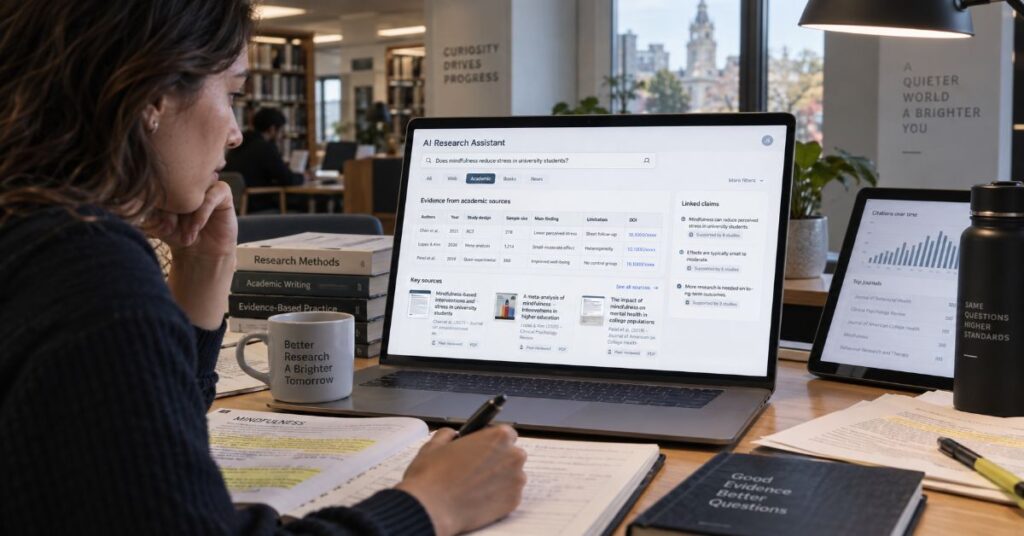
How to make Perplexity cite more academic sources: switch the source focus to Academic, use a research-capable search mode, and ask for peer-reviewed primary studies with explicit evidence criteria before you ask for a narrative answer. That combination matters because citation quantity and scholarly quality are not the same thing. In September 2026, an independent audit of Perplexity’s figure-bearing citations reported that 34.7% of citation links either could not be opened or did not contain a figure from the sentence they were attached to. The lesson is not that citations are useless; it is that source steering and source verification are separate jobs.
Most high-ranking guides stop after one instruction: turn on Academic focus. That is necessary, but it leaves the harder questions unanswered. Which studies should be eligible? How do you stop a review article from crowding out primary evidence? How do you force the answer to expose study design and limitations? What should you do when Perplexity still cites a publisher landing page, a news summary, or a paper you cannot access? And how should the workflow change now that Perplexity has 2026 integrations with scholarly providers such as EBSCOhost and existing education integrations with Wiley?
This guide treats Perplexity as a retrieval-and-synthesis layer rather than a bibliography generator. It shows how to control the source pool, write evidence-first prompts, run a two-pass literature search, audit citations at claim level, and decide when a dedicated academic database is still the better tool. The aim is not to make every answer look academic. It is to make the evidence chain stronger, more reproducible, and easier to verify.
How to Make Perplexity Cite More Academic Sources
The fastest improvement comes from changing what Perplexity is allowed to retrieve before you refine the wording of the question. Perplexity’s July 2026 Pro Search documentation says its search can draw from different content types according to the selected focus, including Web, Academic, Finance, and Files. Its getting-started guidance is even more direct: for research papers, choose Academic to prioritise peer-reviewed journals and scholarly articles. In practice, this is the first control to use because it affects the candidate source pool rather than asking the model to prefer academic material after a broad web search has already occurred.
How to Make Perplexity Cite More Academic Sources in One Query
Use a query that combines four constraints: source class, date range, evidence hierarchy, and output fields. For example: “Use Academic sources only. Find peer-reviewed primary studies from 2021-2026 on remote work and productivity. Prioritise meta-analyses for orientation, then randomized, longitudinal, or quasi-experimental primary studies. For each source give authors, year, study design, sample, main finding, stated limitation, DOI or publisher link, and explain which claim in your synthesis it supports.” The key move is asking for evidence structure before asking for prose.
This approach complements the magazine’s academic research workflow by turning “find papers” into a reproducible evidence request. It also reduces a common failure mode: a fluent answer supported by several citations that all trace back to the same review, institutional explainer, or secondary summary. Requiring one row per distinct study and demanding methods and limitations makes duplication easier to spot.
Do not assume “Academic” means “peer reviewed only.” Academic retrieval can include preprints, repositories, conference papers, and other scholarly material. If peer review is mandatory, say so explicitly and ask the system to label preprints separately rather than silently mixing them into the same evidence tier.
Why Source Selection Beats Prompt Wording Alone
A prompt can influence ranking and synthesis, but it cannot reliably repair a weak retrieval pool. This is the central distinction that many tutorials miss. If a general Web search has already surfaced news stories, SEO pages, course notes, and summaries, a sentence such as “use academic sources” asks the model to rescue scholarly material from a mixed candidate set. Selecting Academic first gives scholarly documents a better chance of entering the candidate set at all.
Perplexity’s source-selection pipeline is not fully public, so no prompt can guarantee a particular journal or database will appear. That is why it is useful to think in layers: eligibility determines what can be retrieved; ranking determines what is likely to be used; synthesis determines what gets written; and citation rendering determines which sources are visible beside claims. The magazine’s guide to how Perplexity chooses sources explores that broader funnel. For an academic user, the practical implication is simple: intervene as early in the funnel as possible.
The same point appears in 2026 research on generative search. A multilingual audit of 15,942 citations across ChatGPT, Perplexity, and Google AI Overview found that source types and citation concentration differed substantially by platform, and that simply requesting sources changed source composition only modestly. This does not prove that prompting is ineffective in every domain, but it does undermine the idea that one magic phrase can turn a general search into a systematic literature search.
Treat prompt wording as a second-stage control. Once Academic focus or an institution-approved source set is active, prompts can specify the evidentiary standard: primary versus secondary literature, recency, population, study design, language, jurisdiction, publication status, and the metadata you need for verification.
Build an Evidence-First Prompt That Changes the Result
The most reliable academic prompts describe the evidence you want before they describe the prose you want. “Write a literature review” invites the model to optimise for a coherent review. “Build an evidence table from eligible studies, then synthesize only those rows” makes the answer auditable. This is a small structural change with a large effect on research discipline because every paragraph must be traceable back to an explicit evidence set.
| Prompt Control | Weak Version | Stronger Academic Version | Why It Matters |
| Source class | Use reliable sources | Use peer-reviewed journal articles and label preprints separately | Prevents blogs or news from satisfying a vague reliability request. |
| Evidence type | Find research | Prioritise systematic reviews for orientation, then primary studies for causal or empirical claims | Separates synthesis evidence from underlying studies. |
| Date | Use recent studies | Limit to 2022-2026, but include older landmark studies only if later reviews still treat them as foundational | Balances freshness with field history. |
| Metadata | Give citations | For every study: authors, year, title, journal, DOI, design, sample, main result, and stated limitation | Makes fabrication and mismatch easier to detect. |
| Synthesis rule | Summarise findings | Do not make a claim unless at least one listed study directly supports it; flag disagreement rather than averaging it away | Links prose to evidence instead of rewarding fluency. |
A second technique is to ask for negative constraints. Tell Perplexity not to use Wikipedia, commercial blogs, press releases, news recaps, or university marketing pages unless they are being cited for a non-research fact such as a product announcement. Negative constraints should be narrow: banning all secondary sources can remove high-quality systematic reviews and professional guidelines that are useful for orientation.
Third, make the model expose uncertainty. Ask it to mark “not verified,” “preprint,” “secondary source,” “retracted or corrected,” and “full text unavailable” where applicable. In our editorial workflow, this is more useful than asking for “high confidence” because the labels describe a checkable condition rather than an opaque model judgement. The magazine’s AI citation tool comparison uses the same principle: a citation badge is not enough; the source must exist and support the adjacent claim.
Use Pro Search, Research, and Premium Sources Differently
Perplexity now has several layers of research capability, and they solve different problems. Pro Search is useful when you need a focused answer with multiple searches and extensive citations. Research mode is designed for deeper, multi-step investigations and longer reports. Premium Sources add licensed or curated datasets and publications in supported areas. None of these automatically turns a search into a systematic review; they increase depth or source access, while your evidence criteria still determine what counts as acceptable academic support.
| Plan / Capability | Public 2026 Price | Academic-Relevant Features | Important Caveat |
| Free | US$0/month | Cited answers; limited advanced search and uploads | Suitable for light discovery, but lower research limits. |
| Pro | US$20/month | Deep Research, advanced models, preferred model selection, broader search and file access | Consumer usage limits are described dynamically rather than as one stable public cap. |
| Education Pro | US$10/month with verification | Pro features plus education-specific tools and extended access to Perplexity Academic | Official pages differ in how they describe Pro Search limits; check the account UI. |
| Max | US$200/month or US$2,000/year | Highest consumer limits, advanced research access, frontier models, more file and Computer capacity | Higher limits improve volume, not citation correctness by themselves. |
That caveat is not theoretical. Perplexity’s September 2, 2026 plan comparison describes Pro and Education Pro search allowances as weekly limits for average use, while the July Education Pro help page describes unlimited Pro Searches. Because official documentation is not perfectly aligned, any article that prints a precise consumer cap without a current account check risks becoming stale or wrong. Pricing itself is clearer: the official pricing page lists Pro at US$20 per month and Max at US$200 per month; Education Pro is listed at US$10 per month with SheerID verification.
For citation-sensitive work, choose the capability based on task complexity rather than prestige. A narrow question with a clear population and outcome may need only Academic focus plus Pro Search. A broad state-of-the-field review may justify Research mode. The magazine’s evidence review of Deep Research accuracy is a useful reminder that longer, more polished reports still require citation auditing.
Control Source Quality With Study Design, Date, and Source-Class Constraints
“Academic” is a source category, not an evidence hierarchy. A peer-reviewed cross-sectional survey, a randomized controlled trial, a meta-analysis, and an editorial can all be academic publications while answering different questions with different evidentiary strength. To get better citations, tell Perplexity what kind of claim you are making and what study design is appropriate for that claim.
For treatment effects, ask for systematic reviews, randomized trials, or high-quality comparative studies. For prevalence, ask for representative surveys and define the population and geography. For technical performance, request benchmark papers and the exact benchmark version. For social-science mechanisms, specify longitudinal, natural-experiment, or quasi-experimental evidence where possible. For a fast-moving technology topic, include preprints but require them to be labelled and separated from peer-reviewed findings.
“AI is the front door to research for many users, and that makes quality sources more important than ever.” — Sam Brooks, Executive Vice President, EBSCO Information Services, May 2026
That comment accompanied EBSCO’s May 2026 integration with Perplexity Premium Sources. EBSCO said the partnership brings peer-reviewed full-text journals from EBSCOhost into Perplexity and lets users trace an answer back to the underlying research paper. Perplexity’s Emily Jorgens described the value as access to “curated, peer-reviewed scholarship” trusted by academic researchers. These partnerships can improve availability, but they do not eliminate methodological screening: a searchable paper can still be old, underpowered, irrelevant, corrected, or retracted.
The best prompt therefore combines source quality and method quality. Ask for “peer-reviewed primary studies,” but also ask Perplexity to explain why each study design is suitable for the question. When papers conflict, require it to attribute the disagreement to differences in sample, measurement, intervention, outcome definition, or statistical method instead of collapsing everything into “mixed evidence.”
Diagnose Why Perplexity Keeps Citing Blogs and News
If Perplexity still returns non-academic sources, do not keep rewriting the same prompt blindly. Diagnose the reason. Sometimes the query contains a current event, product feature, or policy detail for which a journal article does not exist yet. Sometimes a scholarly paper exists but is inaccessible, poorly indexed, or too new to rank. Sometimes the answer mixes two tasks – an academic claim and a current factual claim – and uses different source classes appropriately.
| Symptom | Likely Cause | Best Correction |
| News stories dominate | Query is framed around a recent event or named announcement | Split the query: first establish the event with a primary source, then ask Academic focus for research on the underlying phenomenon. |
| Review articles dominate | Broad topic and synthesis wording rewards overview papers | Ask for the review first, then a second pass for the primary studies cited by that review. |
| Publisher landing pages appear | Full text or metadata is partially accessible | Request DOI, title, journal and abstract-level evidence; verify full text separately. |
| Preprints mixed with journals | Fast-moving field has limited peer-reviewed coverage | Require publication-status labels and a separate peer-reviewed-only synthesis. |
| Irrelevant “academic” pages | Keyword overlap is stronger than conceptual match | Add population, discipline, method, outcome and exclusion terms. |
Paywalls deserve special treatment. A paywalled citation is not automatically a bad citation, and in 2026 Perplexity has documented licensed premium-source relationships. The magazine’s guide to why Perplexity cites paywalled articles explains the distinction between reader access and platform access. Your verification standard should be: can you identify the paper, confirm the relevant claim, and access enough of the source through your institution, an open version, or the publisher to evaluate it?
When no scholarly evidence exists, the correct result is not a fabricated journal citation. Ask Perplexity to say “no peer-reviewed evidence located within the stated scope” and then list the best available primary documentation separately. That is a stronger research outcome than forcing every sentence to wear an academic-looking citation.
Turn One Search Into a Two-Pass Literature Workflow
One-shot literature reviews encourage premature synthesis. A better workflow uses two passes. Pass one maps the evidence landscape: reviews, major debates, canonical terms, leading authors, common methods, and recent clusters. Pass two searches for the underlying primary studies and challenges the first-pass summary. This separation reduces the risk that one influential review becomes the hidden source for most of the answer.
| Pass | What to Ask Perplexity | Output to Save | Verification Step |
| 1. Map | Identify systematic reviews, meta-analyses, landmark papers, major competing explanations, and research gaps | A short map with 8-12 anchor sources and search vocabulary | Confirm that anchor sources exist and are on-topic. |
| 2. Expand | Find distinct primary studies behind each major claim; avoid duplicates and secondary summaries | Evidence matrix with design, sample, result, limitation, DOI | Open each paper or authoritative record and check metadata. |
| 3. Stress-test | Find studies that contradict the emerging conclusion or use different methods/populations | Counter-evidence table | Check whether disagreement is substantive or methodological. |
| 4. Synthesize | Write only from the verified matrix; cite the primary source for empirical claims | Narrative synthesis with claim-to-source mapping | Spot-check every claim and all numerical values. |
The magazine’s broader Perplexity research guide is useful for general research technique, but academic work benefits from this extra separation between discovery and synthesis. The workflow also makes follow-up prompts more precise. Instead of “find more sources,” you can ask: “The current matrix has no longitudinal evidence from Europe after 2023. Find up to five eligible studies that fill that gap.”
For larger projects, save the evidence matrix in a spreadsheet or reference manager rather than leaving it only inside a Thread. Track a stable identifier (DOI, PMID, arXiv ID, or publisher record), publication status, access status, and the exact claim you plan to support. This reduces the chance that a later rewrite detaches a citation from the evidence it originally supported.
Verify Every Citation Before It Enters Your Bibliography
The most important rule is simple: do not transfer a Perplexity citation into a paper until you have verified the underlying source. A live link proves that a page exists; it does not prove that the page supports the sentence, that the paper is peer reviewed, or that the bibliographic details are correct. This distinction is supported by both Perplexity’s own validation advice and 2026 independent research.
A September 2026 Haus Research audit asked Perplexity search models 310 factual questions about technology companies and examined 1,826 citations attached to sentences containing figures. It reported that 34.7% of those citations were inaccessible or contained none of the figures from the sentence, while 14.4% of figure-bearing claims lacked any passing citation at the claim level. That audit is not an academic-domain benchmark, but it is a strong warning against treating citation presence as citation correctness.
Academic studies show a similarly mixed picture. A 2026 EACL paper evaluating web-search credibility across assistants found Perplexity had the highest source credibility in its tested misinformation-prone topics, yet other 2026 work on generated references in rotator cuff literature found substantial reference errors and concluded that AI-generated references should not be used without verification. Different studies measure different tasks, so neither result should be universalised. Together they show why a good workflow separates source credibility, bibliographic accuracy, topical relevance, and claim support.
Use a five-point check: confirm the source exists; confirm authors, title, year, journal, and DOI; confirm publication status; open the relevant passage or result; and confirm the cited claim matches the paper’s population, method, and direction of effect. If you need a formatted reference, use the original paper’s metadata or a reference manager. The magazine’s guide to citing Perplexity and its sources reaches the same practical conclusion: cite the original evidence, not the AI layer that led you to it.
Where Perplexity Fits Against Google Scholar and Research-Specific Tools
Perplexity is strongest when you need rapid orientation, synthesis, follow-up questions, and a readable map of a topic. It is weaker when you need exhaustive coverage, transparent database syntax, citation-network analysis, deduplication, screening workflows, or reproducible systematic-search documentation. That is why serious academic work often combines Perplexity with a dedicated discovery or evidence tool rather than choosing one platform for every stage.
| Tool | Best Use in This Workflow | Strength | Main Limitation |
| Perplexity Academic / Research | Orientation, synthesis, question refinement, evidence matrix drafting | Conversational synthesis with visible citations and current retrieval | Coverage is not a transparent or exhaustive academic index. |
| Google Scholar | Broad paper discovery, author/title lookup, citation trails | Very broad scholarly discovery and cited-by links | Less structured synthesis; filtering and deduplication can be cumbersome. |
| PubMed / discipline databases | Controlled domain search and reproducible retrieval | Strong metadata and domain indexing | Narrower subject coverage and less conversational synthesis. |
| Elicit / Consensus | Evidence-oriented discovery and structured research questions | Designed around papers and research evidence | Coverage and features differ by field and plan. |
| Scite | Checking how papers are cited and whether later literature supports or contrasts them | Citation-context analysis | Not a replacement for full literature discovery or appraisal. |
The magazine’s Perplexity versus Google Scholar comparison frames them as complementary: Perplexity for orientation and synthesis, Scholar for broader paper discovery and citation tracking. That division becomes even more important for theses and systematic reviews, where missing a key study is a methodological problem rather than a minor inconvenience.
Use Perplexity to accelerate the parts of research that benefit from dialogue: generating synonyms, identifying contested concepts, explaining methods, comparing papers, and surfacing gaps. Use dedicated databases to document the search, prove coverage, and retrieve the canonical bibliographic record. The best tool is the one that matches the stage of the evidence workflow.
Institutional Sources, Wiley, EBSCO, and Uploaded Course Materials
Academic sourcing changed materially in 2025-2026 because Perplexity began integrating licensed scholarly content and institution-controlled materials. Its education product describes Wiley integration for academic resources, searches restricted to approved course materials, and Spaces that can include Google Drive content. In May 2026, EBSCO announced that EBSCOhost research databases were being added to Perplexity Premium Sources, with references visible to all users and full-text click-through available to users whose institutions provide EBSCOhost access.
“EBSCOhost gives our users access to the kind of curated, peer-reviewed scholarship that academic researchers have trusted for decades.” — Emily Jorgens, Head of Business Development and Partnerships at Perplexity, May 2026
Institutional grounding is especially useful when the goal is not “all scholarship” but “the scholarship my course, lab, or organisation has approved.” Perplexity’s education page says searches can be restricted to approved course materials, which is a different research problem from open-web academic discovery. It can reduce irrelevant retrieval, but it can also narrow coverage, so the source boundary should be disclosed in any serious review.
“Our goal is to make every degree AI-ready … empowering our 75,000+ students to develop the skills they need to succeed in an AI-driven world.” — Arnold Castro, Assistant Dean of AI, Mays Business School, Texas A&M University, 2026
Wiley’s Matt Kissner made the same trust argument from the publisher side in January 2026, saying AI-related demand for Wiley’s “must-have content and data” was accelerating across industries. That commercial context matters: more scholarly material is becoming available to AI systems through licensing rather than only open-web crawling. Researchers should therefore ask not just “is it paywalled?” but “what source relationship or institutional entitlement is providing access, and can I independently verify the cited evidence?”
For Developers: Domain Filters Can Be Stricter Than the Consumer UI
If you are building an academic workflow through Perplexity’s API, source control can be more explicit than a normal consumer search. Current Agent API documentation exposes domain allowlists and denylists through the search_domain_filter control, with a maximum of 20 domains or URLs in one list. That means a lab, publisher, or research team can restrict retrieval to a defined set such as PubMed, a government evidence portal, selected society journals, or an institutional repository. The same documentation supports publication-date, last-updated, and relative recency filters, so the retrieval rule can be encoded rather than repeated in natural-language instructions.
This is useful when “academic” is still too broad. A health-evidence application might allowlist PubMed and selected guideline bodies for one workflow, while a computer-science monitor could allow arXiv plus a set of conference or society domains. The limitation is equally important: a 20-domain allowlist is not a complete scholarly index, and domain-level filtering cannot judge whether an individual article is peer reviewed, retracted, methodologically strong, or relevant to the claim. Treat domain filters as eligibility controls, not quality scores.
Perplexity’s API platform currently separates several jobs. Search returns ranked web results with filtering; Sonar provides web-grounded language-model responses with built-in search; Agent API supports tool-using workflows and search presets; and Embeddings supports semantic search and retrieval pipelines. For citation-sensitive systems, a robust architecture keeps the retrieved source objects separate from generated prose. Store the title, source URL, publication date, and stable scholarly identifier where available, then map generated claims back to those records. This reduces the temptation to trust a model-generated bibliography string that may have lost or altered metadata.
The developer workflow also makes reproducibility easier. Log the query, filter configuration, date range, model or preset, and returned source identifiers. If the evidence set changes later, you can distinguish a retrieval change from a synthesis change. For regulated, clinical, legal, or publication-grade research, that audit trail is often more valuable than squeezing one more citation into the answer. The same principle applies in the consumer product: the goal is not maximum citation density, but a traceable path from question to eligible source to supported claim.
“Armughan is joining us at an extraordinary time in our trajectory as AI-related demand for our must-have content and data accelerates across industry verticals.” — Matt Kissner, President and CEO, Wiley, January 2026
Our Content Testing Methodology
This feature guide was verified against current September 2026 public documentation rather than a fabricated account-level benchmark. We checked Perplexity’s July 2026 Pro Search documentation for Academic focus, source modes, model selection, citation behaviour, and its explicit instruction to validate linked information. We checked the September 2026 plan-comparison page, current pricing page, Education Pro documentation, and Max documentation for pricing and research-access claims. Where those official pages conflict – notably in how consumer Pro Search limits are described – the article reports the conflict instead of inventing a single cap.
For citation reliability, we cross-referenced different evaluation types rather than collapsing them into one “accuracy rate.” These included Perplexity’s DRACO benchmark for deep-research factual and citation quality, the 2026 EACL study on source credibility and groundedness, a September 2026 independent audit of claim-to-citation support for numerical facts, and a 2026 medical study testing reference hallucination. Because those studies use different prompts, domains, units of analysis, and model versions, their percentages are presented only within their original scope.
We also reviewed live indexed search results for the target query and close variants. The dominant structure in competing 2026 guides is “turn on Academic focus, ask a precise question, verify sources.” This article adds an evidence-first prompt architecture, a two-pass discovery workflow, a failure-diagnosis table, explicit treatment of official plan-limit conflicts, and the impact of EBSCO/Wiley source licensing. We did not claim direct logged-in UI tests that could not be performed in this production environment.
This article was researched and drafted with AI assistance and reviewed by the Sami Ullah Khan editorial desk at Perplexity AI Magazine. All data, citations, pricing figures, and named quotes have been independently verified against primary sources before publication.
Conclusion
Getting more academic citations from Perplexity is less about finding a clever phrase and more about designing the retrieval process. Start by changing the source pool to Academic or an institution-approved collection. Then specify the evidence class, study design, date range, population, publication status, and metadata you need. Ask for an evidence table before narrative synthesis, and use a second pass to find the primary studies behind review-level claims.
The final step is the one AI cannot responsibly remove from scholarly work: verification. Open the paper, confirm the bibliographic record, inspect the relevant result, and make sure the source supports the exact claim you intend to cite. Perplexity can compress the time required to map a field and compare papers, and 2026 partnerships with EBSCO and Wiley are expanding the scholarly material available inside AI workflows. But retrieval breadth, access, and citation display are not substitutes for systematic coverage or critical appraisal. For high-stakes academic work, the strongest workflow remains hybrid: Perplexity for discovery and synthesis, dedicated scholarly databases for coverage and provenance, and human review for the final evidentiary judgement.
FAQs
Q: How to make Perplexity cite more academic sources?
A: Select Academic as the source focus, use Pro Search or Research for deeper retrieval, and request peer-reviewed primary studies with a defined date range, study design, population, and DOI or publisher metadata. Ask for an evidence table before synthesis. Then open and verify every source before citing it in your own work.
Q: Does Perplexity Academic only use peer-reviewed papers?
A: No. Academic-oriented retrieval can include scholarly materials such as preprints, conference papers, repositories, and journal articles. If peer review is required, state that explicitly and ask Perplexity to label preprints and other non-peer-reviewed sources separately.
Q: Can I force Perplexity to use only journal articles?
A: You can strongly constrain the request by selecting Academic focus and asking for peer-reviewed journal articles only, but no public documentation guarantees perfect compliance for every query. Review the returned source list and reject items that do not meet your eligibility criteria.
Q: Is Perplexity better than Google Scholar for finding academic sources?
A: They solve different parts of the workflow. Perplexity is useful for conversational synthesis and follow-up questions; Google Scholar is stronger for broad scholarly discovery, author/title lookup, citation trails, and finding related papers. For comprehensive research, use them together.
Q: Why does Perplexity still cite websites when I ask for academic sources?
A: The query may include current facts that have no journal source, the academic paper may be inaccessible or poorly indexed, or the prompt may mix research and non-research tasks. Split the question, use Academic focus, and specify peer-reviewed primary evidence for the claims that truly require it.
Q: Can Perplexity access paywalled academic papers?
A: Sometimes access comes through licensed Premium Sources or institutional entitlements, but reader access and platform access are not the same. A citation behind a paywall is not automatically invalid. Verify the paper through your institution, an open version, DOI record, or publisher page before relying on it.
Q: Should I cite Perplexity in an academic paper?
A: Usually you should cite the original paper or primary source that Perplexity helped you discover, not Perplexity as the evidence for the claim. If your institution requires disclosure or citation of AI assistance, follow its specific policy and citation style.
Q: Does paying for Pro or Max make citations more accurate?
A: Paid plans provide more capable search modes, models, source access, and higher usage limits, which can improve research depth. They do not guarantee that every citation supports every claim. Citation accuracy still depends on retrieval, synthesis, source quality, and manual verification.
References
- Perplexity. (2026, July 21). What is Pro Search? Perplexity Help Center. Perplexity Pro Search documentation
- Perplexity. (2026, September 2). Which Perplexity subscription plan is right for you? Perplexity Help Center. Perplexity plan comparison
- Perplexity. (2026). Pricing: Plans for individuals and enterprise. Perplexity pricing page
- EBSCO Information Services. (2026, May 19). EBSCO Information Services and Perplexity partner to ground AI answers in peer-reviewed research. EBSCO partnership announcement
- Zhong, J., Zhang, H., Yang, J., Yarats, D., Wang, T., Jung, K., Zhang, S., Southern, C., Ho, J., & Ma, J. (2026). DRACO: A cross-domain benchmark for Deep Research accuracy, completeness, and objectivity. DRACO paper
- Vykopal, I., Pikuliak, M., Ostermann, S., & Simko, M. (2026). Assessing web search credibility and response groundedness in chat assistants. Proceedings of EACL 2026, 2539-2560. ACL Anthology record
- Ozbek, I. C., & Bagcier, F. (2026). Reference hallucination in AI-assisted academic writing: A comparative analysis of ChatGPT, Gemini, and Perplexity in rotator cuff literature. Indian Journal of Orthopaedics, 60(8), 1949-1956. PubMed record
- Nguyen, P. A., Noorily, J., Flathers, M., Notsu, H., Ospina-Pinillos, L., Nguyen, T., Clark, S., Keane, A., Thompson, G., & Torous, J. (2026). Sources of Truth: A multi-platform, multilingual audit of citations in AI mental health information queries. arXiv record
- Perplexity. (2026). Search filters: Domain, date, recency, and location controls. Perplexity API Documentation. Perplexity API search filters
