
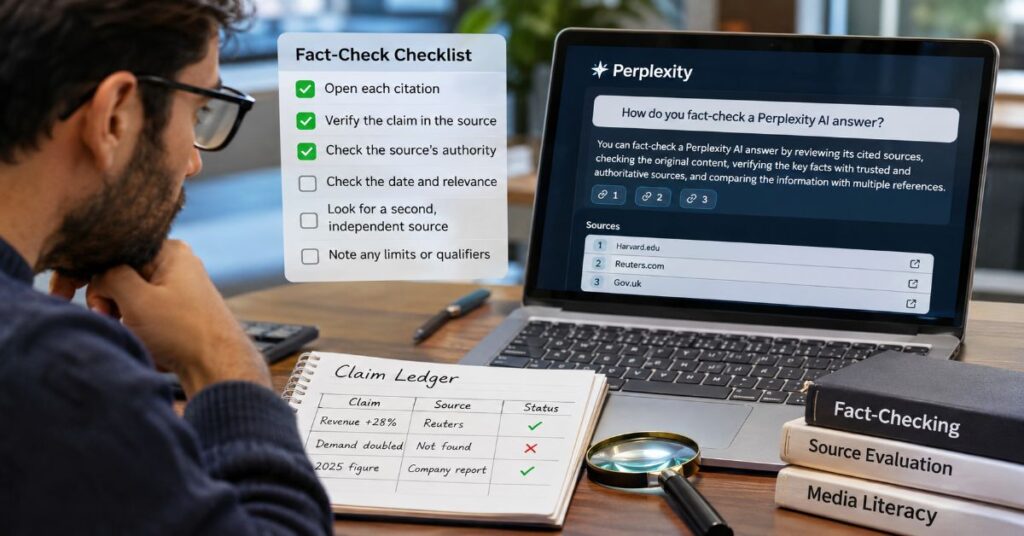
Perplexity makes fact-checking easier by attaching citations to its answers, but a citation does not prove that the linked source supports the exact claim beside it. To fact-check a Perplexity AI answer, isolate each important statement, open its citation, compare the wording with the original evidence, check the source’s date and authority, and corroborate high-impact claims independently. The difference between a real link and a verified fact is where reliable research begins.
The distinction matters because an AI-generated answer can be polished, detailed and accompanied by several numbered references while still containing a wrong date, an overstated statistic, a quotation without a transcript or a conclusion that the source does not establish. The citation may lead to a legitimate page; the error may lie in how the page has been interpreted or compressed.
The goal is not to distrust every Perplexity response or to spend an hour checking an everyday definition. It is to match the amount of verification to the consequence of being wrong. A student checking a background explanation needs a different evidence trail from a journalist publishing a quotation, a business analyst reporting revenue or a professional assessing a current regulation.
This guide introduces a six-layer citation integrity test, a claim ledger, a source hierarchy and a reproducible workflow. It also explains why benchmark results cannot be collapsed into one universal accuracy percentage, how to recognise Perplexity-specific citation failures, and when a second AI answer is not independent confirmation. The result is a practical method for deciding what is safe to use, what needs qualification and what should remain unresolved.
Why Fact-Checking Must Start With the Claim, Not the Citation
Perplexity’s numbered citations are useful because they give readers a route from a generated answer to material on the open web. But a route is not a verdict. To answer the question “how do you fact check a perplexity ai answer”, begin by isolating the factual statement and asking what evidence would make it true. Then open the citation and test whether the page actually supplies that evidence.
Treat each answer as a set of independently testable propositions rather than one polished paragraph. A sentence such as “The company’s revenue rose 28 per cent in 2025 because demand doubled” contains at least three propositions: the revenue figure, the comparison period and the causal explanation. A single source may support the first without supporting the second or third. If Perplexity compresses them into one sentence, the reader must separate them again before checking.
For a broader explanation of the distinction between a correct answer and a supported citation, see our guide to why Perplexity can be wrong about cited facts. The central lesson is not to distrust every answer. It is to stop treating the presence of a source marker as the end of the investigation.
The Six Layers of Citation Integrity
A practical Perplexity fact-check should pass six separate tests. They form a chain: if an early link fails, later confidence is difficult to justify. A live URL establishes only the first layer. Strong research requires the rest.
1. Source existence: does the cited page open, and is it the page Perplexity appears to identify? A broken link, unrelated redirect, missing document or inaccessible preview is not usable evidence. Record the problem rather than silently substituting a different page.
2. Source identity: is the cited page the original record or merely a secondary account? A news report may accurately describe a regulator’s announcement, but the regulator’s notice is usually better evidence for the exact rule. A blog may summarise a paper, but the paper itself is the correct place to inspect its sample, method and limitations.
3. Claim support: does the source support every material part of the sentence? Check the entity, amount, unit, date, geography, population, version and qualifier. A page that mentions a company does not necessarily support the funding figure Perplexity attributes to it. A study that finds an association does not establish causation.
4. Authority: is the publisher qualified to establish this particular fact? A government regulator is generally a stronger source for its own rules than a commercial blog. A peer-reviewed paper is usually preferable for a scientific result, while the original company release may be the best source for a product launch date. Authority is domain-specific; no publisher is automatically authoritative on everything.
5. Freshness and scope: is the evidence current for the question, and does it apply to the relevant place, period, version and population? A tax threshold from last year, a software feature from an older release or a legal rule from another jurisdiction may be accurately quoted but unsuitable for the user’s situation.
6. Synthesis and calibration: has Perplexity preserved the source’s meaning, uncertainty and limitations? An answer can quote a true number while implying a false conclusion. It can combine two separate findings into a causal story, remove “may”, “in this sample” or “as of this date”, or present a disputed interpretation as settled fact.
| Layer | Question | Common failure | Pass condition |
| Existence | Does the page open? | Broken or unrelated URL | Correct page is accessible |
| Identity | Is it the original source? | Secondary summary replaces primary record | Provenance is clear |
| Support | Does it prove this sentence? | Number or qualifier is absent | Exact proposition is supported |
| Authority | Is it suitable evidence? | Opinion used as official fact | Publisher fits the claim |
| Freshness | Is it current and in scope? | Old version or wrong jurisdiction | Date and scope match |
| Synthesis | Is the summary faithful? | Context removed or certainty inflated | Meaning and limits preserved |
The six-layer model is the article’s central framework. It is deliberately more demanding than simply checking whether the citation exists, because the most consequential errors often happen after a source has been found.
How to Open a Citation and Test the Exact Match
Start with the citation number beside the claim, not with the general source list at the bottom of the answer. Open the linked page in a new tab and confirm the publisher, title, author or issuing organisation, publication date and document type. Do not rely on the preview card alone. Previews can truncate the relevant wording, and a search result snippet may show a phrase without the context that determines its meaning.
Next, search within the page for the distinctive number, name, phrase or date used in Perplexity’s answer. If the answer says a report found 42 per cent, search for “42”, “42%” and the relevant subject. If the page is a PDF, use its search function and inspect the page containing the result. If the source has tables, check the table heading, column label, denominator, footnote and reporting period. A number without its unit or denominator can be technically present but materially misrepresented.
Read the paragraph before and after the matching passage. Context frequently changes the interpretation. A paper may report a positive result in one subgroup and no effect in the full sample. A government page may describe a proposal rather than a rule already in force. A company announcement may refer to planned availability, not general release. A quotation may be part of a question, an allegation or a statement the author later rejects.
Use a three-part test: what does the source explicitly say; what does Perplexity say it means; and what additional inference has been added? Keep those three layers separate in your notes. If the source says a product “supports integration with selected services”, Perplexity should not turn that into “integrates with every major platform”. If a paper says the treatment was associated with an outcome, the answer should not claim the treatment caused it.
When the citation is a secondary report, follow its references upstream. Open the original study, filing, dataset, court decision, regulator notice or company documentation. The secondary article may be a useful guide, but the original record lets you check what was measured and what was actually announced. For an academic claim, verify the paper’s title, authors, journal or conference, publication status and DOI rather than trusting a plausible citation string.
If the link is blocked by a paywall, login or geographic restriction, do not assume the preview is sufficient. Look for an openly accessible version from the publisher, author repository, government archive or institutional repository. If no version is available, record the claim as not independently verified. A source that cannot be inspected may still be genuine, but the reader cannot honestly claim to have checked its support.
Build a Claim Ledger Before You Investigate
Fact-checking becomes inefficient when a reader opens a dozen tabs, remembers only fragments and then tries to reconstruct which source supported which statement. A claim ledger prevents that drift. It is a compact record of what was said, what evidence was inspected and what conclusion the reviewer reached.
For a short answer, four columns are enough: claim, best source, what the source actually shows and status. For a report, add the URL, publication date, primary-source link, exact page or paragraph, contrary evidence, reviewer and date checked. The point is not to create paperwork for its own sake. It is to preserve the chain between the AI statement and the evidence used to assess it.
Rewrite each claim in plain language, one proposition per row. Do not paste a long paragraph into one cell. If a sentence contains a date, a percentage and an explanation of why the percentage changed, split it into three rows. This reveals mixed outcomes: the date may be right, the percentage may use a different denominator and the causal explanation may be speculation.
Prioritise by consequence and uncertainty. A simple editorial triage score can multiply impact by uncertainty, with each rated from 1 to 3. A low-impact, easily checked background statement scores 1 or 2. A current legal deadline with unclear jurisdiction may score 9. This is not a scientific probability of error; it is a practical way to decide what to check first when time is limited.
Preserve the original Perplexity prompt and the date the answer was generated, especially for fast-changing questions. Record whether Web, Academic, Finance, a file source or a research mode was used, and note any selected model if visible. The product interface, available models and retrieved pages can change. A saved prompt makes it easier to reproduce the investigation and understand why a later answer differs.
| Claim | Evidence inspected | What the evidence establishes | Status |
| Named event occurred on a stated date | Original announcement | Date and event match | Verified |
| Reported percentage increased | Dataset and table note | Percentage matches, denominator differs | Partly supported |
| New rule applies nationally | Regulator notice | Notice applies only to one region | Unsupported as written |
| Quotation attributed to an executive | Transcript or recording | No matching statement located | Unresolved |
A ledger turns an informal check into an auditable process. It is particularly useful when Perplexity’s answer will be quoted, shared, used in a presentation or passed to someone who was not present during the original research.
Choose Primary Sources Without Ignoring Source Quality
Primary sources are the records closest to the event or fact being checked. They include official datasets, legislation, court decisions, regulatory notices, company filings, original research papers, technical documentation, transcripts and direct statements. They are often the best starting point because they reduce the number of intermediaries between the evidence and the claim.
But “primary” does not automatically mean “complete” or “unbiased”. A company’s press release is primary evidence of what the company announced, not independent proof that its product performs as advertised. A government dataset may be authoritative but require careful reading of definitions and collection methods. A research paper is the original scholarly report, but it may be a preprint, have a small sample or contain limitations acknowledged by its authors. Evaluate both provenance and suitability.
Match the source type to the question. For a legal rule, use the current statute, regulation or regulator guidance and confirm the jurisdiction and effective date. For a company’s financial results, use the filing or audited report rather than a news summary. For a scientific finding, inspect the full paper and supplementary methods. For a product feature, use the vendor’s current documentation, release notes or support article. For a public quotation, seek a transcript, recording or original interview.
Use independent corroboration when the claim is important. Two websites repeating the same press release are not two independent confirmations. Trace each report to its origin. If several articles all cite one unnamed source, they may represent one evidence stream rather than several. Genuine triangulation means that distinct sources with different access or methods converge on the same proposition.
Perplexity’s source selection and labels can help users discover material, but they do not remove this judgement. Our article on how Perplexity decides which sources to show looks at source discovery and the limits of what can be inferred about its selection process. The fact-checker’s task begins after discovery: decide whether the retrieved evidence is appropriate for the particular claim.
Check Dates, Numbers, Quotes and Causal Claims Separately
Certain claims deserve extra scrutiny because they are easy to distort during summarisation. Dates, numbers, quotations and causal statements should each receive a distinct check. A page can mention the right topic and still fail to support one of these details.
Numbers require units, denominators, time periods and definitions. “Revenue rose 20 per cent” is incomplete without the comparison period, currency, accounting basis and whether the figure is reported or adjusted. “The model is 90 per cent accurate” is meaningless without the benchmark, test set, scoring rule and date. If Perplexity gives a percentage, locate the table or dataset that produced it and inspect the footnotes. Check whether it has converted an absolute count into a rate or compared different populations.
Dates require event precision. An announcement date, publication date, effective date, launch date and date a feature became generally available can all differ. In policy and law, a page may describe a proposal, consultation or future commencement. In technology, a feature may be announced in one month, rolled out gradually and become available to only some plans later. Do not let one date stand in for another.
Quotations require exact wording and attribution. Search for the phrase in quotation marks, then inspect the full interview, transcript, video or official statement. A paraphrase should not be placed inside quotation marks. If the exact words cannot be found, do not repeat them as a direct quote. A quote can be assembled from fragments, stripped of a qualifying clause or attributed to a person who was discussing someone else’s view.
Causal claims require more than a source that reports two things occurring together. A study may find correlation, association or a result in a controlled setting. Those are not interchangeable with proof of causation. Look for the research design, control group, sample, confounders and authors’ own limitations. A news article may use causal shorthand in its headline that the underlying paper does not support.
For high-impact facts, write the result in calibrated language. “The paper reported an association in a sample of 420 adults” is more informative than “the treatment works”. “The company announced a planned launch for October” is safer than “the product launched in October” if general availability has not been confirmed. Precision is not verbosity; it is the difference between evidence and overstatement.
Recognise Perplexity-Specific Failure Modes
Perplexity is an answer engine that combines search and generated synthesis. Its citations make the evidence trail more visible than in an answer with no references, but several failure modes can still occur between retrieval and the final sentence. Understanding these patterns helps a reader know what to inspect.
Citation drift occurs when a source is relevant to the topic but does not support the precise sentence beside it. The model may retrieve a page about the correct company, study or policy and attach it to a more specific number or conclusion that the page never states. This is why matching the source to the whole proposition matters more than recognising the publisher’s name.
Source substitution occurs when a secondary account is presented where the original document is needed. A news article may summarise a report but omit the methodology or qualification. A product review may repeat a vendor’s feature description without testing it. Follow the source trail upstream when exactness matters.
Context compression occurs when a generated summary removes limitations, exceptions or uncertainty. A study’s result may apply only to a particular group. A rule may apply only in one jurisdiction. A product function may be restricted to selected plans. If those details disappear, the answer may be broadly related to the source but misleading for the user’s actual question.
Temporal mismatch occurs when the cited page was accurate at publication but is no longer current. Product interfaces, model rosters, prices, public policies, market figures and regulations can change. Check the date on the source and, for a live question, find the latest official page or record. A citation is not made current merely because Perplexity retrieved it today.
Prompt-premise acceptance is another risk. If a question assumes that an event happened, that a person said something or that a product has a certain feature, the system may answer within that framing instead of challenging it. Ask a neutral version of the question and verify the premise independently. This is especially important for allegations, political claims and disputed events.
The 2026 evidence base illustrates why these risks should be separated. The EACL study measured source credibility and groundedness; the ICLR DeepTRACE study audited multiple dimensions of citation and evidence; the Tow Center tested source identification. They are complementary, not interchangeable. For a wider look at task-specific performance, see Perplexity AI accuracy benchmarks.
Use Search Modes and Follow-Up Prompts as Investigation Tools
Perplexity’s search modes and follow-up questions can improve the discovery stage of fact-checking, but they should not be mistaken for independent verification. Pro Search, Academic or other available focus options may help retrieve a broader or more specialised set of sources. Their value depends on the question, the available source landscape and the user’s ability to inspect the resulting evidence.
For a simple factual question, ordinary web search may be enough to find an official record. For a scholarly question, an academic-focused search can help locate papers and citations. For a complex investigation, a deeper research mode may search across more sources and organise a longer synthesis. None of these modes guarantees that every statement in the final answer is supported. More retrieval can increase coverage while also producing more claims that need review.
Use follow-up prompts to expose the evidence structure rather than merely request reassurance. Ask Perplexity to list the exact source passage supporting a particular sentence, identify the primary document behind a news report, separate facts from inference, state the publication date and explain what evidence would contradict the conclusion. These prompts can make weaknesses easier to see, but the answers still need to be checked against the linked pages.
Another useful prompt is: “Find the strongest credible evidence against your conclusion. Do not defend the previous answer. Identify any source that contradicts it, and explain whether the disagreement is about the facts, definitions, date or interpretation.” This can surface overlooked counterevidence and help prevent confirmation bias. Still, a model-generated counterargument is only a lead until its sources are examined.
Do not use repeated rephrasing as a substitute for corroboration. If the same question produces three different answers, that instability is a warning to investigate. If it produces the same answer three times, that consistency is not proof; the model may be repeatedly drawing on the same flawed source. The right test is whether independent evidence supports the claim.
Deep Research can be helpful for broad investigations, but long reports create a larger audit surface. A 20-page report may contain dozens of claims, and a citation near a paragraph may not support every sentence in it. Our guide to Perplexity Deep Research accuracy explores why depth and presentation quality should not be confused with factual accuracy.
A Reproducible 10-Minute Fact-Check Workflow
The following workflow is designed for a short answer that matters enough to verify but does not require a full academic or legal review. Ten minutes is a planning estimate, not a guarantee: complex, disputed or high-stakes claims will take longer. The aim is to make each action explicit so that the process can be repeated by another reader.
Minute 1 — Preserve the answer. Save the prompt, response, date and any visible model or search mode. Copy the exact sentences you intend to use. Do not edit away the wording before you have captured the claim you are checking.
Minutes 2–3 — Split and rank claims. Turn the answer into individual propositions. Mark numbers, dates, quotations, named people, legal statements, product specifications and causal explanations. Give each claim a quick impact and uncertainty rating, then begin with the highest-risk item.
Minutes 4–5 — Open the citations. For each priority claim, open the specific numbered source, confirm that it is the intended page and locate the matching passage. Read the surrounding context and note the author, publisher and publication date. If the source is inaccessible or unrelated, mark it unresolved.
Minutes 6–7 — Trace to primary evidence. If the citation is a summary, follow its reference to the original report, filing, dataset, paper or official notice. Confirm the relevant definition, time period, jurisdiction, version and denominator. For a quote, find the original transcript or recording.
Minute 8 — Look for independent corroboration. Find a second source that does not simply repeat the first. For a number, check the underlying dataset or a separate official record. For a contested issue, look for credible counterevidence and identify whether the disagreement is factual or interpretive.
Minute 9 — Assign a status. Mark the claim verified, partly supported, unsupported, contradicted, outdated or unresolved. Record one sentence explaining why. Do not force uncertainty into a yes-or-no answer.
Minute 10 — Rewrite with the correct level of certainty. Retain only what the evidence supports. Add the relevant date, scope or qualification. If the claim remains unresolved and matters to the decision, omit it or state that it could not be verified. Do not cite Perplexity’s summary as a substitute for the original evidence.
This workflow can be scaled. A journalist may add an editor and source archive. A student may retain the DOI and page number. A business analyst may require a reviewer for financial figures. A compliance team may record the applicable jurisdiction and approval date. The underlying sequence stays the same: preserve, decompose, inspect, trace, corroborate, classify and rewrite.
When a Second Source Is Not Enough
Independent corroboration is important, but “two sources agree” is not a complete standard. The sources may have copied one another, relied on the same press release or repeated a claim from an unverified social post. A fact-checker must identify where the evidence originates and whether the sources provide genuinely separate confirmation.
For a simple event date, an official announcement and a reputable independent report may be sufficient. For a financial claim, the company filing and a market regulator’s record may provide separate confirmation. For a scientific claim, the original paper and a systematic review can offer different levels of evidence. For a contested allegation, a statement from one party should not be treated as proof of the allegation itself.
Check for meaningful disagreement rather than hiding it. Different figures may use different definitions, time windows or populations. One report may include tax while another excludes it. One paper may measure a short-term outcome and another a long-term outcome. The correct response is to explain the distinction, not to select the number that best matches the AI answer.
When the evidence remains divided, report the uncertainty. A careful conclusion might say that the official record confirms the announcement date, while independent sources disagree about the scale of its effect. Or that a study found an association but the available evidence does not establish causation. A transparent unresolved status is more useful than false certainty.
For readers who need a broader cross-platform workflow, our AI chatbot accuracy verification guide explains how to assess claims across multiple assistants. The Perplexity-specific process in this article remains focused on opening its citations and tracing them to evidence.
Set the Verification Standard by the Cost of Being Wrong
Not every sentence needs the same amount of investigation. The appropriate standard depends on how much harm or cost a mistake could create. A low-stakes explanation of a familiar term may need one reliable reference. A current price, safety instruction, legal deadline, medical recommendation or public allegation deserves a much stronger review.
For everyday learning, check the definition against a recognised reference and test whether the explanation preserves the important conditions. If the answer gives a surprising statistic, locate the original report. If it provides a quotation, verify the exact wording. A reader should be able to explain the idea independently rather than merely repeat the AI’s phrasing. Our guide to checking whether an AI explanation is correct covers this transfer test.
For academic work, verify the paper in the publisher’s database or a trusted scholarly index. Confirm authors, title, year, publication venue, DOI and whether the work is peer-reviewed or a preprint. Read the relevant section and check whether Perplexity has represented the method and conclusion accurately. Do not cite an AI-generated bibliography without opening every reference. A fabricated or mismatched citation can undermine an otherwise sound assignment.
For journalism and publishing, verify quotes against recordings or transcripts, statistics against the original dataset and allegations against documentary evidence. Keep notes showing which source supports each sentence. Attribute claims accurately and preserve uncertainty. If a source does not support the claim, rewrite the claim or remove it. A citation list at the end of a story does not repair unsupported wording in the body.
For business and finance, check amounts, currencies, reporting periods, assumptions and the date of the source. Distinguish announced funding from cash received, revenue from bookings, profit from adjusted EBITDA and a forecast from a reported result. Market prices and product availability can change quickly. Do not make an investment or procurement decision from an AI-generated summary alone.
For law, medicine, safety and regulated matters, use current authoritative sources and qualified professionals. Confirm the jurisdiction, date and facts that apply to the individual case. Perplexity can help locate official guidance or explain unfamiliar terminology, but it should not replace professional judgement. If the answer conflicts with a clinician, lawyer, regulator or safety authority, do not resolve the conflict by asking the model to choose a side.
A useful editorial rule is proportional verification: the greater the consequence, the stronger and more independent the evidence must be. If you cannot obtain that evidence, say so and avoid presenting the claim as established.
What Perplexity Can and Cannot Guarantee
Perplexity’s product design makes source inspection part of the answer experience. Its Help Centre describes search and Pro Search as processes that retrieve material and synthesise it into an answer with citations. That is valuable: readers can move from a generated summary to the pages that informed it. It is not a promise that every cited sentence has been independently audited or that every source is the best available source.
The platform’s features and model choices can change over time, and the precise controls available may depend on the account, subscription, region or product rollout. This article therefore avoids publishing a fixed commercial pricing matrix or universal query cap as though it were a permanent fact. The target question is about verification, not purchasing a plan. More searches, longer reports or access to additional models can improve research coverage, but they do not eliminate the need to inspect evidence.
Perplexity’s own product pages describe citations as a way to see the source behind an answer and encourage users to verify evidence. That is the right way to use the feature: as an audit trail. Source labels and domain-level signals may help users recognise the general type of publisher, but a domain label cannot establish that every page on that site is accurate, current or relevant to a specific claim.
There are also limits to what an external reader can know about the search process. The full ranking formula, every retrieval decision and the precise internal reasoning path are not publicly available in a way that lets a user reconstruct every system choice. Avoid claims about undisclosed ranking weights, guaranteed freshness windows or a fixed citation boost unless Perplexity documents them. A confident technical explanation is not evidence when the underlying specification is private.
The limitations are equally important. A source may be weak, inaccessible or outdated. A citation may not support the exact claim. A summary may omit context. Search results may miss relevant evidence or reproduce a false premise. Longer outputs may create more claims to verify. In some cases, traditional search or direct access to a government, academic or company source is a better first step than asking an answer engine to synthesise the issue.
Perplexity is best understood as a research assistant that helps locate and organise evidence. It is not the evidence itself, and it cannot take responsibility for the final interpretation. The user remains responsible for checking the source, judging its suitability and deciding whether the conclusion is strong enough for the intended use.
Our Editorial Verification Process
This article was prepared as an explanatory guide, not as a controlled product benchmark. We reviewed the live search results for the target keyword and close variants, examined the structure and evidence choices of ten relevant pages, and built an independent outline around citation integrity, source provenance and consequence-based verification. Search-result ordering can vary by location, account and time; the ten pages are a snapshot of the research results available on 6 November 2026, not a claim of a universal ranking order.
For factual claims, we prioritised Perplexity’s official Help Centre and product documentation, the Columbia Journalism Review’s Tow Center reporting, the 2026 EACL paper on source credibility and groundedness, and the 2026 ICLR DeepTRACE research. We kept each study’s scope separate and did not convert task-specific results into a universal Perplexity accuracy rate. We also checked OpenAI’s public guidance on hallucinations as a cross-platform explanation of why fluent answers can still contain fabricated facts or citations.
The live sitemap.xml, sitemap_index.xml and post-sitemap.xml endpoints did not return parseable XML through the available browsing interface. Internal links were therefore selected from indexed pages on Perplexity AI Magazine that were directly relevant to the topic. The article does not claim that the complete sitemap was extracted. No direct quotations from named industry figures were added because sufficiently attributable, topic-specific 2026 quotations could not be independently verified from the sources reviewed; inventing quotes would weaken the article’s trustworthiness.
The ten-minute workflow is an editorial procedure proposed for readers, not a peer-reviewed benchmark or a claim that every fact can be checked in ten minutes. The risk score is a prioritisation aid, not a statistical probability. No universal pricing table or exact plan cap is included because those details are not necessary to answer the search query and can change by region, account and product rollout.
This article was researched and drafted with AI assistance and reviewed by the Sami Ullah Khan editorial desk at Perplexity AI Magazine. All data, citations, pricing figures, and named quotes have been independently verified against primary sources before publication.
Conclusion
The most reliable way to fact-check a Perplexity AI answer is to test each important claim against the evidence behind its citation, then follow that evidence to the original record where necessary. A working link proves that a page exists; it does not prove that the page supports the exact wording, that the publisher is authoritative for the question, or that the information is current.
That distinction is the foundation of responsible AI-assisted research. Separate claims, inspect the cited passage, check context and date, trace secondary reporting upstream, and corroborate consequential facts independently. Record uncertainty rather than forcing every result into a true-or-false label. The level of checking should rise with the cost of being wrong.
Perplexity’s citations, search modes and research features can make evidence easier to discover and inspect. They do not transfer the final responsibility for interpretation to the platform. The best outcome is not blind trust or blanket rejection: it is a user who can show exactly what a source establishes, what remains uncertain and why the final statement is justified.
FAQs
How do you fact-check a Perplexity AI answer?
Open the citation attached to each important claim, compare the exact wording with the source passage, check the date and context, and follow secondary sources to the original record. For consequential claims, corroborate the evidence independently rather than relying on the AI summary.
Does a Perplexity citation prove that an answer is correct?
No. A citation shows a link to a source, not that the source supports every part of the sentence. The source may be outdated, secondary, irrelevant or misinterpreted. Read the passage and check its scope before relying on the claim.
Can Perplexity make up sources or misrepresent citations?
AI search systems can produce citation errors, including mismatched or unsupported references. Treat every link as something to inspect. Confirm the title, author, publisher, date and passage, and trace important claims to primary evidence.
Should I trust Perplexity’s source labels?
Use source labels as contextual clues, not guarantees. A domain-level label cannot establish that a particular page supports a particular claim. Read the actual article or document and assess its authority for the subject.
Is Perplexity accurate enough for academic research?
It can help discover literature and organise an initial research question, but every reference must be checked in the publisher or scholarly database. Read the original paper, verify its DOI and publication status, and confirm that the AI has represented its methods and limitations correctly.
Is asking another AI to check Perplexity enough?
No. Another model can suggest counterarguments or alternative sources, but its agreement is not independent evidence. Verify the claim against primary documents or genuinely independent sources.
What should I check first in a long Perplexity report?
Start with claims that have the greatest consequences if wrong: figures, quotations, named people, legal rules, medical or safety advice, product specifications and causal conclusions. Split compound sentences into separate claims and verify the highest-risk items first.
Should I cite Perplexity or the original source?
For academic, journalistic and professional work, cite the original source for the factual claim whenever possible. Disclose AI assistance separately if your institution or publisher requires it. The generated summary is not a substitute for the evidence.
References
- Perplexity. (n.d.). What is Pro Search? Source
- Perplexity. (n.d.). Perplexity Search: Accurate, cited AI answers for every question. Source
- Vykopal, I., Pikuliak, M., Ostermann, S., & Simko, M. (2026). Assessing web search credibility and response groundedness in chat assistants. Proceedings of the 19th Conference of the European Chapter of the Association for Computational Linguistics, 2539–2560. Source
- Venkit, P. N., Laban, P., Zhou, Y., Huang, K.-H., Mao, Y., & Wu, C.-S. (2026). DeepTRACE: Auditing deep research AI systems for tracking reliability across citations and evidence. ICLR 2026. Source
- Jaźwińska, K., & Chandrasekar, A. (2025, March 6). AI search has a citation problem. Columbia Journalism Review. Source
- OpenAI. (n.d.). Does ChatGPT tell the truth? Source
- Google. (n.d.). View related sources from Gemini Apps. Source
- Allaham, M., & Diakopoulos, N. (2026). Synthetic sources?: Auditing generative search engine citations for evidence of AI-generated sources. arXiv. Source
Published
Spotted an error? Read our corrections policy or email editorial@perplexityaimagazine.com.