
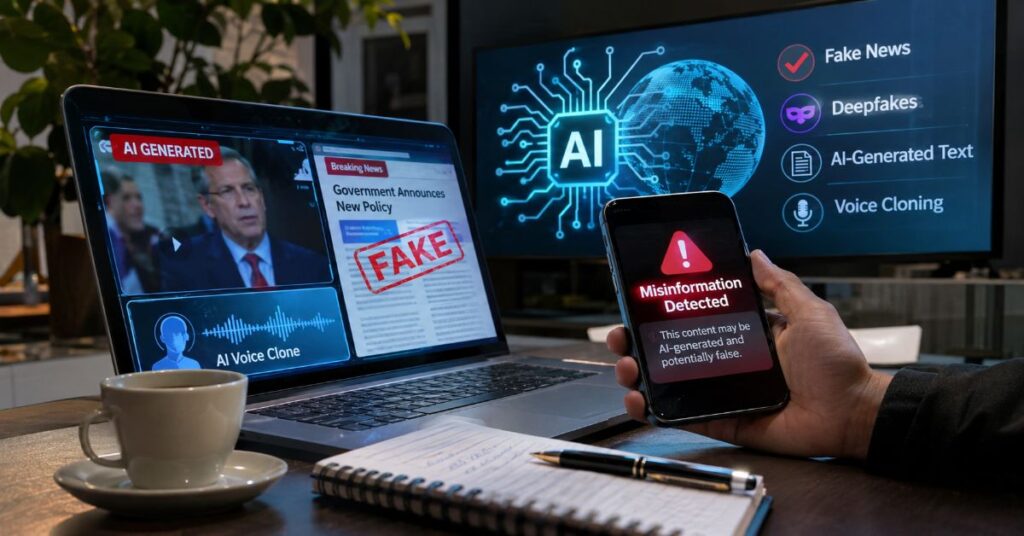
Yes—AI misinformation is likely to get worse before it gets better, although the outcome is not predetermined. The immediate risk is not simply that artificial intelligence can create a convincing fake video; it is that AI can produce an endless supply of plausible claims, tailored explanations, synthetic voices and fabricated supporting material faster than institutions can check them.
That distinction matters. Public debate often treats misinformation as a visual problem: a politician appears to say something they never said, a fabricated image spreads during a crisis, or a cloned voice requests an urgent bank transfer. Those incidents are serious, but the latest evidence points to a wider challenge. Text can be persuasive without looking unusual, and an ordinary-looking paragraph can carry a false claim more effectively than an obviously manipulated image.
The International Panel on the Information Environment (IPIE) analysed 60 experimental effects from 24 peer-reviewed publications involving 33,801 participants. Its 2026 synthesis found that more recent studies tended to report higher perceived accuracy and credibility for AI-generated misleading text, while people had become more sceptical of visual AI misinformation over time. The authors caution that effects vary substantially across contexts and that the evidence base is geographically narrow.
This is not a forecast that truth will disappear or that every online conversation will become untrustworthy. It is a warning about an uneven transition: production tools are spreading quickly, while provenance systems, platform enforcement, public habits and legal frameworks are developing at different speeds. The central question is therefore not whether AI will create misinformation. It already can. The question is whether society can build reliable ways to establish origin, test claims and preserve trust before the volume and velocity of synthetic content overwhelm existing systems.
Why the Next Phase May Be Harder Than the Deepfake Era
The first wave of public concern focused on spectacular synthetic media. A fake video is easy to demonstrate in a headline and emotionally powerful when it appears to show a public figure doing something shocking. But spectacular fakes are only one part of the problem. The more routine risk is a believable claim delivered in familiar formats: a local news-style post, a health explanation, a forged customer-service message, a fabricated quote card or a confident answer in a discussion forum.
Generative systems reduce the cost of producing variations. A bad actor can ask for the same false narrative in different tones, lengths and languages, then adapt it for a neighbourhood group, a professional audience or a political community. The technology does not need to invent a new lie every time. It can repackage an existing claim so that it feels locally relevant and socially familiar.
Yotam Ophir, an associate professor of communication at the University at Buffalo, described the shift succinctly: “AI is changing the speed, scale, and accessibility of content creation.” His point is important because misinformation predates generative AI. The new variable is the production environment: more content, more versions and lower barriers to imitation.
Scale alone does not guarantee persuasion. People do not believe every message they encounter, and automated content can be repetitive, detectable or ignored. Yet volume creates an operational burden. Journalists, fact-checkers and platform moderators must identify which claims are spreading, determine whether they are materially false, trace their sources and respond before a narrative becomes entrenched. Even a modest increase in the number of claims can strain teams when each claim appears in many forms.
The Evidence Challenges the Deepfake-First Narrative
The IPIE meta-analysis is one of the most useful current checks on assumptions about AI misinformation. It combines experimental research rather than relying only on viral examples. Across 24 publications and 33,801 participants, the synthesis found that recent studies tended to show greater perceived credibility for text-based GenAI misinformation. By contrast, people’s perceptions of visual misinformation—primarily deepfakes—had become more sceptical over time.
This does not mean text is always more dangerous than video. The report highlights substantial variation across studies, and the underlying research is concentrated in Western Europe and North America. It also measures experimental outcomes, not the full real-world effects of every misinformation campaign. The finding should be read as a warning against over-investing in the most visible format while neglecting less dramatic ones.
| Evidence point | What it suggests | Important limitation |
| 24 publications; 60 experimental effects; 33,801 participants | A substantial experimental evidence base is now available. | The studies differ in design, content and context. |
| Text credibility appears to be increasing in more recent studies | Plausible written claims deserve greater attention. | This is a pattern across studies, not a universal rule for every audience. |
| Scepticism toward visual AI misinformation has increased over time | Audiences may be learning to question obvious synthetic media. | Scepticism does not mean viewers can reliably identify every deepfake. |
| Preventive corrections reduced perceived accuracy by 0.17–0.43 standard deviation units in post-2020 studies | Providing context before exposure can help. | The effect varies, especially when measuring detection rather than judgement. |
A second useful lens comes from a peer-reviewed Harvard Kennedy School Misinformation Review study published in July 2026. Its survey of 54 international experts found that perceived threats differed by domain: video deepfakes scored highest in politics, AI-generated text scored highest in health, and audio deepfakes scored highest in finance. The study is an expert assessment, not a direct measurement of incident rates, but it reinforces a practical lesson: there is no single format that defines the threat.
In short, the next phase is likely to be multimodal and context-specific. A fake campaign video may demand provenance checks; a false medical explanation may require clinical review; a cloned executive voice may require payment verification. Treating all three as the same ‘deepfake problem’ leaves gaps.
The Economics of Plausible Falsehoods
AI changes the economics of misinformation in three connected ways. First, it reduces the labour required to draft and adapt content. Second, it makes personalisation cheaper: a message can be rewritten for a different age group, profession, region or ideological community. Third, it lowers the cost of maintaining a campaign over time. Instead of publishing one fabricated story, an operator can generate follow-up posts, comments, translations, summaries and apparent eyewitness accounts.
The critical resource is no longer only the ability to create a convincing fake. It is distribution. A thousand low-quality posts that reach nobody may have little impact; a small number of claims amplified by trusted accounts, recommendation systems or influential figures can have a disproportionate effect. This is why content moderation cannot focus exclusively on whether an individual image or paragraph was generated by AI. It must also examine coordinated behaviour, repeated narratives, deceptive impersonation and the networks that amplify them.
The University at Buffalo’s Yotam Ophir has emphasised that misinformation spreads through social and political environments, not through technology alone. When scientific subjects become markers of group identity, people may evaluate claims partly through what those claims signal about their community. A polished AI-generated explanation can exploit this dynamic, but it did not create the underlying social division.
There is also a supply-side asymmetry. A false claim can be generated and published in seconds; a responsible correction may require a journalist to locate original documents, contact experts, verify dates, explain uncertainty and persuade platforms to distribute the correction. The correction is slower because accuracy is labour-intensive. A healthy information system must therefore make verification easier and make deceptive mass distribution less rewarding.
The Most Dangerous Output Depends on the Situation
A single ranking of AI misinformation formats can mislead decision-makers. The Harvard Kennedy School study by Alexander Loth, Martin Kappes and Marc-Oliver Pahl surveyed 54 experts and found distinct risk patterns across political, health, financial and social contexts. Political video deepfakes received the highest average threat rating in that domain (6.31 out of 7). In health, AI-generated text was rated highest (5.80). In finance, audio deepfakes received the highest rating (5.65).
| Context | Format that stood out in the 2026 expert survey | Why the format matters |
| Politics | Video deepfakes | A fabricated clip can appear to show a candidate making a damaging statement or withdrawing from a contest. |
| Health | AI-generated text | False advice can imitate explanatory or professional language and be repeated at scale. |
| Finance | Audio deepfakes | A cloned voice can exploit trust, urgency and familiar workplace procedures. |
| Public debate | Mixed formats | Text, images, clips and comments can reinforce one another and create a false impression of consensus. |
The survey also found disagreement about the best response. Government regulation received the largest share of ‘most effective’ selections, but it also received a notable share of ‘least effective’ selections. Media literacy was similarly divided. That is not proof that regulation or education is useless. It indicates that experts disagree about how much each intervention can achieve on its own.
The practical implication is to design safeguards around the harm. Election authorities need rapid channels to verify voting information and respond to fabricated candidate media. Hospitals and public-health agencies need trusted, accessible explanations that can compete with false medical claims. Banks and businesses need callback procedures and dual authorisation for unusual payment instructions. The same generic warning label cannot solve all these problems.
The Trust Crisis: When Real Evidence Can Be Dismissed as Fake
The most corrosive consequence may be a change in how people argue about evidence. If synthetic media becomes common, a person caught on genuine video can claim the footage is fabricated. This is often described as the liar’s dividend: the existence of deepfakes gives dishonest actors a ready-made excuse to dispute authentic recordings.
The reverse problem is equally serious. People may accept a fabricated clip because it confirms what they already believe, while rejecting genuine reporting that challenges their assumptions. In both cases, the dispute shifts away from evidence and towards identity, loyalty and suspicion.
Research published by the University of Sydney in November 2026 adds another dimension: accusations that online content is AI-generated can themselves undermine trust in political discussion. The researchers analysed 220,373 posts and comments from major Reddit news and political communities around the 2024 US presidential election. Their findings suggest that claims of bot activity or AI manipulation can be used to discredit opposing views, even when the underlying content has not been shown to be synthetic.
That creates a double bind. Better detection may help identify some manipulated content, but a public that treats every inconvenient statement as potentially fake may become less willing to accept any evidence. The goal cannot be universal suspicion. It must be calibrated trust: confidence based on transparent sourcing, independent corroboration and a traceable chain of custody.
Dr Abeba Birhane of Trinity College Dublin warned lawmakers in February 2026 that generative AI poses a “major threat” to truth, democratic processes and public trust. The concern is not that every AI output is deceptive. It is that convincing content can be produced without a reliable relationship to truth, while institutions struggle to communicate which material is authentic.
Why AI Detectors Cannot Be the Final Authority
AI detectors are often presented as a simple answer: upload an image, video or paragraph and receive a verdict. That expectation is too strong. Detection systems are statistical tools. Their performance can vary with the model used to generate the content, later editing, compression, cropping, translation, screenshots and the distribution of material they were trained to recognise.
A detector can produce false positives, labelling authentic content as synthetic, and false negatives, missing manipulated content. This is especially damaging when the decision has consequences for a journalist, election candidate, employee or ordinary person whose reputation is at stake. A detector result should therefore be treated as one signal in an investigation, not as proof.
The problem is not limited to detectors. Content provenance systems can provide useful evidence about origin and editing history, but they do not establish whether a claim is true. A genuine photograph can be paired with a false caption. A real video can be presented with an incorrect date or location. A synthetically generated image can illustrate a harmless fictional scene. Authenticity and truth are related but separate questions.
A useful verification process asks at least four questions: where did the file come from; has it been altered; does the surrounding claim match the evidence; and can independent sources corroborate the event? No single technical signal answers all four.
Provenance, Watermarks and the Limits of Technical Fixes
Content provenance is a promising part of the response. The Coalition for Content Provenance and Authenticity (C2PA) standard allows supported media to carry signed information about origin and editing. In May 2026, OpenAI described its use of C2PA Content Credentials alongside SynthID watermarking for supported generated images. In July 2026, the company said supported audio generated through its tools would also include SynthID watermarking and that its verification tool would support audio checks.
These developments matter because provenance can shift the question from ‘Does this look fake?’ to ‘What can we establish about this file’s history?’ Signed metadata can help journalists and platforms understand how content was created or edited. Watermarks can provide another signal that may survive some transformations that remove metadata.
But provenance is not a universal authenticity certificate. Metadata can be stripped through ordinary transformations, including screenshots or format conversion. A missing watermark does not prove that content is human-made, because the material may come from a system that does not add that watermark. A positive provenance signal also does not prove that the content is accurate, fairly contextualised or legally owned.
OpenAI’s own provenance guidance makes this distinction explicit: signals can help identify origin but do not guarantee accuracy, lack of editing or correct context. Its developer documentation also notes that a ‘not detected’ result does not rule out AI generation, particularly when metadata has been removed or the content comes from unsupported systems.
| Mechanism | What it can help establish | What it cannot establish alone |
| C2PA Content Credentials | Signed origin and editing information for supported files. | Whether the statement or scene depicted is true. |
| Invisible watermark | A signal associated with supported generated content. | Whether an unmarked file is authentic or made without AI. |
| AI detector | A probabilistic assessment of whether content resembles generated material. | A definitive finding suitable for high-stakes decisions without corroboration. |
| Independent verification | Whether sources, dates, locations and claims agree. | A guarantee that every unknown detail has been resolved. |
The strongest future system will be layered. Provenance can help establish origin; forensic analysis can examine manipulation; journalists and subject experts can test claims; platforms can reduce coordinated amplification; and public institutions can publish timely, accessible corrections. Technical tools are useful precisely when their limits are understood.
What Platforms, Governments and Newsrooms Need to Change
Platforms should be judged not only by the number of synthetic items they label or remove, but by whether they reduce the reach of coordinated deception and respond quickly to credible reports. Transparency reports should distinguish between detection, enforcement and measurable distribution outcomes. A label applied after a false story has reached millions is not equivalent to preventing its spread.
Governments should avoid treating every false or unpopular statement as a matter for censorship. Rules should focus on demonstrable harms such as impersonation, fraud, deceptive election information, non-consensual synthetic imagery and coordinated manipulation, while protecting journalism, satire, research and political criticism. Independent oversight and clear appeal processes are essential because enforcement decisions can themselves be abused.
Newsrooms need procedures that work under deadline pressure. A practical protocol includes preserving the original file, recording where and when it was received, checking provenance where available, contacting the apparent source through a separate channel, searching for earlier versions, verifying the location and date, and obtaining independent confirmation before publication. If verification remains incomplete, the report should say so plainly.
The International Panel on the Information Environment found that preventive corrective information produced small-to-moderate reductions in perceived accuracy in post-2020 studies, while labelling effects were more variable. That suggests newsrooms and public agencies should not wait until a false claim goes viral. Clear explanations of likely false narratives, known facts and verification routes can prepare audiences before exposure.
The responsibility is distributed. AI developers influence the design of generation and provenance systems. Platforms control ranking and distribution. Governments set legal boundaries. Newsrooms verify and explain. Schools and community organisations help people build habits of source evaluation. None can solve the problem alone, and each should be accountable for the part it controls.
What Individuals Can Do Without Becoming Full-Time Fact-Checkers
The public does not need to become a forensic analyst. A few habits can reduce the chance of being misled or helping a false claim spread.
- Pause before sharing emotionally charged material, especially during elections, disasters, public-health scares or breaking news.
- Find the original source rather than relying on a screenshot, repost, forwarded voice note or cropped video.
- Check dates and context. An authentic clip from an earlier event can be used to support a false claim about today.
- Look for independent confirmation from more than one credible source, preferably sources that do not all repeat the same original post.
- For financial requests, verify through a separate trusted channel. Do not rely on a voice or video call alone for urgent changes to payment details.
- For medical claims, consult recognised health authorities or a qualified clinician rather than treating a polished AI answer as medical evidence.
- Use provenance or detection tools as clues, not verdicts. A missing watermark or a detector score is not proof of authenticity.
- Correct mistakes visibly. If you shared a false claim, update or remove it and explain the correction rather than silently deleting the post.
The point is not to distrust everything. It is to match the level of verification to the potential harm. A funny synthetic image shared as a joke does not require the same investigation as a video that could affect voting, trigger a bank transfer or change a patient’s treatment.
Will the Situation Eventually Improve?
There are credible reasons for cautious optimism. Provenance standards are becoming more visible; some AI providers are adding watermarks and verification features; researchers are measuring persuasion and testing interventions; and public institutions are beginning to build specific response procedures. The evidence that preventive corrections can reduce perceived credibility is particularly important because it shows that people are not helpless in the face of synthetic misinformation.
However, improvement will not arrive automatically as detectors become more sophisticated. Generative systems and detection systems are in an adaptive contest. A technical signal that works for one model, file type or platform may not generalise to another. A label may lose value if it is applied inconsistently. Regulation may fail if it is too broad, too slow or captured by political interests. Public education may fail if it focuses on spotting visual glitches rather than evaluating sources and claims.
The most realistic outlook is uneven progress. Some categories of manipulation will become easier to identify, while others move into less visible formats. Some platforms and institutions will develop strong procedures, while others remain vulnerable. Some audiences will become more discerning, while others will be targeted with increasingly personalised narratives.
The decisive measure of progress should therefore be institutional resilience, not the fantasy of a perfect detector. Can a bank verify a voice-based payment request? Can an election authority rapidly correct fabricated voting information? Can a newsroom establish the origin of a clip before publishing it? Can a health agency make accurate guidance easier to find than a fabricated medical claim? These are measurable tests of whether society is getting better at managing the problem.
Our Editorial Verification Process
This article was prepared through a review of peer-reviewed research, institutional research summaries, university reporting and official technical documentation available as of 6 November 2026. The central quantitative evidence comes from the IPIE 2026 meta-analysis of 24 publications, 60 experimental effects and 33,801 participants. The domain-specific threat comparison comes from the July 2026 Harvard Kennedy School Misinformation Review study of 54 experts. Additional context was checked against research and statements published by the University at Buffalo, Trinity College Dublin, the University of Sydney, OpenAI and the official OpenAI developer documentation.
The article distinguishes experimental findings from expert perceptions, reported incidents and editorial interpretation. Expert ratings are not treated as observed prevalence; detector and provenance capabilities are not described as universal; and claims about future escalation are framed as forecasts rather than established facts. Pricing is not relevant to this conceptual analysis. No proprietary benchmark or in-house detection test is claimed.
The website sitemap could not be retrieved through the available browsing route at the time of preparation. Consequently, no internal URLs have been invented or inserted. The editorial team should add verified, relevant site links in the body after supplying an accessible sitemap or confirmed article URLs.
This article was researched and drafted with AI assistance and reviewed by the Awais Khalid editorial desk at Perplexity AI Magazine. All data, citations, pricing figures, and named quotes have been independently verified against primary sources before publication.
Conclusion
AI misinformation is likely to become more difficult to manage before safeguards mature, but a worsening future is not inevitable. The evidence suggests that the next challenge will not be limited to photorealistic deepfakes. Persuasive text, synthetic voices, fabricated context and the strategic use of doubt may be just as consequential, depending on the domain.
The IPIE findings point towards a more nuanced response: prioritise text-based misinformation, invest in preventive corrections, and evaluate labels rather than assuming they work uniformly. The Harvard expert survey adds that political, health and financial harms require different safeguards. Provenance standards can help establish where supported content came from, but they cannot decide whether a claim is true.
The hardest problem is preserving shared standards of evidence. When people can dismiss authentic material as synthetic and accept fabricated material that confirms their beliefs, the information environment becomes vulnerable even without a perfect deepfake. That is why the response must combine technical infrastructure with credible institutions, transparent journalism, proportionate rules and everyday verification habits.
The transition may be turbulent. Yet the same technologies that lower the cost of deception can also support translation, monitoring, research and rapid correction. Whether AI misinformation gets worse before it gets better will depend less on one breakthrough detector than on whether society builds systems that make truth easier to verify and deception harder to scale.
Frequently Asked Questions
Q: Will AI misinformation get worse before it gets better?
A: Probably in the near term. Generative tools make it cheaper to produce and personalise misleading content, while verification, regulation and public understanding are still catching up. The outcome is not inevitable: provenance, preventive corrections and stronger institutional procedures can reduce harm.
Q: Is AI-generated text more dangerous than deepfake video?
A: Not in every situation. A 2026 IPIE meta-analysis found that text-based AI misinformation may currently pose greater persuasive risks overall, while a Harvard expert survey rated video deepfakes as especially concerning in politics. The risk depends on the subject and intended harm.
Q: Can AI detectors reliably identify fake images and videos?
A: No detector should be treated as a universal truth test. Tools can make mistakes, and performance may change after editing, compression or format conversion. Use detector results alongside provenance, source checks and independent corroboration.
Q: What is the liar’s dividend in AI misinformation?
A: It is the advantage gained when someone can dismiss genuine evidence by claiming it is a deepfake. As synthetic media becomes more familiar, dishonest actors may exploit uncertainty to undermine authentic recordings.
Q: Do AI watermarks prove that content is true?
A: No. Watermarks and provenance metadata can help identify origin or provide an editing history for supported content. They do not prove that a claim is accurate, fairly presented or correctly contextualised.
Q: What is the best way to reduce AI misinformation?
A: There is no single fix. Strong responses combine preventive corrections, provenance standards, platform enforcement, independent journalism, domain-specific regulation and media literacy.
Q: How can I check whether a viral voice message is fake?
A: Do not rely on how familiar the voice sounds. Contact the person through a separate, trusted channel, especially before sending money or acting on an urgent instruction. Look for independent confirmation of the claim.
Q: Will AI eventually solve AI misinformation?
A: AI can help monitor, translate, detect and verify content, but it cannot solve the problem alone. Human judgement, reliable institutions, transparent sourcing and accountable distribution systems remain essential.
References
- Clark, S., & Lewandowsky, S. (2026). The continued influence of AI-generated deepfake videos despite transparency warnings. Communications Psychology, 4, Article 13. https://www.nature.com/articles/s44271-025-00381-9
- Herasimenka, A., Valenzuela, S., Boulianne, S., Esser, F., Given, L. M., Lewandowsky, S., Navarro-López, E. M., & Howard, P. N. (2026). Confronting misinformation produced with generative AI: A meta-analysis of experimental scientific evidence (Synthesis Report SR2026.2). International Panel on the Information Environment. https://doi.org/10.61452/UGTR3022
- Loth, A., Kappes, M., & Pahl, M.-O. (2026, July 29). Experts disagree on how to fight AI disinformation, but agree that health and politics need different solutions. Harvard Kennedy School Misinformation Review. https://misinforeview.hks.harvard.edu/article/experts-disagree-on-how-to-fight-ai-disinformation-but-agree-that-health-and-politics-need-different-solutions/
- OpenAI. (2026, May 19). Advancing content provenance for a safer, more transparent AI ecosystem. https://openai.com/index/advancing-content-provenance/
- OpenAI. (n.d.). Provenance signals in OpenAI-generated content. OpenAI Help Center. https://help.openai.com/en/articles/8912793-provenance-signals-in-openai-generated-content
- OpenAI. (n.d.). Content provenance. OpenAI API Documentation. https://developers.openai.com/api/docs/guides/content-provenance
- University at Buffalo. (2026, June 30). Why misinformation persists. https://www.buffalo.edu/research/landing-pages/news.host.html/content/shared/university/news/ub-reporter-articles/stories/2026/06/persisting-misinformation.detail.html
- Trinity College Dublin. (2026, February 19). Generative AI poses “major threat” to democracy, Dr Abeba Birhane warns Oireachtas Committee. https://www.tcd.ie/digital-security-resilience/news/generative-ai-poses-major-threat-to-democracy-dr-abeba-birhane-warns-oireachtas-committee/
- Postiglione, M., Gortner, I., Fosdick, L., Gao, C., Kraus, S., & Subrahmanian, V. S. (2026). A nonpartisan study of deepfake activity and engagement around the 2024 US presidential election. Proceedings of the International AAAI Conference on Web and Social Media, 20(1), 1891–1908. https://doi.org/10.1609/icwsm.v20i1.42728
Published
Spotted an error? Read our corrections policy or email editorial@perplexityaimagazine.com.