
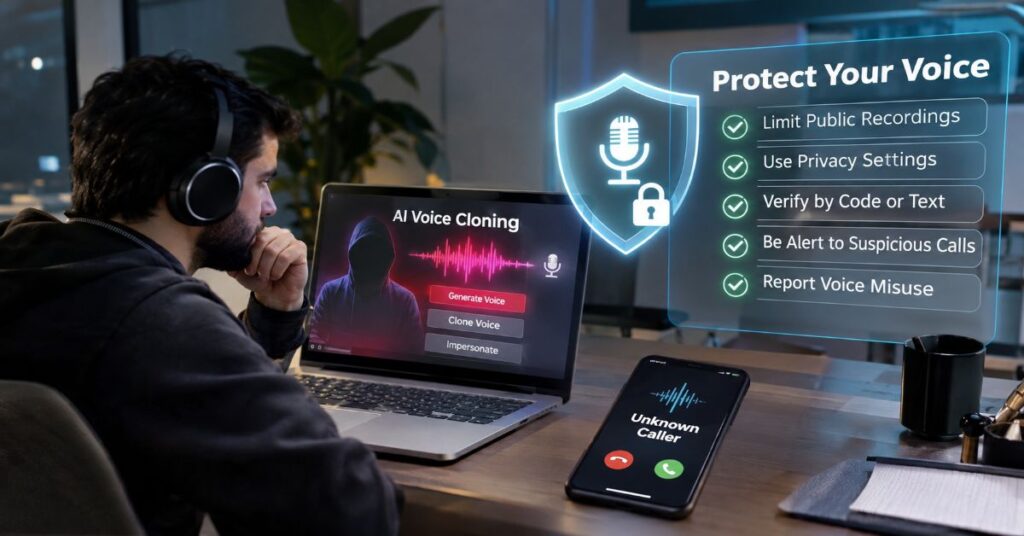
You can protect your voice from being cloned by AI without consent only by reducing the audio and identity data available to attackers, strengthening how people verify you, and preparing a response plan; no current setting can make every public recording impossible to copy. The uncomfortable reality is that a voice can be recognisable enough to persuade a relative or colleague even when the person behind the call is not you.
Voice cloning is not simply a novelty in text-to-speech software. A synthetic voice can be used to impersonate a family member, authorise a payment, fabricate an endorsement, deliver a false statement or make a caller appear to be a trusted employee. The danger is not limited to whether a clone sounds perfect. It is whether the recipient has a reason to believe the voice and is pressured to act before checking.
The distinction between access and permission is central. A podcast, public speech, social-media reel or voicemail greeting may be accessible to strangers, but accessibility does not establish consent to create a synthetic voice, decide what it says, distribute it or use it commercially. Consent should be specific to the purpose, context, duration and audience. A performer who agrees to narration for one campaign has not necessarily agreed to a permanent model that can generate unlimited future dialogue.
This guide approaches the issue as a security lifecycle rather than a list of suspicious-call tips. It explains what makes a recording useful to a cloning system, how to reduce unnecessary exposure without abandoning online communication, which technical controls are worth understanding, how to verify identity when a familiar voice calls, and what to do if a clone appears. It also separates documented legal duties from proposals and jurisdiction-specific protections. The aim is not to promise perfect prevention; it is to make unauthorised cloning harder to exploit and easier to challenge.
1. Understand What You Are Actually Protecting
A voice is more than a sound file. It carries patterns that listeners associate with a person: accent, pitch range, rhythm, pronunciation, breath, habitual pauses, emotional expression and the way words are joined together. Voice-cloning systems attempt to model some of those characteristics so that new speech can be generated in a recognisable style. Depending on the system, the result may be a short imitation, a text-to-speech voice, a voice conversion effect or a real-time transformation of another speaker.
That distinction matters because the risk changes with the capability. A short generated clip can be enough to make a false voicemail. A system capable of producing open-ended speech can be used in a longer conversation. A real-time voice changer can let a fraudster speak spontaneously while sounding more like the person being impersonated. These are not identical technical problems, and a detector designed for one may not reliably identify another.
The voice model itself is also not necessarily the original recording. Microsoft describes a voice model as a set of parameters that mimics unique vocal characteristics and says the model is not an audio recording that can simply be reversed into the original training audio. That does not make a model harmless: it may still generate new speech in a person’s recognisable voice. Protecting original files, derived voice models and the uses made of generated output therefore requires different controls.
A practical protection plan should therefore ask four questions: Who can hear my recordings? Who can download or reuse them? Who can create or operate a voice model? And how will recipients know that a request genuinely came from me? The last question is often the most important because a technically convincing voice does not prove identity, intent or authorisation.
2. Reduce the Audio Footprint Without Disappearing Online
The simplest way to reduce cloning exposure is to limit unnecessary public access to clean, long and repeated samples of your voice. That does not mean deleting every video, avoiding podcasts or refusing to speak online. It means making deliberate choices about what must be public, what can be restricted and what should never be uploaded to an unknown service.
Audit the places where your voice is already available
Search your own name, creator handle, business name and common usernames. Review public videos, livestream archives, podcast feeds, webinar recordings, conference talks, online course samples, public voicemail greetings and audio attached to old social posts. Look at the accounts as a stranger would: can someone play the audio without following you, joining a group or receiving approval? Check older accounts as well as the platforms you use every day. A forgotten public profile can remain searchable long after you stop posting.
For each recording, decide whether public access is necessary. Change the audience setting where possible, remove obsolete posts that no longer serve a purpose, disable public downloads if a platform offers that option, and avoid placing long unedited voice samples in profile introductions. For business pages, consider whether every promotional video needs a full-length spoken narration or whether a shorter clip, captions or a licensed voice actor is more appropriate.
Treat voice notes and voicemail as exposed data
A voicemail greeting may be available to anyone who calls your number. A voice note can be forwarded outside its original conversation. A meeting recording may be retained by a platform or shared with participants. Review whether your greeting needs to contain your full name, workplace or schedule. A neutral greeting can still be professional without providing an unnecessary sample. For sensitive conversations, use services and settings approved for the purpose, and do not assume that an end-to-end encrypted message cannot be copied by a recipient.
Privacy controls reduce exposure; they do not create a technical barrier against every copy. Someone who can listen may record the audio with another device. A private account can be compromised, a friend can forward a clip, or a recording can be captured at an event. The realistic goal is to reduce easy collection, limit the amount of clean material exposed and make misuse more difficult to operationalise.
This is also a data-minimisation issue. The same logic used before sharing sensitive information with an AI tool applies to voice recordings: submit only what the task requires, to a service whose handling rules you understand, and with permission from the people represented in the file. Our guide to AI privacy and data-sharing risks explains why “not used for training” and “not stored” are different privacy promises. A vendor’s privacy policy should be checked for retention, deletion, access, subprocessors and model-training terms before you upload voice material.
3. Make Consent Specific, Documented and Revocable Where Possible
Consent is not a single checkbox that should be treated as permission for every future use. A person may agree to provide a voice sample for accessibility, dubbing, an audiobook or a company’s customer-service assistant while rejecting political advertising, adult content, financial promotions or open-ended synthetic dialogue. A meaningful permission process should identify the purpose, intended audience, distribution channels, duration, compensation, editing rights, permitted topics and conditions for ending future use.
Microsoft’s published custom neural voice requirements provide a useful example of a stronger process. The company says customers must obtain explicit written permission from voice talent to create a custom neural voice. Its documentation also describes a recorded acknowledgement statement and speaker-verification checks that compare the consent recording with training audio. This is a service-specific safeguard, not a universal law or guarantee that every voice-cloning provider uses the same controls.
ElevenLabs’ documentation says a Professional Voice Clone can only be created by the person whose voice it is, and that verification is required. It also describes sharing a verified clone privately when the speaker wishes to share it. These restrictions are meaningful product rules, but they should not be mistaken for a general prohibition across the wider voice-cloning market. Users should check the exact product, feature and current terms before uploading anyone’s voice.
For voice actors, employees, presenters and creators, written agreements should distinguish the recording licence from the synthetic-model licence. A permission to record a performance is not automatically a permission to train a reusable model. A permission to create a model is not automatically a permission to generate any sentence. If the agreement is for a fixed campaign, define the end date and what happens to the model and source files afterwards. Include a process for approving sensitive scripts and identifying outputs that fall outside the agreed scope.
Consent records should be securely stored and linked to the relevant recording and model version. A useful record identifies the speaker, the authorised organisation, the permitted purpose, the relevant media, the date and version of the agreement, the allowed distribution and any restrictions. Avoid collecting more identity information than necessary, and restrict access to the records because consent documents can themselves contain personal data.
4. Know the Difference Between Anti-Cloning, Watermarking and Detection
Technology marketed as voice protection can refer to several very different functions. Confusing them creates a false sense of security. Some methods attempt to make source audio less useful to a cloning model; others mark a recording so that its origin or synthetic status can be checked; still others analyse suspicious audio after it has been generated. A tool that detects a fake does not necessarily prevent a clone, and a watermark does not necessarily stop a model from learning a voice.
| Control | Primary purpose | Useful for | Main limitation |
| Audio cloaking / adversarial perturbation | Alter source audio to interfere with speaker-feature extraction or cloning | Creators preparing selected recordings for public release | May reduce audio quality or fail against different models, processing or removal attempts |
| Watermarking / provenance | Attach a detectable signal or signed record to media | Proving origin, tracing distribution or identifying marked generated audio | Does not necessarily prevent copying or mark every derivative |
| Synthetic-speech detection | Estimate whether audio is generated or manipulated | Investigating a suspicious clip or call | Can produce false positives and false negatives; performance changes with codecs and new models |
| Speaker verification | Compare a voice with an enrolled identity | A controlled authentication workflow | A convincing clone may resemble the enrolled speaker; voice match alone is not proof of liveness |
| Access and rights controls | Limit who can obtain samples, models and generation permissions | Professional and enterprise voice workflows | Cannot control every copy once a recording has escaped authorised systems |
The Federal Trade Commission’s Voice Cloning Challenge recognised several approaches, including synthetic-speech detection, real-time analysis that assigns a liveness score, inaudible audio distortions intended to interfere with cloning, and authentication watermarks. The FTC’s description is important because it shows that the research community is exploring multiple layers rather than one universal anti-cloning switch. It does not mean each approach is now available as a dependable consumer product.
Research projects such as AntiFake have explored adversarial audio perturbations, while audio watermarking projects such as Meta’s AudioSeal focus on identifying generated speech. These are distinct research and engineering directions. Before using a tool, ask whether it modifies original audio, whether the protection survives compression and re-encoding, which voice-cloning systems were evaluated, whether it works for your language and accent, and whether the provider publishes independent testing. Do not upload confidential or third-party audio to an experimental service without permission.
For a closer look at the limits of automated analysis, see our deepfake detection checks. The key takeaway is that a detector score is supporting evidence, not a final verdict. A robust plan combines provenance, source records, human review and independent identity checks.
5. Secure the Accounts and Systems That Hold Your Voice
Voice protection is also account security. A private audio archive, creator account, cloud drive, podcast host or employee collaboration platform can become a source of high-quality recordings if an attacker gains access. Protect the account that stores the audio, not only the device used to record it.
Use strong authentication and reduce account recovery risk
Use a unique password for each important account and a password manager to avoid reuse. Enable multi-factor authentication, preferably with a passkey or security key where supported. Review active sessions and connected applications. Remove old collaborators, third-party integrations and devices that no longer need access. Protect the email account used for password resets because control of that inbox can allow an attacker to take over other services.
For creators and organisations, separate public publishing accounts from private production storage. Give contractors access only to the project folders they need. Avoid sharing a permanent cloud-drive link to an entire archive when a single file will do. Set expiry dates on links, restrict downloads where practical, and review access logs if a platform provides them. Keep a secure copy of original recordings with timestamps and project metadata so that later disputes can be investigated.
Treat voice models as controlled assets
If you operate a voice model, do not leave generation access open to every employee or contractor. Use role-based access, named accounts, approval for sensitive scripts, generation logs and a clear process for disabling a model. Keep the source recordings, consent record, model identifier and output history linked. A company should be able to answer who generated a clip, under which permission, for what project and whether the output was distributed.
If a provider offers deletion, clarify what deletion means. Does it remove the uploaded sample, the trained model, cached copies, backups, generated outputs and data held by subprocessors? Does it stop future generation, or also remove previously published audio? These are separate questions. Keep the provider’s written response and do not assume that removing a visible project from a dashboard proves every copy has been erased.
6. Stop Treating a Familiar Voice as an Authentication Factor
The most useful behavioural defence is to verify the request rather than trying to judge whether the voice sounds real. A caller may sound exactly like a relative, manager or bank employee and still be an impostor. Conversely, a genuine person may sound unusual because of illness, poor reception, stress or background noise. Audio quality is not a reliable identity test.
The Federal Trade Commission advises people who receive an urgent call supposedly from a loved one to call that person using a number they already know. If they cannot be reached, contact another family member or friend. Police Scotland similarly recommends limiting public voice clips, using a family code word, calling back on a known number and reporting suspected voice-cloning scams.
Build a family verification routine before an emergency
Agree a private phrase or code word with close family members. Do not post it online, include it in a shared social-media profile or reuse a phrase that could be guessed from public information. Keep the group small and decide how to update it if a phone is lost or a family member’s account is compromised. A code word is a useful extra check, but a callback to a trusted number is stronger because a code word can be overheard, leaked or extracted through social engineering.
If a caller claims that a relative is injured, arrested, stranded or in danger, pause the conversation. Ask for a name and location, but do not treat correct personal details as proof; scammers may gather those details from social media or data breaches. End the call and contact the person directly using the number already saved in your contacts. If you cannot reach them, contact another trusted person who can physically verify the situation.
Businesses need a separate approval path
An executive voice should never be the only approval for a bank transfer, supplier-account change, payroll update or disclosure of credentials. Use dual authorisation, callback procedures using directory numbers, transaction limits and documented approval in a trusted business system. A caller who insists on secrecy, bypassing normal controls or staying on the line while a payment is made should trigger escalation.
Our reporting on how banks detect voice fraud explains why banks combine multiple signals rather than relying on a voice match alone. Organisations should review any workflow that treats a voice biometric as sufficient evidence for a high-risk action. A voice can be a convenience factor, but it should not be the sole key to money, identity or access.
7. Respond to a Suspected Clone Before It Spreads
If you discover a recording that appears to use your voice without permission, the first priority is to preserve evidence without amplifying the content. Do not repost the clip to prove that it is fake. Publicly repeating it can increase its reach, create additional copies and make it harder to establish which upload was original.
Preserve the evidence
Record the URL, account name, platform, date and time you found the content. Capture screenshots that show the account and surrounding context. Save the original file only when it is lawful and safe to do so, and preserve any messages, payment requests, threats or correspondence with the uploader. Keep a timeline of when you contacted the platform, the reference number, the response and any changes to the content. If a financial loss or threat is involved, contact the relevant bank or payment provider immediately.
Where possible, retain a known-authentic source recording and its metadata. Do not edit the original evidence file. Make a working copy for analysis and store the original in a restricted location. If the matter may become a legal dispute, ask a qualified digital-forensics professional how to preserve chain of custody. A detector report can be useful, but it should not replace the original file, source context or a professional assessment.
Report the content to the right organisation
Use the platform’s impersonation, privacy, copyright or synthetic-media reporting route as appropriate. Explain that the content uses your identifiable voice without permission, identify the specific post and account, and state what remedy you are requesting. If the clone is being used to solicit money, impersonate an employee or threaten someone, report the fraud to the relevant law-enforcement or cybercrime authority as well. If the content appears on multiple platforms, keep a separate record of each location.
Our guide on what to do after a deepfake covers a wider deepfake response sequence, including evidence capture and platform reporting. The same principle applies to voice-only abuse: preserve the source and context, report the specific distribution point and avoid forwarding the file unnecessarily.
If the clone has been used to contact family or colleagues, warn them through a separate trusted channel. Tell them what the fake is asking for, which number or account was used and how they should verify future contact. If money has been transferred, contact the bank or payment provider immediately and ask whether the transfer can be stopped or recalled. Change exposed credentials, revoke suspicious sessions and secure any account that may have been compromised.
8. Understand the Law Without Assuming One Global Rule
The legal position depends on where the speaker, user, platform and audience are located, what the voice is used for, whether it identifies a person, and whether the conduct involves fraud, privacy invasion, commercial exploitation, defamation or another recognised harm. There is no single worldwide rule that makes every unauthorised voice clone automatically unlawful in every context.
In the European Union, GDPR may apply where voice data is personal data and, in some circumstances, biometric data processed for uniquely identifying a person. The European Parliament’s 2025 briefing on AI scam calls explains that voice data can fall within the GDPR framework and that consent and transparency obligations may be relevant. The precise legal basis depends on the processing and the facts; it is not accurate to say that every audio recording is automatically special-category biometric data.
The EU AI Act’s Article 50 transparency rules apply from 2 August 2026. The European Commission says deepfakes, including generated or manipulated audio, must be disclosed as artificially generated or manipulated in the circumstances covered by the Act. These are transparency obligations, not a universal personal veto over every use of someone’s voice. They also do not mean that a label itself prevents impersonation or guarantees removal.
In the United States, the Federal Trade Commission can address deceptive or unfair practices and impersonation-related scams under applicable law, while state laws may provide additional protections involving publicity rights, privacy or biometric information. The NO FAKES Act has been proposed in Congress to address unauthorised digital replicas, but a bill should not be described as enacted federal law unless its legislative status is verified at the time of publication. Existing remedies may differ between states and between commercial and non-commercial uses.
In the United Kingdom, data-protection, fraud, privacy, intellectual-property and other laws may be relevant depending on the facts. National Trading Standards’ February 2026 warning documented criminals using cloned voices to simulate consent for direct debits. That case illustrates the practical gap between an audio recording that sounds like a customer and genuine authorisation from that customer.
For readers in Pakistan and other jurisdictions where a specific voice-cloning statute may not exist, do not assume that a legal vacuum means no remedy is available. Depending on the conduct, cybercrime, fraud, identity misuse, privacy, consumer-protection or intellectual-property rules may be relevant. The exact route should be checked with a local lawyer or the competent authority. This article is general information, not legal advice.
9. What the Evidence Says About the Scale of the Threat
Statistics about voice cloning need careful interpretation because many reports measure different things: AI-related fraud overall, synthetic speech in a particular industry, consumer exposure to scams, or the number of verified incidents. Those measures should not be presented as if they were all counts of unauthorised voice clones.
The FBI’s 2025 Internet Crime Complaint Center reporting, as summarised in its public communications, recorded 22,364 complaints containing AI-related information and adjusted losses of about US$893 million. This is a broad AI-related category. It includes more than voice cloning and should not be described as the amount lost specifically to cloned voices.
Pindrop’s 2025 Voice Intelligence and Security Report reported a 149% increase in synthetic voice fraud attacks at banks and a 475% increase at insurance companies during 2024. These are vendor-reported findings drawn from Pindrop’s own fraud intelligence and customer environment, not a universal estimate for every bank or insurer. The distinction matters when translating an industry-specific signal into a personal risk estimate.
National Trading Standards reported that its Operation Derdap blocked nearly 21 million scam calls and shut down 2,000 numbers over a six-month period. The February 2026 release also described a specific operation in which voice clones were used to simulate consent for direct debits. The 21 million figure concerns scam calls more broadly, not 21 million voice-cloning incidents.
Louise Baxter MBE, Head of the National Trading Standards Scams Team, described the issue as a combination of traditional scams and new techniques, warning that criminals were using AI to deceive people and trick legitimate systems into processing fraudulent payments. John Herriman, Chief Executive of the Chartered Trading Standards Institute, said voice cloning was making it harder for consumers and legitimate businesses to distinguish real interactions from fraudulent ones. Their statements are important because they connect the technical capability to operational fraud, rather than treating it only as a synthetic-media curiosity.
The European Parliament’s October 2025 briefing also summarised survey and enforcement evidence, including reports of people encountering voice-clone scams and uncertainty about their ability to recognise them. These figures are useful context, but survey wording, sample size and country coverage affect what can be concluded. A responsible article should state the source population and measurement rather than repeating a striking percentage without its definition.
10. Build a Protection Plan for Your Role
The best controls depend on how often your voice is published, how much authority listeners attach to it and what could happen if someone impersonates you. A private individual, a creator, a professional voice actor and a finance department do not need identical controls. They do, however, need a shared understanding that a voice is not a password.
| Who you are | Priority controls | Evidence to retain |
| Individual or family | Restrict unnecessary public audio; set a private verification phrase; use known-number callbacks; agree a no-urgent-transfer rule. | Original recordings, account links, scam messages and incident timeline. |
| Creator, journalist or public speaker | Audit public archives; separate personal and professional accounts; review licences; watermark or register originals where useful; monitor impersonation. | Source masters, publication dates, licences, consent records and copies of impersonation reports. |
| Voice actor or employee talent | Use specific written permission; define permitted scripts, duration, audience and compensation; approve sensitive outputs; restrict model access. | Signed agreements, consent recordings, model IDs, generation logs and deletion confirmations. |
| Business or finance team | Dual approval for payments; trusted directory callbacks; access controls; logging; incident response; no voice-only authorisation. | Call records, approval logs, transaction details, vendor documentation and preserved audio. |
Review the plan after a major change: a new public platform, a new voice-model provider, a viral recording, a data breach, a change in employment or a new law. A policy written once and never tested is unlikely to work when an urgent call arrives. Assign an owner, define response times and make sure staff know how to report suspicious use without forwarding the audio to everyone.
11. The Limits: What You Cannot Reliably Prevent
No individual can remove every copy of their voice from the internet, guarantee that a public recording will never be captured or force every third-party system to honour their preferences. A privacy setting can be changed; an account can be compromised; a recording can be downloaded by someone who was legitimately allowed to hear it. Even protective audio processing can be defeated by new models, conversion pipelines or a different source recording.
Hany Farid, a digital-forensics researcher and professor, has warned that people may not expect a convincing video call from someone who appears to be a parent or loved one to be fraudulent. In a 2026 Berkeley conversation, he described the experience as a new level of phishing and explained that he and his wife use code words for unusual situations. The practical lesson is not that code words solve the whole problem; it is that identity verification must be designed before the stressful moment. In a 2026 Berkeley interview, Farid said: “I think people are not expecting you’re going to get a FaceTime call from what looks like your parents and it’s going to be a scam.”
These limits should not lead to fatalism. Layered controls reduce opportunity and increase the chance that abuse can be detected, challenged and contained. The most resilient defence is a combination of fewer unnecessary recordings, well-protected accounts, specific consent, controlled model access, trusted identity checks and a prepared incident response. No single layer is perfect; together they make the attack less likely to succeed.
The wider context of privacy controls and inference is covered in our 2026 AI privacy analysis.
For the broader voice-detection question, see whether phone systems can detect cloned voices.
Our Editorial Verification Process
This explainer was researched by cross-checking official platform documentation, government and regulatory guidance, a European Parliament research briefing, published industry reporting and the Perplexity AI Magazine pages linked in the body. We reviewed the official Microsoft Foundry documentation on voice-talent permission and speaker verification; ElevenLabs’ Professional Voice Clone documentation; the FTC’s material on voice-cloning harms and detection approaches; Police Scotland’s prevention and reporting advice; the European Commission’s Article 50 transparency guidance; National Trading Standards’ February 2026 release; and Pindrop’s 2025 Voice Intelligence and Security Report.
The SERP review covered ten ranking or near-ranking guides and identified recurring advice about limiting public audio, code words and callback verification. The article’s structure was developed independently around the voice-data lifecycle, consent governance, technical control differences, account security, incident response and jurisdictional limits. Internal links were selected from verified indexed pages on Perplexity AI Magazine because the three sitemap endpoints did not return parseable XML through the available browsing layer.
No proprietary voice-cloning service was tested, no audio samples were uploaded to a commercial detector, no independent benchmark was conducted and no legal opinion was obtained. Product rules and pricing can change; this article does not make a commercial pricing comparison because the core question is protection, not purchase selection. The named quotations and statistics are attributed to their published sources, and vendor-reported figures are labelled as such. The article was researched and drafted with AI assistance; it should receive final human editorial and legal review before publication, particularly for jurisdiction-specific claims.
Conclusion
Protecting your voice from unauthorised AI cloning is not a matter of finding one app, watermark or privacy setting. It is a matter of controlling the points at which a recording becomes available, a voice model is created, a synthetic output is generated and another person decides whether to trust it. The strongest personal defence starts before an incident: reduce unnecessary public audio, secure the accounts that hold recordings, retain original files and agree how important requests will be verified.
For professional voice users, the standard should be higher. Consent should identify the purpose and boundaries of model creation, not simply authorise a recording. Providers should explain their verification and retention processes. Employers should restrict model access and prevent voice-only approval for sensitive actions. Platforms and regulators have a role, but their protections vary by country and by type of misuse.
The remaining uncertainty is substantial. Detection tools are evolving, legal protections are uneven and the technical gap between a convincing clone and an authentic speaker may continue to narrow. Yet the most damaging scams still rely on familiar human weaknesses: urgency, fear, secrecy and trust. An independent callback, a second approval and a carefully documented consent process are not glamorous technologies, but they remain among the most dependable controls available.
Frequently Asked Questions
Q: How can I protect my voice from being cloned by AI without consent?
A: Limit unnecessary public audio, review privacy settings, secure accounts that store recordings, keep original files and establish an independent way for family or colleagues to verify important requests. No current method guarantees that every public recording cannot be copied.
Q: Can someone clone my voice from a short video?
A: A short, clear sample may be enough for some voice-cloning systems to imitate recognisable vocal characteristics. The amount and quality of audio required vary by model, so there is no universal minimum duration.
Q: Does making my social-media account private stop voice cloning?
A: It reduces access for strangers but does not guarantee prevention. Followers can record or forward audio, accounts can be compromised and copies may already exist elsewhere.
Q: Do audio watermarks prevent someone from cloning my voice?
A: Not necessarily. Watermarks can help identify origin or synthetic content, while anti-cloning perturbations attempt to make source audio less useful to a model. They solve different problems and neither is foolproof.
Q: Can AI voice-clone detectors prove that a recording is fake?
A: No detector should be treated as conclusive on its own. Results can vary with language, noise, compression and the model used. Preserve the file and verify the claim through independent evidence.
Q: What should I do if someone uses my voice in a scam?
A: Preserve the post URL, account details, timestamps and messages; report the content to the platform and relevant authorities; warn affected contacts through another channel; and contact your bank immediately if money was sent.
Q: Is it illegal to clone someone’s voice without permission?
A: It depends on jurisdiction and use. Privacy, biometric-data, publicity, fraud, consumer-protection and intellectual-property rules may apply, but there is no single global rule covering every situation. Obtain local legal advice for a specific case.
Q: Can a company use an employee’s voice after they leave?
A: That depends on the consent, employment and licensing agreements, applicable law and the intended use. A recording licence should not automatically be treated as unlimited permission to create or continue using a synthetic voice model.
References
- European Commission. (2026, July 31). Commission starts enforcing AI Act rules and new transparency requirements on 2 August. https://digital-strategy.ec.europa.eu/en/news/commission-starts-enforcing-ai-act-rules-and-new-transparency-requirements-2-august
- European Parliament Research Service. (2025, October). Scam calls in times of generative AI. https://www.europarl.europa.eu/RegData/etudes/ATAG/2025/777940/EPRS_ATA%282025%29777940_EN.pdf
- Federal Trade Commission. (2024, April 8). Fighting back against harmful voice cloning. https://consumer.ftc.gov/consumer-alerts/2024/04/fighting-back-against-harmful-voice-cloning
- Microsoft. (2026). Disclosure for voice and avatar talent. Microsoft Learn. https://learn.microsoft.com/en-us/azure/ai-foundry/responsible-ai/speech-service/text-to-speech/disclosure-voice-talent
- National Trading Standards. (2026, February 5). Phone scams take sinister twist as victims’ voices cloned. https://www.nationaltradingstandards.uk/news/phone-scams-take-sinister-twist-as-victims-voices-cloned/
- Pindrop. (2025). 2025 Voice Intelligence and Security Report. https://www.pindrop.com/wp-content/uploads/2025/07/Voice-Intelligence-and-Security-Report-Report-June-2025.pdf
- Police Scotland. (n.d.). Voice cloning scams. https://www.scotland.police.uk/advice/scams-and-frauds/voice-cloning-scams/
- ElevenLabs. (n.d.). Voice cloning overview. https://elevenlabs.io/docs/eleven-creative/voices/voice-cloning
- Federal Trade Commission. (2024, April). Approaches to address AI-enabled voice cloning. https://www.ftc.gov/policy/advocacy-research/tech-ftc/2024/04/approaches-address-ai-enabled-voice-cloning
- Berkeley News. (2026, April 6). Berkeley Talks: The erosion of shared reality in the age of deepfakes. https://news.berkeley.edu/2026/04/06/berkeley-talks-hany-farid-on-deepfakes/
Published
Spotted an error? Read our corrections policy or email editorial@perplexityaimagazine.com.