
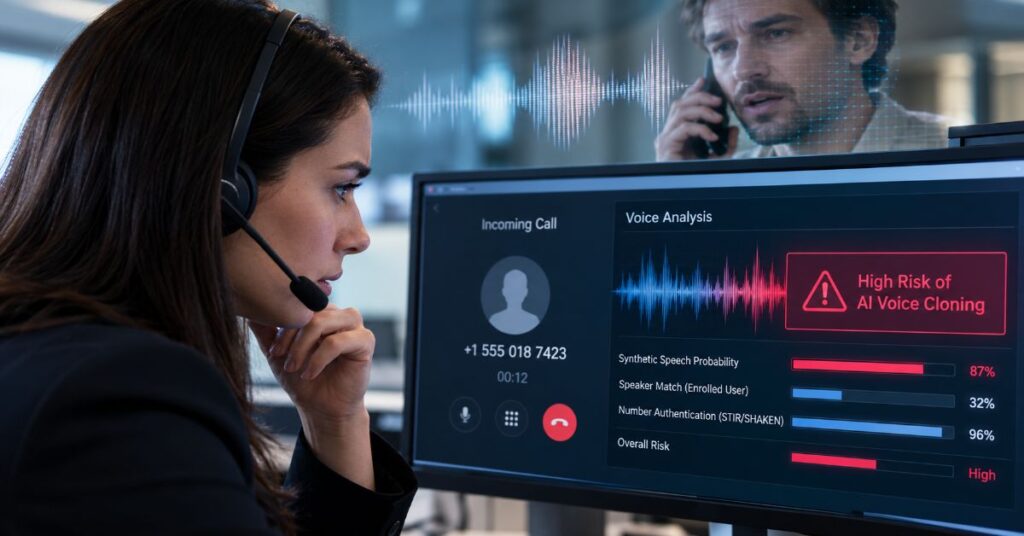
Yes, AI voice cloning can be detected by phone call systems that run specialist audio analysis, but most ordinary phone calls do not come with automatic, reliable clone detection. That distinction matters because a caller who sounds exactly like a customer, executive or family member may still be using synthesized speech—and an authentic-sounding voice is not an authentication credential.
Enterprise contact centres can insert anti-spoofing models into incoming call flows, score speech for signs of synthesis and refer higher-risk calls for additional checks. Some providers also combine acoustic analysis with enrolment signals, call metadata and fraud intelligence. The public telephone network, by contrast, primarily transports voice; it does not inherently certify that the speaker is human, that a familiar voice belongs to its apparent owner or that the request is legitimate.
The limits are measurable. A peer-reviewed 2026 study tested 95 listeners using cloned and genuine speech passed through simulated GSM, VoLTE and VoIP conditions. Their overall classification accuracy was 54.8%, underscoring why relying on an employee’s ear is unsafe. That figure concerns people, not anti-spoofing software, and cannot be borrowed as a detector benchmark.
This guide separates four easily confused problems—synthetic-speech detection, speaker matching, telephone-number attestation and transaction authorization—then explains what a real business can test before trusting a vendor’s dashboard. It also addresses what individuals should do when a caller sounds convincingly familiar.
What a Phone Call System Actually Knows
The Network Carries Audio; Detection Requires Another Layer
A mobile network, PSTN trunk or VoIP session establishes communication and carries audio frames. Ordinary call routing features such as ringing, voicemail, caller ID and call recording do not by themselves decide whether the speech originated from a person or a model. To make that determination, an organisation must deploy compatible detection infrastructure at a place where the audio is available for authorised analysis. On consumer handsets, built-in spam-label or number-screening features should not be confused with an audio deepfake verdict unless the provider explicitly documents that function.
Four Distinct Security Questions
| Question | Relevant control | What it cannot establish alone |
| Is this speech synthesized or transformed? | Audio anti-spoofing / liveness classifier | The caller’s identity or intentions |
| Does this voice resemble an enrolled user? | Speaker verification / voice biometrics | That the audio was not cloned |
| Is this number associated with an authenticated origination? | STIR/SHAKEN and carrier signals | That the person talking is who they claim |
| Should the bank transfer or password reset proceed? | Workflow authorization and out-of-band checks | The voice’s physical origin |
A good operational design keeps those four verdicts separate in both the interface and the audit trail. A green signal in one layer must never silently overwrite a red or unknown signal in another. In particular, a signed calling number does not vouch for the contents of a telephone conversation.
Can AI Voice Cloning Be Detected by Phone Call Systems in Real Time?
The Detection Pipeline
An incoming audio stream is segmented into windows, transformed into acoustic representations and evaluated by a model trained to distinguish genuine speech from synthetic or manipulated samples. Engineers may combine temporal features, spectral information, learned embeddings and contextual signals. A deployment can score windows repeatedly rather than waiting for the whole call, but its first useful verdict depends on adequate speech duration, quality, latency budgets and the model threshold. Silence, music, a greeting lasting half a second and a heavily compressed connection are not equivalent inputs.
Pindrop describes its Pulse product as capable of producing a deepfake risk evaluation in two seconds. That is a product claim about a specific configuration, not proof that every carrier or call-centre platform has the same capability. Organisations should request measurement of time to the first stable verdict under their own telephony codecs, languages and call patterns, rather than accepting a brochure latency figure.
What the Verdict Should Do
A detector is more useful as a risk signal than as a binary gate. A high-risk result may lead to step-up authentication, transfer to a trained fraud queue or a pause on sensitive actions; a low-risk result should not waive identity checks. Score changes during a call also matter. Fraud can begin with an ordinary speaker and switch to a generated voice, or a legitimate user may turn on a speech-assistance tool partway through a conversation.
The underlying design choice is therefore not simply “detect or miss”. It is when to collect sufficient evidence, when to surface uncertainty and how much harm an unnecessary block would cause for a genuine caller.
Why Voice Clones Are Difficult to Identify Over the Phone
Phone Audio Can Hide or Distort Evidence
Phone calls are not laboratory recordings. Encoders remove information, microphones introduce room acoustics, networks add packet loss and some calls pass through multiple transcoding stages. A feature that appears to distinguish clean synthetic audio may not survive a narrowband call; conversely, certain artefacts may become more pronounced under a particular codec. The direction is not guaranteed and depends on the detector, generator and channel.
Warzych, Łuczyński and Klink reported human detection accuracy of 63.7% under GSM conditions and 44.0% under VoLTE in their 2026 experiment. These counterintuitive results caution against simple claims that higher sound quality always makes deception easier or harder. They also cannot be generalised to every population, language, or commercial anti-spoofing product.
Unseen Generators and Audio Transformations
Training a classifier on a catalogue of known voice generators can produce strong results on familiar samples while missing novel models or altered outputs. In a 2025 forensic investigation, Univaso and San Segundo found that MFCC-based methods did not generalise adequately across different cloning algorithms; a commercial detector they assessed was also vulnerable to environmental noise and signal clipping. Those findings support testing with genuine field-like material, not assuming that an overall accuracy percentage covers the attacks a particular organisation will receive.
Short clips create a further problem: the detection engine needs enough speech to model characteristics reliably, while the attacker may need only a few seconds to issue a command. At a finance help desk, the secure operational response is to prevent one phone utterance from authorising money movement regardless of the predicted audio label.
Evidence in 2025–2026: What the Numbers Really Say
Published evidence spans vendor claims, independent listening studies and technical benchmarks. Their denominators, task definitions and input conditions differ. Mixing them produces a misleading headline: the chance that a human guesses correctly is not the same as the chance that an enterprise detector flags an attempted account takeover.
| Evidence | Reported observation | Important limit |
| Warzych et al., 2026 | 95 listeners; 54.8% overall human classification accuracy | Simulated channels and human judgement, not a live detector trial |
| Pindrop, 2025 industry report | 130 million calls analysed; synthetic voice share 0.33% in Q4 2024 | Vendor observation across its monitored sample |
| Pindrop Pulse product page | Two-second detection claim; up to 99.4% accuracy with additional Pindrop products | Vendor-stated conditions; not a general guarantee |
| Univaso & San Segundo, 2025 | Noise and clipping exposed weaknesses in tested forensic approaches | Specific methods, datasets and scenarios |
| ASVspoof 5 research | Some attacks remain hard for benchmark systems | Challenge metrics cannot be directly mapped to live fraud loss |
The commercially consequential metric is often false acceptance at a specified false-rejection level, broken down by call type and attack. A 99% average accuracy claim means little if the missed 1% is concentrated in high-value recovery calls, or if thousands of customers are incorrectly blocked. Fraud operations also need base-rate awareness: even a relatively capable detector can generate many false alerts when actual malicious voice cloning is uncommon.
Reading an Accuracy Claim Correctly
Ask whether the quoted result measures spoof detection alone, a larger multifactor bundle, a curated offline set or production conditions. Check whether it includes new synthesis engines, real mobile calls, noisy environments and multilingual customers. Ask for confidence intervals, class prevalence and threshold selection. Numbers collected under a 50:50 genuine-versus-fake test set are particularly misleading when presented as a promise about a customer base where malicious clones may be rare.
Detection, Authentication and Call Spoofing Are Not Synonyms
A Recognisable Voice Can Still Be a Fake
Speaker verification tries to determine whether a voice matches an enrolled person. A high similarity score does not prove physical presence when cloned or replayed speech has been engineered to resemble the reference voice. Conversely, anti-spoofing may flag synthetic content without knowing whose voice it mimics. This is why voice biometrics and liveness checks should be designed and measured as separate controls.
A Trusted Telephone Number Can Carry Untrusted Audio
STIR/SHAKEN is designed to improve trust in caller-number information in supported telephone networks. It cannot determine whether the speaker is a human, a voice clone, a bot or a fraudster with access to a legitimate calling route. Similarly, a plausible local area code, a saved contact name or an organisation’s switchboard display does not turn a request for payment into an authenticated instruction.
A useful enterprise policy defines the claims the system may make: “number attested,” “voice matched,” “possible synthetic audio,” and “customer independently verified”. Conflating those labels encourages frontline staff to treat technology as certainty where it offers only supporting evidence.
A Practical Call-Centre Architecture That Can Reduce Risk
Choose Intervention Points Before Choosing Models
Map which decisions can cause irreversible harm: account takeover, payment redirection, credential reset, patient-record access and benefit changes. Place detection early enough to inform those interactions, while preserving an accessible path for genuine callers. Streaming analysis in the interactive voice response stage may catch suspicious audio before an agent completes a risky transaction. Post-call forensic scanning can uncover trends, but it cannot undo an unauthorised transfer approved during the call.
Keep Humans Responsible for Consequential Actions
A high-risk score should open a controlled workflow: log the reason, explain the need for further verification neutrally, avoid disclosing sensitive account facts and use a separate, trusted channel to confirm the request. Agents should not tell a caller precisely which acoustic patterns triggered the alert; such feedback can help attackers refine samples. Nor should agents accuse people who use assistive speech technologies of fraud. The policy should treat the audio score as one input, not a moral judgement about the caller.
| Stage | Useful safeguard | Evidence to log |
| Call ingress | Risk scoring and number/network signals | Call ID, time, routing path, model version |
| Identity step | Independent knowledge or possession factor | Factor type, outcome, policy version |
| High-value action | Callback through trusted records or secure app approval | Approver, destination, amount, confirmation |
| Incident response | Fraud review with controlled access to audio | Score timeline, reviewer decision, retention basis |
Operational resilience matters as much as model sophistication. An unavailable detection API must not silently turn into permission to skip controls on a payment flow. Define safe fallbacks, uptime requirements, review queues and accessibility accommodations before launch.
How to Test a Voice-Cloning Detector Before Buying
Build a Representative, Authorised Evaluation Set
Create a consented evaluation set covering genuine staff and customers, multiple languages and accents, mobile and VoIP channels, quiet and noisy environments, short and long utterances, and permitted synthetic samples from several generators. Include replay, text-to-speech, voice conversion and benign assistive speech where relevant. Keep training, threshold tuning and final evaluation speakers and generation systems separate where feasible; testing on the same voices used in tuning can overstate generalisation.
Measure Operational Harm, Not Just a Score
Evaluate equal error rate or area under a receiver operating characteristic curve if useful for research, but prioritise operating-point false-positive and false-negative rates, detection latency, missing audio, manual-review load and failures per thousand real calls. For a bank, a false negative on an account-recovery attack may be costlier than a false positive that creates extra verification. For an emergency service, the risk balance differs. No single threshold should be copied mechanically across sectors.
- Request a confusion matrix by codec, language, generator family and call duration.
- Test the model with genuinely unseen voices and cloning systems.
- Record the first stable result time and how frequently the verdict changes mid-call.
- Model analyst staffing and abandoned-call effects at observed call volumes.
- Validate incident workflows and appeal paths for incorrectly flagged customers.
- Repeat testing after model, codec, telephony-provider or voice-generator changes.
Do not describe this article as hands-on testing of a specific detection service: no model was deployed or experimentally benchmarked for this article. The checklist translates the published research into a proposed procurement and quality-assurance protocol.
Which Products and Integrations Matter?
Commercial solutions include specialist contact-centre detection and telephony/communications architectures that support third-party audio analysis. Pindrop publicly documents Pulse for contact centres and links it to other Pindrop products. Telnyx has published an engineering explainer describing real-time and post-call detection design patterns; the article is useful architectural context, not independent proof that a particular buyer’s deployment will meet the quoted performance.
Capabilities, access, data handling, commercial licensing and integration effort depend on the supplier and contract. No universally comparable public price-per-minute schedule, minimum seat count or complete hidden-cap matrix was verified for the products discussed here, so supplying a fabricated “2026 pricing matrix” would be misleading. A quote should specify minutes or concurrency, setup, storage, retention, regions, supported audio paths, professional services and support-level commitments.
| Evaluation field | Questions for the vendor |
| Deployment path | SIP trunk, media stream, on-premises, cloud, IVR or post-call? |
| Decision output | Continuous risk score, categories, timestamps, confidence and audit exports? |
| Performance evidence | Independent prospective results by codec and unseen generators? |
| Privacy | Where is audio processed and retained; is training opt-in? |
| Commercials | Usage units, minimum commitment, overages, support and cancellation? |
| Fallbacks | What happens when the stream drops or the scoring service fails? |
A Vendor Benchmark Is Not a Fraud-Loss Forecast
A product that recognises synthetic speech may still fail to prevent a loss when its score arrives too late, the agent ignores the alert or the transaction can be authorised without independent approval. Conversely, a firm may prevent most clone-enabled account takeovers through strong payment controls even if it does not classify every malicious utterance correctly. Measure prevented risky actions and customer friction alongside acoustic accuracy.
What an Individual Should Do During a Suspicious Call
Verify Through a Channel the Caller Does Not Control
If someone claiming to be a relative, colleague, bank representative or executive urgently requests money, credentials or a security-code disclosure, do not use the voice itself as proof. End the call if necessary and contact the person using a previously saved number, an organisation’s independently located official number or an established secure messaging channel. A callback to the number displayed during the suspicious call is not sufficient.
An agreed family verification phrase can help in some circumstances, but it should not become a widely shared, static secret. More importantly, do not allow the caller to define the verification procedure. Urgency, secrecy and a sudden refusal to use normal approval channels are stronger reasons to slow a transaction than any one supposed “robotic” audio artefact is proof of a clone.
Do Not Expect a Universal Built-In Phone Alert
Some devices and services offer spam warnings, caller screening or other protections. These features vary by manufacturer, region and service and are not interchangeable with verified deepfake-audio detection. A consumer should not assume that the absence of an “AI voice” warning means the caller is genuine. If money or accounts are at risk, use external verification regardless of perceived voice quality.
Regulation and Privacy: Detection Is Not Unlimited Surveillance
In February 2024 the US Federal Communications Commission clarified that AI-generated voices fall within the Telephone Consumer Protection Act’s rules for artificial or prerecorded voice calls. That does not mean every AI-assisted conversation is illegal, nor does it grant a general licence to record or analyse callers without regard to applicable consent and privacy laws. The legal treatment depends on how the call is made, its purpose and jurisdiction.
Organisations should document a lawful basis for audio processing, restrict recordings and score access, publish understandable notices where required, and apply proportionate retention periods. Deepfake detection can affect vulnerable customers, including those with speech impairments, accents or voice-assistance technologies. Accessibility reviews, human challenge paths and discrimination testing belong inside procurement—not as afterthoughts.
Regulation also does not establish whether a particular vendor’s detector is accurate. A legal rule governing synthetic calls and a technical system identifying them are different interventions. Procurement teams should ask legal advisers to validate recording-consent, cross-border-processing and automated-decision rules in the jurisdictions actually served.
Three Overlooked Failure Modes
1. The Call Is Human, but the Request Is Fraudulent
A real voice can carry a stolen script, a coerced request or an impersonation performed by an ordinary person. A detector that correctly labels speech as human cannot certify a payment instruction. Risk-based transaction controls therefore remain essential even when audio detection is excellent.
2. The Voice Is Synthetic, but the Call Is Legitimate
Accessibility applications, consented assistants and customer-service automation may generate speech without deceptive intent. A blanket rule blocking every artificial voice can exclude legitimate users. Classify the activity and verify the authority behind the request rather than equating synthetic speech with criminal conduct.
3. A Correct Alert Arrives After the Damage
A 95%-accurate alarm that triggers after account changes are committed does not protect the transaction. Instrument call stages and ensure that high-risk actions require their own authorization checkpoint. This is a workflow-engineering problem as much as a machine-learning problem.
Our Editorial Verification Process
This article compares primary and peer-reviewed evidence available through 26 October 2026. The research included the Pindrop Pulse product documentation and 2025 Voice Intelligence and Security Report; the 2026 Warzych, Łuczyński and Klink study of GSM, VoLTE and VoIP listening conditions; research by Univaso and San Segundo on forensic voice-clone detection; ASVspoof 5 literature; and the FCC’s official 2024 ruling announcement. Vendor figures are explicitly identified as vendor-reported. Human listening results are not presented as commercial-detector accuracy.
No telephone detection service was installed, no original calls were captured, and no independent field trial was carried out for this article. Product capabilities and pricing can change; buyers must confirm live commercial terms. The publisher’s sitemap and alternative sitemap URLs could not be retrieved during preparation, and no valid internal article URLs were established. The six suggested insertion locations appear in the editor’s note after the references; they are not fabricated hyperlinks.
AI assistance disclosure: This article was researched and drafted with AI assistance. Editorial verification and final sign-off by the named publication author should be completed before publication; no unperformed human review or firsthand testing is claimed here.
Conclusion
Phone call systems can detect some AI-generated and cloned voices when they have specialist analytics in the call path. The reliable conclusion is narrower than a marketing promise: detection results are probabilistic, depend on the model and audio conditions, and answer a different question from caller authentication. Human ears are not a dependable substitute. Nor do a familiar telephone number or a voice that matches an enrolment recording establish authority to change an account or transfer money.
The strongest defence is layered and procedural. Audio anti-spoofing can flag risk early; caller-number assurance, speaker verification and independent authentication can contribute other evidence; and a well-designed transaction workflow can stop irreversible actions until authority has been confirmed. Every layer can fail, but the organisation should not allow one layer’s failure to silently bypass the others.
Evidence is still evolving, particularly for newly released cloning models, transformed voices and calls across different codecs and languages. Buyers should evaluate solutions against their actual calls, disclose uncertainty to staff, protect accessibility and retest after material changes. The most useful question is not simply whether a system can label a voice as AI-generated. It is whether the whole service remains safe when that label is wrong.
Frequently Asked Questions
Can AI voice cloning be detected by phone call systems?
Yes, specialist phone-call analytics can flag synthetic or cloned speech during or after calls. Ordinary phone connectivity does not guarantee this capability, and any detector can produce false positives or false negatives. Check a provider’s documented features and independent testing before relying on its verdict.
Can mobile phones automatically tell if a voice is AI-generated?
Not universally. A spam alert or caller-screening feature is not necessarily an audio-clone detector. Capabilities vary by device, service and location.
Can a cloned voice fool voice biometrics?
It can be a threat to voice-based authentication. Anti-spoofing and independent authentication factors help, but speaker similarity alone is not proof of live, authorised participation.
Does STIR/SHAKEN detect AI voices?
No. STIR/SHAKEN supports authentication of telephone-number information in relevant networks; it does not determine whether speech is synthetic.
How quickly can AI voice detection work?
Some commercial vendors advertise results within seconds. Real deployment latency depends on sufficient speech, streaming design, codec conditions and infrastructure.
Can noise and compression make detection harder?
Yes. Distortion, clipping, codecs and unfamiliar generators can shift performance. Their effects vary, so real-call-condition tests are essential.
Are AI-generated calls always illegal?
No. US rules regulate particular artificial or prerecorded calls and associated consent requirements; lawfulness depends on circumstances and jurisdiction.
What should I do if a caller sounds like someone I know but asks for money?
Do not authorise the request on voice recognition alone. End the conversation and verify independently using a number or secure channel you already trust.
References
Barrington, S., Cooper, E. A., & Farid, H. (2025). People are poorly equipped to detect AI-powered voice clones. Scientific Reports, 15, 11004. https://doi.org/10.1038/s41598-025-94170-3
Federal Communications Commission. (2024, February 8). FCC makes AI-generated voices in robocalls illegal. https://docs.fcc.gov/public/attachments/DOC-400393A1.pdf
Pindrop. (2025). 2025 Voice Intelligence and Security Report. https://www.pindrop.com/wp-content/uploads/2025/07/Voice-Intelligence-and-Security-Report-Report-June-2025.pdf
Pindrop. (n.d.). Pulse for contact centers [Product documentation]. https://www.pindrop.com/pulse-for-contact-centers
Pindrop. (2026). Inside the detection of Meta Muse: Two AI voices, one new security challenge. https://www.pindrop.com/resources/article/inside-the-detection-of-meta-muse
Telnyx. (2026). How to detect an AI-generated voice on live calls. https://telnyx.com/resources/detect-ai-generated-voice-live-calls
Univaso, P., & San Segundo, E. (2025). Detection of cloned voices in realistic forensic voice comparison scenarios. Frontiers in Artificial Intelligence. https://doi.org/10.3389/frai.2025.1678043
Warzych, J., Łuczyński, M., & Klink, J. (2026). Human detection of voice-cloned speech under GSM, VoLTE and VoIP conditions. Acoustics, 8(2), 41. https://doi.org/10.3390/acoustics8020041
Pham, L., et al. (2025). A comprehensive survey with critical analysis for deepfake speech detection. Computer Science Review, 57, 100757. https://doi.org/10.1016/j.cosrev.2025.100757