
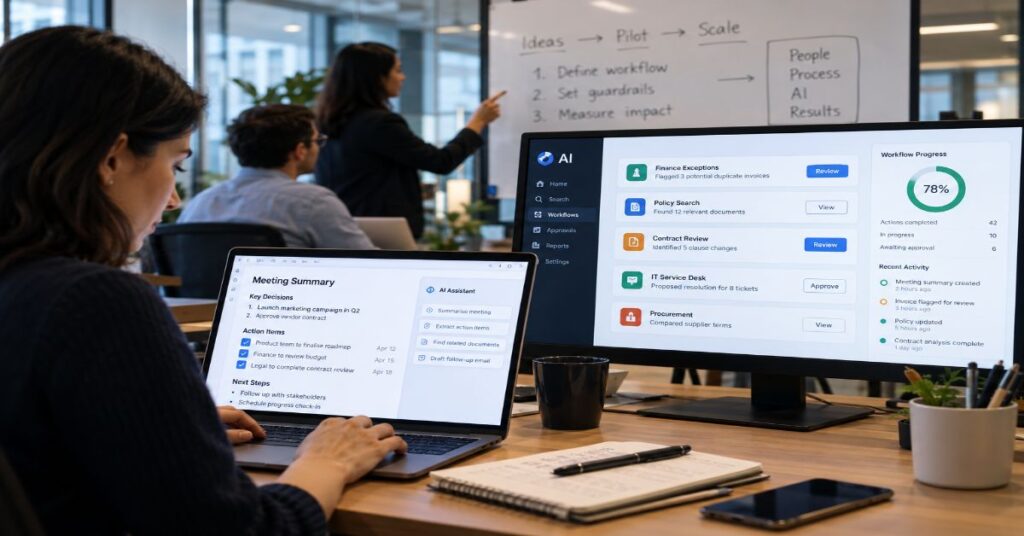
How companies are actually using AI internally in 2026 is less about replacing entire departments than about automating the neglected work between them: summarising decisions, locating evidence, routing exceptions, preparing reviews and pushing approved updates into business systems. That distinction matters because McKinsey’s 2026 global survey found that eight in ten respondents credited AI with improving their personal productivity, while just 37% reported a positive impact on enterprise earnings before interest and taxes (EBIT). The gap is the story—not a footnote.
Employees can finish a draft in minutes and still wait days for approval. A chatbot can retrieve a policy and still point to a superseded version. An agent can propose the right next step and then fail because it lacks permission to update the system of record. The best deployments confront all three constraints: process design, information quality and authority to act. That is why counting users or generated messages tells executives relatively little about whether AI has changed the economics of a workflow.
The evidence is growing, but it is not uniform. McKinsey surveys executives and employees about reported outcomes; Deloitte surveys enterprise leaders about implementation; vendor case studies illustrate what particular deployments claim to achieve, rather than independently proving average industry returns. These sources deserve different weights. This analysis separates documented examples from illustrative process designs and proposes an operational scorecard managers can apply to their own organisation. It examines the quiet internal AI jobs, the controls required for agents, the reasons pilots disappoint, and the most defensible path from isolated productivity to measurable performance.
The Real Shift: AI as an Operational Layer
The standard narrative starts with a software purchase: provide staff with an assistant, run training, measure sign-ins and congratulate the organisation on adoption. Yet the actual unit of transformation is a complete business process, not an individual seat. Internal AI becomes an operating layer when outputs are attached to the documents, queues, permissions and decisions through which work already moves.
Five Distinct Roles, Not One Magic Employee
Assistant
Drafts, summarises, translates and proposes; the employee retains the job of deciding what is true and useful.
Reviewer
Compares an artefact against policy or standards, highlights possible exceptions, and provides evidence for a human judgement.
Coordinator
Moves a request to the next owner, updates authorised fields and follows up on deadlines; this is valuable precisely because it crosses handoffs.
Decision Support
Prepares options, scenarios, forecasts or anomaly explanations while preserving provenance and uncertainty.
Controlled Executor
Takes narrowly authorised actions in business systems, logs what happened and escalates actions that exceed a predetermined threshold.
These roles should not be confused with levels of autonomy. The same model may safely draft a meeting recap yet be unsuitable for authorising a vendor payment. A sensible design defines what the system can read, what it can write, what it must explain and what always requires human sign-off. OpenAI’s August 2026 enterprise analysis describes the broader move from assistance to execution, while also emphasising permissions, review and governance; its usage statistics reflect its own customer base and are not a universal measure of business value.
How Companies Are Using AI Internally in 2026
A useful way to examine internal AI adoption is to follow ordinary work rather than departments. Consider a sales handoff, a revised employee policy, an invoice discrepancy or an incident after-action report. Each task depends on several systems and people. AI can narrow the coordination burden, but only if the company fixes the boundary conditions: access, ownership, approval and recording the outcome.
| Internal workflow | AI-supported activity | Human control / success metric |
| Meeting follow-through | Extract actions, owners and dates; prepare reminders | Owner confirms actions; percentage completed on time |
| Internal knowledge search | Retrieve answers with policy citations and version dates | Policy owner verifies; correct-answer rate |
| Finance exceptions | Flag duplicate invoices and explain variances | Finance approves; false-positive and recovery rates |
| Legal review | Identify clause changes and extract obligations | Counsel approves; risk-weighted review backlog |
| IT service desk | Categorise incidents and propose resolution steps | Engineer verifies; mean time to resolution |
| Engineering | Generate tests and propose migrations or fixes | Reviewer validates; escaped defects and deployment time |
| Procurement | Compare supplier terms and overlapping contracts | Buyer approves; validated spend avoidance |
| HR operations | Draft answers grounded in approved policies | HR reviews sensitive decisions; escalation accuracy |
Meetings Become Work Orders
A meeting summary is an artefact, not a business result. The more useful pattern extracts the explicit decision, identifies an accountable owner, proposes a due date and creates a draft task in a project tracker. The owner should approve ambiguous commitments before the system writes them. Deloitte’s 2026 research describes a financial-services company building agentic workflows to capture meeting actions, draft reminders and track follow-through. The report supports the existence of this pattern, but does not establish a universal financial return for it.
Knowledge Retrieval Needs Version Control
An internal answer engine can search policy libraries, tickets, product documentation and project notes. But its true task is not to generate convincing prose; it must find the current authoritative source, identify conflicting documents and refuse certainty when permissions prevent a complete answer. Enterprises should test retrieved answers against a curated set of questions that includes deliberately outdated pages. A system that is fast but confidently cites obsolete policy increases operational risk rather than reducing it.
Finance and Procurement Move Towards Exception Work
Finance teams can use AI to draft variance narratives, identify unusual expense categories or prepare audit evidence bundles. Procurement can compare supplier renewal terms and surface duplicate subscriptions. These are candidate workflows, not claims that every company already automates them. The value comes from reducing the work needed to determine which items merit investigation. Payment approvals, supplier master-data changes and regulatory representations deserve stronger controls than a narrative draft.
Five Invisible AI Jobs Inside the Business
Job titles lag behind workflows. An organisation may have no position called “AI workflow router” while its support, finance and operations teams increasingly rely on that function. Naming these jobs makes the design responsibilities—and the failure modes—visible.
Meeting Synthesiser
Converts scattered verbal commitments into reviewable records, annotated decisions and confirmed next steps.
Knowledge Librarian
Finds source documents, warns about stale information, and makes an answer traceable to a governed repository.
Workflow Router
Classifies incoming requests, recommends the appropriate owner and detects requests stranded between queues.
Exception Investigator
Compiles context around an outlier, drafts a hypothesis and presents evidence without silently closing the case.
Compliance Pre-reviewer
Screens documents for potentially missing clauses, inconsistent obligations or required escalations.
None of these functions should be treated as a substitute for accountability. The most defensible division of labour is that AI prepares, checks and transports evidence while a named human remains responsible for irreversible actions and consequential decisions. Where managers cannot identify the human owner of a particular automated step, the workflow is not ready to scale.
What Real Deployments Reveal—and What They Do Not
Documented cases are more illuminating than anonymous lists of possible use cases, provided the source and its limitations are explicit. Four 2026 sources illustrate different dimensions of deployment: a research survey, an enterprise case study, an academic field study and a vendor customer story.
An IT Service Desk in Manufacturing
A 2026 Information Systems Journal case study by Sharma and co-authors examines Apollo Tyres Limited and describes generative AI in IT service management, including multilingual interactions, incident categorisation, asset management and an internal FAQ capability. It is useful because it studies the capabilities an organisation had to develop, not merely the interface employees saw. It remains a particular case; the paper does not prove that the same results will transfer to every service desk.
An Airline and a Large Manufacturer
OpenAI’s August 2026 enterprise publication describes Virgin Atlantic using Codex to refactor legacy code and ChatGPT Work for competitive research. The reported dramatic reductions in time are customer examples presented by the technology provider, not neutral controlled benchmarks. Microsoft’s August 2026 KOHLER customer story likewise reports extensive Copilot adoption and employee time savings following training and a champion network. Both cases demonstrate that enablement and specific workflows matter, but neither should be converted into a guaranteed return-on-investment assumption for another organisation.
Financial Services: The Back Office Is the Front Line
The Cambridge Centre for Alternative Finance’s 2026 financial-services report places process automation, data visualisation, software engineering and knowledge management among leading use cases under pilot or deployment. Its finding that four of the top five use cases are back-office functions directly supports the argument that internal operations deserve more attention than flashy customer-facing demonstrations. But financial institutions differ in regulatory exposure, systems complexity and process standardisation; examples must be adapted rather than copied.
AI Agents, Handoffs and Systems of Record
The operational leap from assistant to agent occurs when software can do more than suggest text. A tightly designed agent can inspect a ticket, gather permitted evidence, draft an action, seek authorisation and write an approved change to a business application. This adds value at the seams between tools. It also concentrates risk because a mistaken action can travel into a system relied upon by other teams.
The Seven-Step Handoff Contract
- Define the trigger: exactly what event starts the workflow?
- Define permitted data: which repositories, records and classifications may be read?
- Define the output: what evidence and format must the model produce?
- Define the decision owner: who is accountable for accepting or rejecting the proposed action?
- Define system write access: which fields can change and under what conditions?
- Define failure handling: when does the workflow stop, roll back or escalate?
- Define proof of completion: which event in the source system confirms that work is finished?
This contract distinguishes a useful automation from a disconnected demonstration. It also prevents an agent from treating a plausible answer as permission to act. An audit trail should preserve input references, model or workflow version, tool calls, approval events and the final system record. For sensitive data, logs themselves require minimisation and access control.
McKinsey’s August 2026 survey found that 40% of respondents from large organisations said they were scaling AI agents, compared with 27% a year earlier. These are respondent-reported deployment stages, not evidence that 40% of large enterprises run autonomous operations end to end. The difference matters when projecting benefits or discussing workforce substitution.
The Shadow AI Problem Is Really an Ownership Problem
Shadow AI is the use of unapproved models, subscriptions, prompts or automations outside an organisation’s designated controls. Risks include sensitive text copied into unsuitable services, untraceable output entering a report, hidden subscription duplication and unofficial agents holding powerful credentials. The issue is not simply that employees are disobedient. Sometimes approved tools are too slow, unhelpful or inaccessible for real work, encouraging workarounds.
A Practical Permission Matrix
| Workflow / data | Read | Draft or recommend | Write / execute |
| Public marketing material | Approved employees | Approved AI tool | Human review before publication |
| Internal operating policy | Authorised staff only | Source-grounded draft | Policy owner approval |
| Confidential client record | Named role with need to know | Approved enterprise environment | Restricted and logged |
| HR, health or regulated data | Specialist authorisation | Approved use case only | Human accountable decision |
| Payments or production access | Minimal scoped access | Recommendation and evidence | Dual control or explicit approval |
A matrix is a design illustration; actual access rules must reflect local law, contractual commitments and the organisation’s security policy. “Enterprise grade” is not a substitute for checking retention settings, data residency, identity and access management, tool permissions and incident response. A least-privilege approach can start with retrieval and drafting, then authorise limited writes only after evaluation. Revoke rights when an automation is retired or an employee changes role.
Deloitte reports that only around one in five organisations in its 2026 survey had a mature governance model for autonomous agents. That should direct attention towards operational control quality, not merely model-selection debates. Every live agent needs a business owner, technical owner, source-of-truth map, exception path, review cadence and kill switch.
Why Internal AI Projects Fail Despite High Usage
A high-use assistant can still produce negligible organisation-wide value. When a pilot accelerates one task but leaves every approval, handoff and correction unchanged, the bottleneck simply moves downstream. Other failures are less visible: a search answer is accurate but outdated, teams automate incompatible versions of a process, or managers cannot separate genuine time savings from extra work created by reviews and rework.
Six Failure Patterns to Diagnose
Task Speed Without Process Speed
Drafting falls from forty minutes to five, but an unchanged three-day approval queue determines completion time.
No System of Record
A recommendation appears in chat but nobody updates the ledger, CRM, policy library or ticket.
Weak Data Stewardship
AI retrieves conflicting source documents and presents an unwarrantedly authoritative synthesis.
Split Ownership
IT owns the platform, operations owns the process, security owns restrictions—and nobody owns the measured outcome.
Activity-Based Metrics
A dashboard reports logins and tokens while error rates, delays and actual costs are unknown.
Review Bottlenecks
A machine prepares most of a case instantly, but one overloaded specialist must still approve every low-risk item.
The strongest diagnostic question is: if this model disappeared tomorrow, which completed business outcomes would slow down, and by how much? If the company cannot name the outcomes or retrieve baseline records, it is measuring enthusiasm, not operational value. Another test asks whether employees have quietly created parallel manual checks because they distrust the automated output. That behaviour is a cost the business case must count.
How to Measure AI Value Without Inflating ROI
Avoid treating a claimed hour saved as a realised cash saving. A worker who produces a draft faster may redeploy the time to useful work, reduce overtime or simply experience less pressure. Only some cases translate directly into lower costs. The business case should make the mechanism explicit: throughput, avoidance of an identifiable expense, higher quality, faster collections, or demonstrable revenue contribution.
A Quality-Adjusted Net Value Model
A practical estimate is: Net workflow value = verified productive capacity released + validated error/rework savings + attributable incremental margin − software expense − integration expense − evaluation and oversight expense. Where released capacity cannot be linked to additional output or avoided cost, report it as capacity rather than cash ROI. Where revenue attribution is speculative, do not insert it as a confirmed benefit.
| Metric | Baseline | Pilot result | What to verify |
| Median request-to-completion time | Before deployment | After deployment | Exclude paused or abandoned cases |
| First-pass acceptance rate | Pre-AI sample | Same-complexity pilot | Use blinded quality review where possible |
| Rework minutes per case | Recorded actuals | Recorded actuals | Include review of AI outputs |
| Cost per completed item | Fully loaded process cost | All-in process cost | Include tokens, licences and support |
| Escalations / serious errors | Risk-weighted baseline | Pilot incidence | Track severity, not only frequency |
| Source-grounded answer accuracy | Reviewed test set | New and stale questions | Test citations and currency |
A Worked Example—Illustrative, Not a Market Benchmark
Suppose a team handles 2,000 requests per month. A redesign cuts active handling time by six minutes per request, releasing 200 hours monthly. At an illustrative fully loaded labour cost of £30 per hour, the gross capacity equivalent is £6,000. If quality checks, integration support and AI operations together cost £2,500 monthly, the implied net capacity value is £3,500—not necessarily £3,500 of cash savings. Only count realised savings if staffing, overtime, external spending or revenue outcomes actually change. The hypothetical figures illustrate the arithmetic and are not a price quote or measured deployment.
McKinsey’s 2026 analysis reports that around 37% of respondents saw a positive contribution to enterprise EBIT, essentially unchanged from the prior year, even as scaling increased. That is consistent with delayed or uneven economic conversion, but the survey alone cannot determine why a particular company failed. A workflow-level before-and-after evaluation, ideally including comparable cases not exposed to AI, is still necessary.
A Five-Stage Internal AI Maturity Model
A maturity model is useful only when stages describe observable operational behaviour. A company should not claim to be “agentic” simply because a vendor product contains agents. The distinction is what employees can delegate, who owns the result and whether outcomes improve.
| Stage | Observable practice | Exit criterion |
| 1. Informal experimentation | Individuals paste text into a tool | Approved use and safe-data rules exist |
| 2. Assisted work | AI drafts within one bounded process | Accuracy, effort and reviewer roles measured |
| 3. Coordinated work | Approved events and drafts move between tools | System-of-record updates are reliable |
| 4. Managed AI operations | Permissions, evaluation and escalation standardised | Exceptions tracked; audits reproducible |
| 5. Redesigned process | Roles and queues rebuilt around proven AI capabilities | Quality-adjusted business outcomes improve |
Progress is not monotonic. A legal team may operate at stage four for document extraction while remaining at stage two for negotiating complex contracts. A manufacturer may automate one narrow maintenance triage workflow while keeping other decisions entirely manual. The appropriate level depends on the reversibility of errors, availability of ground truth, quality of integrations and strength of institutional controls.
Deloitte’s 2026 survey suggests substantial variation: 37% of respondents characterised their use as relatively surface level, 30% reported redesigning key processes and 34% were undertaking deeper transformation. The percentages reflect survey categories and rounding, not a universally validated diagnostic scale. They reinforce the need to distinguish adoption from redesign.
The AI Handoff Audit: A Practical Starting Point
The best opportunity may be a dull internal queue rather than the most visible use case. A handoff audit identifies instances where work changes hands, a record must be recopied, a manager lacks context or an approval waits for information that already exists elsewhere. Instead of asking staff where they want AI, ask what work repeatedly stalls and what proof would show the stall has ended.
Run the Audit Across One Complete Process
- Select one high-volume but bounded process, such as invoice exceptions or onboarding requests.
- Map each trigger, system, human owner, approval and completion event.
- Record a baseline of elapsed time, active work, rework and error severity.
- Identify where information is retyped, summarised, searched for or reassigned.
- Classify each candidate action as read, draft, recommend or execute.
- Pilot the lowest-risk steps first using representative hard cases.
- Compare results against a defined threshold for quality-adjusted benefit.
- Decide whether to redesign the workflow, expand carefully or stop.
Two counterintuitive findings often emerge from this exercise. First, the most valuable AI action may be a small routing improvement rather than a sophisticated generated report, because routing shortens elapsed time for everyone downstream. Second, an automated step can create negative returns when it floods approvers with low-quality recommendations. Both phenomena are hypotheses to test with process data, not claims about a universal organisational pattern.
Buy, Build or Connect?
Use an existing product when a workflow is common, controlled and well supported; build narrowly when the proprietary context is critical and internal technical capacity is strong; connect services when value depends on combining trusted sources and current systems. McKinsey’s 2026 survey found that 32% of respondents said their organisation had forgone buying at least one software product or feature because agentic coding enabled an internal build. This does not mean building everything is cheaper: maintenance, security reviews, uptime and auditability belong in the total cost.
Workforce Effects and the Next Internal Operating Model
Some of the most important internal changes involve human work rather than software features. Routine preparation may contract; exception handling, source stewardship and approval design may expand. Faster drafts may increase demand for people who can judge evidence, uncover edge cases, communicate uncertainty and own consequential decisions. These are plausible changes, not proof that every role will be protected or eliminated.
McKinsey’s 2026 survey found that 14% of respondents at AI-using organisations reported an overall workforce decline to which AI had contributed during the previous year, while two-thirds reported little or no total employment change attributable to AI. Expectations for future changes were more negative than realised changes. Survey attribution and employer expectations cannot settle the labour-market effect, but they argue against confident declarations that AI has already replaced whole departments.
The clearest distinction may become between companies where AI makes isolated employees quicker and companies where processes move with fewer delays, less rework and clearer accountability. BCG’s September 2026 analysis of front-runners describes shifts toward outcome ownership, human evaluation and redesigned decision rights. A company need not copy those structures wholesale; it can begin by giving a named owner the authority to improve one complete workflow and the responsibility to monitor its downstream effects.
Three Decisions That Determine Whether AI Is Worth Scaling
Choose the Boundary, Not Just the Model
Executives understandably compare models on speed, fluency, reasoning scores and procurement cost. Those variables matter, but the unit of risk in an operational deployment is the boundary between information and authority. A system asked to extract dates from a signed contract is doing fundamentally different work from one allowed to alter payment instructions based on that extraction. The latter needs not merely a better model but an independently verified recipient, a restricted permission scope, transaction limits and a reliable approval record. Any business case that combines both activities under the label “contract automation” obscures the critical distinction.
A responsible deployment inventory should therefore list action classes instead of only applications. Reading a document, composing a draft, making a recommendation, updating an internal note, sending an external communication, approving a transaction and changing access permissions are separate classes. Each requires a proportional assurance level. When the action is difficult to reverse or affects a person’s employment, financial position or rights, the default should be a controlled escalation rather than unattended execution. This is a design recommendation, not a statement that every jurisdiction imposes an identical legal standard.
Measure Queue Time as Well as Worker Time
Many AI business cases fail by measuring the wrong clock. Consider an internal procurement request requiring two hours of active work over nine calendar days. If AI reduces that active work to twenty minutes but the same approvals still consume eight days, the employee enjoys a real reduction in effort while the requester sees almost no service improvement. Conversely, automatically collecting the correct evidence before the first review may save fewer labour minutes but remove several days of elapsed time. Organisations should chart both measures for the same request cohort, with complexity and urgency recorded before the pilot begins.
This creates a more useful prioritisation principle: search for steps with the largest combination of delay, avoidable rework and controllable risk. High-frequency work is an obvious candidate, but repeated delays in infrequent high-value processes can justify investment too. An audit committee evidence request, for instance, may have little volume but considerable consequences when documents cannot be located. The value test should reflect exposure, not just transaction count. It should also distinguish a faster answer from a better operational decision.
Protect the Human Learning Loop
If AI handles every first pass, employees may lose opportunities to acquire the judgement needed to detect subtle errors. This risk is particularly relevant in functions where expertise traditionally grows through routine review, such as coding, legal analysis, finance and incident response. A deployment can mitigate it by sampling AI decisions for structured human review, recording disagreement reasons and using difficult cases as deliberate training material. The goal is not to preserve inefficient manual effort for its own sake; it is to maintain enough internal expertise to audit the system and recover when it fails.
Managers should ask who can explain a result without the model, who can revoke an unsafe action and how new starters learn from exceptions. These questions rarely appear in software adoption dashboards, but they determine whether the enterprise remains capable of supervising automation as it becomes more pervasive. In mature operations, the capacity to challenge AI recommendations is part of the benefit of AI governance rather than an obstacle to speed.
Our Editorial Verification Process
This analysis cross-checked McKinsey’s August 2026 global AI survey, Deloitte’s 2026 State of AI in the Enterprise, the Cambridge Centre for Alternative Finance’s 2026 financial-services report, a 2026 Information Systems Journal case study, and dated company or vendor publications from OpenAI, Microsoft and BCG. We separate broad self-reported survey findings from individual customer stories and hypothetical workflow examples. Survey percentages are not presented as causal proof, and vendor-reported performance examples are identified as such. We have not run original company-level field interviews, empirical product evaluations or paid-plan benchmarking for this article.
No product-by-product price comparison is included because enterprise contracts, feature caps, data processing terms and usage charges depend on deployment and require current individual quotations. Equally, no original hands-on testing is claimed. The source website’s live sitemap and fallback endpoints were inaccessible during preparation, so publication-specific internal article links could not be independently verified; they have deliberately not been fabricated.
This article was researched and drafted with AI assistance. Awais Khalid and the Perplexity AI Magazine editorial team should independently review the text, cited source pages, figures and attributed examples before publication. Such human review has not been represented as completed.
Conclusion
Companies are using AI internally to prepare decisions, search institutional knowledge, investigate exceptions, maintain software and coordinate work that would otherwise disappear into meeting notes, shared inboxes and disconnected systems. The technology is visible in pilots, but its most consequential effect may remain invisible to the outside world: a cleaner handoff, a reliable record update or a faster resolution of an operational problem. It is too early to assume that these changes translate automatically into cash savings or workforce reductions.
Evidence from 2026 surveys points to both significant adoption and substantial execution gaps. The dividing line is not the number of models purchased or employees trained. It is whether a company knows which work the system may perform, who owns the decisions, how failures are caught, and whether the entire process improves after accounting for review and operating costs. The credible next phase of enterprise AI will probably involve more delegated tasks, but also stricter permissions, better data stewardship and clearer human responsibility.
There are genuine open questions: how reliably agentic systems will handle unusual cases, whether costs remain predictable as usage scales, how different sectors will regulate automated decisions and which forms of worker displacement or augmentation become durable. A rigorous internal deployment is one that can answer those questions with evidence from its own work, rather than with adoption statistics alone.
Frequently Asked Questions
How Are Companies Actually Using AI Internally in 2026?
They use AI for internal search, document review, meeting follow-through, software maintenance, exception triage, procurement comparisons and bounded agent actions. Most successful designs connect output to a process and retain human oversight for consequential decisions.
What Is the Difference Between an AI Assistant and an AI Agent at Work?
An assistant mainly produces information or suggestions. An agent can also use authorised tools to advance or complete workflow steps. Agency does not imply unlimited autonomy; permissions, approvals and audit trails remain essential.
Which Internal AI Use Cases Are Most Valuable?
Value depends on the organisation’s bottlenecks. High-volume, repetitive, measurable processes with good source data and clear ownership are strong candidates. Use baseline metrics to compare quality-adjusted outcomes before expanding.
Why Is AI Adoption Not Producing More Enterprise Profit?
Local time savings can be offset by unchanged approvals, weak data, manual rework, integration expense and uncertain revenue attribution. Survey results identify the gap but do not establish one universal cause.
Is Shadow AI Always a Security Breach?
No. Shadow AI means use outside approved oversight and may or may not involve a confirmed breach. It can still create privacy, information-quality, contractual and operational risks that deserve investigation.
How Should Businesses Measure AI Return on Investment?
Track full request-to-completion time, quality, rework, cost per completed item, error severity and attributable economic outcomes. Do not convert every hour theoretically saved into a realised cash saving.
Will Internal AI Replace Departments?
Current evidence does not justify a blanket prediction. Tasks, roles and workflows may change unevenly. Human decision rights, audit requirements and complex exceptions still constrain full replacement.
Should Companies Build Their Own AI Agents?
Build only when unique workflows and capabilities justify development and maintenance. Existing tools or integrations may be more economical for standard processes; assess security, ownership, lifecycle cost and vendor lock-in.
References
McKinsey & Company. (2026, August 25). The state of AI in 2026: On the road to ROI. https://www.mckinsey.com/capabilities/quantumblack/our-insights/the-state-of-ai
Deloitte. (2026). The state of AI in the enterprise. https://www.deloitte.com/us/en/what-we-do/capabilities/applied-artificial-intelligence/content/state-of-ai-in-the-enterprise.html
OpenAI. (2026, August 12). From assistance to execution: How enterprises put AI to work. https://openai.com/index/how-enterprises-put-ai-to-work/
Cambridge Centre for Alternative Finance. (2026). 2026 global AI in financial services report. https://www.jbs.cam.ac.uk/faculty-research/centres/alternative-finance/publications/2026-global-ai-in-financial-services-report/
Sharma, et al. (2026). Generative AI implementation in enterprises: Lessons from a case study of enhanced IT service management. Information Systems Journal. https://doi.org/10.1111/isj.70029
Microsoft. (2026, August 10). KOHLER achieves 98% Microsoft 365 Copilot adoption with AI change management strategy. https://www.microsoft.com/en/customers/story/26948-kohler-company-microsoft-365-copilot
Boston Consulting Group. (2026, September 24). Five ways that AI front-runners change how work gets done. https://www.bcg.com/publications/2026/companies-use-ai-to-redesign-work
Google Cloud. (2026, June 4). 10 companies putting AI agents to work across industries. https://cloud.google.com/transform/10-companies-making-ai-work-across-industries