
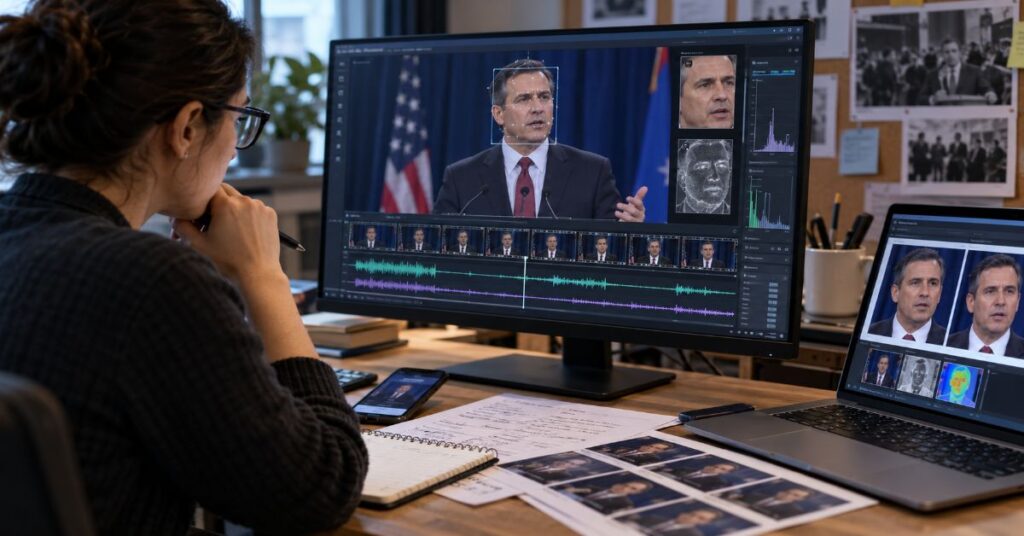
To answer “how can i tell if a video of a politician is a deepfake”, start by checking where the footage originated and whether independent records show the same words and event—not by hunting for a suspicious blink. A perfectly convincing face may be synthetic, while a visibly glitchy clip may simply be compressed. The decisive question is what can be corroborated.
Political videos are unusually persuasive because a familiar face lends authority to a few seconds of audio. Yet a clip can mislead in at least four ways: it can be generated, altered, selectively edited or authentically recorded but falsely described. Each possibility needs a different check. Calling everything a deepfake misses ordinary deceptions; dismissing everything as artificial can also give public figures an excuse to dispute genuine evidence.
The UK House of Commons Library’s May 2026 guidance urges people to establish who posted a recording, identify its original source and compare it with other evidence. The Brennan Center for Justice likewise advises against treating AI detector outputs as definitive. The approach below combines those principles with concrete, repeatable steps that a reader, journalist or campaign researcher can undertake without specialist forensic software.
This guide distinguishes clues from proof, shows how to search for earlier recordings, explains the value and limits of Content Credentials, and provides a decision framework for sharing or escalating a disputed clip. It does not claim that a single test can establish authenticity with certainty.
The Five-Minute Check Before You Share
Start with a Claim, Not a Feeling
Write the actual allegation in one sentence: “This video supposedly shows [politician] saying [words] at [event] on [date].” That formulation separates the claim from the emotional reaction it provokes. Then find the original link rather than relying on a forwarded copy or a screenshot. Record the uploader, date, caption and any watermark, and note whether the account is connected to the alleged event. Account verification badges can help identify a publisher but do not independently authenticate a specific recording.
Search a distinctive phrase from the speech with the politician’s name, then look for complete event coverage on an official campaign or government channel, a broadcaster’s archive, a parliamentary recording, or the event organiser’s site. Compare the original soundtrack and the seconds before and after the alleged quote. If a speaker announced an extraordinary policy change, a longer public record and independent reporting would ordinarily be expected, although a lack of immediate coverage alone proves nothing.
A Fast Triage Routine
| Minute | Action | What a Result Means |
| 1 | Save the exact claim and original post | Preserves what is being alleged |
| 2 | Search the speaker, quote and event | Looks for independent coverage |
| 3 | Find a longer original clip or transcript | Tests omitted context and voice changes |
| 4 | Reverse-search two distinct frames | Can reveal old or reused footage |
| 5 | Classify as corroborated, misleading or unresolved | Avoids turning clues into certainty |
If the clip might influence voting, provoke unrest or accuse someone of a serious offence, slow down further. Verification urgency should increase with potential harm, not with how provocative a video feels. One reliable official record that directly contradicts the clip may be more informative than a dozen speculative comments about a person’s eyes.
Separate Four Different Ways a Political Video Misleads
The word “deepfake” is often used as shorthand for any suspicious clip. That blurs critical distinctions. A fully synthetic video, an authentic video with cloned speech, a straightforward splice and an old recording falsely dated to this week call for different evidence. A viewer who checks only lip movements may miss the last two categories entirely.
| Type | What Changed | Most Useful Test |
| Synthetic face or scene | Image sequence generated or substituted | Provenance and independent recordings |
| Voice cloning or dubbing | Speech replaced while imagery remains | Compare full original audio and transcripts |
| Selective editing | Real pieces rearranged or shortened | Inspect full uncut sequence |
| False context | Real media attached to false time, place or claim | Reverse search and event records |
A genuine face and a genuine voice do not prove that the accompanying caption is accurate. Conversely, a fabricated video may incorporate a genuine quotation. Authenticity, context and factual truth are separate judgments: a speech can be recorded accurately while the politician’s claim remains demonstrably false.
A useful editorial habit is to maintain three columns: “What the file is”, “What event it shows” and “Whether the statement is true”. Mixing the columns causes both false accusations and unwarranted exonerations. This distinction is especially important when short videos circulate in languages other than the one spoken in the original footage.
Trace the Source and Recover the Full Recording
Follow the Upload Trail Backwards
Inspect the earliest post that can be found, but do not assume the earliest indexed post is the creator. Social media search may hide older posts, remove timestamps or reorder results. Search the account handle, visible watermarks, text on a podium and the quoted phrase. If there is a broadcaster logo, locate that broadcaster’s own feed rather than treating the watermark as proof; watermarks themselves can be copied or overlaid.
A politician speaking at a public meeting often leaves a wider evidence trail: the event agenda, an audience recording, a broadcaster’s live stream, an official transcript and photographs by independent news photographers. Compare details that should agree across these sources: clothing, audience reactions, banners, the order of speakers and the timing of interruptions. Independent agreement is strongest when different organisations captured the same scene, not when several accounts reposted the identical clip.
Reverse-Search More Than One Frame
Pause the video at a distinctive moment and save a clear screenshot. Use a reverse image service such as Google Lens or TinEye, then repeat with a frame showing the venue rather than the politician’s face. A previous publication can reveal that a supposed October 2026 speech is actually from an earlier year. Another frame may reveal a cropped subtitle, omitted person or change of location. The House of Commons Library and established fact-checking organisations recommend this approach as a useful way to recover context.
Negative results require restraint. A video may not have been indexed; search providers have uneven geographical coverage; and crops, aspect-ratio changes or overlaid captions can frustrate matching. “No reverse-search results” is not equivalent to “newly generated”. Compare multiple searches rather than interpreting one empty screen as an answer.
Inspect Audio, Lips, Light and Motion Without Overclaiming
Which Clues Actually Merit a Second Look?
Misaligned mouth movements, unnatural changes in voice quality, repeated facial textures, inconsistent reflections, unstable earrings or unexpected background motion can prompt further checking. Watch a segment at normal speed and, if the player supports it, at reduced speed. Compare consonants for which the lips should close, but remember that poor network connections, dubbed audio and platform compression can also produce noticeable delay.
Audio warrants its own investigation. Cloned speech can be attached to real footage of a politician standing at a lectern, making face-focused checks useless. Listen for sudden changes in room acoustics, breath patterns or crowd response. A mismatched audience reaction may indicate an edit, but sound mixes and camera cuts provide innocent explanations too. The correct next step remains comparison with an independent or longer recording.
Lighting and anatomy cues are also fragile. Stage lights create asymmetric shadows; camera stabilisation can warp backgrounds; a low-bitrate video can distort teeth and hair. A deepfake with excellent synthesis may display none of the once-famous glitches. PolitiFact’s interviews with computer-vision researcher Siwei Lyu discuss eye reflections and lip-sync as possible clues while emphasising tracing a clip and seeking cross-verification.
Why Pixel-Level Guessing Is the Wrong First Move
Human observation is not a validated classifier. It becomes particularly unreliable with short, low-resolution clips, quick cuts, subtitles obscuring the mouth or synthetic audio over real video. Treat a perceived glitch as a reason to investigate, not a licence to post a categorical accusation. In a contentious election, an unsubstantiated accusation that genuine footage was fabricated may itself distort public understanding.
Use Content Credentials and Metadata Carefully
Content Credentials are provenance records based on standards from the Coalition for Content Provenance and Authenticity (C2PA). They can cryptographically bind information about an asset’s creation and modifications to a media file. A supported viewer or verification service may display details of the participating device or software, edits and signing history. The C2PA specification describes these credentials as provenance signals, not as independent judgments about whether every statement depicted is true.
An intact credential from a trusted recorder can increase confidence in the documented production chain. A credential from an editing application may legitimately disclose alterations. But signatures need interpretation: what identity is vouched for, which operations are represented, and whether there is evidence beyond the credential that the pictured event happened as described? The credential can establish a claimed chain of custody without certifying political claims in the audio.
What If the Video Has No Credentials?
Do not label it a deepfake. Recording tools and platforms do not universally preserve C2PA data; redistribution, screenshots and transcoding can remove information. Missing metadata is a gap in provenance, not a positive detection result. Ordinary file metadata such as timestamps, camera model or GPS location is likewise neither universal nor intrinsically trustworthy: it can be absent, stripped or modified. Compare it with an external timeline, not with an assumption about how authentic files must look.
| Finding | Reasonable Interpretation | Unsafe Conclusion |
| Valid credential from relevant source | Supports a documented provenance claim | Every statement in video is true |
| No C2PA credential | Provenance not established through this channel | Video is AI-generated |
| Timestamp in local file | Possible supporting clue | Event date proven |
| Platform AI label | Useful alert requiring follow-up | Entire clip proven synthetic |
Why AI Deepfake Detectors Cannot Give a Verdict
Automated detectors analyse statistical patterns, artefacts or inconsistencies associated with generated media. They can provide useful leads in a professional investigation, but performance depends on the kinds of examples used for training, the quality of input and whether the forgery technique resembles the training distribution. A short, heavily compressed social video is not necessarily comparable with a clean laboratory benchmark.
A June 2026 peer-reviewed survey in Artificial Intelligence Review evaluated deepfake detection across image, video and audio datasets, focusing on generalisation and robustness. Its analysis found substantial performance degradation when models were exposed to unfamiliar distributions and vulnerabilities under adversarial attack. The point is not that every detector fails on every clip; it is that a percentage score without a known validation setting cannot be translated into certainty about the video in front of you.
Interpreting a Score Correctly
A detector saying “90% AI” is not necessarily estimating a 90% probability that the video is fake. The score may be an uncalibrated classification output. Ask how the service defines that percentage, what training data were used, whether compressed phone recordings were tested, and how often genuine videos were wrongly flagged. Two tools agreeing is not full independence if their training data or methods overlap.
The Brennan Center explicitly advises against over-reliance on AI detection tools in election contexts. The practical compromise is to use them as secondary checks after source verification. If a detector disagrees with an authenticated full recording, investigate that conflict rather than automatically overriding the recording. Never manufacture an accuracy or confidence figure for an untested service.
A Worked Example: A Viral Resignation Clip
Consider a hypothetical 18-second video showing a cabinet minister apparently resigning during a televised interview. The politician’s face looks natural; subtitles say the resignation is effective immediately; and thousands of users are reposting the clip. No single feature settles the matter. This example is illustrative, not a claim about a real politician or a video that we examined.
First transcribe the exact resignation sentence and locate the earliest accessible post. Search for the interview date and programme. If the claimed interview is real, the broadcaster may hold a longer version. Check whether the crucial sentence appears there. If the complete broadcast contains a different answer while the viral segment uses the same images, cloned audio or synthetic dubbing becomes plausible. If the full interview contains the words but reveals that the politician was quoting an opponent, the clip may be misleadingly edited rather than deepfaked.
Next compare contemporaneous reporting and any official statement. Be cautious about silence: a genuine breaking announcement can precede coverage, especially in local politics. Save copies of the source links and record when each page was accessed. Check two distinct video frames for earlier appearances, inspect the subtitles separately from the audio and document any unresolved mismatch. The outcome might be “not substantiated as genuine” rather than “proved AI”.
This hypothetical case illustrates why the reporting claim and the recording must be tested separately. If no full recording can be located and no independent outlet confirms the event, the responsible conclusion is unresolved. It is not a licence to declare the public figure guilty of a statement, nor to assert that the politician has been impersonated.
Verify Dates, Places and Quotes in Election Footage
The Time-and-Place Test
Political footage often acquires new meaning when a truthful image receives a false date. An older rally may be relabelled as a recent protest; a statement before an election may be circulated as a response to a result; a speech in one country may be claimed as evidence about another. Examine banners, badges, event names, language, buildings and other visible clues. Search for the event programme and reporting that places the politician there.
Weather, shadows and clothing can supplement that investigation but should not become stand-alone verdicts. Large venues may host several events with similar stages and graphics. Time-zone differences and overnight uploads can produce apparently contradictory dates. A source record listing the time of a broadcast and a second recording of the same public event are usually stronger than guesses based on cloud cover.
Translate and Attribute the Actual Words
When footage crosses languages, distinguish the original audio, a human translation, an automated subtitle and the poster’s paraphrase. Machine captions can mistranscribe names and qualifiers; political slogans frequently require context. Search the original-language phrase when possible and compare with an official transcript or independent translation. A video can be authentic while a subtitle deceptively changes a negative statement into a positive one.
For election rules, registration dates, polling locations or official results, prioritise the relevant electoral authority over a viral clip, whether or not the politician looks real. A verified video is still a poor substitute for the primary administrative record when the public must act on a deadline.
Recognise the Liar’s Dividend and the False-Positive Risk
Deepfakes create two opposing harms. People can believe a fabricated clip, but people can also dismiss genuine recordings by alleging that they are fabricated. This second dynamic is often described as the liar’s dividend: widespread awareness of synthetic media can give someone plausible rhetorical cover to deny authentic evidence. The risk rises when audiences equate uncertainty with exoneration or treat an automated detector as a neutral court.
An effective verification process must therefore test an authenticity claim and a falsification claim to the same standard. An allegation that “this is a deepfake” should be accompanied by positive evidence, such as a documented original showing different words, strong provenance evidence or a forensic finding whose limits are disclosed. An unexplained facial glitch does not satisfy that standard.
Keep a written distinction between “the clip was altered”, “the clip appears misleading”, “the clip has not been verified” and “the claim is false”. These phrases are not interchangeable. If the public figure denies a video, independently examine the denial, its timing and any supporting evidence rather than treating it as conclusive. Conversely, widespread circulation and prominent media repetition do not convert a fabricated recording into fact.
How to Document, Report and Correct a Suspected Deepfake
Preserve Evidence Without Repeating the Deception
Save the original post URL, the visible caption, its publication timestamp, the first time you saw it and any relevant screenshots. If lawful and necessary for an investigation, keep an unmodified local copy and note the source and time it was acquired. Avoid circulating the audio or visual allegation simply to warn others; repeated exposure may give a false claim additional reach. A correction can point to an authoritative original and describe the discrepancy without embedding the deceptive clip again.
Report impersonation or manipulated media through the platform’s relevant reporting route. If the clip makes allegations that could affect personal safety, an election or financial decisions, alert a credible fact-checking organisation, newsroom or appropriate electoral authority. Include the exact URL, claimed speaker, date, identified original source and the reason for concern. A request for review is more useful than a dramatic unsupported declaration.
A Four-Part Verification Record
| Field | Record | Reason |
| Claim | Exact caption and quoted words | Prevents claim drift |
| Origin | Uploader, earliest traceable copy and event | Establishes provenance trail |
| Corroboration | Full recording, transcripts and independent reports | Tests accuracy and context |
| Status | Corroborated, misleading, manipulated or unresolved | Preserves uncertainty |
For journalists, corrections should be updated when new evidence emerges. Distinguish the time an article was amended from the time of the underlying event. If a deepfake detector was used, identify the tool and its role while making clear that the published finding rests on independently evaluated evidence. Public trust improves when the method is reproducible, not when an editor gives an unqualified assurance.
A Practical Decision Framework for Readers and Newsrooms
Use a layered judgment rather than a binary “real/fake” instinct. Evidence for authenticity includes an identifiable original recording, independent versions of the same moment, a transcript whose full context matches the clip and consistent provenance information. Evidence against the claim includes an earlier source with a conflicting caption, an original video showing that the words were swapped, a demonstrably false event date or a credible documented forensic analysis.
The decision does not need a numerical score. Classify “corroborated” only when independent evidence supports the recording and claimed context; “misleading context” when the underlying footage is genuine but the caption or edit changes its meaning; “manipulated” when specific evidence supports alteration; and “unresolved” when competing explanations cannot be distinguished. Keep factual claim-checking separate from that classification.
| Finding | What to Say Publicly | Sharing Decision |
| Multiple original sources agree | Recording and context corroborated | Share with source |
| Original found, caption demonstrably wrong | Authentic footage, misleading context | Share correction only |
| Specific documented alteration found | Manipulation supported by evidence | Explain alteration with evidence |
| Source missing; detector or visual clues only | Authenticity unresolved | Do not amplify as fact |
High-stakes cases merit escalation. A local reporter dealing with a low-quality forwarded copy may need a forensic specialist, broadcaster or original recorder. Responsible escalation is a strength, not a failure of verification. The purpose of the method is not to promise certainty about every pixel; it is to prevent unsupported footage from becoming a public fact by repetition.
Our Editorial Verification Process
This guide synthesises publicly available guidance from the UK House of Commons Library (5 May 2026), the Brennan Center for Justice, PolitiFact and Full Fact; technical documentation from C2PA; and peer-reviewed 2026 research on detector generalisation. We compared their stated recommendations against distinct failure modes: fabricated video, synthetic audio, altered context, metadata loss and false accusations of manipulation. No user-supplied political video was submitted for forensic inspection, and no independent hands-on detector benchmark was conducted for this article.
The Perplexity AI Magazine sitemap could not be accessed during preparation. Accordingly, no purported internal article URLs have been invented or inserted. Site editors should add six to eight topic-relevant live internal hyperlinks after checking the sitemap and published pages. The guide does not compare commercial deepfake-detection plans because pricing is not necessary to answer the reader’s verification question and no vendor-specific plan has been evaluated.
Editorial transparency: This article was researched and drafted with AI assistance. Publication by Perplexity AI Magazine should occur only after the Awais Khalid editorial desk has independently reviewed the data, citations and any quotations against primary sources. Such editorial review has not been represented as already completed.
Conclusion
The safest answer to a suspected politician deepfake begins outside the video itself. Find who first published the clip, recover the fullest available recording, compare its words with independent evidence and check whether its date, location and caption are accurate. Face movements and detector scores can help identify questions to investigate, but they do not replace proof.
Content Credentials may offer verifiable clues to a file’s production history, while ordinary metadata and platform labels offer more limited assistance. None of these measures alone establishes the truth of a political statement. The most significant blind spot may not be an undetectable synthetic face but genuine footage placed in a deceptive context or real video paired with fabricated sound.
For readers and editors alike, uncertainty is an acceptable outcome. “Unverified” is a precise finding when source records are absent; it should not be inflated into “fake” or “real”. As creation and detection technology evolve, transparent sourcing, independent corroboration and careful corrections remain more durable safeguards than any visual trick or single software result.
Frequently Asked Questions
How Can I Tell if a Video of a Politician Is a Deepfake?
Trace the earliest available upload, find the complete original event recording, compare the audio and context with independent sources, and treat glitches or AI-detector results as clues rather than proof. If no reliable original exists, describe the clip as unverified.
Can I Spot a Deepfake Just by Looking at the Eyes?
No. Unusual reflections or facial movements may be reasons to investigate, but camera lighting, video compression and editing can produce similar effects. Modern synthetic video may contain none of those visible flaws.
Can Deepfake Detectors Confirm a Political Video Is Fake?
Not with certainty. Detector errors can increase when a clip differs from training examples or has been recompressed. Use a detector as supporting information alongside source and context checks.
What If the Video Comes from a Verified Social Account?
A verified account provides some information about the publisher, not an independent guarantee that every attached clip is unedited, correctly captioned or genuine. Check the complete source recording.
Does Missing C2PA Metadata Mean a Video Is AI-Generated?
No. Credential support is optional and credentials may not survive all publishing workflows. Their absence does not establish synthetic origin.
Can a Real Video Still Be Political Misinformation?
Yes. Genuine footage may be misleadingly dated, cropped, spliced or accompanied by false subtitles. Verify the event, full quote and underlying factual claim separately.
How Do I Check a Political Video Shared on WhatsApp?
Ask for its original source, search distinctive phrases and reverse-search clear frames. Treat forwarded copies without an identifiable event or recording history as unverified.
Should I Repost a Suspected Fake to Warn People?
Usually avoid amplifying the allegation. Where a correction is warranted, cite the original evidence and briefly explain the problem without unnecessarily repeating the manipulated claim.
References
Further evidence: House of Commons Library (2026). How to verify images and videos.
Further evidence: Brennan Center for Justice (2024). How to detect and guard against deceptive AI-generated election information.
Further evidence: C2PA (2026). Content Credentials: Technical specification.
Further evidence: C2PA Technical Working Group (2025). C2PA Content Credentials explained.
Further evidence: Nguyen-Le, H.-H., et al. (2026). Deepfake detection across image, video, and audio. Artificial Intelligence Review.
Further evidence: Settles, G. (2023). How to detect deepfake videos like a fact-checker. PolitiFact.
Further evidence: Rahman, G. (n.d.). How to spot deepfake videos and AI audio. Full Fact.
Further evidence: The Texas Tribune (2026). How to spot AI-generated content this election season.
Further evidence: Africa Check (2019). How to spot cheap, out-of-context and deepfake videos.