
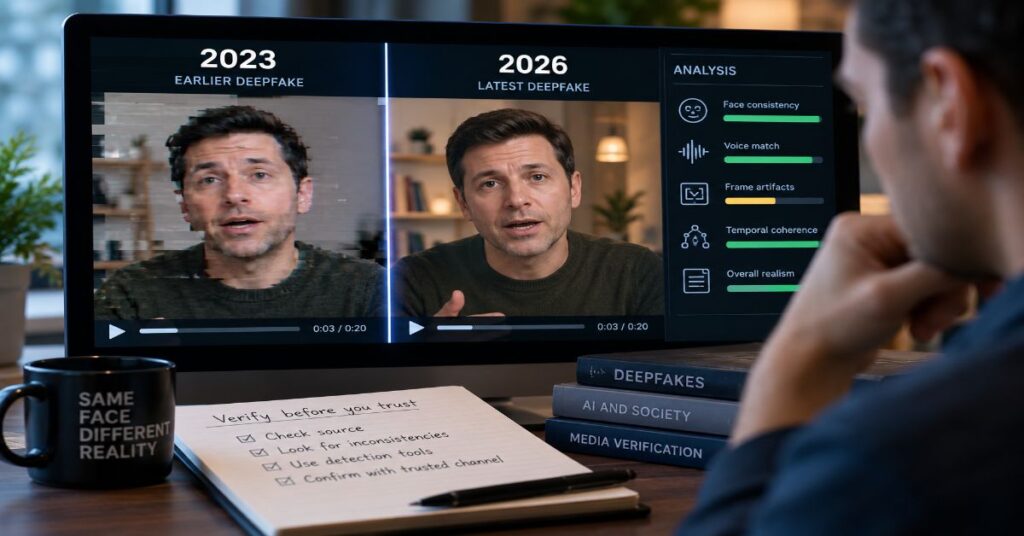
Deepfakes in 2026 are substantially more convincing than they were in 2023, especially in short video clips, face-swapped footage and cloned voices—but “how realistic are deepfakes now compared to 2023” has no single scientifically valid percentage answer. The meaningful change is that a plausible-looking recording is no longer strong evidence that an event happened.
A face that holds together for several seconds, a familiar voice delivering a believable instruction and an apparently ordinary video call create different risks. Neither perfect photorealism nor a sophisticated adversary is required if the recording appears in the right social context. Conversely, an impressive promotional demonstration should not be mistaken for evidence that every generator handles every face, language, angle or lighting condition equally well.
The evidence is unsettling but nuanced. A systematic review published in 2024 pooled findings from 56 studies involving 86,155 people and reported overall detection accuracy of 55.54%, with wide uncertainty and significant variation across modalities. A 2026 paper evaluating deepfake detectors across multiple domains found a persistent performance gap when methods were tested beyond familiar benchmark conditions. These studies measure different questions; neither supplies a neat “2023 versus 2026” improvement score.
This analysis separates the visible advances from the claims that remain unproven. It compares still images, speech, face swaps and entire AI-generated scenes; examines why the ordinary signs people were taught to spot have weakened; and proposes a verification process for a newsroom, business or individual confronting suspicious media in 2026.
How Realistic Are Deepfakes Now Compared to 2023?
The largest practical shift since 2023 is the combination of more credible output, faster iteration and easier distribution. In 2023, many people associated deepfakes with visible face warping, unstable mouth movement or uncanny-looking still frames. Such flaws still occur, but they are poor universal indicators. Today, the absence of an obvious glitch says very little about authenticity.
Four Measures of Realism That Should Not Be Confused
Visual fidelity asks whether a face, voice or environment looks and sounds plausible. Temporal coherence asks whether it stays plausible as the scene unfolds. Semantic coherence asks whether objects, gestures, speech and physical events make sense. Social credibility asks whether the recording arrives through a trusted person, account or context. The last measure can make an imperfect fake persuasive.
Published studies rarely measure all four dimensions in identical tasks across 2023 and 2026. Models change, test sets age and viewers learn new cues. A claim that deepfakes are “90% more realistic” without a repeatable metric, fixed comparison group and defined evaluation protocol should be treated as marketing, not science.
| Dimension | Typical 2023 weakness | 2026 assessment |
| Face appearance | Visible blending and inconsistent detail in some swaps | Better examples exist; quality remains generator-dependent |
| Motion | Flicker, lips and head movement could be unstable | Short clips can be convincing; complex sequences still expose failures |
| Voice | Robotic cadence or inconsistent identity in many outputs | Naturalness has improved; cross-language and emotional nuance vary |
| Detection | Visible artifact checks often seemed useful | Artifact-only checking is not sufficiently reliable |
The evidence also challenges the idea that “2026 deepfake” denotes one technological class. A retouched genuine recording, a face-swap, voice conversion and fully generated footage have distinct strengths and weaknesses. A credible comparison must state which is being evaluated.
The Biggest Visible Change Is in Short, Ordinary Clips
Deepfakes need not survive a long cinema-style scene to cause harm. An eight-second supposed apology, a twenty-second instruction from a manager or a short excerpt from a video conference may be all viewers see. Short duration hides continuity defects and gives audiences little opportunity to cross-check the surroundings. Social platforms also add compression, cropping and distracting captions.
Why Shorter Can Look Better
A system can devote its strongest output to a constrained portrait, familiar framing and a limited range of movement. The farther a scene extends into movement across space, multiple interactions and unusual camera angles, the more opportunities there are for inconsistencies. This is a reason to avoid extrapolating from a polished demonstration to open-ended capability.
A well-made synthetic close-up should be judged against comparable genuine close-ups, not against a list of implausibly easy fakes. Compression introduces its own visual noise and may obscure both real artifacts and fabricated ones. An unfamiliar codec can make an authentic video appear suspicious, illustrating why appearance-only methods produce false accusations.
Realism Is Not the Same as Reliability
Generators can produce plausible output while failing unpredictably under changed circumstances. Reliability would require consistent identity, gestures, object permanence and believable interactions across many runs and prompts. Such broad, independently repeated measurements are much scarcer than promotional examples. The intellectually honest conclusion is significant progress, not universal flawlessness.
Faces and Expressions: Where the Old Clues Fail
The internet’s classic deepfake checklist—count fingers, look for unusual blinks, inspect the hairline—is increasingly unreliable as a yes-or-no test. Some generators can reproduce these details plausibly, and ordinary camera noise can create equally strange effects. A suspicious eyelid may justify investigation; a normal blink cannot authenticate a clip.
The Type of Fake Matters More Than a Single Realism Score
A May 2026 research paper by Zihao Zhao and colleagues found substantial differences in observers’ ability to classify synthetic faces. Under the study conditions, participants could recognise certain Stable Diffusion-generated faces very quickly, while StyleGAN-generated and face-swapped examples were more readily confused with real images. The result is not that one product is always safe or dangerous; it is that realism and detection vary materially by manipulation method.
A separate 2026 meta-analysis in Computers in Human Behavior: Artificial Humans reports that participants discriminate authentic from deepfake faces above chance overall, with important qualifications relating to stimulus type and research design. That should prevent a misleading soundbite that humans can never distinguish synthetic faces. The more accurate account is heterogeneous human performance.
A Better Inspection Strategy
Where examination is necessary, inspect the original-resolution material when possible, consider transitions between frames and ask whether the lighting, depth, occlusion and identity remain consistent. Crucially, treat this as lead generation for further verification rather than a final verdict. Even expert analysis needs the right material and provenance.
Voice Cloning Raises a Different Trust Problem
A convincing voice does not need any visible face. The attack can arrive as a telephone call, voice note or short recording in a group chat. For businesses, the critical weakness is often not voice naturalness alone but the assumption that recognising a voice confirms authorisation.
What the Listening Evidence Actually Says
Fraunhofer AISEC’s 2026 public listening-study dataset reports 35,532 judgements from 1,768 participants across 138 text-to-speech and voice-conversion systems. It compares 2025–2026 listening judgements with an earlier perception study and finds that accuracy on fake samples was broadly similar in the reported comparison, while the accuracy of identifying real speech declined. Those figures concern particular tasks and sample selections, not all real-world calls.
A synthesised voice may sound unusually convincing in a common phrase yet become less stable when asked to respond to unpredictable turns of conversation. Even then, an attacker can use pre-recorded segments, human steering or contextual information to create trust. It is unwise to recommend a universal challenge phrase as sufficient protection.
The Control That Outlasts Voice Quality
An unexpected request to change bank details, transfer money or release sensitive files should be verified via a separately established channel. Call a known number from your own records, require approved workflow confirmation and avoid numbers or links provided in the suspicious request. This design remains useful whether synthesis quality improves or deteriorates.
Why Detection Benchmarks Can Mislead
Deepfake detectors are necessary investigative aids, not magic authenticity meters. When researchers evaluate a detector on fakes similar to its training data, the result may look excellent. When the same system meets footage from a new generator, unusual language, compression pipeline or capture method, its accuracy can fall.
The Out-of-Distribution Gap
A June 2026 survey with empirical evaluation by Nguyen-Le and colleagues examined methods across visual and audio modalities and documented substantial degradation under cross-domain conditions. Its reported results depend on the protocols and metrics used; readers should not treat any specific performance decline as a universal industry average. The authors also discuss attacks designed to fool detectors and limitations of existing benchmark datasets.
Deepfake-Eval-2024, presented at a CVPR 2026 workshop, used media actually circulated across websites and languages. The paper reports sharply lower area-under-curve performance for off-the-shelf open-source detectors than in earlier benchmark settings. The comparison illustrates domain shift, not proof that every detection product has the same failure rate.
| Evidence | What was measured | What it does not prove |
| 2024 meta-analysis | Pooled human judgements across 56 papers | A 2023-to-2026 human improvement rate |
| Nguyen-Le et al., 2026 | Cross-domain detector generalisation | A single accuracy score for every detector |
| Deepfake-Eval-2024 | Real-world media versus older benchmark conditions | That all commercial detectors perform identically |
| FVBench, CVPR 2026 | Broad video detection benchmark with 120K+ clips | That generated video is always indistinguishable |
Ask These Questions of a Detector Vendor
Which synthetic generators and real capture conditions were excluded from training? How were false positives measured? Was content compressed or cropped before evaluation? How does the detector behave on unseen languages and new model families? Is the score calibrated for the deployment environment? Strong answers matter more than an unsupported “99% accurate” headline.
The Research Findings Most People Miss
The dominant public discussion assumes that realism moves in one direction and everyone’s ability to spot fakes falls at the same pace. The literature points to a more complicated picture: different generated-media families are distinguishable to different degrees; exposure and viewing conditions matter; and a detection model can be very good at one collection of fakes and much weaker elsewhere.
Finding One: Realism Is a Distribution, Not a Score
A convincing best-case face is not representative of all synthetic faces. Training images, source identity, camera motion and editing workflow introduce variance. Any responsible publication should describe the sample rather than imply one example characterises every model.
Finding Two: False Suspicion Is Also a Cost
The Fraunhofer listening dataset’s lower recognition of genuine audio in its comparison is particularly consequential. A verification system can fail not only by accepting a fake but also by discrediting an authentic recording. Newsrooms, employers and investigators need procedures to handle both error types.
Finding Three: Distribution Changes the Threat
Content that lasts only seconds, is presented without its original metadata and circulates through trusted social connections can be influential without forensic perfection. The question “does the fake have defects?” is therefore less operationally important than “what decision will somebody make because of it?”
These are editorial inferences derived from the research rather than results of first-hand testing by this publication. The distinction matters: interpretation can guide policy, but it should not masquerade as a newly measured benchmark.
How Realistic Are Deepfakes in Live Calls and Meetings?
A live meeting introduces requirements that an edited clip can avoid: low-latency response, consistent identity through changing angles and coherent conversation. Those constraints can still expose a fake. But business risk is not limited to fully autonomous impostors. Attackers may combine synthetic faces, voice imitation, stolen context and scripted human responses.
What a Video Call Can and Cannot Prove
Seeing a colleague on camera is evidence that a moving likeness was displayed, not independent proof of the participant’s identity. A call invitation, account name and apparent facial match can all be compromised together. Authentic identity must rest on stronger controls: controlled meeting entry, secondary approvals and pre-established transaction procedures.
The widely reported 2024 impersonation attack against engineering firm Arup is an important warning about organisational verification failures. Its existence does not establish how often such events happen today, nor does it justify a prediction that all video meetings will soon be unsafe. The lesson is about process design under uncertainty.
| Situation | Weak assumption | More defensible response |
| CEO appears on video | Face match proves authority | Second approval from established channel |
| Urgent voice note | Familiar voice proves sender | Call back using known contact records |
| Viral public clip | No glitches means authentic | Find original source and independent corroboration |
| Detection model says “real” | Score is a certificate | Review provenance and contextual evidence |
Internal-link insertion point (URL unverified): Add a verified site article on AI agents, cybersecurity or workplace AI governance here.
Can Content Credentials Solve the Authenticity Problem?
The Coalition for Content Provenance and Authenticity (C2PA) offers a different starting point: rather than hoping an algorithm can recognise every manipulation, cryptographically bound credentials can document aspects of a media file’s origin and editing history. They can be valuable when the participating camera, software, publisher and distribution pipeline preserve the relevant information.
Provenance Is Not a Universal Truth Stamp
A valid credential can support the claim that certain assertions were recorded and have not subsequently been altered without detection. It does not prove that a camera pointed at a genuine event, that the people in a scene spoke truthfully, or that an absent credential signifies fabrication. Legacy footage and ordinary platform processing can leave a file without usable provenance.
The International Press Telecommunications Council published an extensive Content Credentials FAQ in July 2026, including questions about metadata being stripped by content delivery networks and the limits of deepfake detection. The practical takeaway is to combine origin evidence with ordinary reporting: source contact, timing, independent witnesses and documentary corroboration.
Three Layers of Evidence
Layer one is provenance: where a file appears to originate and whether signed records survive. Layer two is corroboration: whether independent reporting supports the depicted event. Layer three is forensics: whether specialised analysis identifies manipulation or unexplained anomalies. None should automatically replace the others.
Internal-link insertion point (URL unverified): Add a verified site article on AI transparency, disclosures or digital trust here.
A Verification Workflow for Readers and Organisations
The most valuable defence is a procedure that does not depend on being more perceptive than the attacker’s model. A low-risk meme requires a lighter response than instructions to transfer money or an allegation that could damage somebody’s reputation. Proportionality makes verification workable.
Step 1: Preserve Context
Keep the original file, message, sender account, claimed time and surrounding conversation when lawful and appropriate. Do not rely solely on a reposted, recompressed screenshot. Record what is known and what is merely alleged.
Step 2: Separate Claim from Recording
Write down the precise factual claim: did someone say these words, attend this meeting, authorise a transfer or appear at this location? A clip can be authentic yet misleadingly captioned, selectively edited or presented out of context. The verification target is the claim, not simply pixels.
Step 3: Seek Independent Confirmation
For a financial instruction, obtain approval via an established workflow or independently dialled number. For public events, seek full-length footage, eyewitness reporting, original publication and credible primary statements. Avoid circulating accusations while authenticity is unresolved.
Step 4: Use Technical Signals Carefully
Check available Content Credentials and any trustworthy source metadata. Consult suitably qualified forensic specialists for consequential material. A detector can provide a lead, but ambiguous or negative results should not be converted into definitive assertions.
Step 5: Document the Decision
Keep a record of what evidence was checked, remaining uncertainty and who authorised a consequential action. This matters if the verdict later changes and reduces reliance on memory or confidence.
What 2027 Will Probably Change—and What Remains Unknown
Further improvements in motion continuity, sound, editing control and low-latency generation are plausible, given the trajectory of research and commercial development. Yet precise forecasts are not established facts. Different modalities advance unevenly, and safeguards, operating costs, misuse controls and distribution practices also shape what people actually encounter.
Avoid the Prediction Trap
Claims that every video will soon be indistinguishable or that detectors will become useless conflate best-case synthesis quality with real-world prevalence. Conversely, claiming the problem is solved by watermarking ignores absent metadata, nonparticipating tools and social-engineering techniques that do not require fully synthetic media.
More dependable research would track fixed evaluation cohorts, preserved originals, varied compression and independent human and machine ratings over time. Without such longitudinal testing, confidence about year-by-year improvements can exceed the evidence. A clear uncertainty statement is more useful to readers than fabricated precision.
The central implication is durable: societies should make important decisions based on corroborated identity and origin, not on how convincing a recording happens to look. Better media literacy helps, but it cannot substitute for resilient organisational design.
Our Editorial Verification Process
This article compares studies published through October 2026, with particular emphasis on research evaluating human judgements, real-world deepfake detector generalisation and provenance standards. We used the 2024 56-paper meta-analysis for pooled human performance; 2026 work by Zhao and colleagues for variation across synthesis methods; Nguyen-Le and colleagues and Deepfake-Eval-2024 for detector robustness; and the C2PA and IPTC materials for content provenance.
These studies do not use one unified 2023-versus-2026 test set, so we do not calculate an invented percentage improvement. Benchmark-specific statistics are labelled as such. The article contains no claims of newsroom hands-on model testing. No product pricing matrix is included because this is an assessment of media realism rather than a review of commercial software subscriptions.
This article was researched and drafted with AI assistance. It requires final review and independent source checking by the Awais Khalid editorial desk at Perplexity AI Magazine before publication. Editorial review and original hands-on testing have not been represented as already completed.
Site internal links were not inserted because the current sitemap and published URLs could not be verified during preparation. Seven clearly labelled placement notes indicate contextually appropriate insertion points; replace each with a genuine 3–6-word contextual hyperlink after confirming the live URLs.
Conclusion
Compared with 2023, deepfakes in 2026 can look and sound much more credible in the situations where most people actually encounter them: brief recordings, recognisable faces, social clips and voice messages. Yet realism is not uniform, and no single percentage can faithfully summarise progress across techniques, audiences and settings.
The strongest research also cuts against two simplistic responses. First, an attentive person cannot be expected to identify every manipulated recording by looking for old-fashioned glitches. Second, a high-scoring detection model cannot guarantee authenticity when confronted with unfamiliar generators or distribution conditions. Human and machine errors must both be accounted for.
Provenance standards offer a more promising complement to forensics, particularly when institutions preserve credentials and record how content was produced. But signed metadata cannot validate every underlying event, while absent metadata does not turn genuine footage into a forgery.
In practical terms, the important transition since 2023 is from treating realistic footage as self-authenticating to treating it as evidence that must be corroborated. Whether the next generation of synthesis models becomes seamlessly interactive is an open technical question. The need for independent identity verification, clear reporting standards and proportionate safeguards is not.
Frequently Asked Questions
How Realistic Are Deepfakes Now Compared to 2023?
Deepfakes in 2026 are generally more convincing and easier to deploy in short clips, face swaps and cloned voices than comparable examples in 2023. The extent varies by technique and testing conditions; research does not support one universal percentage improvement.
Can most people spot a deepfake in 2026?
Not reliably across all formats. A 2024 meta-analysis pooled human detection accuracy at 55.54%, with considerable uncertainty and variation. Some classes of synthetic faces remain easier for viewers to identify than others.
Are AI-generated videos now indistinguishable from real videos?
Some examples are convincing, especially short, constrained clips. That does not mean every generated video survives careful examination, unusual motion or independent source verification.
Are voice clones more dangerous than video deepfakes?
They pose different risks. A cloned voice can exploit existing trust during calls or voice messages without needing realistic moving images. Consequence depends on the requested action and available verification safeguards.
Can an AI detector confirm that a video is authentic?
A detector may help investigate but cannot offer universal certainty. Research documents substantial degradation on unfamiliar real-world media and previously unseen manipulation methods.
Does C2PA prove a photo or video is real?
No. Content Credentials can record signed provenance information and aspects of editing history, but they do not automatically establish the truth of what the image depicts. Missing credentials do not prove a fake.
What should I do if my boss sends an urgent voice message asking for money?
Pause the transaction and verify the instruction through a previously established, independent channel. Follow the organisation’s approval rules even if the voice sounds completely familiar.
What is the best evidence that a viral clip is genuine?
Original-source access, independent corroboration, relevant provenance data and consistent context together provide stronger grounds than visual appearance or a single AI detector score.
References
Human performance in detecting deepfakes: A systematic review and meta-analysis of 56 papers. (2024). Computers in Human Behavior Reports. https://doi.org/10.1016/j.chbr.2024.100538
Zhao, Z., et al. (2026). We are good at detecting Stable-Diffusion-generated deepfakes but not StyleGAN-generated or face-swapped deepfakes. Computers in Human Behavior Reports. https://doi.org/10.1016/j.chbr.2026.101035
Nguyen-Le, H.-H., et al. (2026). Deepfake detection across image, video, and audio: A comprehensive survey with empirical evaluation of generalization and robustness. Artificial Intelligence Review. https://doi.org/10.1007/s10462-026-11608-4
Chandra, N. A., et al. (2026). Deepfake-Eval-2024: A multi-modal in-the-wild benchmark of deepfakes circulated in 2024. CVPR Workshops. https://openaccess.thecvf.com/content/CVPR2026W/APAI/html/Chandra_Deepfake-Eval-2024_A_Multi-Modal_In-the-Wild_Benchmark_of_Deepfakes_Circulated_in_2024_CVPRW_2026_paper.html
Wang, J., Duan, H., Wang, J., & Min, X. (2026). FVBench: Benchmarking deepfake video detection capability of large multimodal models. CVPR. https://openaccess.thecvf.com/content/CVPR2026/html/Wang_FVBench_Benchmarking_Deepfake_Video_Detection_Capability_of_Large_Multimodal_Models_CVPR_2026_paper.html
Fraunhofer AISEC. (2026). Human perception of audio deepfakes (2026). https://deepfake-demo.aisec.fraunhofer.de/human_perception_2026
Coalition for Content Provenance and Authenticity. (2026). C2PA specifications. https://spec.c2pa.org/specifications/
International Press Telecommunications Council. (2026, July 8). IPTC publishes frequently asked questions on C2PA Content Credentials. https://iptc.org/news/iptc-c2pa-content-credentials-faqs-released/
Peng, B., et al. (2026). DREAM: A benchmark study for deepfake photorealism assessment. IEEE Transactions on Pattern Analysis and Machine Intelligence. https://doi.org/10.1109/TPAMI.2026.3663547