
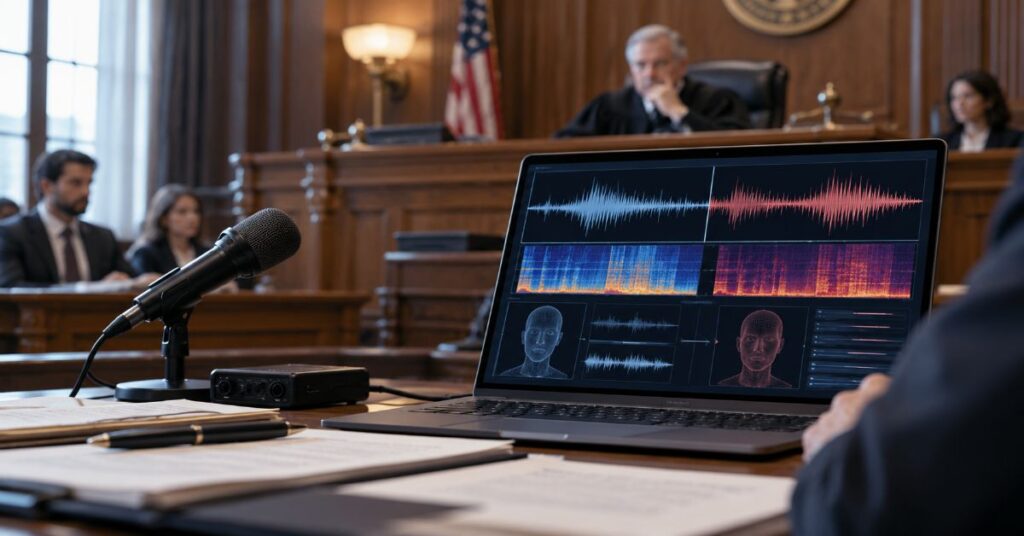
Yes, deepfake audio can be used as evidence in court in some circumstances—but a synthetic voice recording is not automatically proof that the impersonated person said anything. The question “can deepfake audio be used as evidence in court” conceals two opposite courtroom uses: offering a fabricated clip as proof of someone’s words, and offering that same clip as proof that someone manufactured a false recording. A court may reject the first proposition while admitting the second.
The distinction became concrete in the United States in March 2026. In Burnley v. Valentin, a litigant said a disputed telephone recording was an AI-cloned voice; the judge held an evidentiary hearing and found sufficient evidence of authenticity. At the same time, a federal advisory committee was considering whether ordinary authentication rules were calibrated for synthetic media. Neither development means voice cloning is now legally trustworthy by default.
Audio evidence is a bundle of claims, not a single fact. It may imply that words were uttered, that a particular person uttered them, that an event occurred at a particular time, and that the supplied file faithfully preserves the event. Each proposition needs its own foundation. A convincing voice answers almost none of those questions on its own. This guide separates genuine recordings challenged as fakes, demonstrably synthetic material offered for a legitimate purpose, AI-enhanced recordings and outright fraudulent submissions. It also explains practical preservation steps, admissibility rules in US federal courts, distinctions in England and Wales, and what emerging forensic tools can and cannot verify.
Can Deepfake Audio Be Used as Evidence in Court?
Four Different Meanings of “Using” a Deepfake
The answer depends on the purpose for which the recording is offered. A prosecution might introduce a generated robocall to show the existence and content of a fraud campaign. A victim might offer a cloned-voice voicemail to establish harassment, impersonation or attempted deception. An accused person might play a disputed recording to demonstrate fabrication of an allegation. Conversely, a party who submits a synthetic confession while pretending it is a genuine recording may be committing an evidentiary and potentially criminal wrong. The file format is the same; the claimed inference is radically different.
Courts generally ask whether the material has a legally relevant use, whether it is authenticated for that particular use, and whether another exclusionary rule applies. A synthetic recording may be relevant as an artefact of misconduct even when nobody claims its spoken content is true. The court can admit a recording for a restricted purpose and instruct the factfinder not to infer something else from it, although the suitability and effectiveness of such a measure depend on the circumstances.
| Recording offered | Proposed fact | Central problem |
| Admitted synthetic scam call | A fake call was distributed | Prove receipt, origin and material integrity |
| Genuine call disputed as fake | Named person actually spoke | Authenticate speaker and recording |
| Voice clone presented as original | Named person actually spoke | False provenance and possible fraud |
| AI-cleaned genuine recording | Underlying exchange is represented accurately | Show enhancement did not add or distort speech |
This purpose-first analysis offers a better decision tree than an unconditional yes or no. The party’s description of an exhibit determines what authenticity means: a generated message can be authentic evidence of a generated message. It is not an authentic recording of a conversation that never occurred.
What US Federal Evidence Rules Actually Require
Authentication Is Not the Same as Truth
Federal Rule of Evidence 901(a) asks for evidence sufficient to support a finding that an item is what the proponent claims. Examples include a witness with knowledge, distinctive characteristics, expert comparison and familiarity with a voice under Rule 901(b)(5). The rule does not say a digital recording must be certified by an AI detector. Nor does it make a familiar voice conclusive. Voice familiarity can establish a preliminary evidentiary foundation while leaving substantial room to contest accuracy and provenance.
Other rules remain relevant after authentication. Rule 401 addresses relevance; Rule 403 permits exclusion where specified risks substantially outweigh probative value; Rule 702 governs qualifying expert testimony; hearsay restrictions and exceptions can matter when spoken words are offered for their truth. Rule 902 addresses categories of self-authenticating material and certain electronic records. A hash or technical certificate can help establish that a copy matches a source file; it cannot independently establish that the source captured a real speaker.
Why the Purpose of the Statement Matters
Consider a fake call in which a voice resembling a bank manager demands a transfer. If the issue is whether a victim heard a threatening demand, the content may be offered for its effect on the listener rather than to prove the manager made the demand. If the issue is the manager’s participation in the fraud, however, speaker attribution becomes central. The same waveform requires a stronger evidentiary bridge to support the more serious claim.
The American Bar Association’s 2025 discussion of deepfake litigation warned that customary cues—recognition, metadata and intuitive plausibility—are vulnerable to manipulation. These concerns are important, but they do not rewrite Rule 901. Judges must apply the law in force, rather than treat a committee discussion or technology-vendor warning as an enacted rule.
The 2026 Burnley v. Valentin Case: What It Proves
Burnley v. Valentin, 2026 WL 767145 (E.D. Va.), is a valuable example because the allegation concerned audio, not a hypothetical video. During a dispute over a settlement-related telephone conversation, one party relied on a recording and the other asserted the voice was a deepfake. The federal court held an evidentiary hearing and accepted testimony from a person familiar with the voice. It found the recording sufficiently authenticated under Rule 901(b)(1), according to the case account reproduced in the US Courts Advisory Committee’s May 2026 materials.
The careful reading is narrow. The court did not declare that voice recognition defeats every credible cloning objection, did not validate a universal detector and did not establish a categorical rule that synthetic audio is admissible as proof of the impersonated person’s statements. It ruled on a particular evidentiary foundation. The subsequent committee materials themselves questioned whether the existing preliminary threshold is robust enough where a sophisticated forgery can fool a familiar listener.
The “Liar’s Dividend” Is the Opposite Risk
There are two errors to avoid. A court can be deceived by fabricated media. It can also be deceived by an unsupported claim that real media was fabricated—the so-called liar’s dividend. If any objection of “AI deepfake” automatically blocked audio, a guilty party could defeat authentic recordings without providing counter-evidence. If any recognised voice automatically overcame the objection, malicious audio impersonation would gain an easy route into the record.
A defensible response asks for a particularised allegation: what segment was altered, which source or export path is suspicious, what inconsistent records exist, and what method could test the hypothesis? That is why deepfake detection and verification methods are useful as structured checks rather than courtroom verdict machines. They can define questions for a forensic expert but should not be represented as an automatic judicial finding.
The Proposed Federal Deepfake Rule in October 2026
What Proposed Rule 901(c) Would Change
At its 15 October 2026 meeting, the US Advisory Committee on Evidence Rules examined a draft Rule 901(c) tailored to deepfake challenges. The proposal would require the opponent to supply evidence sufficient to support finding an item a deepfake; after that showing, the proponent would have to establish by a preponderance of the evidence that the item was authentic. This is a proposed two-stage allocation, not an operative amendment as of 26 October 2026. The committee had not finally approved it in the published agenda materials.
The distinction between current and proposed law is substantial. Under existing Rule 901 and Rule 104(b), a judge ordinarily decides whether the record contains sufficient evidence for a reasonable factfinder to find authenticity. Under the contemplated additional procedure, a supported challenge could trigger a more demanding judicial finding before jurors encounter the evidence. The committee considered competing worries: under-screening convincing forgeries versus inviting automatic objections that waste trial time.
The same October agenda included discussion of AI-generated outputs and draft Rule 707. That proposal concerns machine-produced evidence without an accompanying expert and is not a synonym for Rule 901(c). Conflating the two rules would give a false picture of what courts presently require. the latest deepfake detection developments show why legal institutions are considering both system reliability and the identity of the human speaker.
| Question | Current federal approach, October 2026 | Proposed deepfake approach |
| Who supplies initial authenticity foundation? | Party offering exhibit, under Rule 901 | Party offering exhibit; challenge may trigger additional stage |
| What triggers stronger judicial scrutiny? | Specific circumstances and existing rules | Supported showing of possible deepfake |
| Who decides disputed threshold? | Judge screens under Rule 104(b); jury may decide ultimate authenticity | Judge would assess authenticity by preponderance after trigger |
| Is the new rule enacted? | Not applicable | No, draft under committee consideration |
Can AI-Generated Audio Ever Prove Something True?
Evidence of Creation, Distribution and Impact
A fabricated recording may directly demonstrate its own content and acoustic characteristics. It can help establish that a threat was sent, that an employer received an impersonation attempt, or that a particular voice imitation circulated. In civil cases, that may matter to reputation, contractual deception, privacy or damages. In criminal matters it may relate to fraud, intimidation or obstruction, subject to the elements of the offence and local law. The audio usually requires accompanying evidence about who created it, where it travelled and who encountered it.
The most persuasive package rarely consists of the audio file alone. It may include original device logs, platform delivery records, contemporaneous messages, authenticated account access records, payment requests and recipients’ observations. A synthetic clip may prove that deceptive speech existed without proving that a named defendant generated or sent it. Investigators should treat creation, transmission, receipt and impact as separate propositions, each supported independently.
Evidence of What Was Not Said
In some disputes the recording is helpful precisely because it is demonstrably fake. A defendant may offer a forensic reconstruction or the synthetic original to show how a misleading exhibit was created. A demonstrative recreation should be clearly labelled as such. A model that produces similar output under certain settings may support a plausibility argument, but reproduction alone does not establish who authored the disputed clip. Disclosure of the model, input recordings, prompts, processing path and relevant reproducibility limits is essential to prevent an illustrative experiment becoming a second source of confusion.
This distinction matters beyond law. how synthetic content affects privacy explains why impersonation compromises identity and trust even when there is no dispute over the technology itself. In litigation the injury and the author of the impersonation must still be established by admissible evidence, not inferred merely from a familiar-sounding voice.
A Forensic Workflow for Disputed Audio
Preserve the Earliest Available Original
The first task is preservation, not detection. Retain the source phone, recorder, messaging export or hosting record when legally possible. Document who supplied it, when it was obtained, the acquisition method, the software version used to extract it and the location of any backups. Generate a cryptographic hash of the acquired file and record it with the chain-of-custody log. Preserve the unmodified original; perform analysis on copies. A hash proves that two byte sequences match, not that the captured conversation really happened.
Establish Provenance Across Each Transfer
Social platforms and messaging services may transcode audio, remove tags, rewrap containers or resample sound. A supposed original forwarded through several apps may have lost precisely the information an examiner would need. Build a timeline from recording device to first upload, each subsequent transmission and the final exhibit. Compare timestamps against call-detail records, device settings and independent communications, allowing for time zones and clock drift. Ask whether any actor could replace the media between stages.
Test for Both Fabrication and Ordinary Editing
A qualified examiner can review acoustic continuity, room tone, spectral artefacts, codec boundaries, duplicated segments, voice characteristics and apparent splices. Tests should have recorded parameters, known reference conditions and stated uncertainties. Audio deepfake classifiers can support triage, but their false-positive and false-negative rates change with generator, compression, language and noise. A “97% fake” product interface does not automatically mean a legally calibrated 97% probability of fabrication.
Where possible, compare independent copies or contemporaneous original captures rather than trusting a single authenticity score. The the difference between accuracy and reliability is especially important here: a model with impressive average test performance may fail on the precise rare case before the court. If the examiner cannot distinguish synthetic generation from compression artefacts, the honest conclusion is inconclusive—not authentic or fake by default.
| Evidence item | What it can support | What it cannot establish alone |
| SHA-256 hash | File remained byte-identical after hashing | Original voice was genuine |
| Audio metadata | Recorded technical attributes or software history | Metadata was not rewritten |
| Speaker comparison | Voice similarity under tested conditions | Speaker identity beyond doubt |
| Deepfake classifier | Pattern-based synthetic-media suspicion | Authorship, intention or certainty |
| Independent call records | A call or session occurred | Exact spoken content |
| Trusted source capture | Continuity from collection to preservation | Truth of every statement |
What Judges Should Ask of Detection Experts
A detection report is only as useful as its scientific foundation. The court should ask what population the system was evaluated on; how closely that material resembles the disputed recording; whether results are calibrated; whether preprocessing alters the signal; whether the model’s version can be reproduced; and whether an independent method reaches compatible conclusions. A detector trained mainly on studio-quality English speech may behave differently with a short, noisy, compressed telephone call.
Expert evidence should disclose counterarguments. Can a legitimate noise-removal filter create artefacts falsely associated with synthesis? Could a novel voice-cloning method defeat a detector? Is there an acceptable error estimate for the exact operating conditions? Were reference samples gathered without contamination from public synthetic impersonations? These questions are consistent with Rule 702’s focus on sufficiently reliable principles and application, although specific admissibility findings depend on the court.
A practical report should include the sample length, file hash, format, acquisition path, transformations, detector or analysis versions, validation scope, uncertainty and alternative explanations. “AI says fake” is not a methodology. Nor is “I know the voice” a complete scientific rebuttal. Courts may accept familiar-listener testimony for foundational purposes, but technical and contextual evidence can materially strengthen or undermine it.
Readers interested in general verification practices should distinguish the safeguards described in the limitations of AI citations from media forensic authentication. A citation can confirm that a statement is attributed to a source; neither the citation nor an AI-produced summary proves that an audio recording faithfully represents an event.
AI Enhancement Can Create a Separate Admissibility Problem
Cleaning Noise Is Not the Same as Reconstructing Speech
Courts already encounter recordings enhanced for audibility. Conventional equalisation or volume adjustment may preserve underlying speech while making it easier to hear, provided the operator can explain the process and the original is available. Generative “restoration” is different when a model predicts and inserts likely phonemes, words or missing segments. Such output may be a useful investigative aid but risks being mistaken for captured sound. A reconstructed sentence cannot safely be treated as a newly recovered fact without rigorous validation.
The relevant disclosure is not simply that AI was used. Identify whether processing only changed presentation or generated new signal content; what portions changed; and whether listeners were given a side-by-side original. The strongest practice keeps the source exhibit, processed version, parameter log, software version and specialist explanation together. Where the reconstruction is materially speculative, the court may find the unaltered recording and a transcript of uncertainties more useful than apparently pristine audio.
Transcription Errors and Attribution Errors
Speech recognition adds another layer of inference. A transcript can substitute the wrong name, remove negation or merge speakers. Source audio and transcript should be distinguished, disputed passages timestamped, and inaudible words marked rather than guessed. The transcript may be an aid to evaluating the recording rather than independent proof of what happened. The judge’s directions and relevant procedural rules determine its courtroom role.
This is also where transparent editing matters. how AI disclosures affect trust provides a broader editorial analogue: disclosure allows an audience to distinguish what was observed from what a system inferred. Forensic disclosure requires more than a general statement that an algorithm helped; it must specify the changes capable of affecting meaning.
How England and Wales Differ From US Federal Courts
A US evidence-rule citation should not be exported casually to a British case. Courts in England and Wales use different procedural and evidential frameworks, with important distinctions between criminal and civil proceedings. In criminal cases, authenticity, continuity, expert evidence, disclosure and the fairness of admitting disputed material may all arise; the statutory power to exclude prosecution evidence under section 78 of the Police and Criminal Evidence Act 1984 can be relevant when its admission would have such an adverse effect on fairness that it ought not be admitted. In civil cases, procedural control and the judge’s evaluation of reliability play different roles.
The Crown Prosecution Service’s digital-material disclosure guidance, updated in June 2026, emphasises investigative strategy, reasonable lines of enquiry and handling digital information. It does not create a single special deepfake-audio admissibility test. Parties should ask early which devices, exports and specialist material must be preserved and disclosed. An allegation of synthesis is more useful when attached to a testable factual basis than when made as a generic objection to any inconvenient recording.
EU transparency rules and national bans on certain impersonations may be relevant to conduct surrounding a deepfake, but those duties do not automatically decide whether a UK, US or EU court accepts a particular exhibit. The publication and creation rules explored in AI regulation across jurisdictions answer different questions from a judge’s admissibility ruling. Criminal liability, civil liability and evidential admissibility are related but separate analyses.
| Issue | US federal litigation | England and Wales |
| Core framework | Federal Rules of Evidence, including Rules 901, 403 and 702 | Criminal/civil evidence law and applicable procedure |
| Synthetic voice allegation | Specific authentication challenge; proposed reform debated | Authenticity and fairness assessed under local rules |
| Preservation | Origin, chain of custody, forensic process | Continuity, disclosure and forensic process |
| Key caution | Proposed Rule 901(c) is not current law | Do not assume US Rule 901 applies |
The Practical Checklist for Lawyers, Victims and Investigators
Before relying on a sound file, write down the proposition it is meant to prove in one sentence. If that sentence says “the defendant uttered these words”, plan speaker and provenance authentication. If it says “the victim received this synthetic demand”, plan receipt, timeline and source authentication. If it says “this accusation was fabricated”, document the suspected generation pathway and independent contradictions. The same evidence file can support one proposition while failing another.
Next secure originals, make forensic copies, record chain of custody and prevent casual editing. Ask the person who received or recorded the audio to write a contemporaneous account before they encounter online commentary about the incident. Seek corroboration from messaging logs, independent witnesses, communications records and physical circumstances. Consult qualified forensic counsel before publishing an accusation based on a disputed voice.
For a technical challenge, avoid the shortcut of submitting an opaque detection screenshot. Obtain the test setup, method, source sample, model version, expected error behaviour and alternative explanations. If an assessment is inconclusive, say so. An unsupported false accusation of a deepfake can be as damaging to the truth-finding process as an unquestioned synthetic exhibit.
Three Scenarios That Change the Evidentiary Analysis
Scenario One: A CEO Voice Clone Orders an Urgent Transfer
A finance employee receives a voicemail apparently from the chief executive, demanding that an unusually large sum be sent to a new supplier. A bank later disputes the authorisation. The recording can be evidence that someone attempted to induce a transfer, provided the employee, messaging service and preservation records establish what was received. It cannot by itself prove that the chief executive ordered payment; indeed, the employer may be arguing the opposite. Logs showing the message arrived from a spoofed number, invoices referencing the purported beneficiary and written contemporaneous reactions can help reconstruct the event without assuming speaker identity.
The key evidentiary question may be not “is the voice real?” but “did this particular request cause the disputed transfer, and who orchestrated it?” Voice synthesis explains the mechanism of persuasion but does not answer attribution. Investigation should identify account access, network and telecom records, beneficiary accounts, recruitment of intermediaries and instructions exchanged outside the audio channel. The audio may also be offered to show notice, reliance or the reasonableness of an employee’s reaction, depending on the legal issue and governing rules.
Scenario Two: A Real Conversation Is Dismissed as AI
A party offers a recording of a negotiated agreement, only to be met with the assertion that the other speaker is a synthetic impersonation. The court should look beyond competing declarations of certainty. Were both participants in the same place, or on a service with retrievable call records? Did either person refer to details known at the time but not available in public training material? Was the recording saved before the dispute arose, and can another device or witness corroborate it? Those circumstances may help even when no reliable generative fingerprint can be recovered.
The Burnley hearing illustrates how ordinary testimony can still matter. It also illustrates why a strong challenge should not be dismissed simply because a person recognises the voice. Cross-examination can explore the witness’s degree of familiarity, the duration and quality of the sample, the existence of references for comparison, and whether the witness heard synthetic demonstrations before making an identification. Courts must prevent both fabricated authenticity claims and tactical allegations of fabrication from displacing the evidence.
Scenario Three: Generative Restoration Supplies a Missing Word
Imagine a noisy call recording in which a model outputs “I agree to pay” while the original sound contains only a fragment that could be “I agree” or “I do not agree”. A single inferred word reverses the apparent legal meaning. The processed file may be useful in developing investigative hypotheses, but its polished sound should never be confused with an independent observation. A transcript that prints the generated words without qualifications compounds the problem.
The correct comparison presents the original waveform, the enhancement output, the settings, the known listening limitations and competing interpretations. An independent analyst may be asked whether enhancement operates by selecting components already present in the recording or synthesising content from learned speech patterns. If the result cannot be replicated or supported by the original sound, the evidentiary value of that added word should be assessed separately from the source recording.
What Authenticity Technology Still Cannot Settle
Provenance standards and cryptographic signing can document the origin and processing history of particular digital objects when participants maintain trustworthy credentials and records. They are promising evidence-management tools, not universal truth certificates. A signed recording might faithfully preserve a speaker who intentionally lied. A file might be authentic but attributed to the wrong person. A genuine recording could have been made unlawfully. A missing provenance credential is not proof of fabrication, especially when a recording came through an older device or an intermediary service that strips metadata.
For similar reasons, a court should be cautious about treating industry detection benchmarks as legal likelihood ratios. Detection data commonly reflects a selected mix of synthetic and genuine samples, laboratory compression, and particular voice models. The disputed courtroom file may differ from each of those conditions. The appropriate forensic language is tied to a tested proposition: these observations are consistent with synthesis under specified conditions, or the results do not distinguish synthesis from conventional processing. Precise-sounding percentages without a relevant validation population can communicate less, not more, truth.
As tool vendors improve, the enduring question is whether each claimed link in the evidentiary chain can be inspected. A fingerprint from a provider may support a claim that its own system generated the clip; it cannot automatically exclude every competing synthesiser. A verified device signature can support a capture pathway; it cannot guarantee there was no speaker on a loudspeaker in front of the microphone. Multiple independent lines of evidence narrow these uncertainties more effectively than presenting one commercial label as a verdict.
Our Editorial Verification Process
This explainer was prepared by comparing Federal Rule of Evidence 901 as published by Cornell’s Legal Information Institute, US Courts evidence-rule materials for May and October 2026, the federal judiciary’s pending-amendments pages, the March 2026 Burnley v. Valentin case summary reproduced in advisory materials, 2025 American Bar Association analysis, the March 2025 Lawfare scholarship on generated voices, and the Crown Prosecution Service guidance on digital material as updated in June 2026. The distinction between enacted and proposed federal rules was checked against the official status pages as of 26 October 2026.
This was a documentary source review, not a laboratory evaluation, a firsthand forensic analysis or legal advice. No audio file was tested, no detector was benchmarked and no witness interviewed for this article. The published WordPress sitemap endpoints were unavailable during the research session; related internal article URLs were selected only where independently discoverable and publicly accessible. Reported case descriptions should be checked against original court filings before being relied on in litigation. This article was researched and drafted with AI assistance. An independent human editorial or legal review should verify all data, citations and named quotations against primary sources before publication; such a review is not represented here as already completed.
Conclusion
Deepfake audio exposes a mismatch between what sounds convincing and what the legal system needs to establish. A synthetic recording can be powerful proof that an impersonation, deceptive campaign or threat occurred. It generally cannot, simply because the voice is recognisable, prove that the impersonated person spoke its content. A real recording challenged as synthetic occupies the opposite position: courts should neither accept it reflexively nor exclude it on unsupported suspicion.
As of October 2026, US federal courts still apply established evidentiary rules while an advisory committee considers a more demanding route for supported deepfake challenges. The Burnley dispute shows how specific foundations matter, not that the technology problem is solved. England and Wales apply their own evidentiary and disclosure principles. Across both systems, careful acquisition, transparent enhancement, independent corroboration and modest forensic claims matter more than a one-click authenticity score.
The unresolved question is how courts can demand stronger verification without making every routine telephone recording prohibitively expensive to use. Technology will change that balance, but it will not remove the need to identify precisely what an exhibit purports to prove.
Frequently Asked Questions
Can Deepfake Audio Be Used as Evidence in Court?
Yes. Synthetic audio can be admitted when relevant and properly authenticated for its actual purpose—for example, proving that a fake message was created or received. It cannot ordinarily prove that the impersonated person actually spoke. The applicable court rules and other objections determine the result.
Can a voice-cloned confession convict someone?
A synthetic confession is not reliable proof that the person confessed. A purported original must be authenticated, and other rules and constitutional protections may apply. Proven fabrication can create separate misconduct issues.
Does a deepfake detector prove a recording is fake?
No. Classifier scores depend on training data, processing, recording conditions and the kind of synthesis involved. Forensic analysis should explain uncertainty and seek corroborating records.
What if someone falsely claims a real recording is AI-generated?
A bare allegation need not defeat a recording. Courts can assess foundation, contrary evidence and the specific concerns raised; knowingly false challenges can have legal consequences.
Has the United States adopted a special deepfake evidence rule?
Not as of 26 October 2026. The Advisory Committee was considering draft Rule 901(c), but the published materials did not identify it as enacted law.
Is AI-enhanced audio treated the same as the original?
Not necessarily. Noise reduction and generative reconstruction can change the evidence in different ways. The original, processing records and limits of the enhancement matter.
Can audio metadata establish who said something?
Usually not on its own. Metadata may inform provenance and timing but can be edited or lost. Identity requires a wider evidentiary foundation.
Are the rules the same in Britain and America?
No. US federal rules and the law and procedure of England and Wales differ. The forum, case type and purpose of the recording determine the legal analysis.
References
Federal Rules of Evidence, Rule 901. (Current text). Legal Information Institute, Cornell Law School. https://www.law.cornell.edu/rules/fre/rule_901
United States Courts. (2026, October 15). Advisory Committee on Evidence Rules: October 2026 agenda book. https://www.uscourts.gov/sites/default/files/document/2026-10-evidence-rules-agenda-book.pdf
United States Courts. (2026, May 7). Advisory Committee on Evidence Rules: May 2026 agenda book (discussion of Burnley v. Valentin). https://www.uscourts.gov/sites/default/files/document/2026-05-evidence-rules-agenda-book.pdf
United States Courts. (2026). Pending rules and forms amendments. https://www.uscourts.gov/forms-rules/pending-rules-and-forms-amendments
American Bar Association. (2025, May). AI and you: Deepfakes and the disruption of evidentiary standards in litigation. https://www.americanbar.org/groups/gpsolo/resources/ereport/2025-may/ai-you-deepfakes-disruption-evidentiary-standards-litigation/
Wexler, R., Barrington, S., Cooper, E., & Farid, H. (2025, March 10). AI-generated voice evidence poses dangers in court. Lawfare. https://www.lawfaremedia.org/article/ai-generated-voice-evidence-poses-dangers-in-court
Crown Prosecution Service. (2026, June 18). Disclosure manual: Chapter 30 – Digital material. https://www.cps.gov.uk/prosecution-guidance/disclosure-manual-chapter-30-digital-material
Maryland State Bar Association. (2026). Legal challenges of deepfake evidence. https://www.msba.org/site/content/News-and-Publications/News/General-News/Legal_Challenges_of_Deepfake_Evidence.aspx
United States Courts. (2026). Federal Rules of Evidence. https://www.uscourts.gov/forms-rules/current-rules-practice-procedure/federal-rules-evidence