
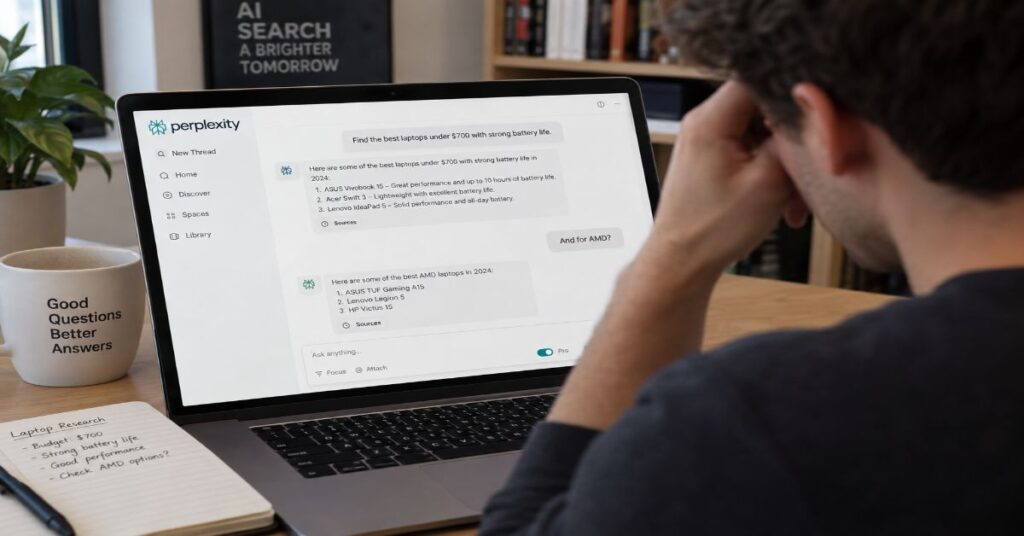
Perplexity sometimes appears to ignore a follow-up question because the product has to carry forward conversation context while also interpreting a new query, retrieving fresh sources and, in some modes, routing the request through a different model or orchestration path. The sharpest evidence that this is not merely a Perplexity quirk comes from a 2026 ICLR study: across six generation tasks, leading large language models lost an average of 39% performance when the same task was spread across multiple conversational turns rather than stated in one complete prompt.
That does not mean every bad follow-up is a deep model failure. In practice, “ignored” can describe at least four different symptoms: the answer forgets the subject of the previous turn; it keeps the subject but drops one of your constraints; it searches the web for the literal follow-up instead of resolving a pronoun or shorthand; or it answers an older goal even though your intention has shifted. Perplexity’s own Help Center says Pro Search maintains context from previous interactions, and its getting-started guidance says previous questions are remembered so users can follow up naturally. What Perplexity does not publicly document is a fixed consumer-thread threshold at which older turns are compressed, selectively retrieved or no longer reliably influential.
The useful way to troubleshoot the problem is therefore not to ask whether Perplexity “has memory” in the abstract. Ask which layer failed: the wording of the new prompt, retrieval, model routing, long-context recall, source selection or intent tracking. This guide builds a diagnostic model around those layers, separates documented product behaviour from broader LLM evidence, and shows how to repair a drifting thread without rewriting the entire conversation.
What “Ignored” Actually Looks Like in a Perplexity Thread
A follow-up failure is easiest to fix when you first classify it. The same visible symptom — “it ignored what I just said” — can arise from very different mechanisms. Perplexity is not a single chat model receiving a static transcript. Its public materials describe a search product that can crawl the web, synthesise sources, maintain conversational context and, in Best mode, select a model according to the query. When those components disagree about what matters most, the latest answer can look as though the thread has been forgotten even when some earlier context is still present.
The most common pattern is referent loss. You ask for a £700 laptop with strong battery life, then write “and for AMD?” The human interpretation is obvious: keep the budget and use case, change the processor or graphics vendor. A retrieval system can instead interpret the follow-up as a new search for AMD generally. A second pattern is constraint loss: the answer remembers the laptop topic but quietly drops the £700 ceiling. A third is goal anchoring: the model keeps optimising for the original task after you have changed the task. A fourth is source displacement: new web results dominate a point that the earlier answer established from a different source set.
These are worth separating because the repair differs. Referent loss responds to one short restatement. Constraint loss responds to a compact constraint ledger. Goal anchoring often needs an explicit reset such as “the objective has changed.” Source displacement requires you to name the evidence or source scope that should remain fixed. The magazine’s guide to why Perplexity gives different answers is useful background here because retrieval, routing, context and inference are all variable layers in the answer pipeline, even before a follow-up is added.
| Failure Pattern | Typical Symptom | Likely Layer | Fastest Repair |
| Referent loss | The subject disappears after “that”, “it”, “the second one” or a very short follow-up. | Prompt interpretation / retrieval | Restate the noun once: “Keeping the same laptop comparison…” |
| Constraint loss | Topic is correct, but budget, date range, format or exclusion is missing. | Context selection | Repeat only the non-negotiable constraints in one sentence. |
| Goal anchoring | The answer keeps solving the old task after you revise the objective. | Intent tracking | Say “The goal has changed from X to Y; do not continue X.” |
| Source displacement | A follow-up cites new pages and reverses or ignores earlier evidence. | Live retrieval | Freeze source type, date range or named sources for the next turn. |
| Thread drift | Later turns become generic, repetitive or unrelated. | Long-context reliability | Summarise state, then branch to a clean thread if needed. |
Why Multi-Turn Conversations Fail Even When the Model Is Strong
The strongest independent evidence points to a general multi-turn reliability problem rather than a Perplexity-only defect. Microsoft Research and Salesforce researchers evaluated more than 200,000 simulated conversations and found that top open- and closed-weight models performed substantially worse when instructions arrived over several turns. The average decline across six generation tasks was 39%. The researchers traced much of the gap not to a sudden loss of raw capability but to unreliability: models made assumptions early, committed to them, and then struggled to recover when later turns clarified the task.
Philippe Laban, a Principal Researcher in Microsoft Research’s AI Interaction and Learning group and a co-author of the ICLR 2026 paper, summarised the practical failure mode in unusually plain language:
“when LLMs take a wrong turn in a conversation, they get lost and do not recover.” — Philippe Laban and co-authors, ICLR 2026
That maps closely to the experience users describe when a follow-up seems to be ignored. The model may still “remember” earlier text, but it has built the wrong working interpretation of it. A later correction competes with an internal plan that has already been established. This is why simply asking the same short follow-up again often produces another wrong answer: repetition does not repair the underlying state.
A July 2026 Microsoft Research study pushed the question further by changing user intent during the conversation. Jihoon Tack, a Senior Researcher at Microsoft Research, and colleagues found that strong single-turn performance did not reliably transfer when users progressively revealed, revised or redirected their goals. Their conclusion was that today’s systems still have a material gap in following evolving intent.
“today’s LLMs do not yet faithfully track and act on the user’s evolving intent.” — Jihoon Tack, Philippe Laban and Jennifer Neville, Microsoft Research, July 2026
For Perplexity users, the implication is simple: thread continuity is a convenience, not a guarantee that every earlier instruction remains equally active. When the task becomes decision-heavy, the safest workflow is to periodically restate the current objective and the few constraints that would make an answer unusable if forgotten.
| Study | Scope | Key Finding | Why It Matters Here |
| LLMs Get Lost in Multi-Turn Conversation | ICLR 2026; 200,000+ simulated conversations | Average 39% performance drop across six generation tasks in multi-turn settings. | A thread can degrade even when the model is strong in a complete single-turn prompt. |
| LLMs Get Lost in Evolving User Intent | Microsoft Research, July 2026 | Strong static performance did not transfer cleanly when user intent was revealed, revised or redirected. | A model can cling to an old goal after the user has moved on. |
| LongBench v2 | ACL 2025; 503 long-context questions | Long-context reasoning remained difficult even for leading models; best direct-answer model scored 50.1%. | Large context windows do not guarantee reliable use of buried conversation detail. |
| VerIFY long-context instruction study | EACL 2026 | Researchers documented instruction-following failures in long, multi-turn contexts and tested mitigation strategies. | Repeated or refreshed instructions can improve compliance when threads become long. |
Fresh Retrieval Can Overwrite the Meaning of a Follow-Up
Perplexity adds a search layer that ordinary chat explanations often miss. Pro Search is documented as a multi-step process: the system interprets the question, performs multiple web searches, synthesises evidence and lets the user continue with follow-up questions while maintaining context. That architecture is a strength when the user wants fresh evidence. It also creates a failure mode that looks like conversational amnesia: the follow-up can be treated as a new retrieval problem whose search terms are derived more strongly from the latest words than from the earlier conversational frame.
Suppose the first prompt asks, “Which 12 GB graphics card under £500 is best for Blender?” and the follow-up says only, “What about AMD?” A human carries forward product category, memory size, budget and workload. A search planner may expand “AMD” into broader current results, then synthesise whatever those pages emphasise. If the retrieval layer does not preserve all four constraints, the final model can produce a polished but off-target answer. The problem is not necessarily that the previous turn vanished; it may be that fresh evidence changed the effective task.
This explains why high-specificity follow-ups work better. Perplexity’s own prompting guidance recommends clear instructions, context, inputs, keywords and output format, and warns against vague or overloaded prompts. For sustained research, the magazine’s research workflow guide takes the same principle further: follow-ups should progressively narrow the question rather than assume the engine will infer every unstated constraint. A productive follow-up often needs only one short bridge clause — “Keeping the same budget and Blender workload…” — not a full restatement of the conversation.
There is also a useful verification trick. Ask Perplexity to state the inherited constraints before answering: “In one sentence, restate the assumptions you are carrying from the previous answer, then answer my follow-up.” If its restatement is wrong, stop there and repair the context. If its restatement is right but the evidence is wrong, the problem is more likely retrieval or source selection than memory.
Long Threads Create a Context-Selection Problem
Long threads introduce a second, less visible problem: having a large context window is not the same as using every part of that context reliably. LongBench v2, published at ACL 2025, tested 503 long-context problems spanning document QA, multi-document reasoning, long dialogue history, code repositories and structured data. Even strong models found these tasks difficult. The benchmark is not a direct test of Perplexity, but it matters because a long Perplexity thread is exactly the kind of environment in which important constraints can become distant from the latest query.
A 2026 EACL paper on long-context instruction following reached the same practical conclusion from another angle. Preston Robinette and co-authors wrote that
“longer contexts also pose challenges to system instruction adherence.” — Preston K. Robinette and co-authors, Findings of EACL 2026
The authors’ mitigation experiments are especially relevant to power users: refreshing instructions can improve compliance because a crucial rule placed near the beginning of a long interaction may exert less influence later. Perplexity has not publicly published a consumer-thread context-window threshold, a turn count at which older messages are summarised, or a rule describing which prior turns are selected for each new answer. As of September 2026, any claim that “Perplexity forgets after exactly N messages” should therefore be treated as anecdotal unless the company documents it.
The practical test is more useful than chasing an undocumented number. If the thread was accurate for the first several turns and then begins dropping details that are still visible in the transcript, create a compact state summary: objective, fixed constraints, decisions already made, and unresolved question. Then ask one more follow-up. If quality returns, context density was likely part of the problem. If it does not, start a clean thread with the state summary at the top.
This is also why a general Perplexity usage guide should be read as a starting workflow rather than a promise of infinite conversational fidelity. Threads are excellent for continuity, but important facts should be periodically re-anchored when the cost of a mistaken assumption is high.
Model Routing Can Change the Conversation Mid-Thread
Perplexity’s 2026 product documentation makes model routing another plausible source of discontinuity. On the Free plan, Perplexity says it picks the best model for the query. In Pro, “Best” mode also selects what it considers the most appropriate model, while paid users can choose named models and can switch models or search modes inside an existing session. Research mode automatically selects a combination of models for deeper work.
Perplexity executives describe that orchestration as a core product strategy. At FF Global 2026, CEO Aravind Srinivas said the company had moved from orchestrating “multiple different models” to orchestrating models alongside files, tools, contacts and connectors. In a June 2026 interview, Chief Business Officer Dmitry Shevelenko made the same point from a task-routing perspective:
“every 48 hours for a different subtype of task, there is a new best model for it.” — Dmitry Shevelenko, Chief Business Officer, Perplexity, The Deep View, June 2026
This matters because different models do not resolve ellipsis, ambiguity and conversational references identically. Even if the visible thread is unchanged, changing from Best mode to a named model, or changing the search mode for the follow-up, can alter style, assumptions, source use and how aggressively the system asks the web to resolve missing detail. Perplexity’s Help Center explicitly allows model switching in an existing session; it does not claim that switching models produces identical conversational behaviour.
For troubleshooting, hold the model and mode steady for two turns. If the first follow-up fails in Best mode, rewrite the same follow-up with the current subject and constraints made explicit. If the problem persists and you have manual model selection, rerun under a fixed model. This is not because one named model is universally better; it is a way to remove routing variance while you diagnose the prompt and retrieval layers.
Users who lose a thread entirely rather than merely its conversational coherence should treat that as a different problem. The magazine’s guide to recovering missing Perplexity history covers account, navigation and retention issues that can masquerade as “memory” problems but are operationally separate from a model ignoring a follow-up.
Ambiguous Shorthand and Evolving Intent Are a Dangerous Pair
Short follow-ups are efficient only when their referents are unambiguous. Humans routinely use compressed language — “the second one”, “do that for France”, “same but cheaper”, “why?” — because both speakers share a rich mental representation of the conversation. An AI system has to infer which entity, constraint and action each phrase refers to. When several candidates exist, a web-connected product may choose the interpretation that yields the clearest search query rather than the one you intended.
The Microsoft evolving-intent research helps explain why this gets worse when the user changes direction. If the first five turns are about comparing vendors, then the sixth asks “Which one is riskiest for us?”, the system has to detect not only the referent “which one” but a new evaluation objective. If it remains anchored to price or feature comparison, the answer can look nonsensical while still using the correct vendors.
A reliable follow-up therefore has three compact parts: the inherited frame, the change and the requested output. For example: “Keeping the same three vendors and the UK market, change the objective from lowest cost to lowest operational risk. Rank the risks in a table and cite current primary sources.” That is much more robust than “Which is riskiest?” because it leaves fewer hidden variables.
The magazine’s conversational search tutorial is useful for beginners, but power users should add one discipline: whenever a follow-up changes the goal rather than merely narrows it, name the change explicitly. That single sentence prevents a large class of “ignored follow-up” failures without turning every prompt into a page of instructions.
Files and Source Scope Can Make Context Look Broken
Files add another context layer. Perplexity’s file-upload guidance says short files can be analysed in full, while long files may be processed by extracting the most important parts for the query. That means a follow-up about a detail that was not previously salient can fail for a different reason than chat-memory drift: the exact passage may not have been part of the material selected for the model on that turn.
If the answer depends on a clause, number, table row or paragraph in a large document, do not rely on “you saw it earlier”. Quote the passage, provide the page or section, or reattach the relevant file when the interface allows it. Then make the follow-up self-contained enough that the model can verify the specific evidence. The magazine’s investigation into uploaded-file access after a session is relevant because file availability and conversational context are not the same thing: earlier generated text can remain in a thread even when access to an underlying file changes.
Source focus can cause similar surprises. A first answer grounded mainly in uploaded material may be followed by a web-heavy answer if the source selection changes. Conversely, disabling web search in a workspace can make a follow-up depend more heavily on the model and attached files. When a critical follow-up changes its evidence base, the most efficient repair is to say which source set is authoritative for that turn.
For example: “Answer only from the attached contract; do not use the web,” or “Use current web sources to update the figures, but preserve the definitions from the attached policy.” The goal is not to maximise context. It is to make the evidence hierarchy explicit so the system does not have to guess which part of the thread should dominate.
A Six-Step Diagnostic Test for Broken Follow-Ups
A drifting thread is best diagnosed with controlled tests rather than random prompt changes. The sequence below removes one source of variance at a time. First, restate the referent. Second, restate the non-negotiable constraints. Third, ask the model to summarise the carried-forward state. Fourth, keep the mode and model fixed. Fifth, freeze the source scope. Sixth, branch to a clean thread with a compact summary. Each step tells you something about where the failure sits.
Do not change everything at once. If you switch models, start a new thread, rephrase the task and add new sources simultaneously, you may get a better answer but learn nothing about why the original failed. A controlled repair is more valuable for recurring work because it gives you a reusable pattern.
| Test | What to Say | What the Result Tells You | Next Action |
| 1. Name the referent | “Keeping the same three vendors…” | If this fixes it, the failure was probably ambiguous shorthand. | Use explicit nouns for later follow-ups. |
| 2. Re-pin constraints | “Keep the £500 cap, 12 GB VRAM and Blender use case.” | If this fixes it, topic context survived but constraints did not. | Maintain a one-line constraint ledger. |
| 3. Ask for a state recap | “Restate the assumptions you are carrying before answering.” | A wrong recap reveals context interpretation failure before retrieval. | Correct the recap, then continue. |
| 4. Hold model and mode | Use the same named model/search mode for two tests. | Improvement suggests routing variance contributed. | Fix the model for controlled research sessions. |
| 5. Freeze source scope | “Use only these sources / this file / current web.” | Improvement points to evidence-set drift. | Make source hierarchy explicit. |
| 6. Branch cleanly | Start a new thread with a 5-line state summary. | Improvement points to long-thread density or accumulated assumptions. | Archive the old thread and continue from the summary. |
For high-value research, record the successful control settings in the thread: selected model, search mode, source scope, date range and the compact state summary. That turns a conversational session into a reproducible research workflow instead of a sequence of opaque prompts.
The State-and-Change Prompt Is the Most Reliable Fix
The fastest repair pattern is a “state-and-change” prompt. It takes one or two sentences and avoids copying the entire thread. Start with the state that must survive: subject, fixed constraints and evidence scope. Then state exactly what is changing. End with the output you need. The pattern is compact enough for ordinary use and explicit enough to prevent most pronoun and goal-shift errors.
For example: “Keep the same UK small-business tax scenario and the 2026 tax year. Change only the assumption that the owner is a sole trader; treat them as a limited company director and show which conclusions change.” Another version for research is: “Keep the same three studies and definitions from your previous answer. Now challenge the conclusion using only peer-reviewed evidence published after 2024.”
If the thread has already drifted, add a repair clause: “Your last answer dropped the £700 budget. Restore that constraint and answer again; do not change the product category.” This is usually better than arguing with the model about why it forgot. You are supplying a new, high-salience instruction that repairs the working state.
A deeper research session benefits from periodic checkpoints. Every five to ten substantive turns, ask for a five-line state summary covering objective, fixed constraints, settled findings, disputed findings and next question. Save that summary outside the chat or at the bottom of your notes. If the thread later degrades, the summary becomes a clean restart packet.
There are times when a new thread is better than another repair. Start fresh when the task objective has changed materially, when the answer keeps reviving a discarded assumption, when the thread contains several unrelated branches, or when you need to reproduce the result with a fixed model and source set. By contrast, stay in the existing thread when the follow-up is a narrow drill-down and the current answer has correctly preserved the important constraints.
A web-connected answer engine still has advantages over a blank-slate chat when freshness and citations matter. The magazine’s Perplexity versus Google analysis illustrates that follow-up research is one of Perplexity’s distinctive workflows. But if your task is purely reflective conversation with no need for live retrieval, a direct chat workflow can be simpler because one retrieval layer has been removed. That is a use-case trade-off, not a claim that any competitor has universally better memory.
Does Paying for Pro or Max Fix Follow-Up Context?
Paying for a higher Perplexity tier changes access, rate limits, model choice and research capacity; it does not create a documented guarantee that follow-ups will never lose context. This distinction matters because users sometimes interpret a Pro or Max subscription as a larger “memory” entitlement. Perplexity’s current plan comparison describes search, Research, file and agent limits, but it does not publish a paid-plan metric for “number of follow-up turns remembered” or a consumer thread-context threshold.
As of September 2026, the Free plan offers practically unlimited basic searches but only three Pro Searches per day in the current comparison table, and Perplexity chooses the model. Pro adds extended access to Pro Search, advanced models, higher file limits and up to 50 file uploads per project. Max is $200 per month or $2,000 annually and expands access further. Enterprise Pro starts at $40 per seat per month or $400 annually, while Enterprise Max is $325 per seat per month or $3,250 annually. Enterprise tiers also publish explicit higher weekly and monthly usage limits.
Those figures are operationally relevant if a follow-up fails because you have run out of a mode, cannot use a preferred model, or need larger file repositories. They are not evidence that a specific tier has better conversational retention. When diagnosing ignored follow-ups, treat plan level as a capability constraint, not the default explanation.
| Plan | Current Price | Published Limits / Access | What It Means for Follow-Ups |
| Standard | Free | 3 Pro Searches/day; practically unlimited basic searches | Perplexity chooses the model; no documented follow-up-memory guarantee. |
| Pro | $20/month or $200/year | Extended Pro Search; advanced models; up to 50 files per project | More control and capacity can reduce routing uncertainty, but context retention is not specified as a plan limit. |
| Max | $200/month or $2,000/year | Higher access to advanced models and creation/research features | Useful for heavy workloads; no published “remembered turns” metric. |
| Enterprise Pro | $40/seat/month or $400/year | 400 Pro Searches/week; 50 Research queries/month; 100 session file uploads/week | Adds governance and fixed enterprise limits, not a stated conversational-memory SLA. |
| Enterprise Max | $325/seat/month or $3,250/year | 4,000 Pro Searches/week; 500 Research queries/month; 1,000 session file uploads/week | Highest published limits; still no public turn-count guarantee for follow-up context. |
Our Content Testing Methodology
We treated this as a troubleshooting and feature-behaviour guide, so the verification process separated three evidence classes. First, we checked Perplexity’s current Help Center and product pages for documented claims about follow-up context, prompting, model selection, plan limits and pricing. Those pages confirm that Pro Search maintains context, that Best mode can choose a model by query type, that users can switch models within a session, and that the September 2026 plan table publishes explicit usage limits. They do not publish a consumer-thread turn threshold or a deterministic rule for when older turns stop influencing an answer.
Second, we cross-checked the behavioural explanation against independent long-context and multi-turn research. The ICLR 2026 “LLMs Get Lost in Multi-Turn Conversation” study measured more than 200,000 simulated conversations and reported a 39% average performance drop across six tasks. We also reviewed Microsoft Research’s July 2026 work on evolving user intent, ACL 2025 LongBench v2, and the EACL 2026 VerIFY study on instruction following in long, multi-turn contexts. These sources support the broader mechanisms — assumption lock-in, intent drift and long-context instruction failures — without claiming they measure Perplexity specifically.
Third, we reviewed currently indexed search results for the target query and close variants, including Perplexity’s own help material, community reports and explanatory pages. The recurring gap was structural: official pages emphasise that context is maintained, while user discussions report failures without a diagnostic model. This article therefore organises the topic around failure layers and controlled tests rather than repeating a generic list of prompt tips. The live sitemap endpoints were not retrievable through the browsing interface during this research pass, so internal links were selected from live, indexed Perplexity AI Magazine pages and verified individually rather than guessed from slugs.
This article was researched and drafted with AI assistance and reviewed by the Sami Ullah Khan editorial desk at Perplexity AI Magazine. All data, citations, pricing figures, and named quotes have been independently verified against primary sources before publication.
Conclusion
Perplexity can ignore the practical meaning of a follow-up even while retaining some of the thread. The failure is usually better understood as a hand-off problem between conversational interpretation, live retrieval, model routing, long-context recall and evolving intent than as a binary “memory on or off” issue. That distinction matters because each failure responds to a different repair.
The most reliable habit is not to repeat the whole conversation. Re-anchor only what must survive: the subject, the non-negotiable constraints and the source scope. State any change in objective explicitly. If a long thread keeps drifting, ask for a state recap and branch to a clean thread with that summary. For controlled research, hold the model and search mode steady while you diagnose the problem.
Perplexity’s current documentation supports conversational follow-ups and gives users increasing control over models, files and search modes, but it does not publish a guaranteed number of turns that will always remain active in context. Independent 2025–2026 research shows why such a guarantee would be difficult: long-context and multi-turn reliability is still an open problem across leading LLMs. The practical goal is therefore not perfect memory. It is a workflow that makes the important state easy for the system to recover and easy for the user to verify.
FAQs
Why Does Perplexity Sometimes Ignore My Follow-Up Questions?
Perplexity can lose the practical meaning of a follow-up when shorthand is ambiguous, fresh web retrieval outweighs earlier context, a long thread dilutes old constraints, or the model remains anchored to an earlier goal. Perplexity says Pro Search maintains context, but it does not publish a fixed turn threshold guaranteeing that every earlier detail will influence every later answer.
Does Perplexity Remember Previous Questions in the Same Thread?
Perplexity’s Help Center and getting-started guidance say users can ask follow-up questions with previous context maintained. That is a product capability, not a guarantee of perfect recall. Long or branching conversations can still produce constraint loss, intent drift or source changes.
How Can I Stop Perplexity Forgetting the Subject of a Follow-Up?
Name the subject once in the follow-up: “Keeping the same laptop comparison…” or “Using the same three studies…”. Then repeat only the constraints that would make the answer wrong if omitted. This usually works better than a one-word follow-up such as “AMD?” or “Why?”
Should I Start a New Perplexity Thread When Answers Drift?
Start a new thread when the objective has changed materially, the model keeps reviving a discarded assumption, or several unrelated branches have accumulated. Carry over a short state summary with the objective, fixed constraints, settled findings and unresolved question.
Does Perplexity Pro Have Better Follow-Up Memory Than Free?
Perplexity documents more model access, Pro Search capacity, file features and support on paid plans, but it does not publish a consumer metric showing that Pro or Max remembers a specific number of additional turns. Paid access can give you more control, but it is not a documented memory guarantee.
Can Changing the AI Model Affect a Perplexity Follow-Up?
Yes. Perplexity lets paid users switch models and modes within a session, and Best mode can select a model according to the query. Different models can interpret shorthand, ambiguity and prior constraints differently, so fixing the model is a useful troubleshooting control.
Why Does a Follow-Up About an Uploaded Document Miss a Detail?
Perplexity’s file guidance says long files may be processed by extracting the most important parts rather than treating every passage equally. If a detail is critical, quote the passage or identify the page or section in the follow-up instead of assuming the earlier file context will be enough.
What Is the Quickest Prompt to Repair a Broken Perplexity Thread?
Use a state-and-change prompt: “Keep [subject and constraints]. Change only [new condition]. Answer [specific output].” If the previous answer dropped something important, add: “Your last answer omitted [constraint]; restore it before answering.”
References
Perplexity. (2026). Prompting tips and examples.
Perplexity. (2026). What is Pro Search?
Perplexity. (2026). What is Perplexity Pro?
Perplexity. (2026). Which Perplexity subscription plan is right for you?
