
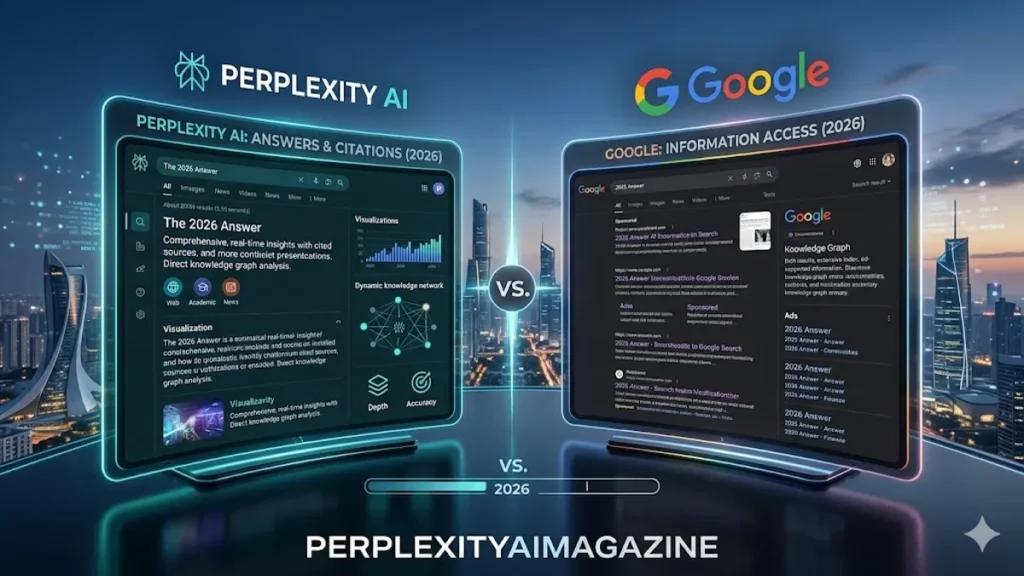
I switched Perplexity AI to my default browser search for three months in 2025 to find out what Google does that Perplexity cannot replace, and what Perplexity does better. The answer is not the dramatic “Perplexity has killed Google” narrative that some AI publications have run with, nor is it the dismissive “AI search is just a gimmick” counterargument. It is more nuanced and more practically useful than either of those positions.
Perplexity AI is genuinely better than Google for a specific category of queries that represents a significant portion of what most knowledge workers, students, researchers, and professionals search for. For everything outside that category, Google remains unmatched. Understanding exactly where that line sits is what this article is for.
Where Perplexity AI Is Clearly Better Than Google
Perplexity AI consistently outperforms Google for what I call synthesis queries — questions where the answer requires reading and integrating information from multiple sources rather than navigating to a specific page. When you ask Google “what are the long-term cardiovascular effects of daily aspirin use in patients over 70?” it returns a list of links from medical publications, WebMD, Mayo Clinic, and academic sources. You then need to open several, read them, and synthesise the answer yourself. Perplexity reads them for you, synthesises a structured answer with numbered citations linking to each source, and lets you verify any specific claim in one click.
Research published across independent evaluations consistently shows that Perplexity reduces research time on complex informational queries by 25–30% compared to traditional search. Its 93.9% factual accuracy score on the SimpleQA benchmark outperforms Google AI Overviews on complex queries. Its citation transparency — every claim linked to its source — is something Google’s AI Overviews do not replicate with equivalent granularity.
The queries where Perplexity reliably beats Google:
- Multi-source research queries — any question requiring synthesis across several credible sources rather than navigation to a single page.
- Complex analytical questions — “compare the evidence for X and Y approaches to Z” type queries where the answer requires evaluating competing evidence.
- Academic and scientific questions — with Academic Focus active, Perplexity retrieves from peer-reviewed sources in a way Google’s general index does not systematically prioritise.
- Follow-up research sessions — Perplexity maintains context across a conversation, so follow-up questions build on previous ones. Google resets each query.
- Any query where you need to verify the source of a specific claim — Perplexity’s numbered citations make this instant. Google’s results require clicking through and reading to find the specific claim.
Where Google Is Still Irreplaceable
Google’s advantages over Perplexity are real and significant. They are not diminishing with AI improvements — they are structural features of what Google is built to do. The first is index scale: Google indexes the entire web in a way no competing platform approaches. For obscure topics, niche subjects, regional content, and anything published in the past few hours, Google’s coverage is deeper than Perplexity’s.
The second is local and transactional search. When you search for a restaurant nearby, a local business’s phone number, directions to an address, product prices across retailers, or a news headline from this morning — Google is faster, more comprehensive, and more directly actionable than Perplexity for these use cases. Perplexity does not compete on Maps, Shopping, Images, or local business discovery.
The third is navigational search. When you are trying to reach a specific website, find a company’s official page, or navigate to a known destination, Google’s understanding of branded queries and navigational intent is not matched by Perplexity’s research-first architecture. Perplexity will give you information about a company; Google will take you directly to the company’s website.
| Query Type | Use Perplexity | Use Google |
|---|---|---|
| Research with synthesis | ✅ Perplexity wins — cited synthesis | Links only — synthesis manual |
| Complex multi-part questions | ✅ Perplexity wins — thread continuity | Each query resets |
| Academic / peer-reviewed sources | ✅ Perplexity wins — Academic Focus | Mixed with non-academic content |
| Local business search | Limited | ✅ Google wins — Maps + index depth |
| Shopping / price comparison | Not designed for this | ✅ Google wins — Shopping integration |
| Navigational queries | Not optimal | ✅ Google wins — branded query strength |
| Image search | Limited | ✅ Google wins — largest image index |
| Breaking news | News Focus available | ✅ Google wins — real-time index |
| Fact-checking with source verification | ✅ Perplexity wins — instant citations | Requires clicking through multiple results |
| Following up on a topic | ✅ Perplexity wins — full thread context | No conversation continuity |
When to use Perplexity AI vs Google Search by query type, 2026. Most power users run both for different tasks rather than replacing one with the other.
The Honest Verdict
Perplexity AI is better than Google for research. It is not better than Google for everything Google does. The question “is Perplexity better than Google?” is slightly misconceived because it treats them as competing for the same space — and they are not, entirely. Google is a search engine that tries to be useful for every query type across the entire spectrum of human information need. Perplexity is a research engine that tries to be the best possible tool for finding, synthesising, and verifying information from the web.
The most accurate 2026 answer is: switch to Perplexity as your primary research tool for informational queries. Keep Google for navigational, local, shopping, and image queries. Most power users in 2026 already run exactly this combination — they have not replaced Google, they have added Perplexity for the category of queries where it is materially better.
💡 The two-tool workflow most knowledge workers use in 2026Set Perplexity AI as the default for research queries — complex informational questions, multi-part comparisons, academic topics, fact-checking. Keep Google as the default for everything else — navigational, local, shopping, images, quick news headlines. The combined cost is $0 if you use both free tiers, or $20/month if you upgrade Perplexity to Pro. Most users find this combination covers every search need better than either tool alone.
Click Here to Read More About AI & Tech!
Frequently Asked Questions
Is Perplexity AI better than Google for research?
Yes, for most research workflows. Perplexity’s numbered citation system, Academic Focus mode, Deep Research feature, and thread continuity consistently outperform Google’s link-based results for complex informational queries. Perplexity reduces research time by 25–30% on synthesis tasks and makes source verification instant. For local, shopping, navigational, and image queries, Google remains superior.
Can Perplexity replace Google completely?
No — and this is not the right goal. Google’s local search, Maps, Shopping, image index, and navigational query strength serve use cases that Perplexity does not target. Most users who adopt Perplexity seriously use it alongside Google rather than instead of it: Perplexity for research and synthesis queries, Google for everything else. The combination outperforms either tool alone.
Why is Perplexity better than Google for research?
Four reasons: numbered citations that verify every claim instantly, Academic Focus that restricts to peer-reviewed sources, thread continuity that builds context across follow-up questions, and Deep Research that synthesises dozens of sources into structured reports. Google’s link-based results require you to do this synthesis manually — clicking through multiple articles, reading, and integrating information yourself. Perplexity does it for you.
Is Perplexity AI more accurate than Google?
For complex informational queries, yes. Perplexity scores 93.9% on the SimpleQA factual accuracy benchmark. Google’s AI Overviews have documented error rates estimated at up to 15% on complex queries (Gartner). Perplexity’s citation transparency also makes any remaining errors easier to catch and verify. For straightforward factual lookups, both are similarly accurate.
Is Perplexity AI free like Google?
Yes — Perplexity has a free plan that includes unlimited standard searches, all Focus modes, voice search, Collections, and limited Spaces access. Unlike Google, Perplexity’s free plan has a daily limit on its Pro Search (enhanced research) mode at approximately five queries per day. Pro at $20/month removes that limit. Google Search remains completely free with no usage limits.
What does Perplexity do that Google cannot?
Four things Google cannot match: numbered inline citations linking every claim to a verifiable source, conversational threads where follow-up questions retain full context from previous exchanges, a dedicated Deep Research mode producing structured multi-source reports in minutes, and Focus modes that direct searches specifically to academic papers, Reddit communities, YouTube content, or computational data via Wolfram Alpha.
How many people are switching from Google to Perplexity?
Perplexity has grown from 22 million to 45 million monthly active users between January and April 2026 — over 100% growth in under four months. It processes 780 million queries per month, triple its mid-2024 volume. This growth reflects users adding Perplexity for research tasks rather than wholesale replacement of Google, which still processes billions of queries daily. The market is expanding, not simply redistributing.
