
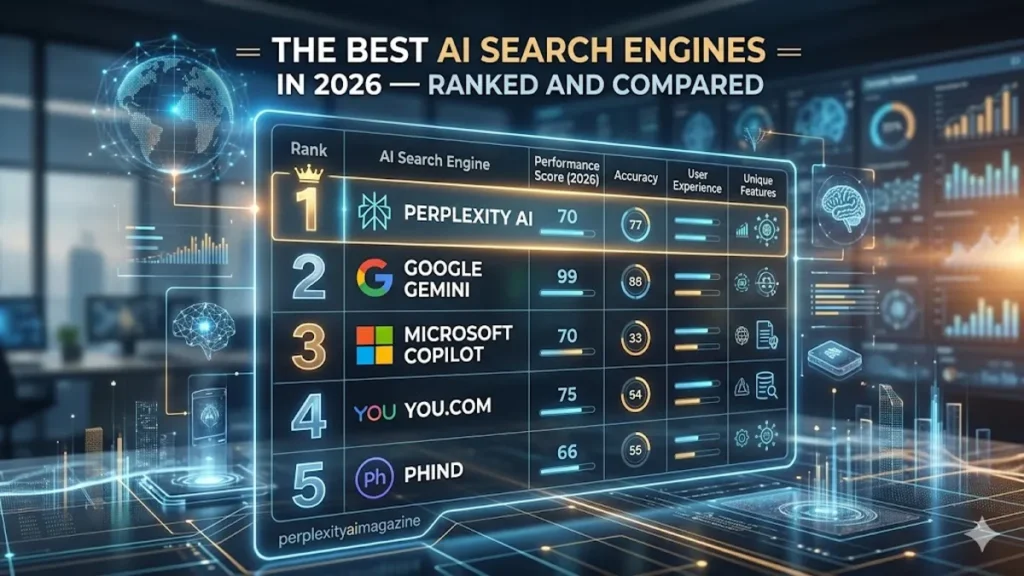
In 2026, “AI search” has moved from a marketing description to a meaningful technical category. The platforms in this comparison are not traditional search engines with AI features bolted on. They are systems built around a different premise: instead of returning a list of links and expecting you to synthesise the information yourself, they retrieve, read, and synthesise that information for you — with varying degrees of transparency about where the answer came from. – best ai search engines.
I have tested every platform in this ranking on identical research tasks. The evaluation criteria are the ones that matter for actual use: factual accuracy and citation quality, research depth, how well the tool handles complex multi-part queries, cost relative to what you get, and the specific use cases where each platform genuinely excels. These are honest rankings based on real use — not press release summaries.
1. Perplexity AI — Best Overall AI Search Engine
Perplexity AI earns the top position in 2026 for one reason above all others: it is the only AI search platform where every claim in every answer is linked to a specific, verifiable source you can check in one click. This is not a marginal feature — it is the architectural principle that distinguishes serious research tools from fast answer generators. With 93.9% factual accuracy on the SimpleQA benchmark, 95% citation precision, 780 million queries processed per month, and a $20 billion valuation reflecting investor confidence in its trajectory, Perplexity AI is the most mature, most research-appropriate AI search platform available in 2026.
Its Focus modes (Academic, Reddit, YouTube, News, Wolfram Alpha) give precise source control. Its Deep Research mode, updated in March 2026 to lead on the Scale AI Research Rubric, produces structured multi-source reports that most competing platforms cannot approach. The Comet browser, free on iPhone, Android, Mac, and Windows, extends Perplexity’s capabilities into full browsing sessions. The free plan is genuinely useful. Pro at $20/month is one of the most justified AI subscriptions available. For research-intensive workflows, Perplexity AI is the clear choice.
2. ChatGPT Search — Best General-Purpose AI with Search
OpenAI’s ChatGPT with Search enabled is the second-strongest AI search platform in 2026. GPT-5.2 brings genuine improvements in multi-step reasoning, and the search integration has matured significantly from its early versions. ChatGPT Search provides web-retrieved answers with source citations, and its conversational interface handles complex follow-up questions well. Its advantage over Perplexity is breadth — as a general-purpose AI, it handles creative writing, coding, image generation, and voice conversation in ways Perplexity does not compete on. Its disadvantage is that search is one of many features rather than the core product, which means citation granularity and research depth are slightly behind Perplexity’s dedicated architecture.
3. Grok — Best for Real-Time Social Intelligence
Grok from xAI earns its position through two genuine differentiators: real-time access to the X social graph (data no other AI platform has) and a documented hallucination rate of approximately 4% — among the lowest measured for any frontier model. For monitoring social media, tracking breaking news through X discourse, and conversational research with a personality that engages rather than deflects, Grok is the strongest option. At $8/month via X Premium, it is also the most affordable paid AI with real-time capabilities. Its weakness is citation granularity — it does not match Perplexity’s systematic claim-by-claim attribution.
4. Google Gemini — Best for Google Ecosystem Users
Google Gemini’s 2026 position is defined by two extraordinary capabilities: a 1 million token context window that enables processing entire books or datasets in a single session, and native integration across Gmail, Docs, Sheets, Drive, and other Google Workspace applications. For users embedded in Google’s ecosystem, Gemini’s workflow integration is unmatched. Its Deep Research, powered by Gemini 3.1 Pro, performs well on technical and scientific analysis. Its pricing — starting at $7.99/month with 2TB Google One storage included — makes it potentially the best value for existing Google storage subscribers.
5. Microsoft Copilot — Best for Microsoft 365 Users
Microsoft Copilot’s ranking reflects the same logic as Gemini’s — its strength is integration depth rather than raw search quality. Native AI assistance in Word, Excel, PowerPoint, Outlook, and Teams gives Copilot a practical workflow advantage for Microsoft-dependent organisations that no standalone search tool can replicate. Its research quality, powered by GPT models and Bing’s index, is functional but not research-first. GitHub Copilot, a separate product, is among the strongest AI coding tools available.
| Platform | Best For | Citation Quality | Free Plan | Paid Plan |
|---|---|---|---|---|
| Perplexity AI | Research, fact-checking, academic work | Excellent — numbered inline citations | Unlimited standard search | $20/month Pro |
| ChatGPT Search | General use + research + creative tasks | Good — improving with GPT-5.2 | GPT-5.3 with limits | $20/month Plus |
| Grok | Social media monitoring, X intelligence | Good — less granular than Perplexity | Limited access | $8/month via X Premium |
| Google Gemini | Google Workspace, multimodal, long docs | Moderate — less systematic | Gemini 3 Flash + 15GB storage | $7.99–19.99/month |
| Microsoft Copilot | Microsoft 365 users, enterprise | Moderate — Bing-powered | Bing chat + Edge sidebar | $20/month Pro |
| You.com | Privacy-focused search, developer tools | Good — cited responses | Yes | $15/month Pro |
Best AI search engines 2026 ranked by research quality and use case fit. All pricing as of April 2026.
💡 The optimal AI stack for most knowledge workers in 2026Most serious information professionals in 2026 do not rely on a single AI search tool. The most effective combination is: Perplexity AI for cited research and fact-finding → ChatGPT or Claude for writing and synthesis → Grok for real-time social intelligence. This covers all major research and production needs for approximately $48/month total. – best ai search engines.
Click Here to Read More About AI & Tech!
Frequently Asked Questions
What is the best AI search engine in 2026?
Perplexity AI leads for research-grade work requiring verifiable citations. It combines real-time web retrieval, numbered inline citations on every claim, Deep Research for multi-source synthesis, and Focus modes for targeted source selection. For general-purpose AI plus search, ChatGPT Search with GPT-5.2 is the strongest alternative. The right choice depends on whether you prioritise research quality or general-purpose capability.
Is Perplexity AI better than ChatGPT for search?
For research tasks requiring transparent, verifiable citations: yes. Perplexity’s architecture is search-first with numbered citations on every claim. ChatGPT Search is improving but search is one feature among many rather than the core product. For creative tasks, coding, image generation, and general conversation, ChatGPT’s broader capability set makes it the better choice. Many users run both.
Which AI search engine is free?
All major AI search platforms have free tiers. Perplexity AI offers unlimited standard searches free. ChatGPT provides GPT-5.3 access with usage limits. Google Gemini includes its Flash model with 100 AI credits free. Microsoft Copilot is free via Edge. Grok has limited free access. The Comet browser by Perplexity is a completely free download with no subscription required.
What is the most accurate AI search engine?
Perplexity AI scores 93.9% on the SimpleQA factual accuracy benchmark with 95% citation precision. Grok is reported at approximately 4% hallucination rate by independent testing. Both are among the most accurate AI search platforms in 2026. The practical difference is that Perplexity’s citation transparency makes errors catchable instantly, while Grok’s multi-agent architecture reduces errors at the generation stage.
Is Google still the best search engine in 2026?
Google remains the best search engine for navigational queries, local business searches, shopping, images, and maps — where its incomparably large index is decisive. For research-grade informational queries requiring synthesised, cited answers, dedicated AI search engines like Perplexity are consistently more accurate and more efficient. Most users in 2026 use both: Google for practical everyday tasks, Perplexity for research.
What makes Perplexity different from other AI search engines?
Three things: numbered inline citations that link every claim to a verifiable source, a retrieval-first architecture that searches the live web before generating any answer, and dedicated research features (Academic Focus, Deep Research, Spaces) that are purpose-built for sustained research workflows rather than casual queries. Perplexity was designed as a research tool first — not a chatbot that was given search access later.
Can AI search engines replace Google?
Not entirely, and probably not soon. Google’s local search, shopping integration, Maps, image search, and sheer index scale serve use cases that dedicated AI search engines do not target. For informational research queries, AI-native engines like Perplexity are already superior for many users. The more accurate framing is that AI search engines are replacing the specific subset of Google queries that required reading multiple articles — not Google itself.
