
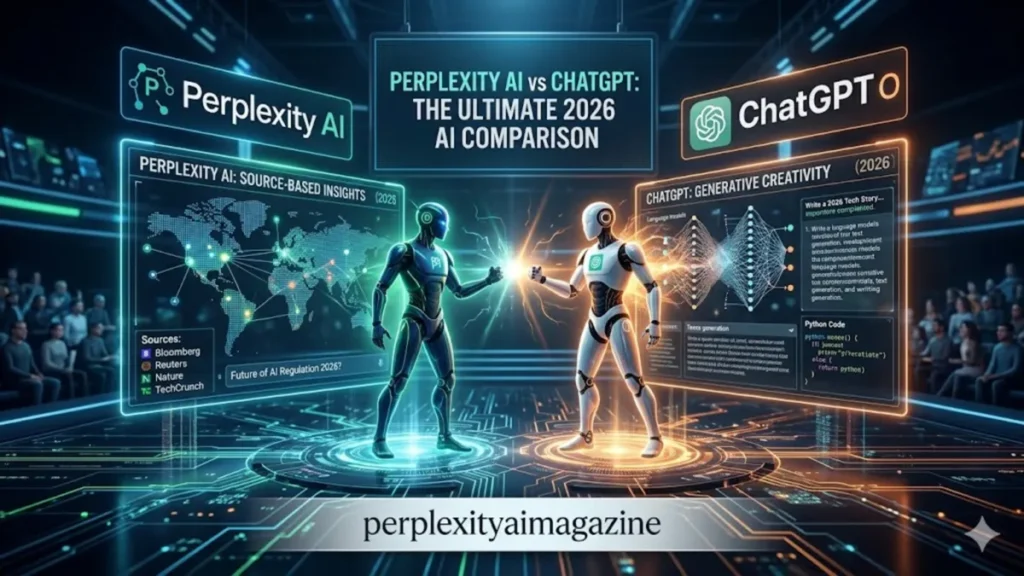
The dawn of 2026 has solidified a fundamental shift in the digital landscape: we no longer simply “search” for information; we negotiate with it. For over a decade, the Google search bar was the undisputed gateway to the internet, a predictable ritual of keywords and blue links. Today, that ritual is being dismantled by two distinct architectures of intelligence. On one side stands ChatGPT, the cultural phenomenon from OpenAI that has evolved from a clever conversationalist into a massive, multi-modal operating system for the mind. On the other is Perplexity AI, the self-proclaimed “answer engine” that treats the internet not as a library of documents, but as a real-time database to be synthesized and cited. – perplexity ai vs chatgpt.
The choice between Perplexity and ChatGPT is no longer a matter of which AI is “smarter”—the underlying large language models (LLMs) are increasingly comparable in raw reasoning power. Instead, the decision hinges on the user’s intent. Are you trying to build something from nothing, or are you trying to find something that already exists? ChatGPT remains the undisputed champion of the “blank page,” helping users draft, code, and brainstorm with a creative fluidity that mimics human thought. Perplexity, meanwhile, has captured the loyalty of the “research class”—journalists, analysts, and students—who demand transparency, real-time accuracy, and the comfort of a clickable footnote. As OpenAI integrates its “SearchGPT” capabilities into the core ChatGPT experience, the battle for the future of information retrieval has moved from the laboratory to the front lines of global productivity.
The Architect vs. The Librarian: Defining the Paradigm
To understand the friction between these two platforms, one must look at their foundational philosophies. ChatGPT is an architect. It is designed to take a prompt and build a structured response, often drawing from its vast, pre-trained internal parameters. While it can now browse the web with high proficiency, its primary strength is “generative.” It excels at taking a 50-page PDF and turning it into a poem, or taking a vague idea for a software feature and outputting a functional Python script. Its interface, particularly with the 2025 release of “Canvas,” is optimized for iteration—allowing users to highlight text and ask the AI to “shorten this” or “change the tone.” – perplexity ai vs chatgpt.
Perplexity AI, by contrast, operates like a world-class librarian with a photographic memory. It was built from the ground up on a framework known as Retrieval-Augmented Generation (RAG). When you ask Perplexity a question, its first instinct isn’t to “think,” but to “look.” It dispatches multiple search queries simultaneously, parses the top results from the live web, and then uses an LLM to weave those results into a coherent narrative. “The goal is to be the world’s most transparent information interface,” says Aravind Srinivas, CEO of Perplexity. This commitment to transparency is visible in the UI, where citations are not buried in a menu but are presented as prominent chips above the response.
| Feature | ChatGPT (OpenAI) | Perplexity AI |
| Primary Identity | General-purpose AI Assistant | AI-powered “Answer Engine” |
| Search Philosophy | Integrated “SearchGPT” mode | Native RAG (Search-first) |
| Citations | Inline footnotes (select modes) | Prominent source cards & chips |
| Core Strength | Creative writing, coding, reasoning | Fact-finding, research, news |
| Model Choice | Fixed (GPT-4o / GPT-5 series) | Switchable (Claude, GPT, Sonar) |
| Ecosystem | DALL-E, Canvas, Custom GPTs | Pages, Discover, Shopping Hub |
The War for Real-Time Accuracy
In the early years of the AI boom, ChatGPT was frequently criticized for “hallucinations”—the confident delivery of false information. This was a byproduct of its training; it was predicting the next word in a sequence, not checking a fact. By 2026, OpenAI has largely mitigated this through its “SearchGPT” integration, but a ghost of that reputation remains. For users whose jobs depend on accuracy—lawyers, doctors, and financial analysts—Perplexity’s “Source-First” approach provides a psychological safety net. If Perplexity makes a claim about a stock price or a legislative change, the link to the primary source is always millimeters away. – perplexity ai vs chatgpt.
The competitive landscape shifted significantly in late 2025 when Perplexity launched its “Pro Discovery” and “Shopping Hub” features. While ChatGPT focuses on being a collaborative partner, Perplexity is moving toward being a transactional engine. Through its Shopping Hub, backed by investors like Jeff Bezos and Nvidia, users can not only research the best mechanical keyboard but purchase it directly through the interface. This move directly challenges the traditional “Search-to-Ad-to-Store” pipeline that has enriched Google for decades, positioning Perplexity as a utility rather than just a chatbot.
“Perplexity is not trying to be your friend or your therapist. It is trying to be the shortest path to the truth. That is a fundamentally different product goal than what OpenAI is pursuing.” — Ben Thompson, Stratechery (Analyst Quote)
Creative Agency and the “Canvas” Era
While Perplexity wins on factual retrieval, ChatGPT has pulled ahead in the realm of “agentic” workflows. With the introduction of the GPT-5.4 model family, ChatGPT has moved beyond the “chat” box. Its “Canvas” interface allows for a side-by-side workspace where the AI and the human can work on the same document or codebase in real-time. This turns the AI from a search tool into a co-author. For a developer, ChatGPT isn’t just a place to find a library; it’s the place to write, test, and debug the code in a persistent sandbox.
This “workspace” evolution is ChatGPT’s moat. The platform has become an ecosystem. With millions of “Custom GPTs” created by users for specific tasks—ranging from board game rule explainers to specialized academic tutors—OpenAI has created a network effect that Perplexity, with its narrower focus on search, has yet to match. ChatGPT’s multimodal capabilities also remain the gold standard; its ability to “see” via a camera and “hear” with emotional nuance in Live Mode makes it a more versatile companion for daily life.
| Metric (2025-2026 Est.) | ChatGPT | Perplexity AI |
| Monthly Active Users | ~1.2 Billion | ~45 Million |
| Annual Recurring Revenue | ~$4.5 Billion | ~$200 Million |
| Top User Demographic | Creative Pro, Devs, Casual | Researchers, Journalists, Analysts |
| Platform Availability | Web, iOS, Android, macOS, Win | Web, iOS, Android, Chrome Ext. |
| Market Valuation | ~$157 Billion | ~$21 Billion |
The Ethics of the Infinite Index
As both companies grow, they face a shared existential crisis: the “vampire” problem of AI search. By summarizing the web so effectively, they risk starving the very publishers they rely on for information. If a user gets a perfect summary of a New York Times article on Perplexity, they have no reason to click the link, depriving the Times of ad revenue. Perplexity attempted to solve this in mid-2025 with its “Publishers’ Program,” a revenue-sharing model that pays creators when their content is cited. OpenAI has taken a different route, signing multi-year, billion-dollar licensing deals with giants like Axel Springer and Condé Nast.
“We are moving into an era where ‘knowledge’ is no longer a commodity you find, but a service you subscribe to. The risk is that we trade the messy diversity of the open web for a polished, AI-curated monoculture.” — Dr. Feifei Li, Stanford Institute for Human-Centered AI
The divergence in these approaches reflects their corporate identities. OpenAI is the “Big Tech” incumbent, playing the game of high-stakes corporate partnerships. Perplexity is the “disruptor,” trying to build a new, decentralized economy for information. For the end user, this battle determines the quality of the “truth” they receive. A “licensed” answer from ChatGPT might feel more official, but a “searched” answer from Perplexity might feel more objective and less influenced by backroom corporate deals. – perplexity ai vs chatgpt.
Takeaways for the AI-Native User
- Accuracy vs. Agency: Use Perplexity when the cost of being wrong is high; use ChatGPT when the value of the creative output is the priority.
- The Citation Divide: Perplexity remains the superior tool for academic and professional research due to its transparent, source-heavy UI.
- Workflow Integration: ChatGPT’s “Canvas” and sandbox environments make it the better choice for long-term projects like coding an app or writing a book.
- Real-Time Nuance: While both have web access, Perplexity’s RAG engine is generally faster and more comprehensive for breaking news and technical documentation.
- Ecosystem Depth: ChatGPT offers a broader suite of multimodal tools (DALL-E, Voice, Video), whereas Perplexity is a specialized “surgical” tool for data.
Conclusion
The rivalry between Perplexity AI and ChatGPT is not a zero-sum game, but a reflection of the dual nature of human inquiry. We are a species that needs both facts and stories. Perplexity has mastered the art of the fact, turning the chaotic sprawl of the internet into a structured, verifiable index. It has restored a sense of order to an information environment that was increasingly cluttered by SEO-driven “junk” content. ChatGPT, conversely, has mastered the art of the synthesis, providing a mirror for our own creativity and a tool for expanding the boundaries of what we can build.
As we move deeper into 2026, the two platforms are likely to converge. OpenAI will continue to sharpen its search capabilities to protect its massive user base, while Perplexity will inevitably add more generative “workspace” features to increase user retention. However, their core identities will remain distinct. Choosing between them is an exercise in self-awareness: do you need a map to help you navigate the world as it is, or a compass to help you create a world that hasn’t yet been imagined? In the age of AI, the most important skill is knowing which tool to pick up before you start the conversation.
Click Here to Read More About AI Tools!
FAQs
1. Is Perplexity AI more accurate than ChatGPT?
Generally, yes, for factual and real-time queries. Because Perplexity is built primarily as a search engine using Retrieval-Augmented Generation (RAG), it prioritizes sourcing and verifying information from the live web. While ChatGPT’s “SearchGPT” mode is highly capable, its core remains a generative model, which can occasionally prioritize conversational flow over strict factual adherence if search is not explicitly engaged.
2. Can I use Perplexity for coding like I use ChatGPT?
You can, but the experience is different. Perplexity is excellent for finding code snippets, documentation, or debugging specific errors by searching Stack Overflow and GitHub. However, ChatGPT (specifically with its Canvas and sandbox features) is superior for writing large-scale applications, refactoring code, and maintaining a persistent development environment where the AI understands the context of your entire project.
3. Which tool is better for students and researchers?
Perplexity AI is widely considered the gold standard for research. Its “Focus” modes allow users to restrict searches to academic papers (via Semantic Scholar) or specific domains. The way it displays citations—clearly linked and easy to verify—makes it much easier to integrate into formal bibliographies and prevents the accidental plagiarism that can occur with purely generative tools.
4. Do I need to pay for both subscriptions?
For most users, one is sufficient. If your work is 80% research and data gathering, Perplexity Pro is the better investment. If your work involves writing, content creation, or complex problem-solving, ChatGPT Plus offers more value. However, many power users in 2026 utilize both: Perplexity to gather the “raw materials” of a project and ChatGPT to “manufacture” the final result.
5. How do these tools handle user privacy?
Both companies offer “Pro” or “Team” tiers that provide enhanced data protection. OpenAI generally allows users to opt-out of training their models on user conversations. Perplexity has similar privacy controls but emphasizes that its search-centric nature means it focuses more on the query than the personal context. Always avoid inputting sensitive or proprietary data into the free, public versions of either tool.
References
BrightEdge. (2026, April 4). How OpenAI’s new search engine could change the search landscape. BrightEdge SEO Blog. https://www.brightedge.com/blog/how-openais-new-search-engine-could-change-search-landscape
Coursera. (2026, January 27). Perplexity vs. ChatGPT: Key differences and which is best for your tasks. Coursera Articles. https://www.coursera.org/articles/perplexity-vs-chatgpt
Panto AI. (2026, April 8). Perplexity AI statistics 2026: Users, queries, revenue & growth. GetPanto. https://www.getpanto.ai/blog/perplexity-ai-statistics
Stanford Graduate School of Business. (2025, June 18). Perplexity’s Aravind Srinivas on the infinite value of knowledge. Stanford GSB Insights. https://www.gsb.stanford.edu/insights/perplexitys-aravind-srinivas-infinite-value-knowledge
Zapier. (2026, March 24). Perplexity vs. ChatGPT: Which AI tool is better? [2026]. Zapier Blog. https://zapier.com/blog/perplexity-vs-chatgpt/
