
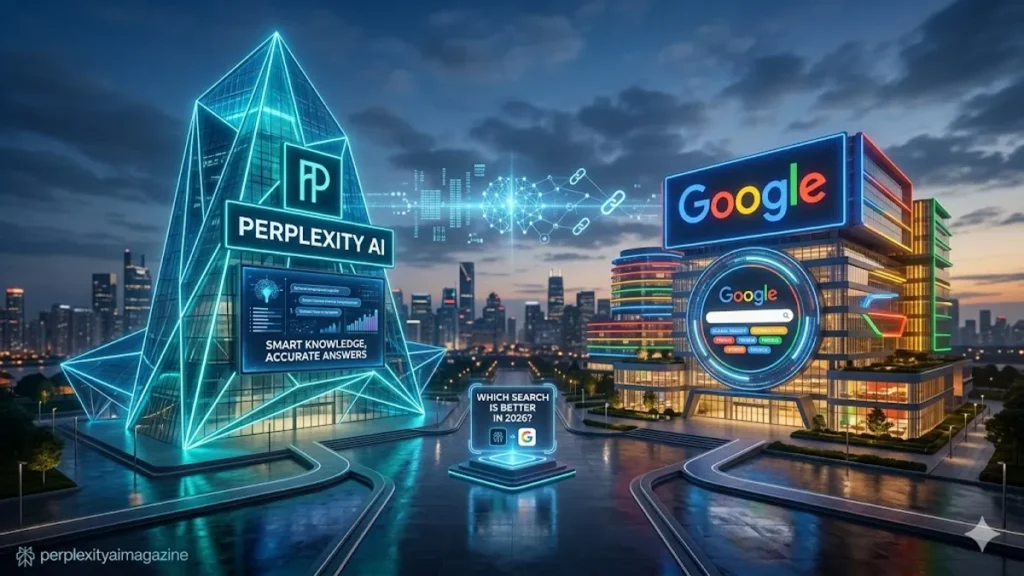
By April 2026, the fundamental act of “Googling” has entered a state of identity crisis. For over a quarter-century, the world’s information was organized by a list of blue links, but today, that interface feels increasingly like an artifact of a slower era. The shift is driven by a profound divergence in how we retrieve truth: Google remains the dominant ecosystem of discovery, while Perplexity AI has emerged as the premier engine of synthesis. While Google leverages its massive index to offer breadth and local utility, Perplexity’s “answer engine” model prioritizes depth and transparency through real-time citations. For the average user, the choice is no longer about which tool has more data, but whether they want to browse a library or interview a librarian. – perplexity ai vs google.
The competitive tension reached a fever pitch in late 2025 with the wide release of Google’s AI Overviews, a direct response to Perplexity’s rapid ascent among power users. Perplexity, led by former OpenAI researcher Aravind Srinivas, has successfully positioned itself as the “distilled” alternative to a Google search page often cluttered with sponsored content and SEO-optimized filler. By providing direct, conversational answers grounded in verifiable sources, Perplexity has captured a vital demographic of researchers, developers, and analysts. However, Google’s unmatched integration with Maps, YouTube, and Workspace ensures that while Perplexity may win the “answer,” Google still owns the “action.” As both companies race to define the post-link internet, the result is a fundamental rewriting of the digital contract between publishers, platforms, and the public.
The Librarian vs. The Index: A Clash of Philosophies
The primary distinction between Perplexity and Google lies in the “Last Mile” of the user experience. Google was built to be a gateway—a middleman that directs you to other people’s websites. Its business model, predicated on the $200-billion-a-year search advertising machine, requires users to see and click on links. Perplexity, by contrast, is a destination. It uses Retrieval-Augmented Generation (RAG) to read the internet on your behalf, providing a cohesive narrative that combines information from dozens of sources into a single, cited paragraph. This approach effectively collapses the research process, turning a ten-minute browsing session into a ten-second read. – perplexity ai vs google.
This architectural difference creates a “speed-to-truth” gap that has become Perplexity’s primary marketing weapon. When a user asks about the specific regulatory hurdles for a new biotech startup in Singapore, Google provides a list of government PDF links and news articles. Perplexity provides the answer itself, with small, clickable footnotes that verify each claim. “We aren’t a chatbot; we are an answer engine,” Srinivas has frequently noted in interviews, emphasizing that the goal is to provide the shortest path to a factual conclusion. Google has attempted to close this gap with its Gemini-powered overviews, but it faces the “Innovator’s Dilemma”: providing too good an answer might discourage the very clicks that sustain its advertising partners.
| Feature | Google Search (AI Overviews) | Perplexity AI |
| Core Identity | Discovery & Commercial Gateway | Synthesis & Research Engine |
| Monetization | Ad-heavy (CPC/CPM) | Subscription (Pro) & Revenue Sharing |
| Primary Output | Hybrid (AI Summary + Links) | Direct Answer (Citation-first) |
| Local Utility | Unmatched (Maps, Reviews, Hours) | Limited (Mostly textual) |
| Research Depth | Broad, exploratory | Deep, multi-step “Pro” reasoning |
| Ecosystem | Android, Chrome, Workspace | Browser-agnostic, API-focused |
The Battle for Accuracy and Trust
As AI hallucinations became a mainstream concern in 2025, the two platforms took different paths to establish trust. Perplexity’s strategy was to “show its work.” Every sentence in a Perplexity response is typically tied to a source card. This transparency has allowed it to maintain a lower perceived error rate among academic and professional circles. In a 2026 market analysis, researchers found that Perplexity’s “Deep Research” mode—which can browse up to 50 sources for a single query—provided 25% more accurate technical documentation than traditional search engines. This “source-grounding” is the bedrock of its appeal to those who cannot afford to be wrong. – perplexity ai vs google.
Google, meanwhile, has leveraged its vast “Knowledge Graph”—a database of billions of facts about people, places, and things—to anchor its AI. While Google’s AI Overviews initially faced criticism for occasionally citing satirical or outdated content, the 2026 iterations are significantly more robust. Google’s advantage is its ability to cross-reference AI-generated text with its proprietary data on real-world entities. For instance, if you ask for the “best-rated sushi near me,” Google’s AI doesn’t just guess; it pulls live data from millions of verified Google Maps reviews. Perplexity, lacking this proprietary physical-world data, remains a tool primarily for digital and academic inquiry rather than local logistics.
“The existential threat to Google isn’t that someone makes a better search engine, but that someone makes search unnecessary. Perplexity is moving toward a future where the AI is the agent that does the work, not just the index that finds the work.” — Ben Thompson, Stratechery Analyst
The New Economics of Content
The most contentious front of the Perplexity vs. Google war is not technological, but ethical. By summarizing the web so effectively, both platforms risk “cannibalizing” the traffic of the publishers they rely on. In late 2025, Perplexity took a radical step by launching its “Publishers’ Program.” Under this model, Perplexity shares a portion of its revenue with content creators whose work is used to generate an answer. This was a preemptive strike against the lawsuits that have plagued OpenAI and Google, aiming to create a sustainable “AI-to-Publisher” economy.
Google has responded with its own multi-billion-dollar licensing deals, but its scale makes a universal revenue-sharing model nearly impossible. The tension is palpable: if a user gets a perfect summary of a Wall Street Journal investigation on the search page, they are far less likely to visit the Journal’s site. This “zero-click” phenomenon is the new reality of 2026. Experts suggest that as AI agents become more sophisticated, the very concept of “website traffic” may be replaced by “knowledge citations,” forcing a complete overhaul of how digital media is valued and sold. – perplexity ai vs google.
| Metric (2025-2026) | Perplexity AI | |
| Daily Search Volume | 9+ Billion | 25+ Million |
| Mobile Integration | Default on 3B+ Androids | Third-party (iOS/Android apps) |
| AI Model Used | Gemini 2.0 / 3.0 Ultra | GPT-4o, Claude 3.7, Sonar |
| Revenue Model | 80% Advertising | 90% Subscription (Pro) |
| User Retention | High (Ecosystem Lock-in) | High (Research Utility) |
Agency and the Rise of “Deep Research”
The latest evolution in this rivalry is the concept of “Agentic Search.” In early 2026, Perplexity introduced its “Comet” updates, which allow the AI to perform multi-step tasks, such as finding a flight, comparing it against your calendar, and drafting an itinerary in one go. This moves the platform from an “answer engine” to a “doing engine.” Google has countered with “Project Astra” and Gemini Live, which integrate vision and voice to provide real-time assistance via smartphone cameras. The goal for both is to transition from a tool you “use” to a companion you “delegate” to.
This transition highlights the different strengths of each company’s engineering culture. Perplexity is agile, iterating on user feedback in weeks rather than months. Its “Spaces” feature allows teams to build shared knowledge bases that the AI can search across, making it a favorite for corporate research departments. Google, however, has the “Moat of Data.” Its ability to see your emails, your flight confirmations, and your document history gives it a contextual awareness that Perplexity, as a third-party tool, can never fully replicate without significant privacy trade-offs. – perplexity ai vs google.
“We are moving from an era of ‘Search and Browse’ to an era of ‘Ask and Receive.’ In this new world, the value is not in the abundance of information, but in the precision of the filter.” — Dr. Feifei Li, Stanford HAI
Takeaways: Navigating the New Search Landscape
- Task-Based Selection: Use Perplexity for deep dives, literature reviews, and factual verification; use Google for local services, shopping, and broad discovery.
- The Citation Moat: Perplexity’s “Source-First” UI is the primary reason it has retained a high-value user base despite Google’s massive distribution advantage.
- Ecosystem vs. Utility: Google remains a lifestyle OS (integrated with Maps/Mail), while Perplexity is a specialized tool for the “Knowledge Class.”
- Zero-Click Reality: Both platforms are significantly reducing outbound traffic to publishers, necessitating new revenue models for digital content.
- Agentic Future: The next frontier is not better answers, but autonomous agents that can execute tasks based on search results.
Conclusion
The battle between Perplexity AI and Google represents more than just a competition for market share; it is a battle for the soul of the internet. Google, the architect of the link-based web, is struggling to evolve without destroying the very ecosystem that made it a titan. Perplexity, the nimble challenger, is attempting to build a new paradigm of “Answer-as-a-Service,” where the value lies in the synthesis rather than the source. For the user, this competition has brought about a golden age of productivity, where the friction between a question and a verified answer has been reduced to almost zero.
However, the “Answer Engine” model carries a collective risk. As we stop visiting original websites and start relying on AI summaries, we risk narrowing our intellectual horizons to whatever the model deems relevant. The “serendipity” of the old web—the accidental discovery of a fascinating article while searching for something else—is being traded for the cold efficiency of a cited paragraph. Whether Perplexity can scale to match Google’s reach, or whether Google will eventually absorb Perplexity’s innovations into its own behemoth, the way we know things has been forever altered. In 2026, the search for truth is no longer a solo journey through the links; it is a conversation with the machine.
Click Here to Read More About AI Tools!
FAQs
1. Is Perplexity AI more accurate than Google Search?
For complex, multi-step research queries, Perplexity often provides more synthesized and accurate answers because it reads and summarizes multiple sources simultaneously. However, Google is still more accurate for “real-world” data, such as business hours, live sports scores, and local navigation, thanks to its integration with Google Maps and its proprietary Knowledge Graph.
2. Does Perplexity AI show ads like Google?
As of early 2026, Perplexity has introduced a “sponsored questions” model that is much less intrusive than Google’s traditional ad results. While Google relies heavily on cost-per-click advertising, Perplexity’s primary revenue comes from its “Pro” subscription. However, Perplexity has started experimenting with brand-sponsored follow-up questions to diversify its income.
3. Can Perplexity replace Google for everyday use?
For informational and academic needs, yes. For transactional needs (buying a specific product, booking a hotel) or local needs (finding a nearby plumber), Google remains superior. Google’s ecosystem—including YouTube and Images—also makes it better for multimedia-heavy searches that Perplexity, which is largely text-centric, cannot yet match.
4. How do these tools affect privacy?
Google tracks user behavior across a massive suite of products (YouTube, Mail, Search) to build a detailed advertising profile. Perplexity claims to be more privacy-focused, though it still collects query data to improve its models. Both offer “Incognito” or “Pro” modes that provide higher levels of data protection for sensitive professional research.
5. Which one is better for students?
Perplexity is generally preferred by students because it automatically generates citations in formats like APA or MLA and allows for “Deep Research” into academic databases. It functions like a research assistant that summarizes peer-reviewed papers, whereas Google Search often prioritizes commercial or SEO-heavy content that may not be suitable for academic work.
References
BrightEdge. (2026, March 12). The state of generative engine optimization: How Perplexity is shifting the search landscape. BrightEdge Research. https://www.brightedge.com/blog/state-of-generative-engine-optimization
Gartner. (2025, December 5). Gartner predicts search engine volume will drop 25% by 2026 due to AI chatbots. Gartner Newsroom. https://www.gartner.com/en/newsroom/press-releases/2024-02-19-gartner-predicts-search-engine-volume-will-drop-25-percent-by-2026-due-to-ai-chatbots
Index.dev. (2025, November 4). Perplexity AI vs Google AI overviews 2026: Which delivers better answers?. Index.dev Blog. https://www.index.dev/blog/perplexity-vs-google-ai-overviews
MediaPost. (2025, August 25). Perplexity AI browser becomes publishing’s new revenue stream. MediaPost Communications. https://www.mediapost.com/publications/article/408425/perplexity-ai-browser-becomes-publishings-new-rev.html
Statcounter. (2026, March). AI chatbot market share worldwide – March 2026. Statcounter Global Stats. https://gs.statcounter.com/ai-chatbot-market-share
