
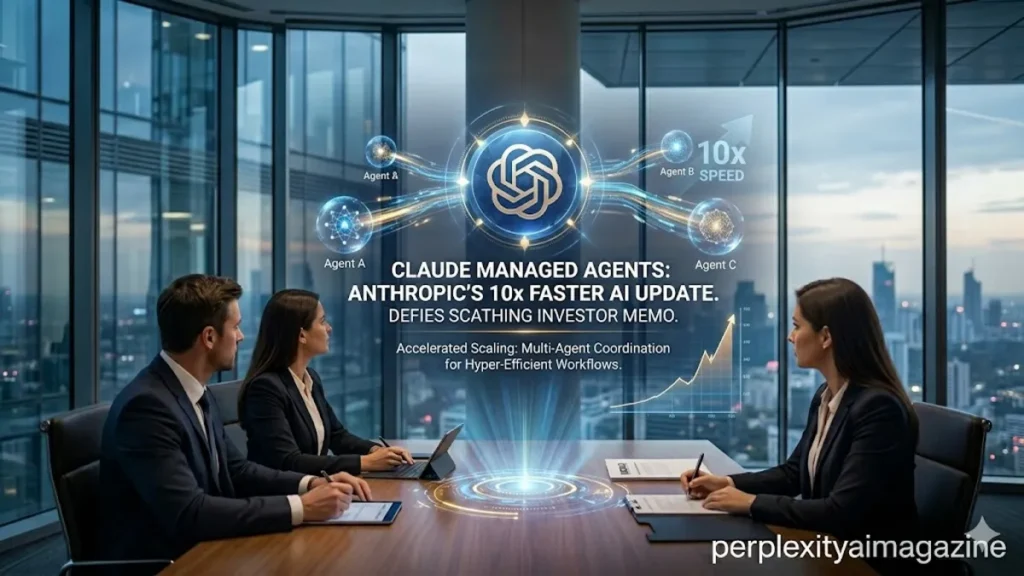
SAN FRANCISCO — Anthropic announced the public beta release of Claude Managed Agents on April 8, 2026, a high-velocity platform designed to enable developers to build and deploy autonomous AI agents up to 10 times faster than previous industry standards. By providing a fully managed infrastructure that handles sandboxing, persistent sessions, and complex multi-agent coordination, Anthropic aims to reduce production cycles from several months to just a few days. The move positions Anthropic as a primary contender in the burgeoning “Agentic AI” market, directly challenging the infrastructure dominance of OpenAI and Microsoft. – anthropic claude agents.
Beyond Simple Automation: The Agentic Leap
The platform introduces a suite of features designed to move AI beyond reactive chat interfaces into proactive, long-running autonomous workflows. Key to this release is secure sandboxing, which allows agents to execute code and interact with environments safely, and multi-agent coordination, enabling parallel workflows where specialized agents collaborate on end-to-end tasks.
“We are moving from agents that suggest to agents that execute,” an Anthropic spokesperson noted during the launch. “The goal is to remove the DevOps overhead that typically kills AI projects before they reach production.”
Early Adopters Report Radical Efficiency Gains
The impact of the “10x faster” claim is already being validated by early enterprise partners. Notion reported integrating agents directly into workspaces for complex task assignment, achieving a 90% cost saving and 85% latency reduction through optimized prompt caching. – anthropic claude agents.
Other notable success stories include:
- Rakuten: Deployed over 70 specialist agents across marketing and finance in one week per agent, shifting their deployment cycle from quarterly to biweekly.
- Asana: Their “AI Teammates” now handle compliance reviews and launch plans that once took days; these now require only a 15-minute human oversight.
- Vibecode: Developed a mobile app builder that allows users to publish apps via voice in under an hour for approximately $100, replacing manual sandboxes that previously took weeks to configure.
Pricing and Technical Accessibility
Claude Managed Agents operates on a consumption-based pricing model. In addition to standard Claude token rates, Anthropic charges $0.08 per active session-hour. This “pay-as-you-go” approach is aimed at startups and researchers who need to prototype rapidly without the burden of custom server maintenance.
Developers can access the platform via the Claude Console, a new CLI tool, or the Claude-API Skill. The platform currently supports the latest iterations of the Claude 4.6 model family (Sonnet and Opus), emphasizing high-reasoning capabilities and native Model Context Protocol (MCP) integration. – anthropic claude agents.
Expert Analysis: The Industrialization of AI Autonomy
The launch of Claude Managed Agents marks a pivotal shift in the AI landscape: the transition from Model-as-a-Service to Infrastructure-as-a-Service. While 2024 and 2025 were defined by the race for higher parameters and better benchmarks, 2026 is becoming the year of “Agency.”
What makes this release significant isn’t just the speed—it’s the governance. By baking identity management, tracing, and secure sandboxing into the platform, Anthropic is addressing the “trust gap” that has prevented many Fortune 500 companies from deploying autonomous agents. However, this creates a “walled garden” effect. While OpenAI offers more model flexibility and Google Vertex AI provides multi-vendor support, Anthropic is betting that developers will sacrifice model choice for a streamlined, secure, and hyper-fast deployment experience.
In the long term, this could lead to an “Agentic Divide,” where companies built on Claude-native stacks move significantly faster than those struggling with the complexities of self-hosted orchestration. – anthropic claude agents.
Click Here to Read More About AI Related News!
5 FAQs: Claude Managed Agents
1. How does Claude Managed Agents achieve “10x faster” speeds? By automating the complex “plumbing” of AI development—such as setting up secure code execution environments (sandboxes), managing user authentication, and handling persistent memory—developers can focus entirely on the agent’s logic and tools.
2. What is the cost of running these agents? The platform follows a consumption model: you pay standard token rates for the Claude model used, plus a flat fee of $0.08 per hour for each active agent session.
3. Is my data safe in the managed sandbox? Yes. Anthropic has designed the sandboxing feature to isolate agent execution, preventing code from accessing the broader system unless explicitly permitted through built-in governance and identity management tools.
4. Can Claude agents work together? Yes, the platform supports “multi-agent coordination.” This allows a “manager” agent to delegate sub-tasks to specialized “worker” agents, enabling them to complete complex projects in parallel.
5. How does this compare to OpenAI’s Agents API? While OpenAI offers powerful reasoning models like the o1/o3 series, Anthropic’s Managed Agents focus on “out-of-the-box” production readiness with native MCP integration and simpler infrastructure setup, albeit limited to the Claude model ecosystem.
