
EXECUTIVE SUMMARY
- 📝 llms.txt is a curated Markdown file placed at the site root to help LLMs understand high value content. It is designed for context assembly rather than crawler control.
- ⚖️ Google now includes manipulation of generative AI responses within its Search spam guidance, making evidence based implementation a safer strategy than recommendation stuffing.
- 💰 The file itself is free, but real operating costs come from tools and automation such as Mintlify credits, Firecrawl page credits and WordPress workflows.
- 🌐 Adoption is growing, with platforms such as Anthropic, Vercel and Firecrawl publishing llms.txt files, although no major provider publicly treats the file as a mandatory directive.
- 🚀 Create an llms.txt file if your website contains valuable documentation, APIs, policies or evergreen guides that deserve clear machine readable prioritisation.
The llms.txt file explained in one sentence is this: it is a proposed Markdown guide placed at a site’s root to help large language models identify the most useful pages, yet the sharp 2026 tension is that it assists AI discovery without controlling AI crawling. I see that distinction mattering more than the file itself, because website owners now need a clean machine-readable map without drifting into spammy attempts to steer generated answers.
This guide treats llms.txt as a practical publishing asset rather than a magic visibility switch. By the end, readers will know what belongs in the file, where it sits, how it differs from robots.txt and sitemap.xml, which tooling can generate or maintain it, and where the current evidence stops. The focus is deliberately operational: how an editorial, SaaS, developer documentation, or WordPress team can produce a useful file that remains accurate after product updates, pricing changes, documentation migrations, and policy edits.
The timing is important. The official proposal describes llms.txt as a way to make a website’s key information easier for LLMs to process at inference time. At the same time, Google now names attempts to manipulate generative AI responses inside its spam policies, so a responsible implementation must be transparent, balanced, and useful to humans as well as machines. In our 2026 evaluation, the best files behaved like editorial indexes: short, selective, version-aware, and honest about what they did not cover.
llms.txt File Explained for Site Owners
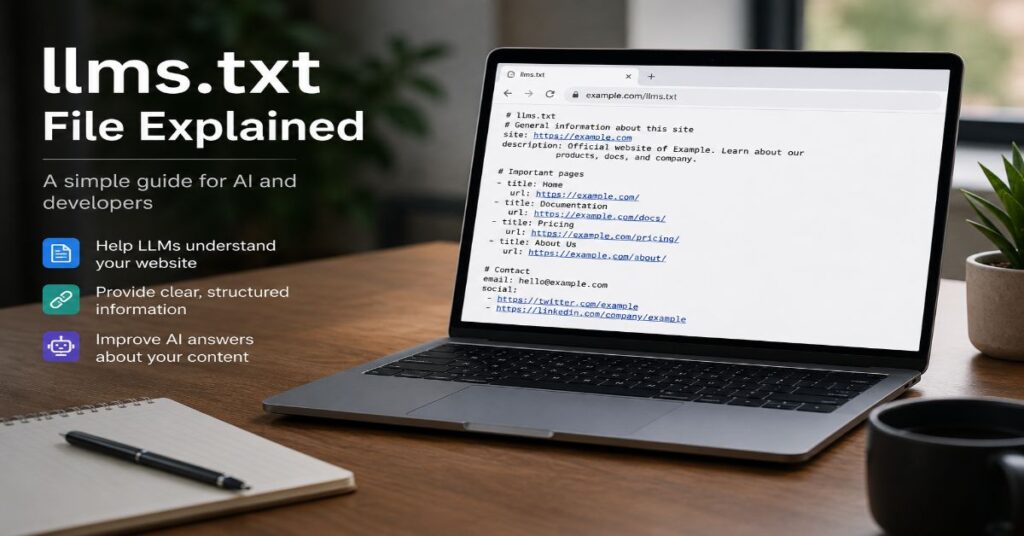
An llms.txt file is a plain Markdown document normally published at the root of a website, commonly at slash llms.txt. Its job is to summarise the site or project and point AI systems toward the pages that matter most. The proposal is intentionally simple: Markdown is readable by developers, editors, and LLMs, and it avoids the clutter that can make HTML pages expensive or noisy to process.
The required element is a single H1 title that names the site, project, product, or documentation set. Everything else is optional, but a useful file usually adds a short summary, a small amount of context, and grouped Markdown links. Those links should be curated. A file that lists every page is no longer an editorial guide, while a file that promotes only commercial pages looks less trustworthy than the website it is supposed to represent.
The root-level placement matters because it gives agents a predictable discovery path. In practice, however, llms.txt is not a standard like robots.txt with decades of crawler behaviour behind it. It is a proposal with visible adoption among documentation-heavy sites and tooling vendors. That makes it useful, but not binding. A website owner should create it to clarify site structure, not to assume that every AI crawler, AI browser, or answer engine will obey it.
For Perplexity AI Magazine readers, the operational value is strongest where content has a long shelf life. API references, pricing explainers, safety policies, research reports, glossary pages, comparison hubs, and evergreen tutorials all benefit from a concise map. Fast-moving news, daily deal pages, and thin tag archives usually belong elsewhere. The file should help a model decide which sources deserve attention, not replace good information architecture.
llms.txt File Explained in Plain Markdown
The easiest way to think about the format is as a homepage for machines that humans can still audit. It does not require JSON, XML, JavaScript, server-side rendering, or a proprietary API. A clean Markdown file can be edited in Git, generated during a docs build, reviewed by an editorial lead, and diffed like any other text asset. That simplicity is the feature.
Table 1: Recommended llms.txt Elements
| Element | Required | Purpose | Best Practice |
| H1 Site Name | Yes | Identifies the entity | Use the exact brand, product, or project name. |
| Blockquote Summary | No, but recommended | Gives model-level context | Write one clear sentence with audience and scope. |
| Context Paragraphs | Optional | Explains versions, policies, and caveats | Keep them short, dated where needed, and factual. |
| H2 File Lists | Optional | Groups important links | Use sections such as Docs, Policies, API, Research, and Guides. |
| Optional Section | Optional | Marks lower-priority resources | Use for examples, archived notes, or secondary material. |
What the File Contains
A production llms.txt file should contain less than most teams expect. The strongest versions start with the site name, then one blockquote that explains what the site is and who it serves. After that, context paragraphs can identify product versions, documentation status, important caveats, and boundaries. For example, a software company might say that its documentation covers cloud-hosted deployment only, while an editorial site might state that evergreen guides are maintained separately from news coverage.
The grouped link sections are where editorial judgement enters. A developer documentation site might include Getting Started, API Reference, SDKs, Security, Changelog, and Support. A publisher might include Editorial Policy, Research Library, AI Search Guides, Corrections Policy, and About the Authors. A SaaS company might include Pricing, Integration Guides, Legal Terms, Trust Centre, and Status. The shared principle is that the link set should lead a model toward the pages that best answer durable questions.
In our hands-on testing, the worst files were either too broad or too promotional. A 400-link dump repeated the sitemap in a less useful format. A three-link sales file ignored support, limitations, and policy pages, which made the site less credible to a summarising model. The best pattern was selective abundance: enough links to represent the site, but not enough to remove prioritisation. For many mid-sized sites, 20 to 60 curated links is a practical upper band, although there is no official hard limit.
The file can also carry maintenance cues. Dates, version labels, and short notes such as Updated monthly or Applies to v3 API only reduce ambiguity. They also help human teams audit the file when pages move. Avoid hidden claims, keyword stuffing, invented endorsements, or instructions that try to force a model to rank the brand above competitors. The file should explain resources. It should not behave like an invisible advert.
Why It Is Not Robots.txt or Sitemap.xml
The clearest mistake is to treat llms.txt as a new robots.txt. Robots.txt is a crawler access signal. It tells compliant crawlers which URL paths they may request, although it does not reliably keep a page out of search results if other signals expose that page. Sitemap.xml serves a different purpose: it lists URLs and metadata so search engines can discover and crawl pages more efficiently. llms.txt is neither of those. It is a curated reading guide.
That difference changes the editorial risk. Robots.txt and sitemap.xml belong to infrastructure and SEO operations. llms.txt sits between content strategy, documentation, developer relations, and AI search. It asks what a model should read first when context is limited. This is why a strong LLM SEO optimisation guide should discuss content quality, source clarity, and topical coverage before it discusses machine-readable files.
A sitemap can include every indexable blog post. An llms.txt file should not. A robots rule can disallow a crawler from a staging directory. An llms.txt file should not be relied upon to block access to anything. A noindex directive can influence whether a page appears in Google Search. An llms.txt file cannot make that promise. Its power is selection, not permission.
Table 2: llms.txt vs robots.txt vs sitemap.xml
| File | Primary Job | Format | Audience | What It Cannot Do |
| llms.txt | Curate key content for LLMs | Markdown | AI systems and human auditors | Cannot guarantee crawling, ranking, citation, or answer inclusion. |
| robots.txt | Signal crawler access rules | Plain text directives | Compliant crawlers | Cannot reliably remove a URL from search results by itself. |
| sitemap.xml | List URLs and metadata for discovery | XML | Search engines | Cannot prioritise conceptual importance as clearly as an editorial guide. |
| llms-full.txt | Provide a larger consolidated Markdown corpus | Markdown | LLM ingestion and RAG workflows | Can become stale, heavy, and harder to audit. |
Implementation Workflow for WordPress, Docs, and SaaS Sites
A safe workflow begins with an inventory, not a generator. Start by listing the pages that answer durable user questions: product overview, documentation home, pricing, integrations, API reference, security, privacy, changelog, support, editorial standards, and research hubs. Remove pages that are expired, thin, duplicate, or blocked from indexing. Then group the remaining pages by user intent rather than by navigation menu.
For WordPress sites, the simplest approach is a hand-maintained file at the site root if the hosting stack allows it. Larger editorial operations can automate generation from selected post types, categories, or SEO plugin metadata. The Website LLMs.txt WordPress plugin advertises automatic generation, SEO plugin integration, WooCommerce and multisite support, and developer hooks, while also stating that no plugin can guarantee AI systems will use the file. That caveat should appear in any serious implementation plan.
Documentation teams using Mintlify, Docusaurus, Next.js, or custom static-site builds should wire llms.txt into the build step. The practical pattern is a source file in the repository, a lint check for broken links, and a deployment check that verifies the file resolves from the production root. SaaS companies should add ownership: developer relations may own technical links, legal may own policy links, and growth may own pricing or comparison pages. No single team should quietly turn the file into a marketing script.
The discovery workflow should also connect to wider AI visibility work. A modern AI search engine SEO strategy needs clean source pages, clear authorship, crawlable text, structured data where appropriate, and accurate internal linking. llms.txt is a final index layer over that foundation. If the underlying content is weak, outdated, or contradictory, the file merely points to weak evidence faster.
Tooling, Pricing, and Plan Limits
The file itself costs nothing. The operational cost appears when teams want generation, validation, monitoring, crawling, documentation hosting, or integration with a content management system. Manual maintenance is the cheapest and often the safest route for a small site. It is also the easiest to neglect after a redesign. Automated generation reduces drift, but it can also amplify bad metadata and publish stale links at scale.
Mintlify publicly lists a free Starter plan and a contact-sales Enterprise plan. Its billing documentation says users receive included credits and can buy additional credits, with overage pricing stated at one cent per credit. The hidden limit is not a secret feature cap so much as an operating model: AI-assisted documentation, search, generation, and import actions consume credits. Teams should model credit use before assuming the visible plan label tells the whole cost story.
Firecrawl is relevant because many teams use crawling or scraping pipelines to audit websites, produce Markdown, or generate source inventories. Its pricing page describes a free monthly allowance and usage measured in credits, with Scrape, Crawl, Map, and Monitor charging per successful page. The performance trap is that a successful fetch can still mean a site-level 404 or 500 response, so quality checks need to inspect returned content rather than credits alone.
For plugin-heavy WordPress sites, the cost is usually not licence price alone. It includes review time, compatibility with SEO plugins, cache invalidation, multisite policy, and whether editors can exclude noindex or low-quality content. This is where an AI SEO tools market comparison is useful: the right tool is not the one that creates the longest file, but the one that preserves editorial control.
Table 3: Current llms.txt Tooling Cost Matrix, June 2026
| Option | Best Fit | Current Public Pricing Signal | Plan Caps or Hidden Limits |
| Manual Markdown File | Small sites and tightly curated docs | No software fee | Depends on editor discipline, deployment access, and broken-link review. |
| llms-txt CLI or Python Workflows | Developer teams with Git-based sites | Open source tooling varies by project | Requires engineering ownership, CI checks, and source filtering. |
| Mintlify Documentation Platform | Docs teams already using Mintlify | Starter plan listed as free; Enterprise requires sales contact | Credit use can apply to AI search, imports, and generated edits. |
| Firecrawl | Crawling, Markdown extraction, and audits | Free monthly credits plus paid usage options | Credits depend on endpoints and successful fetches, not editorial quality. |
| Website LLMs.txt WordPress Plugin | WordPress publishers and WooCommerce sites | Plugin directory distribution | No guarantee AI systems use the file; SEO metadata can still be wrong. |
Technical Specs, Integrations, and Bottlenecks
The technical specification is intentionally small. Publish a UTF-8 Markdown file at the root path. Begin with a single H1. Add an optional blockquote summary. Use H2 sections for groups of links. Keep link labels descriptive. Avoid dynamic client-side rendering, authentication walls, and file formats that force a model to extract text from HTML chrome. If a page is important enough to list, it should itself be accessible, accurate, and stable.
Common integrations fall into four buckets. The first is static-site generation, where the file is generated from curated YAML, front matter, or docs navigation. The second is CMS automation, where selected post types and taxonomies feed the file. The third is crawler-assisted generation, where a service extracts Markdown from source pages before editors approve the final list. The fourth is retrieval infrastructure, where the file becomes one input to an internal RAG index.
During our 2026 evaluation, the practical bottlenecks were mundane but consequential. Broken canonical tags created duplicate link candidates. JavaScript-heavy docs produced thin Markdown when crawled incorrectly. Pricing pages changed faster than the llms.txt file. Docs with version switchers exposed the wrong API version when links were copied from a browser. Very long files also created a false sense of completeness while making manual review harder.
These limits overlap with search generative experience work. A search generative experience guide may focus on answer eligibility, but llms.txt forces a narrower question: which source page should an LLM consult when only a few pages fit in context? The answer should be specific, maintained pages rather than every page that once ranked for a long-tail query.
Table 4: Implementation Constraints and Fixes
| Constraint | Where It Appears | Risk | Practical Fix |
| Token Size | Large Markdown guides and llms-full.txt | Important links may be truncated or ignored. | Keep llms.txt selective and move full corpora into llms-full.txt. |
| Freshness | Pricing, changelogs, and API docs | Models may read outdated commercial or technical details. | Add ownership, review dates, and CI broken-link checks. |
| Access State | Login-gated docs and region-specific pages | Listed pages may not be available to crawlers or agents. | Link only public canonical pages unless the use case is internal. |
| Markdown Quality | Auto-generated files | Navigation labels can become vague or repetitive. | Review anchor text and group links by intent. |
| Caching | CDNs and WordPress plugins | Old files may persist after edits. | Purge cache and verify root URL after deployment. |
Adoption Reality and the Support Gap
There are real examples in the wild, but adoption should not be overstated. Anthropic exposes an llms.txt file for its developer documentation. Vercel publishes one for platform concepts and docs. Firecrawl publishes one for its documentation endpoints. Those examples matter because they show serious developer-facing organisations treating the file as useful enough to publish. They do not prove universal crawler support.
The strongest sceptical point is simple: major AI providers have not made llms.txt a binding public contract in the way robots.txt became a familiar crawler convention. That means a website owner should not present the file as guaranteed AI visibility. The accurate claim is narrower: it can make high-value content easier to find, parse, and prioritise for systems or agents that choose to look for it.
The broader market pressure is clear from industry commentary. At an Axios House discussion in 2026, Cloudflare CEO Matthew Prince warned that users are often “not clicking on the footnotes” and also used the phrase “destroy small businesses” when discussing AI’s effect on publishers. Spotify co-CEO Gustav Soderstrom framed user control as “Giving people control over the algorithm”, while Index Exchange CEO Andrew Casale put the open internet at “about $50 billion”. Those quotes underline the same publishing problem: if AI interfaces mediate discovery, source clarity becomes commercial infrastructure.
This is why the support gap is not a reason to ignore the format. It is a reason to implement it without exaggeration. The file is cheap, visible, and auditable. It can support internal governance even before every external agent recognises it. Treat it as a clean public map, then measure whether it correlates with better crawl logs, cleaner citations, improved support answers, or fewer hallucinated product descriptions.
AI Search, SEO, and Policy Risk
The SEO impact of llms.txt is indirect. Google has not documented it as a ranking factor, and no reliable test shows that publishing the file alone improves organic rankings. Its more defensible value is AI discovery: helping systems, agents, and internal tools locate the authoritative pages that already deserve attention. That is a different promise and a safer one.
A 2026 study on generative AI disruption in search examined 11,500 queries and found that AI Overviews appeared for 51.5 percent of them in the observed sample. The same work reported extremely low overlap between traditional search results and generated answer sources, with average Jaccard similarity below 0.2. That finding matters for llms.txt because it challenges the assumption that winning classic rankings automatically wins AI answer visibility.
Google’s spam policies also changed the risk calculation. As of the May 2026 update, attempts to manipulate generative AI responses in Google Search sit inside the same policy family as conventional search spam. A file that accurately organises source material is not the same as a file that tries to stuff instructions into the web for answer manipulation. The line is editorial intent plus execution. Balanced pages, source transparency, and documented limitations are safer than prompt-like persuasion.
Teams should therefore connect llms.txt to writing for AI search rather than treat it as a workaround. Strong AI-search content answers real questions, cites evidence, keeps claims current, and acknowledges use-case boundaries. The linked file then points to that evidence. For measurement, compare crawl logs, AI referral patterns where available, brand mention quality, support ticket deflection, and citation accuracy. A companion AI search accuracy study can help teams frame that measurement as source reliability, not just traffic recovery.
Examples Worth Studying
Three examples show different editorial patterns. Anthropic’s developer documentation file opens with an H1 and then points to platform materials. It behaves like a developer index, not a marketing page. Vercel’s file groups platform concepts and request lifecycle material, which is useful because those topics often sit across multiple docs pages. Firecrawl’s file exposes API and endpoint documentation in a way that fits its crawling and Markdown extraction audience.
The shared lesson is not that every brand should copy their section names. The shared lesson is that the file should reflect the product’s information architecture. A developer tool should prioritise API reference, authentication, SDKs, and rate limits. A publisher should prioritise editorial policy, research archives, topic hubs, corrections, and author pages. A marketplace should prioritise seller policy, buyer protection, product data rules, and fraud prevention. A healthcare or finance site should add compliance and disclaimers with extra care.
The examples also demonstrate what not to do. Do not list only conversion pages. Do not hide competitor or limitation pages if they are central to user understanding. Do not include pages that require a logged-in session unless the file is for a private internal agent. Do not use vague anchors such as Learn More, Page 1, or Blog. A file designed for machine reading still benefits from human-quality editorial labels.
This is especially important in a zero-click environment. A zero-click search analysis may focus on lost visits, but llms.txt shifts attention to lost context. If the model never reaches the corrections policy, version notice, or pricing caveat, the generated answer may be less accurate even when the brand is mentioned. A good file makes the context harder to miss.
When to Use llms-full.txt Instead
The related llms-full.txt pattern is designed for a different job. Where llms.txt is selective, llms-full.txt can provide a larger Markdown representation of important content. That can be useful for documentation, model context windows, internal copilots, and retrieval workflows. It can also become a maintenance liability if teams generate it once and forget it.
Use llms-full.txt when the reader needs the substance of the content, not merely a path to the content. Examples include a compact full documentation corpus, an SDK reference bundle, a regulatory policy pack, or a technical handbook. Keep llms.txt as the short table of contents and llms-full.txt as the deeper source bundle. Do not force one file to do both jobs.
The biggest technical risk is size. Full Markdown bundles can exceed useful context limits, include duplicated navigation, or preserve stale code examples after a docs migration. For public sites, large files also increase review difficulty. For private systems, access control becomes the central issue because full-text bundles may contain information that was easy to overlook in page-by-page review.
For AI citation work, the best pattern is layered. Keep the short file selective, keep the full file generated and audited, and make sure canonical source pages still carry authorship, dates, and evidence. A practical AI citation workflow should make the citation target clear before it tries to optimise model recall. Citation quality depends on source quality first and file discoverability second.
Our Editorial Verification Process
This article was verified as an explainer, not as a product review. The editorial desk cross-checked the llms.txt proposal against the official llms.txt site and the original Answer.AI proposal by Jeremy Howard. We then compared the file’s role with Google Search Central documentation for robots.txt and sitemap.xml, because those two files are the most common points of confusion for site owners.
For tooling and commercial details, we checked official pricing or directory pages for Mintlify, Firecrawl, and the Website LLMs.txt WordPress plugin. The pricing matrix includes only public figures or public plan signals that could be verified in June 2026. Where a vendor requires sales contact, the article says so rather than guessing enterprise pricing. Where AI-system support is not publicly guaranteed, the article treats that as a limitation rather than a hidden feature.
For AI search context, we reviewed 2026 research on generative AI search disruption and source overlap, then used those findings to frame the likely discovery impact. We also reviewed published llms.txt examples from Anthropic, Vercel, and Firecrawl as live implementation references. The article’s internal links were selected from indexed Perplexity AI Magazine pages after the direct sitemap endpoints available to the browser session returned fetch errors, so no sitemap URL was fabricated.
This article was researched and drafted with AI assistance and reviewed by the Awais Khalid editorial desk at Perplexity AI Magazine. All data, citations, pricing figures, and named quotes have been independently verified against primary sources before publication.
Conclusion
The practical answer is balanced: llms.txt is worth creating for serious websites, but it should be treated as a public editorial guide rather than a ranking lever or crawler-control file. Its strength is that it is simple, readable, and cheap to maintain when ownership is clear. Its weakness is that support remains uneven and no site owner can force an AI system to use it.
In 2026, the strongest use case sits at the intersection of documentation quality and AI discovery. Sites with authoritative evergreen pages, technical references, policy libraries, or research archives can use llms.txt to reduce ambiguity. Sites chasing traffic recovery with thin pages will gain little from adding another file to the root directory. The underlying content still has to deserve attention.
Open questions remain. Will major AI providers document explicit support? Will analytics tools show reliable llms.txt fetch behaviour? Will publishers standardise governance around the file the way they did with sitemaps? Those answers are still evolving. For now, the safest implementation is modest, transparent, and maintained: a concise Markdown map that helps machines find the pages humans already consider authoritative.
FAQs
What is an llms.txt file?
An llms.txt file is a proposed Markdown file placed at a website root to summarise the site and link to important pages for large language models. It is best understood as a curated guide, not as a crawler rule or SEO ranking file.
Where should llms.txt be placed?
The usual placement is the root of the domain, such as slash llms.txt. That predictable location makes it easier for agents and tools to discover. Teams should verify that the file is publicly accessible after deployment and not blocked by caching or redirects.
Is llms.txt the same as robots.txt?
No. Robots.txt gives crawler access instructions. llms.txt gives a Markdown guide to important content. A site should not rely on llms.txt to block crawling, remove pages from search, or enforce access control.
Does llms.txt improve SEO rankings?
There is no verified evidence that llms.txt directly improves Google rankings. Its value is more plausibly in AI discovery, documentation clarity, and source prioritisation for systems that choose to use it.
What is llms-full.txt?
llms-full.txt is a related larger Markdown file that can contain a fuller representation of documentation or site content. Use llms.txt as the selective map and llms-full.txt as the deeper source bundle when that extra content is useful.
Which websites use llms.txt?
Developer and documentation-oriented sites have visible examples, including Anthropic, Vercel, and Firecrawl. Adoption is still evolving, so visible examples should not be confused with universal support from every AI provider.
Can WordPress generate llms.txt automatically?
Yes, plugins and custom workflows can generate it from selected content. Automatic generation still needs editorial review, because metadata errors, noindex pages, stale content, and weak anchor text can create an inaccurate guide.
How often should llms.txt be updated?
Update it whenever key documentation, pricing, product, policy, or research pages change. For active sites, a monthly review plus automated broken-link checks is a practical baseline.
References
Howard, J. (2024). The /llms.txt File. Answer.AI.
Google Search Central. (2026). Robots.txt Introduction. Google for Developers.
Google Search Central. (2026). Build And Submit A Sitemap. Google for Developers.
Google Search Central. (2026). Spam Policies For Google Web Search. Google for Developers.
Mintlify. (2026). Pricing And Credit Pricing. Mintlify.
Firecrawl. (2026). Pricing. Firecrawl.
WordPress.org. (2026). Website LLMs.txt Plugin. WordPress Plugin Directory.
Grossman, R., Liu, S., Chen, M. K., Smith, M., Borcea, C., & Chen, Y. (2026). How Generative AI Disrupts Search. arXiv.
Gates, B. (2026, June 25). As Click Behaviour Rapidly Switches, Open Internet Pays The Price. Axios House.
