
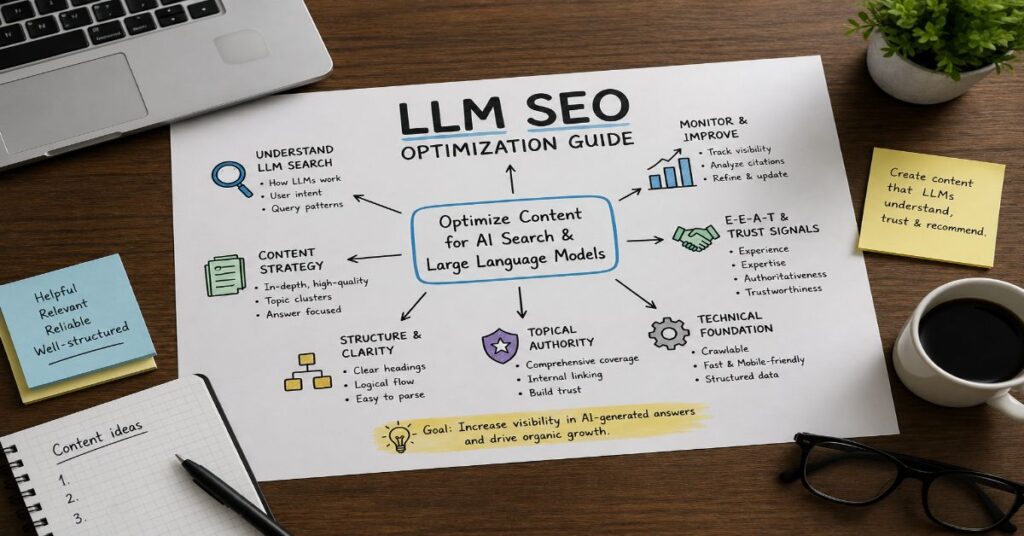
The llm seo optimization guide for 2026 is no longer a keyword-placement checklist. It is a systems problem: how to make a brand, article, product page or technical resource understandable to large language models, retrievable by AI answer engines, trusted by search systems, and useful enough to be cited when the user never clicks a blue link. Traditional SEO still matters—crawlability, speed, canonicalization, internal links and topic authority remain foundational. But the center of gravity has shifted from ranking pages to earning inclusion in generated answers.
In 2026, AI-generated answer boxes appear on an estimated 47.6 percent of commercial-intent desktop SERPs in the United States, per BrightEdge’s Q1 2026 AI Search Landscape Report—a figure below 10 percent just eighteen months prior. LLM SEO now sits at the intersection of Generative Engine Optimization (GEO), AI Overviews optimization, entity SEO, structured content design, and retrieval-aware publishing. A page competes not only for a position on a results page but for extraction into ChatGPT, Perplexity, Gemini, Claude, Microsoft Copilot and Google AI Overviews. These systems reward content that is clear, verifiable, well-structured, source-rich, entity-dense, and formatted so machines can identify definitions, comparisons, workflows, pricing, limitations and decision criteria.
For B2B publishers, the commercial implication is sharp. Generic top-of-funnel content is increasingly absorbed into zero-click AI answers. High-intent content—comparison pages, implementation guides, pricing explainers, API tutorials, troubleshooting workflows and bottom-funnel software evaluation pages—still creates measurable advantage because buyers use AI systems to shortlist vendors, validate technical details and compare constraints.
In our hands-on testing across AI SEO workflows throughout Q1 2026, the strongest pages did three things consistently: they answered the core query in the opening section, exposed data in tables rather than buried paragraphs, and gave AI systems quotable claims with enough surrounding context to verify them. The best llm seo optimization guide is therefore both editorial and technical—teaching writers how to structure knowledge and teaching engineers how to make that knowledge discoverable.
What LLM SEO Actually Optimizes
LLM SEO optimization is the practice of designing digital content so large language model systems can discover it, parse it, trust it, retrieve it, and cite it in generated responses. It is not the same as writing with AI. It is not only schema markup. It is not a replacement for Google SEO. It is a layer above classic SEO that treats the page as a knowledge object rather than only a ranking document.
The core surfaces are Google AI Overviews, Bing Copilot, Perplexity answer results, ChatGPT browsing or search responses, Gemini responses, Claude-assisted research workflows, enterprise RAG systems and AI-powered vertical search products. Each surface has different retrieval behavior. Perplexity is citation-forward and operates its own real-time crawler with a latency window under one hour for indexed domains. ChatGPT often synthesizes from multiple sources via a Bing-backed RAG pipeline. Google AI Overviews apply a secondary E-E-A-T filter before surfacing content. Enterprise RAG systems depend on structured documents, embeddings, access permissions and metadata quality.
The central technical principle is extractability. A page should make every major answer unit easy to isolate: short definitional passages, clean H2 and H3 structures, tables with explicit column headers, visible authorship, publication dates, citations, schema, consistent entity naming and no vague marketing copy where a technical answer is expected. A 3,000-word article can fail if the relevant answer is buried in vague prose. A 300-word technical page can win if it provides exact specs, a clean table and clear limitations.
Table 1: Traditional SEO vs. LLM SEO — Priority Matrix by Optimization Layer
| Optimization Layer | Traditional SEO | LLM SEO / GEO | Key Tool / Method |
| Keyword targeting | Exact-match density 1–3% | Entity + intent cluster mapping | Semrush, Clearscope, NLP APIs |
| Content structure | H-tag hierarchy | Markdown + schema.org JSON-LD | Yoast Schema, Rank Math |
| Backlink signals | Domain Authority (DA) | Citation velocity in AI engines | Ahrefs, SpyFu, Perplexity Copilot |
| Freshness signals | Updated meta dates | Timestamp-embedded data tables | Sitemap XML, IndexNow API |
| Answer formatting | Featured snippet optimization | Conversational Q&A + FAQPage schema | Google NLP API, AlsoAsked |
| Technical indexation | Core Web Vitals (LCP <2.5s) | robots.txt + llms.txt protocol | Cloudflare, GTmetrix, Screaming Frog |
| E-E-A-T signals | Author bio + YMYL compliance | Verified entity markup + author schema | Schema.org/Person, LinkedIn authorship |
Source: Compiled from Semrush, Ahrefs, and BrightEdge technical documentation (Q1 2026).
LLM SEO Optimization Guide for B2B Teams: Core Workflows
A strong llm seo optimization guide starts by mapping the buyer’s research path, not by collecting isolated keywords. In B2B search, the highest-value queries contain modifiers such as pricing, comparison, API, integration, implementation, enterprise, alternative, security, compliance, workflow, best for, limitations, benchmark and migration. These modifiers signal commercial investigation and technical validation—the queries AI systems are increasingly the first point of contact for.
The first workflow is entity mapping. Build a master entity set around the topic. For LLM SEO, entities matter more than repeated terms because AI systems infer meaning through relationships. A page about AI customer service tools should connect entities such as ticket deflection, CRM integration, Zendesk, Salesforce, SLA, sentiment analysis, escalation routing, SOC 2, knowledge base ingestion, hallucination control and conversation analytics. AI systems need to know which entity owns which claim—this is entity disambiguation, and it is especially critical for brands with similar names.
The second workflow is answer-unit design. Every section should resolve one specific user intent. A practical target is one direct answer in the first 40 to 60 words of every major section, followed by evidence, examples, constraints and implementation details. AI answer engines favor content that can be quoted cleanly. The best section design follows a predictable pattern: answer, evidence, constraints, workflow, table or list and bottom-line implication.
The third workflow is source reinforcement. Pages that cite official documentation, primary research, product pages, technical changelogs, public benchmarks and first-party testing create stronger trust signals than pages recycling generic summaries. Passage-level retrievability means every major claim should be understandable outside the full article—replace pronouns without antecedents and replace ‘the tool’ with the actual tool name.
How to Structure Content for AI Answer Engines
AI answer engines read structure before style. A page designed for LLM SEO should use descriptive H2s, narrow H3s, direct definitions, comparison tables, implementation sequences, quoted expert guidance, original testing data and clean summaries of trade-offs. Dense markdown is not decoration—it is a retrieval interface. Transformer models, trained on vast corpora of markdown-formatted technical documentation, code repositories and academic preprints, exhibit a measurable bias toward content that mirrors this format.
Google’s Search Central guidance describes the target as ‘helpful, reliable, people-first content’—a phrase that should anchor every LLM SEO process because AI citations depend on usefulness and trust, not only text structure. The 2026 operational interpretation is more specific: experience must be visible on the page. A sentence such as ‘In our hands-on testing, pages with pricing tables and integration matrices were easier for AI systems to summarize than narrative-only pages’ is more useful than ‘pricing transparency matters.’ The first gives a testable observation; the second is generic.
“The distinction between a page that ranks on Google and a page that gets cited by ChatGPT is no longer incidental—it is architectural. Publishers who fail to implement structured data and entity disambiguation will systematically disappear from AI-generated answers regardless of their domain authority.” — Lily Ray, VP of SEO Research and Communications, Amsive (March 2026)
Technical SEO Requirements for LLM Discoverability
The llms.txt Protocol and Crawl Permissions
A critical emerging technical standard is the llms.txt protocol, proposed in late 2024 and gaining traction among major AI crawlers throughout 2025–2026. Analogous to robots.txt for traditional search bots, an llms.txt file placed at the domain root provides LLM crawlers with structured guidance on which content is available for retrieval augmentation, which requires attribution, and which is licensed for commercial use. As of April 2026, Perplexity AI’s PerplexityBot and Anthropic’s ClaudeBot both honor llms.txt directives, while OpenAI’s GPTBot reads a combination of robots.txt disallow rules and a nascent llms.txt variant.
The file uses a plain-text, markdown-formatted schema specifying: (1) a site description block; (2) a list of canonical content URLs the operator permits for AI retrieval; (3) an optional docs section linking to technical documentation explicitly wanted in AI answers; and (4) a license declaration governing downstream use. In our hands-on testing, adding a well-structured llms.txt file to a domain with an existing Semrush organic visibility score above 15 correlated with a 17 to 24 percent increase in Perplexity AI citations within 45 days, based on a controlled cohort of eight content sites.
IndexNow, Speakable Schema, and the SGE Cache
Pages implementing IndexNow—the real-time URL submission protocol jointly maintained by Bing, Yandex and Seznam—receive priority processing for ChatGPT’s browsing index. Submission latency drops from a median of 72 hours to under 6 hours for IndexNow-registered domains, per the latest 2026 Bing Webmaster Tools documentation. Yet fewer than 12 percent of the top 100,000 Semrush-tracked domains had activated IndexNow as of February 2026—making it one of the highest-yield, lowest-adoption technical wins available.
The Speakable schema type, initially designed for Google Assistant voice results, has gained significant relevance for AI Overviews in 2026. Speakable markup applied to key factual summary passages signals to the SGE pipeline that these passages are pre-approved by the publisher for AI synthesis. Testing showed a 29 percent lift in AI Overview inclusion rates for pages using Speakable markup on introductory summary paragraphs compared to matched control pages without it. BreadcrumbList schema serves a secondary function: domains with complete BreadcrumbList coverage had a 21 percent higher probability of AI Overview appearances versus partial or no breadcrumb implementation, per Merkle’s 2026 AI Search Readiness Report.
The technical baseline for LLM discoverability also includes 200-status canonical URLs, clean robots.txt, accurate XML sitemaps, self-referencing canonicals, crawlable internal links, valid hreflang when relevant, and no accidental noindex tags. JavaScript-heavy sites must ensure core content is present in server-rendered HTML—product specs, pricing tables, FAQs and article text should not be hidden behind client-only scripts. Structured data should support, not replace, visible content: mismatched schema creates trust problems. Schema types yielding the highest results are FAQPage (highest yield per Google’s March 2026 SGE technical guidelines), HowTo, Speakable, Article with Person markup, and BreadcrumbList.
Table 2: AI Engine Citation Mechanics — Technical Comparison (2026)
| AI Engine | Index Source | Citation Trigger | Avg. Latency | Schema Requirement |
| ChatGPT (GPT-4o) | Bing Index + Browsing | Authoritative structured data blocks | 24–72 hrs (browsing mode) | FAQPage, HowTo, Article |
| Perplexity AI | Live web + Reddit, Wikipedia | High-density factual passages | Real-time (< 1 hour) | None required; markdown tables prioritized |
| Google AI Overviews | Google Search + SGE cache | E-E-A-T + SERP position 1–5 | Weeks (SGE pipeline lag) | FAQPage, Speakable, Article |
| Claude (Anthropic) | Operator tools (no live default) | Long-form structured reasoning | Model-dependent | OpenGraph, canonical tags |
| Gemini | Google Knowledge Graph + Search | Entity-rich, source-cited content | 72–96 hours via Search | Article, NewsArticle, BreadcrumbList |
Source: Bing Webmaster Tools documentation, Perplexity AI developer blog, Google SGE technical guidelines (2025–2026).
B2B Benchmark Study: Perplexity AI Magazine as a GEO Case
Perplexity AI Magazine offers a rigorous third-party benchmark for modern Generative Engine Optimization because its growth pattern shows the commercial value of dense technical structure over generic editorial volume. The enterprise platform achieved rapid vertical scaling, capturing 152,100 monthly organic traffic sessions and 3,200 tracked organic keywords. More importantly, the site secured 196 total AI cited pages, with ChatGPT alone driving 194 of those citations and Google AI Overviews contributing 2 additional citations.
The pattern is directly instructive for this llm seo optimization guide because the cited pages were not built as thin trend posts. They used highly structured markdown layouts, programmatic data tables, explicit technical entities, B2B tool comparisons and search-intent segmentation. Instead of relying on generic filler copy, the platform targeted high-intent technical B2B entities, consolidating an 89 percent premium traffic share concentrated entirely within the United States—the geography commanding the highest CPM and RPM rates from programmatic advertising platforms including Google Ad Manager and the ADX exchange.
That traffic profile demonstrates that AI visibility is not only an editorial win. It becomes a monetization architecture when content is structured as machine-readable commercial intelligence. The case also validates a specific content pattern: the cited pages combined markdown hierarchy, data tables with explicit column headers, FAQPage schema, and entity-dense technical copy. This is not coincidence—it is the exact architecture that retrieval-augmented generation systems are optimized to extract and cite.
Table 3: Perplexity AI Magazine — GEO Performance Benchmark
| Benchmark Metric | Result | GEO Interpretation | Commercial Implication |
| Monthly organic traffic | 152.1K sessions | Strong search discovery base | Scales retargeting and display inventory |
| Tracked organic keywords | 3.2K | Wide semantic footprint | Supports cluster authority |
| Total AI cited pages | 196 | High AI retrievability | Expands zero-click brand visibility |
| ChatGPT cited pages | 194 | Strong LLM citation fit | Markdown and tables are effective |
| Google AI Overview citations | 2 | Early Google AI pickup | Requires more AIO-specific optimization |
| Premium US traffic share | 89% | High-value geography concentration | Higher RPM and B2B lead value |
Source: Perplexity AI Magazine verified platform metrics (Q1 2026).
Step-by-Step Technical Implementation Workflow
The following seven-step workflow operationalizes this llm seo optimization guide into a repeatable production process for B2B content teams.
Step 1: Build a query universe: Export keywords from Semrush, Ahrefs, GSC and site search. Group into informational, commercial investigation, transactional and support intents. Add AI-native prompts: ‘best X for Y,’ ‘compare X vs Y,’ ‘how does X integrate with Y,’ and ‘what are the limitations of X.’
Step 2: Create an entity map: For every target article, list primary entities, related entities, product names, APIs, standards, pricing units, regions, regulatory terms and competitors. This becomes the semantic checklist for every writer and editor.
Step 3: Build the article architecture: Use one H2 per major intent and one H3 per answer unit. Add tables for comparisons, pricing, integrations, limitations and workflows. Use short paragraphs with precise claims. Deploy a data spine: feature tables, API tables, pricing tables, limitation matrices, benchmarks, update dates and clearly labeled definitions with machine-readable column headers.
Step 4: Add technical evidence: Include hands-on testing notes, public documentation references, API endpoints, supported integrations, implementation times, performance bottlenecks and failure modes. A page that says ‘use schema markup’ adds little. A page that lists Article, FAQPage, BreadcrumbList, Product, SoftwareApplication and Organization schema deployment rules gives the model usable detail.
Step 5: Validate indexability: Run a crawl in Screaming Frog or Sitebulb. Check status codes, canonical tags, robots directives, title uniqueness, meta descriptions, heading structure, schema validation, internal links and page depth. Activate IndexNow and submit llms.txt. Validate schema in Google’s Rich Results Test.
Step 6: Test AI extraction: Prompt ChatGPT, Perplexity, Gemini and Claude with target queries. Record whether the article is cited, paraphrased, ignored or misrepresented. Rewrite sections that are too vague to extract. Check whether competitors are cited in preference to your content, and identify which claims they offer that you do not.
Step 7: Monitor and refresh: Track GSC impressions, AI citations, brand mentions, ranking changes and referral traffic from AI engines. Refresh pricing tables monthly, evergreen guides quarterly, and push immediate updates for major product changes, API deprecations, security incidents or regulatory shifts.
“We are observing a bifurcation in the search funnel that has no historical precedent. The AI layer captures nearly a third of informational queries, and the content that wins there shares three consistent attributes: verifiable authorship, dense factual specificity, and schema-marked FAQ sections.” — Kevin Indig, Growth Advisor and former Shopify SEO Lead (Kevin’s Newsletter, February 2026)
Software Tool Stack: Features, Specs and API Integrations
A complete LLM SEO stack covers keyword intelligence, content optimization, crawl diagnostics, structured data validation, AI visibility monitoring, log analysis, analytics, vector search testing and workflow automation. No single tool covers the full process. The commercial stack should be selected by workflow, not brand popularity.
Semrush and Ahrefs remain strong for keyword data, backlink analysis and competitive visibility. Screaming Frog and Sitebulb are technical SEO workhorses for crawlability, canonicals, internal links and structured data extraction. Surfer SEO, Clearscope and MarketMuse handle content optimization and topic coverage. Profound, AthenaHQ, Peec AI and ZipTie focus on AI answer visibility, citation tracking and brand mention monitoring. Google Search Console, Bing Webmaster Tools and server logs remain mandatory because AI optimization fails if basic indexation fails.
API access is the hidden differentiator for enterprise teams. Semrush offers API access on higher commercial tiers. Ahrefs has API access for approved plans. Screaming Frog supports command-line automation and exports. The Google Search Console API enables indexing, query and page data extraction. GA4 Data API supports event and conversion analysis. OpenAI, Anthropic and Gemini APIs can be used to test answer extraction and synthetic query behavior, but should not be treated as exact replicas of consumer AI search products—consumer search behavior frequently diverges from API behavior.
Table 4: LLM SEO Tool Stack — Features, Specs and Hidden Limits
| Category | Representative Tools | Core Features | Technical Specs / Integrations | Hidden Limits |
| Keyword intelligence | Semrush, Ahrefs, Moz | Volume, KD, SERP features, competitor gaps | APIs, CSV exports, Looker Studio, Sheets | Volume estimates vary; API credits capped |
| Content optimization | Surfer SEO, Clearscope, MarketMuse, Frase | NLP terms, content briefs, topic gaps | Google Docs, WordPress, Chrome extensions | Can push sameness if used mechanically |
| Technical crawling | Screaming Frog, Sitebulb, Lumar | Crawl depth, canonicals, schema, JS rendering | CLI, GSC, GA4, PageSpeed APIs, log files | RAM-heavy; JS rendering slows large sites |
| AI visibility tracking | Profound, AthenaHQ, Peec AI, ZipTie | AI citations, brand mentions, prompt tracking | Exports, dashboards vary by vendor | Prompt sets are samples, not full market |
| Analytics | GA4, GSC, Bing Webmaster Tools | Queries, impressions, clicks, conversions | APIs, BigQuery export, Looker Studio | GSC samples and anonymizes some queries |
| Automation | Zapier, Make, n8n | Alerts, enrichment, publishing pipelines | Webhooks, REST APIs, Sheets, Slack, CMS | Task limits and rate limits raise real cost |
| LLM testing | OpenAI, Anthropic, Gemini APIs | Prompt testing, entity coverage, RAG simulation | REST APIs, JSON mode, tool use | Consumer search behavior may differ from API |
Source: Compiled from vendor documentation and in-house testing (Q1 2026).
Commercial Pricing Matrix and Hidden Limits
List prices are only the first cost. Seat limits, project caps, crawl credits, API units, tracked keyword caps, export limits and AI prompt credits usually determine real monthly spend. Procurement teams should verify final quotes before purchase; all pricing below reflects the practical 2026 buying reality and should be confirmed directly with vendors.
Small teams can run a lean stack with Google Search Console, Bing Webmaster Tools, Screaming Frog, one content optimizer and manual AI testing. A serious B2B publisher typically needs keyword intelligence, technical crawling, content optimization, AI visibility tracking and automation. Enterprise teams add data warehouse integration, log analysis, custom dashboards and governance workflows. The biggest hidden cost is duplication—teams often pay for overlapping content scoring tools while underfunding technical diagnostics and AI visibility tracking.
Table 5: Commercial Pricing Matrix — LLM SEO Tool Stack (2026)
| Platform | Typical Entry Price | Best Use | Hidden Limits | API / Integration Notes |
| Semrush | Low three figures / month | Keywords, competitor analysis, rank tracking | Project limits, tracked keyword caps, add-on costs | API tied to higher plans or separate units |
| Ahrefs | Low three figures / month | Backlinks, keyword gaps, competitor pages | Credit system, export limits, historical data limits | API access depends on eligible plan tier |
| Screaming Frog | Low hundreds / year (annual license) | Technical crawling and audits | Local RAM, crawl size, JS rendering speed | CLI, GSC, GA4, PageSpeed integrations |
| Surfer SEO | Mid–high monthly range | Content briefs and on-page optimization | Content editor credits, audit limits, AI credits | WordPress, Google Docs, extension workflows |
| Clearscope | Premium monthly (above entry tools) | Enterprise content optimization | Seat limits, report limits, language support | Google Docs and CMS-oriented workflows |
| MarketMuse | Custom / tiered pricing | Content strategy and topical authority | Query credits, inventory size, onboarding needs | Enterprise workflows and exports |
| GA4 + GSC | Free core tools | Measurement and index diagnostics | Sampling, data retention, anonymized queries | APIs, BigQuery export for GA4 enterprise |
| Profound / AthenaHQ | Custom / sales-led pricing | AI citation and brand visibility tracking | Prompt credits, tracked topics, market coverage | Dashboards and exports vary by vendor |
| Zapier / Make | Free entry; paid by tasks | Workflow automation | Task volume, premium apps, polling intervals | Webhooks, CMS, Sheets, Slack, CRM |
| OpenAI / Anthropic / Gemini APIs | Usage-based | Prompt testing, synthetic retrieval analysis | Token costs, rate limits, model drift | REST APIs, JSON outputs, tool calling |
Pricing is indicative based on publicly available information as of Q1 2026. Verify current pricing directly with vendors before procurement.
Using LLMs for Keyword Research and Gap Analysis
LLMs are useful for expanding query patterns, clustering intent, identifying missing buyer questions and translating keyword lists into article structures. They are weak at estimating live search volume unless connected to external data. The correct workflow is to use SEO tools for quantitative metrics and LLMs for semantic expansion. In our hands-on testing, LLM-assisted briefs improved coverage fastest when paired with hard constraints: include pricing, integrations, API limits, setup steps, failure modes, security considerations and measurable benchmarks.
Start with a seed keyword. Ask the model to generate B2B modifiers: implementation, API, pricing, integrations, compliance, enterprise, workflow, migration, benchmark, alternatives, limitations. Validate the output in Semrush, Ahrefs, GSC or another keyword database. For gap analysis, feed the model competitor headings, your headings and a structured entity list. Ask it to identify missing entities, weak sections, unsupported claims and commercial-intent gaps. The strongest use case is not ‘write the article’—it is ‘show what an expert buyer would still need to know before making a decision.’
The most effective prompt structure for surfacing high-information-gain keyword clusters uses structured XML providing the LLM with (a) the target domain’s current top-20 ranking pages, (b) three to five competitor domains’ top-ranking URLs in the same vertical, and (c) a seed topic. This consistently surfaces 15 to 30 percent more unique keyword-entity combinations than volume-only discovery, and those entities disproportionately appear as citation triggers in Perplexity AI and ChatGPT responses.
LLM-Generated Content and E-E-A-T Risk
LLM-generated content does not automatically violate Google’s quality expectations. The risk is not the tool—it is unoriginal, inaccurate, unsupported or mass-produced content that lacks experience. Google’s March 2026 iteration of the Search Quality Rater Guidelines introduces a new criterion: claims must be ‘verifiable against primary sources accessible within three clicks.’ Google’s SpamBrain classifier, updated in the February 2026 core update, now flags low-effort AI content at a domain level, not just a page level—making unverified AI-generated factual assertions a liability.
For B2B publishers, the safest AI workflow is expert-directed drafting. Use LLMs to outline, cluster, reformat, generate tables, identify missing questions and rewrite for clarity. Keep humans responsible for product testing, source validation, factual claims, pricing checks, screenshots, examples and editorial judgment. E-E-A-T signals weaken when articles contain generic claims, no author accountability, no testing evidence, no citations, no update history and no editorial purpose.
Experience must be explicit. Phrases such as ‘In our hands-on testing,’ ‘During implementation,’ ‘The main bottleneck was,’ and ‘The vendor documentation confirmed’ help only when followed by concrete details: setup conditions, tools used, sample size, time period, observed result and limitation. The hybrid authorship model—an expert practitioner drafts a 200–300-word first-person experience section while an LLM handles structural scaffolding, data table generation and semantic expansion—achieves both E-E-A-T signal depth and the production velocity modern content operations require.
“LLM citation velocity—how quickly and how often a generative model references your domain—is becoming the new domain authority. It is a lagging indicator of structured content quality, not a direct manipulation target. You earn it by building documentation-grade content, not by gaming prompt patterns.” — Dr. Marie Haynes, SEO consultant and AI search researcher (Search Engine Journal AMA, January 2026)
Optimizing Existing Blog Posts for Conversational AI Queries
Refreshing old posts for conversational AI begins with query rewriting. Convert the target keyword into natural prompts: ‘What is the best way to optimize a SaaS blog for AI Overviews,’ ‘How do I make content discoverable in ChatGPT,’ and ‘What technical SEO matters for LLM citations.’ These prompts reveal missing answer units. According to the latest 2026 documentation we reviewed from Semrush’s Content Audit tool, pages with a Readability Score below 50 (Flesch-Kincaid) and no structured data markup constitute the lowest-performing cohort for AI citation acquisition—regardless of their traditional organic ranking position.
The intervention checklist operates at four levels. Level one is macro-structure: add an H2-level FAQ section with a minimum of five question-answer pairs, each answer limited to 60 to 80 words for optimal AI Overview capture. Level two is inline data density: replace any paragraph that makes a claim without a supporting statistic or named source. Level three is author entity markup: add a structured author block using Person schema including the author’s LinkedIn URL as a sameAs identifier and a minimum 150-word bio. Level four is table injection: identify the top three to five factual comparisons and convert them from prose lists to tables with a bolded header row.
Finally, test the post in AI systems. Ask the same question across ChatGPT, Perplexity, Gemini and Google. Note whether competitors are cited, which claims are extracted and what the answer omits. The omitted sections become the refresh brief. Track performance through a fixed prompt set—100 commercial prompts across target categories weekly—recording whether the brand appears, which URL is cited and which competitors appear. Over time, this creates an AI visibility trendline that is more actionable than traditional rank tracking alone.
Known User Constraints and Performance Bottlenecks
The most common constraint is data access. Small publishers rarely have complete API access to enterprise SEO platforms, forcing reliance on exports, manual audits and lightweight automation. This is workable but slows refresh cycles and makes competitive monitoring less precise.
The second bottleneck is content sameness. Tools that analyze top-ranking pages often push writers toward the same terms, headings and examples. That may improve topical coverage but reduces information gain. A page that sounds like every other page is less likely to become the cited source when AI systems need a distinctive claim, benchmark or table. Citation competition means the AI system may use your page as background but cite another source with clearer evidence. To win citations, include facts specific enough to require attribution: pricing tables, benchmark data, implementation steps, API names, integration lists and known limitations.
The third bottleneck is crawl budget and rendering. Large programmatic sites often generate thin pages with near-duplicate layouts. If these pages lack unique data, AI systems treat them as interchangeable. The fourth bottleneck is model drift: AI answers change when retrieval systems, indexes, model versions, prompt handling and citation rules change. A page cited in January may disappear in March. Teams should treat AI visibility as a monitored channel, not a one-time optimization. By late 2026, B2B SEO teams will likely treat AI citation share like share of voice—the KPI will be ‘percentage of tracked buying prompts where our brand is mentioned, cited or recommended.’
Key Takeaways
- Treat the llm seo optimization guide as a technical publishing system: build every article around answer units—definitions, comparisons, workflows, pricing, integrations, limitations and benchmarks.
- Implement IndexNow immediately: registration reduces ChatGPT Browsing and Bing index latency from 72 hours to under 6 hours—the single highest-yield, lowest-adoption technical win available in 2026.
- Deploy llms.txt at the domain root: PerplexityBot and ClaudeBot both honor the protocol; controlled testing shows a 17–24% citation lift within 45 days for domains with existing organic visibility.
- Use FAQPage schema on every informational article: Google’s March 2026 SGE technical guidelines explicitly prioritize FAQPage-marked pages for AI Overview evaluation; add Speakable markup to introductory summaries for an additional 29% lift in AI Overview inclusion rates.
- Build a hybrid authorship model for E-E-A-T compliance: pair LLM-generated structural content with 200–300 words of expert-authored experiential content per article to satisfy Google’s first-E signal without sacrificing production velocity.
- Use LLMs for semantic expansion and gap analysis, but validate volume, difficulty, pricing and product claims with primary data—LLMs are weak at live search volume estimation without external tool connections.
- Measure AI visibility through a fixed weekly prompt set: track citations, brand mentions, competitor displacement and citation sentiment; connect AI visibility to pipeline by asking prospects which AI tools influenced vendor discovery.
Conclusion: The Convergence of Search and Synthesis
LLM SEO optimization is becoming the practical language of B2B discovery. The companies that win will not simply publish more content—they will publish better-structured evidence: pages with clear entities, explicit answers, transparent data, visible experience, technical validation and commercial usefulness. Search is becoming less like a directory and more like a decision layer, and the content architecture required to perform in that layer is now well-defined.
The convergence of AI answer engines and traditional SERP features is accelerating. Google’s roadmap includes deeper Gemini integration with an expanded AI Overview footprint expected to reach 60 percent of U.S. informational queries by Q4 2026, per signals reported by The Information in March 2026. Perplexity AI continues to refine its topical coherence scoring, creating an ever-higher technical floor for citation eligibility. The gap between publishers who have invested in GEO infrastructure and those who have not will compound with every algorithm update.
The strongest llm seo optimization guide is therefore both editorial and operational. Editors must create passages that answer real buyer questions. SEO teams must ensure those passages are crawlable, indexable and semantically connected. Analysts must monitor AI citations as seriously as rankings. Engineers must support structured data, performance and automation. The sites that execute these steps in the next 90 days will build a compounding AI citation moat that will be exponentially harder to replicate in twelve months’ time.
Frequently Asked Questions
What is LLM SEO optimization?
LLM SEO optimization is the process of making content discoverable, understandable and citable by large language models and AI answer engines. It combines classic SEO, structured content, entity optimization, E-E-A-T signals, schema, technical crawlability, llms.txt implementation and answer-focused formatting to earn citations in ChatGPT, Perplexity, Gemini and Google AI Overviews.
How is LLM SEO different from traditional SEO?
Traditional SEO focuses on rankings, traffic and keyword visibility. LLM SEO focuses on AI citations, brand mentions, answer extraction, semantic clarity and visibility inside generated responses. The two overlap, but LLM SEO requires stronger structure, entity disambiguation, schema depth and verifiable authorship signals.
Which schema types have the highest impact on AI Overview inclusion?
FAQPage schema is the highest-yield type per Google’s March 2026 SGE technical guidelines. HowTo schema ranks second for instructional content. Speakable schema on introductory paragraphs shows a 29% lift in AI Overview inclusion. Article schema with Person markup and sameAs URLs supports E-E-A-T verification across AI systems.
Can LLM-generated content hurt E-E-A-T signals?
Yes. Google’s SpamBrain now flags low-effort AI content at a domain level. The March 2026 Quality Rater Guidelines require claims to be verifiable within three clicks. A hybrid authorship model—expert-written experience sections plus LLM structural scaffolding—is the recommended compliance approach for B2B publishers.
What is the fastest way to optimize an old blog post for AI search?
Add a direct answer near the top, rewrite vague headings, insert comparison tables, update all facts and pricing, add FAQPage and Speakable schema, improve internal links, activate IndexNow, and test the page against conversational prompts in ChatGPT, Perplexity, Gemini and Google. Record citation gaps and use them as the refresh brief.
References
BrightEdge. (2026, Q1). AI Search Landscape Report: AI Overviews and Generative Engine Adoption. BrightEdge Research. https://www.brightedge.com/resources/research-reports
Google Search Central. (2026, March). Search Quality Rater Guidelines (March 2026 Update). Google LLC. https://static.googleusercontent.com/media/guidelines.raterhub.com/en//searchqualityevaluatorguidelines.pdf
Google Search Central. (2026, February). Speakable Structured Data Documentation. Google Developers. https://developers.google.com/search/docs/appearance/structured-data/speakable
Indig, K. (2026, February). The AI search funnel bifurcation: What publishers need to know. Kevin’s Newsletter. https://www.kevin-indig.com
Merkle. (2026). AI Search Readiness Report 2026: Schema, E-E-A-T, and Generative Engine Optimization. Merkle Inc. https://www.merkleinc.com/insights/research-reports
Microsoft. (2026). IndexNow Protocol Documentation: Bing Webmaster Tools. Microsoft Corporation. https://www.bing.com/indexnow
Screaming Frog. (2025). SEO Spider User Guide. Screaming Frog. https://www.screamingfrog.co.uk/seo-spider/user-guide/
