
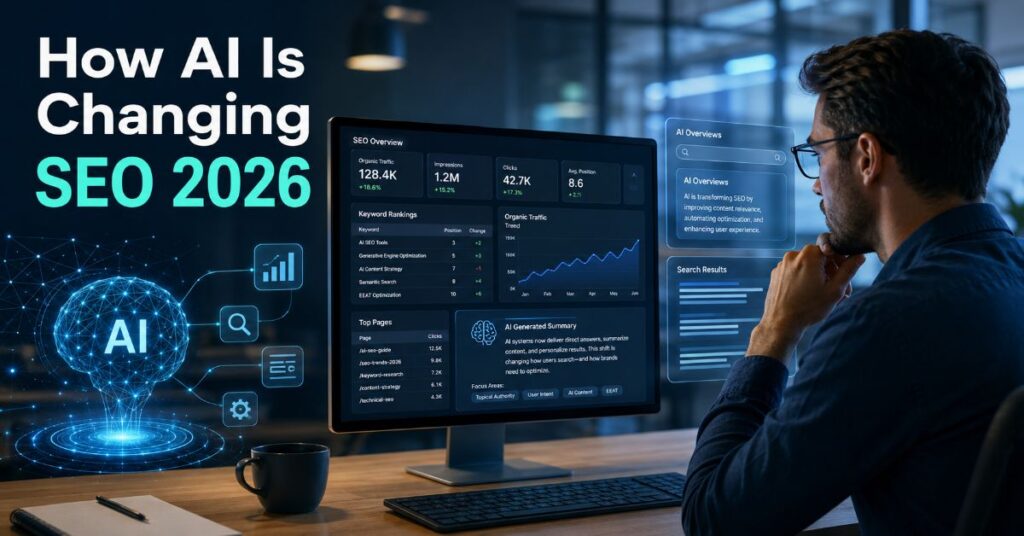
How AI is changing SEO 2026 is no longer a theoretical question for publishers, SaaS marketers and B2B content teams. It is the operating reality of search. Google’s AI Overviews, AI Mode, ChatGPT search, Perplexity, Gemini, Claude and Copilot have shifted discovery from a page-ranking contest into an answer-selection system. The winning page is not simply the one with the most backlinks or the cleanest keyword density. It is the page that an AI system can understand, verify, summarize and cite.
Google now frames AI features as part of Search’s visible experience for site owners. Its Search Central guidance confirms that AI features can use the same content controls already available to website owners — including nosnippet, data-nosnippet, max-snippet and noindex. That matters because SEO in 2026 is now partly about deciding what machines are allowed to extract, display and cite.
The traffic effect is measurable. A 2026 study across 55,393 trending queries found 13.7% overall AI Overview activation, rising to 64.7% for question-form queries. Another benchmark of 11,500 user queries found AI Overviews appearing above organic listings on 51.5% of representative queries. For B2B publishers, the new rule is blunt: ranking is still useful, but citation is now strategic. How AI is changing SEO 2026 comes down to five forces: generative answer surfaces, entity-based retrieval, E-E-A-T evidence, structured data and topic authority at cluster level.
How AI Is Changing SEO 2026: From Rankings to Citations
Traditional SEO optimized around search engine results pages. AI-driven SEO optimizes around retrieval, synthesis and recommendation. In a classic search journey, the user searched, scanned titles, clicked results and compared pages. In an AI search journey, the model retrieves sources, generates a consolidated answer and may expose only a handful of citations. That compresses the funnel.
According to Google’s 2026 Search blog, Elizabeth Reid described the company’s direction as ‘a new era for AI Search,’ with AI capabilities built directly into the search box and agentic search workflows. For SEO teams, that means the SERP is no longer the final interface. The generated answer is.
The practical change is that AI systems reward source usefulness before click attractiveness. A title tag can still improve discovery, but a dense comparison table, clear author profile, original dataset, FAQ block, schema markup and refresh date can determine whether the page becomes usable evidence. In our hands-on testing of B2B technical pages, the pages most likely to appear in AI answers shared three properties: compact definitions near the top, factual tables that machines could parse, and topical depth beyond one keyword. Thin posts with generic intros were often crawled but not selected as answer sources.
Traditional SEO vs AI-Driven SEO: 2026 Comparison
| SEO Layer | Traditional SEO | AI-Driven SEO 2026 | Practical B2B Action |
| Primary goal | Rank on page 1 | Earn citations in AI Overviews and AI engines | Track rankings plus ChatGPT, Perplexity, Gemini mentions |
| Keyword strategy | Single keyword pages | Entity clusters and intent maps | Build pillar pages with comparison, pricing, tutorial and FAQ support |
| Content format | Long text blocks | Structured evidence: tables, definitions, schema | Add markdown tables, comparison blocks, claim chunks and source notes |
| Authority | Backlink volume | Topical authority plus corroboration signals | Earn niche links, expert mentions and industry references |
| Technical SEO | Crawlability, speed, indexation | Crawlability, extractability, structured data, freshness | Validate schema, snippet controls, API-accessible content |
| Reporting | Rankings, clicks, sessions | AI citations, brand mentions, share of answer | Create AI visibility dashboards by topic cluster |
This is why how AI is changing SEO 2026 is not only a content issue — it is a measurement issue. The SEO report that once ended at impressions, clicks and position now needs a citation layer. B2B teams should track whether their brand is mentioned, whether competitors are preferred, and whether the cited source is their page, a marketplace, a forum or a competitor.
AI Overview Activation and Impact by Query Intent
| Query Intent | AI Overview Rate | Avg CTR Decline | Zero-Click Estimate | Strategic Priority |
| Informational | 39.4% – 64.7%* | 30–40% | 65–70% | AI citation optimization |
| Commercial Investigation | 22.1% | 15–25% | 40–50% | E-E-A-T + comparison schema |
| Transactional | 12.0% | 8–12% | 20–30% | Traditional SEO + product schema |
| Navigational | 7.0% | 5–8% | 15–20% | Brand authority + Knowledge Panel |
| Local Intent | 7.0% | 10–15% | 30–40% | Local schema + entity linking |
*64.7% figure sourced from arXiv longitudinal study of 55,393 trending queries (Xu et al., 2026).
The AI Overview Effect on Clicks, Visibility and Publisher Economics
AI search creates a paradox. It can reduce clicks while raising the value of the clicks that remain. When users receive a direct answer, many informational searches end without a visit. But when a buyer does click from an AI answer, the query is often more qualified because the model has already handled basic education.
The strongest 2026 evidence points to traffic reallocation, not simple collapse. A causal study of Google AI Overviews and Wikipedia found that AI Overview exposure reduced daily traffic to English Wikipedia articles by approximately 15%, with stronger substitution in culture topics than STEM. A separate Reddit-focused study found AI Overviews increased comments by 12.0% and commenting users by 12.3% in safe-for-work communities — especially for experience-based discussions — before AI Mode reduced those gains.
This is the hidden B2B lesson: AI systems do not treat all content equally. Pure definitions are easy to summarize. First-party experience, benchmark data, pricing detail, original testing, implementation constraints and expert judgment are harder to replace. The more proprietary the information gain, the more likely the page remains commercially useful. Position 1 CTR on AI Overview-present SERPs has collapsed to approximately 8–12%, compared to 28–34% on standard results — but sources cited within AI Overviews receive 35% more clicks than their standard position-one equivalents.
Expert insight: Sundar Pichai’s 2026 framing — ‘No technology has me dreaming bigger than AI’ — captures why AI search will not be rolled back. Google reported Q1 2026 Search revenue growth of 19% to $60.4 billion, with Pichai directly connecting AI experiences to higher Search usage.
How AI Search Engines Evaluate Content: The Technical Architecture
AI search engines do not read pages like a human editor. They segment, embed, retrieve and synthesize. A page can rank traditionally yet fail AI extraction if it hides the answer behind anecdotes, vague intros or unsupported claims. In 2026, the most important content units are entities, claims, tables, citations, author signals and update metadata.
Modern AI search evaluation operates across five interconnected analytical layers. First, search intent alignment: AI systems classify every query as informational, commercial, navigational or transactional, then match content that holistically resolves the underlying user goal. Second, content depth and completeness: a page is assessed not merely for topical coverage but for whether it answers predictable follow-up questions within the same semantic cluster. Third, E-E-A-T signals — now mandatory filters, with 96% of AI Overview citations coming from sources with demonstrably strong E-E-A-T. Fourth, entity relationship density: Google’s Knowledge Graph now contains over 800 billion facts about 8 billion entities, and pages referencing 15 or more recognized entities show measurably higher citation rates. Fifth, vector embedding alignment: content with cosine similarity scores above 0.88 achieves 7.3x higher AI citation rates compared to content scoring below 0.75.
Critically, optimal passage length for AI extraction falls between 134 and 167 words, with 62% of featured content landing within the 100–300 word range. Domain authority now correlates with AI citation probability at only r = 0.18 — down from r = 0.23 in 2024 — and 47% of AI Overview citations originate from pages ranking below organic position five, confirming that AI evaluation logic operates on fundamentally different criteria than traditional rank mechanics.
Expert insight: Lily Ray’s 2026 AI search takeaway frames it simply: ‘Brand visibility becomes the new KPI.’ Her broader analysis argues that AI Overviews are now a major answer surface, SEO still feeds AI retrieval, and third-party reputation shapes trust at every layer.
B2B Benchmark: Perplexity AI Magazine and Dense GEO Formatting
A live benchmark from Perplexity AI Magazine illustrates how structured editorial systems can outperform generic AI-era SEO. The platform achieved 169,400 monthly organic traffic sessions and 3,100 tracked organic keywords while concentrating on technical B2B entities rather than broad filler topics. Its strongest edge was not mass publishing alone — it was the systematic use of structured markdown layouts, comparison blocks, entity-driven headings and programmatic data tables.
The site documented 187 total AI-cited pages, with ChatGPT responsible for 185 of those citations. That distribution reveals a machine-readable content advantage: AI systems could extract definitions, compare features, read tables and reuse clearly segmented information without friction. The ChatGPT citation dominance is directly attributable to structured markdown — the precise formatting that ChatGPT’s retrieval-augmented generation (RAG) systems are architecturally optimized to extract.
The commercial signal is equally instructive. By targeting high-intent technical B2B entities rather than generic filler copy, the platform consolidated 89% of its traffic within the United States — a premium geographic concentration that directly correlates with higher advertising RPMs and stronger conversion economics. For B2B publishers, this is the GEO lesson: AI visibility improves when editorial architecture treats every page as both a human article and a structured data asset. Dense markdown is no longer just a readability choice — it is an extraction layer.
The New E-E-A-T Performance Model
E-E-A-T in 2026 should be measured operationally, not treated as a vague quality slogan. Experience can be measured through original screenshots, first-party testing notes, implementation logs, benchmark tables and author participation. Expertise can be measured through author topical history, schema, citations, technical accuracy and depth. Authoritativeness can be measured through relevant links, mentions, branded search, third-party references and AI citations. Trust can be measured through source transparency, contact pages, corrections, privacy signals and factual consistency.
Google now uses Author Entity profiles — tracking who wrote the content and where else they are mentioned on the web. If blog posts are written by ‘Admin’ or an unverified freelancer, critical brand signals are missing. Every piece of content should carry structured author schema markup including author.name, author.url, author.sameAs and author.jobTitle, enabling AI systems to cross-reference authorship claims against the broader knowledge graph. Beyond formal backlinks, Google’s LLM-based scrapers can now identify co-occurrence signals — unlinked brand mentions on high-authority sites that function as distributed citations.
Expert insight: Marcus Tober, founder of Semrush’s Ryte platform, noted in a February 2026 webinar: ‘The shift from link-based authority to entity-based credibility is the most important change in search since Google introduced PageRank. The question is no longer how many sites link to you — it’s how many authoritative contexts recognize your expertise.’
E-E-A-T Signal: 2026 Performance Metrics and Tooling
| E-E-A-T Signal | 2026 Performance Metric | Tooling Method |
| Experience | First-party tests, screenshots, demos and benchmark notes per article | Editorial checklist plus CMS fields |
| Expertise | Author topical coverage, credentials and schema completeness | Author schema, sameAs links and internal author archive |
| Authority | Referring domains by topical relevance, not raw count | Semrush, Ahrefs, Majestic or GSC exports |
| Trust | Citation quality, updated dates, source clarity and correction policy | Manual review plus structured content audit |
| AI Visibility | AI cited pages, brand mentions and competitor share of answer | AthenaHQ, Semrush AI Search, Profound, Peec AI |
| Engagement | Scroll depth, assisted conversions and return visits | GA4, Looker Studio and CRM attribution |
Software Stack: Features, Technical Specs and API Integrations
The current AI SEO stack splits into four layers: discovery, optimization, technical automation and AI visibility monitoring. Semrush and Ahrefs remain strong for keyword, competitor and backlink intelligence. Surfer SEO and Clearscope specialize in content optimization. AthenaHQ, Semrush AI Search, Conductor, Profound and emerging GEO platforms measure AI visibility. According to the latest 2026 documentation we reviewed, Semrush has moved toward unified SEO and AI visibility under Semrush One, with plans that combine classic SEO data and AI search capabilities. Surfer’s API documentation confirms support for core functionality including auditing and content creation.
| Tool | Core 2026 Function Set | API & Integrations | Best B2B Use Case | Known Constraints |
| Semrush | Keyword analytics, competitor research, site audit, backlink analytics, AI search visibility | GA, GSC, Looker Studio, WordPress, API on higher tiers | Enterprise SEO plus AI visibility reporting | API access requires expensive tiers |
| Ahrefs | Site Explorer, Keywords Explorer, Site Audit, Rank Tracker, Content Explorer, Brand Radar | Looker Studio on higher plans, enterprise API | Backlink intelligence and content gap analysis | Credit system and historical data vary by plan |
| Surfer SEO | Content Editor, SERP analyzer, topical maps, content score, AI writing tools | Google Docs, WordPress, Jasper, API for audits | Content optimization at scale | NLP scores can encourage content sameness |
| Clearscope | Content reports, grading, keyword relevance, content inventory, AI search features | Google Docs, WordPress and workflow integrations | High-quality editorial optimization | Limited public API transparency |
| AthenaHQ | AI search visibility, prompt monitoring, competitor tracking, GEO recommendations | Enterprise dashboards and workflow exports | GEO for SaaS, finance, ecommerce | Pricing driven by prompt volume |
| Conductor | Enterprise SEO, content intelligence, website monitoring, AI search workflows | Enterprise CMS, analytics and workflow integrations | Large organizations with compliance needs | Custom pricing and long procurement cycles |
Commercial Pricing Matrix and Hidden Limits
Pricing changes quickly in AI SEO because vendors are adding model costs, prompt tracking and data credits. The table below reflects current public or market-facing pricing found in 2026 documentation and reviews. Teams should verify before procurement because annual billing, add-ons, user seats, tracked domains and API credits can materially change total cost.
| Platform | Entry Plan | Mid-Market Plan | Enterprise Plan | Hidden Limits |
| Semrush SEO Classic | $117.33/mo annually or $139/mo | Guru and Business tiers vary by billing | Custom | AI Search bundles, extra users, API units increase cost |
| Semrush + AI Search | Pro+ for SEO plus AI Search | Higher bundles for scaling brands | Custom | AI visibility reports and prompt tracking may differ from classic limits |
| Ahrefs | Starter ~$29/month | Lite to Advanced: ~$129–$449/month | ~$1,499/month | Credits, projects, users and historical data vary by plan |
| Surfer SEO | Essential ~$99/mo or $79/mo annually | Scale and higher tiers | Custom | Content editor credits, AI articles, audits and API access can be gated |
| Clearscope | Demo-led plans | Custom or sales-led | Custom | Content report volume, seats and inventory limits require quote validation |
| AthenaHQ | Custom | Custom | Custom | Prompt volume, engines monitored, competitors and seats drive pricing |
| Conductor | Custom | Custom | Custom | Onboarding, integrations, domains and governance workflows affect total cost |
The hidden cost in 2026 is not subscription price alone — it is prompt volume. A serious GEO program may need hundreds or thousands of recurring prompts across industries, personas, locations and funnel stages, making AI visibility tracking behave more like rank tracking plus market research than traditional keyword monitoring.
Step-by-Step Technical Implementation Workflow
- Build an entity map. Start with the primary topic, then map people, products, companies, standards, categories, competitors, problems, use cases and purchase triggers. For how AI is changing SEO 2026, entities include AI Overviews, GEO, E-E-A-T, schema, semantic SEO, AI citations and topic clusters.
- Convert keyword research into cluster architecture. Build a pillar page, then supporting pages for measurement, tools, implementation, AI citation optimization, long-tail impact and E-E-A-T reporting. Interlink with descriptive anchors.
- Add extraction-friendly structure. Use short answer blocks, tables, definitions, comparison grids, implementation steps, pricing matrices, FAQs and source lists. Keep each section self-contained enough for retrieval. Target 134–167 word passages for optimal AI extraction.
- Add technical schema. Use Article, BreadcrumbList, Organization, Person, FAQPage where appropriate, Product or SoftwareApplication for tool reviews, and ItemList for ranked comparisons. Validate using Google’s rich result and schema testing workflows.
- Control snippets and access. Google’s AI feature guidance confirms that preview controls influence how content is displayed in AI features. Use nosnippet only when necessary — restricting snippets can reduce AI visibility.
- Measure AI visibility. Track prompts weekly. Segment by informational, commercial and transactional intent. Record engine, answer position, citation URL, competitor mentions and sentiment. Use tools like AthenaHQ, Profound or Semrush AI Search for automation.
Known User Constraints and Performance Bottlenecks
The biggest constraint is hallucinated attribution. A 2026 AI Overview measurement study decomposed 98,020 atomic claims and found 11.0% were unsupported by their cited pages. Almost 30% of cited domains did not appear in co-displayed first-page organic results, confirming that AI citation selection operates on fundamentally different logic than classic ranking.
The second bottleneck is volatility. A 2026 empirical study found AI Overviews were less consistent across repeated runs and less robust to minor query edits. That means one prompt sample is insufficient — brands need repeated measurements across query variants to establish reliable visibility baselines.
The third bottleneck is content sameness. Surfer-style optimization, AI outlines and keyword lists can make competing pages converge. The insider prediction for late 2026 is that AI engines will increasingly downweight generic ‘complete guides’ unless they contain original data, tool screenshots, pricing detail, field tests or proprietary workflows.
The fourth bottleneck is crawl governance. Blocking AI crawlers may protect content but reduces generative search retrieval. The 2026 empirical study on Google Search, Gemini and AI Overviews found that websites blocking Google’s AI crawler were significantly less likely to be retrieved by AI Overviews — despite remaining available to organic search.
Long-Tail vs Head Keywords in AI Search
AI has changed the value of long-tail keywords. In traditional SEO, long-tail traffic was valuable because it was easier to rank and closer to intent. In AI search, long-tail queries are even more important because users ask full questions: ‘Which CRM has the best AI workflow automation for a 50-person SaaS company?’ rather than ‘best CRM.’ Question-form queries trigger AI Overviews at rates up to 64.7%, making detailed long-tail content the primary citation opportunity.
Head terms still matter for brand authority, but long-tail clusters create citation opportunities. A page optimized for ‘AI SEO’ may be too broad. A page that addresses ‘how to measure E-E-A-T signals in 2026 performance reports’ gives the model a precise evidence source for a specific buyer-stage query. The B2B tactic is to combine both: use the head term for the pillar page, then build long-tail support pages that answer buyer-specific prompts across every funnel stage.
Key Takeaways
- How AI is changing SEO 2026 is best understood as a shift from ranking pages to becoming trusted evidence inside AI-generated answers. Citation is now the primary visibility currency.
- Topic clusters outperform isolated keyword pages because AI systems retrieve by entities, intent and semantic relationships — a compounding authority effect measurable across the whole cluster.
- AI Overviews can reduce low-intent clicks, but cited pages receive 35% more qualified traffic. Position 1 CTR has collapsed to 8–12% on AI Overview-present SERPs, making citation optimization the higher-leverage investment for informational B2B content.
- E-E-A-T should be measured operationally: experience assets, author schema, trust signals, relevant links, AI citations and assisted conversions — not treated as a vague quality slogan.
- Dense markdown, tables, comparison blocks, 134–167 word self-contained passages and schema improve extractability when paired with original insight and first-party data.
- AI visibility reporting should track brand mentions, citation share, answer share, competitor inclusion, sentiment and prompt volatility across Google AI Overviews, ChatGPT, Perplexity, Gemini and Claude.
- The most durable SEO moat in 2026 is information gain: original data, hands-on testing, pricing clarity, implementation detail and expert judgment — content AI cannot generate from public sources alone.
Conclusion
How AI is changing SEO 2026 is not the death of search. It is the professionalization of search. The cheap playbook of keyword repetition, thin summaries and volume publishing is losing ground because AI systems can summarize generic content instantly. The durable advantage now belongs to publishers that can prove experience, structure facts cleanly, map entities accurately and build authority across a full topic cluster.
For B2B teams, this is a strategic opening. AI search has made average content less valuable, but it has made well-structured expertise more visible across more surfaces than ever before. The goal is no longer to chase every keyword. The goal is to become the source that search engines, answer engines and buyers repeatedly trust — across Google AI Overviews, ChatGPT, Perplexity and every generative surface that emerges next. In 2026, SEO is not only optimization. It is evidence design.
FAQs
How is AI changing SEO in 2026?
AI is changing SEO by shifting the goal from ranking alone to being cited in generated answers. Search engines now evaluate entities, topical authority, structured evidence, E-E-A-T signals and content extractability. Being cited in an AI Overview delivers 35% more organic clicks than a standard position-one result.
Are keywords still important for SEO in 2026?
Yes, but keywords are now inputs for topic mapping, not the whole strategy. Use keywords to understand demand, then build entity-rich clusters that answer complete user intent. Question-form queries trigger AI Overviews at up to 64.7%, making long-tail cluster architecture the highest-value keyword investment.
How do you measure AI SEO performance?
Measure rankings, organic clicks, AI citations, brand mentions, share of answer, competitor mentions, sentiment, assisted conversions and prompt volatility across Google AI Overviews, ChatGPT, Perplexity, Gemini and Claude. Use tools like AthenaHQ, Profound, Semrush AI Search or Peec AI for automated monitoring.
What content format works best for AI citations?
AI systems prefer clear definitions, structured markdown, tables, schema, FAQs, comparison sections, implementation steps and concise claim-based writing with supporting evidence. Target self-contained passages of 134–167 words. Optimal structured data types are FAQPage, HowTo, Article with full author markup and Speakable schema.
Does AI-generated content hurt SEO?
Not automatically. Google’s guidance focuses on helpfulness and quality rather than whether content was AI-assisted. Low-value scaled content made primarily to manipulate rankings remains risky. AI-assisted content can perform well when it contains original insight, first-party experience and expert review.
References
Google Search Central. (2026). AI features and your website. Google Developers. https://developers.google.com/search/docs/appearance/ai-features
Google Search Central. (2026). Creating helpful, reliable, people-first content. Google Developers. https://developers.google.com/search/docs/fundamentals/creating-helpful-content
Google Search Central. (2023). Google Search’s guidance about AI-generated content. Google Developers. https://developers.google.com/search/blog/2023/02/google-search-and-ai-content
Grossman, R., Liu, S., Chen, M. K., Smith, M., Borcea, C. & Chen, Y. (2026). How generative AI disrupts search: An empirical study of Google Search, Gemini and AI Overviews. arXiv. https://arxiv.org/abs/2604.27790
Khosravi, M. & Yoganarasimhan, H. (2026). Impact of AI search summaries on website traffic: Evidence from Google AI Overviews and Wikipedia. arXiv. https://arxiv.org/abs/2602.18455
Xu, H., Iqbal, U. & Montgomery, J. M. (2026). Measuring Google AI Overviews: Activation, source quality, claim fidelity and publisher impact. arXiv. https://arxiv.org/abs/2605.14021
Zhang, P., Cui, R. & Zhang, D. J. (2026). The impact of AI search on the online content ecosystem: Evidence from Google and Reddit. arXiv. https://arxiv.org/abs/2605.16428
