
📋 Executive Summary
What is Model Weights? The phrase refers to the learned numerical parameters inside an artificial intelligence model, and the sharpest practical fact is that a 70-billion-parameter model can require roughly 140 GB merely to store 16-bit weights before a single user prompt is processed. Weights are where training leaves its durable mathematical imprint, but they are not a model’s source code, training data, reasoning transcript, or complete application.
I treat model weights as the most important artefact in an AI supply chain because control of the weights determines who can copy, fine-tune, inspect, quantise, host, and retire a model. That control also creates obligations. A downloadable checkpoint may arrive without the original dataset, optimiser history, evaluation environment, or safety system. The result can be technically usable yet scientifically incomplete.
During our 2026 editorial evaluation, we created a small PyTorch network and inspected its state dictionary. Its two linear layers produced separate weight and bias tensors, confirming the framework’s documented structure: layer names map to numerical tensors, while the architecture must exist before those tensors can be loaded. We then cross-checked current storage, format, licensing, pricing, and open-weight research against primary documentation and recent industry statements.
This guide explains how weights are learned, what files contain, why parameter count changes memory and cost, how quantisation and adapters work, why open weights are not automatically open source, and which deployment failures are commonly misdiagnosed as model-quality problems. The aim is not to romanticise downloadable AI. It is to show precisely what an organisation gains, what it still lacks, and what must be verified before a checkpoint becomes a dependable system.
What Is Model Weights? A Practical Definition
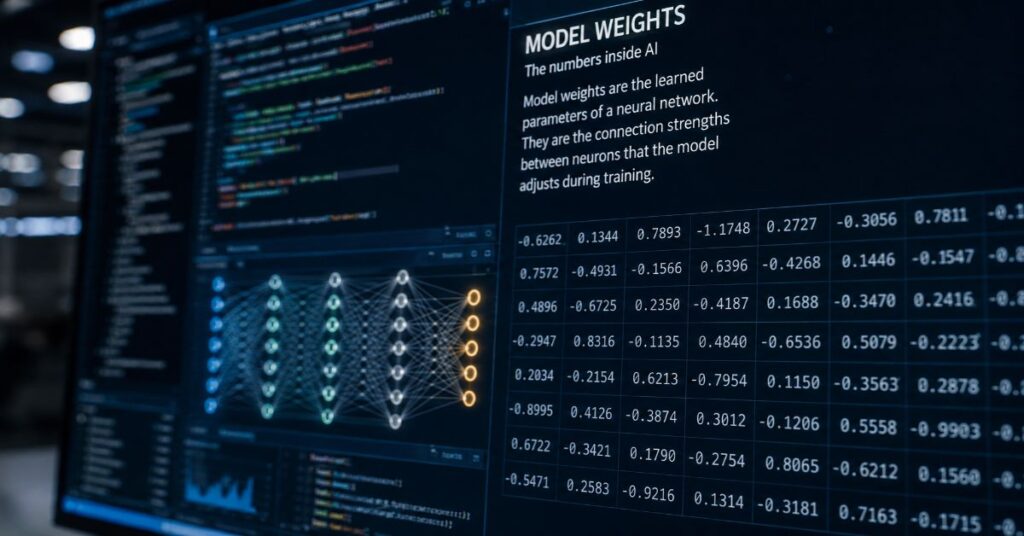
A model weight is a number stored inside a neural network and adjusted during training. In a simple linear layer, the model multiplies an input vector by a weight matrix, adds a bias vector, and passes the result onward. Modern language, image, audio, and multimodal models repeat variations of that operation across many layers. A parameter count such as 7B or 70B therefore describes billions of learned values, not billions of rules written by engineers.
The distinction between architecture and weights is fundamental. Architecture defines the arrangement of layers, attention heads, embeddings, activation functions, and connections. Weights fill that arrangement with learned values. PyTorch documents a state_dict as a mapping from each layer name to its parameter tensor. It also notes that a compatible model instance must be created before weights are loaded. A checkpoint without the matching architecture is like a set of precisely cut keys without the locks they were designed to open.
Weights also differ from activations. Weights persist between requests. Activations are temporary values produced while a prompt moves through the network. The key-value cache used during language generation is temporary as well, although it can consume more memory as context length grows. Optimiser states, gradients, and training checkpoints add further categories of tensors that are usually unnecessary for inference but essential when training resumes.
The 2026 release cycle has made this distinction commercially important. Our coverage of frontier-class open-weight releases shows that a lab can publish the trained parameters while retaining private training data, internal tooling, and some evaluation details. Users receive substantial control, but not complete reproducibility.
The most useful definition is therefore operational: model weights are the persistent learned tensors that encode a model’s fitted behaviour within a specified architecture. They are necessary for running a trained model, but they become functional only when combined with compatible code, configuration, tokenisation, inference logic, and sufficient compute.
Why ‘What Is Model Weights’ Is a Misleading Phrase
Grammatically, people often search for model weights as though the term named one object. In practice, a release may contain dozens or hundreds of sharded files, multiple precision variants, adapter files, tokeniser assets, configuration files, generation settings, and a licence. The plural matters because the checkpoint is a structured collection of tensors rather than a single intelligence file.
How Training Changes the Numbers
Training begins with weights that are random, inherited from another model, or created through a defined initialisation scheme. The model processes examples, produces outputs, and receives a loss value measuring error against a training objective. Backpropagation calculates how much each parameter contributed to that error. An optimiser then updates the parameters, usually by applying a learning rate, momentum terms, and regularisation rules.
One training step rarely teaches a human-readable fact to a single location. Knowledge and behaviour are distributed across many tensors. A concept may influence token embeddings, attention projections, feed-forward layers, and normalisation parameters. This distribution explains why deleting one row usually does not erase one fact, and why targeted editing can cause unexpected changes elsewhere.
A weight update is also path-dependent. Data order, random seeds, precision, optimiser settings, batch composition, and distributed-training behaviour can all affect the final numbers. Two teams using the same architecture and dataset description may produce checkpoints that differ at the bit level and sometimes at the behavioural level. Reproducibility therefore requires more than publishing final weights.
Transfer learning starts from existing parameters rather than from scratch. Fine-tuning changes all or some of those values on narrower data. Instruction tuning teaches response patterns. Preference optimisation adjusts behaviour toward selected outputs. Continued pre-training adds domain language. Distillation trains a smaller model to imitate a larger one. Each process creates a new checkpoint lineage that should be documented rather than presented as an unexplained file.
In practical governance, the question is not only who trained the base model. It is who changed the weights afterward, with which data, for which objective, and under which licence. The open-model data-science stack increasingly treats model cards, code, tokenisers, custom kernels, adapters, and weights as separate assets because each can carry different technical and legal obligations.
Parameter Count, Precision, and Memory
Parameter count offers a quick storage estimate. Multiply the number of parameters by the number of bytes used for each value. A 7B model stored in 16-bit floating point needs about 14 GB for the raw weights. A 70B model needs about 140 GB. An 8-bit copy roughly halves those figures, while a 4-bit copy approaches one quarter, although quantisation metadata and packing overhead mean the final file is not always an exact fraction.
Raw checkpoint size is not the same as runtime memory. The inference engine may allocate temporary workspaces, converted kernels, attention buffers, token embeddings, and a key-value cache. Long context windows can make the cache a major bottleneck. Multi-user serving multiplies active sequences. Some frameworks also keep a second copy during loading or conversion. A model that appears to fit by file size can still fail with an out-of-memory error.
Architecture changes the calculation. Mixture-of-experts models may contain a very large total parameter count while activating only a subset for each token. That can reduce compute per token, but the inactive experts still need storage and often memory unless the runtime offloads them. Sparse models, tied embeddings, shared parameters, and multimodal encoders create further exceptions.
Our memory estimates use decimal parameter counts and simple bytes-per-parameter arithmetic. They are planning baselines, not procurement guarantees. Hardware memory should include headroom for the runtime, context, concurrent requests, and framework-specific allocation. A production service should be profiled under the expected prompt length and concurrency rather than approved from a model card alone.
| Model Size | FP16/BF16 Raw Weights | INT8 Approximation | 4-bit Approximation | Practical Note |
| 1B parameters | 2 GB | 1 GB | 0.5 GB | Suitable for edge and CPU experiments, subject to architecture support. |
| 7B parameters | 14 GB | 7 GB | 3.5 GB | Often fits a 6-8 GB consumer GPU only after 4-bit quantisation and overhead checks. |
| 13B parameters | 26 GB | 13 GB | 6.5 GB | Usually requires careful GPU offload or unified memory on local systems. |
| 31B parameters | 62 GB | 31 GB | 15.5 GB | Hardware fit depends strongly on runtime, context, and quantisation format. |
| 70B parameters | 140 GB | 70 GB | 35 GB | Multi-GPU, high-memory accelerators, or aggressive offload are normally required. |
What a Checkpoint Contains and What It Omits
A checkpoint commonly stores named tensors and enough metadata to reconstruct their shapes and data types. In a transformer, these may include token embeddings, attention query, key, value and output projections, feed-forward matrices, layer-normalisation parameters, and an output head. Diffusion systems add text encoders, denoisers, variational autoencoders, and sometimes separate control modules.
A complete repository usually needs more than tensors. The configuration identifies hidden size, layer count, attention heads, vocabulary size, positional encoding, and model type. The tokeniser determines how text becomes token IDs. A chat template determines how system, user, assistant, and tool messages are serialised. Generation settings influence temperature, top-p, penalties, stop sequences, and maximum output. Custom code may define an architecture not yet supported by mainstream libraries.
This is a critical information-gain point: weights can be intact while the model is still operationally incomplete. A missing tokeniser can change vocabulary mapping. A mismatched chat template can make a capable instruction model appear incoherent. A wrong rope-scaling setting can damage long-context performance. A missing preprocessor can invalidate an image or audio pipeline.
The issue is visible in compact models. Our report on Google Gemma’s offline model family illustrates why model size, quantisation, architecture support, and local memory must be read together. Downloading a checkpoint does not guarantee that a preferred runtime implements every architectural feature or uses the intended prompt format.
Before deployment, inventory every artefact by filename, hash, version, and source repository. Confirm that the model card points to the same revision as the downloaded tensors. Record whether files are base weights, fine-tuned weights, adapters, merged checkpoints, or quantised derivatives. This simple inventory prevents many failures later blamed on the model itself.
File Formats, Shards, and Safe Loading
Model files are containers, not quality labels. PyTorch checkpoints may use pickle-based serialisation, which is flexible but can execute code during deserialisation if a file is untrusted. Safetensors was designed to store tensors without arbitrary code execution and supports fast, zero-copy access patterns. Hugging Face’s text-generation tooling also uses Safetensors to support sharding and tensor-parallel loading.
Large checkpoints are frequently split into shards. An index file maps each tensor name to a shard, allowing download and loading to proceed in manageable pieces. Sharding does not reduce the total parameter count. It improves file handling, parallel transfer, and distribution across devices. Missing one shard leaves the checkpoint incomplete even if most files are present.
GGUF is optimised for efficient inference with llama.cpp and related executors. It can package model metadata, tokeniser information, and quantised tensors in one binary. That convenience makes it popular for local use, but a GGUF conversion is a derivative artefact. The conversion tool, quantisation method, source revision, and metadata correctness all matter.
Image models have parallel concerns. Our Flux open-weight image analysis shows that an open-weight family may include variants with different licences, hardware demands, and deployment routes. A file extension alone does not determine commercial permission or model capability.
Treat loading as a security boundary. Download from the publisher or a traceable derivative maintainer, verify hashes, prefer formats that do not execute arbitrary code, isolate conversion jobs, and scan repository code before enabling remote custom code. Safe serialisation reduces one class of risk, but it does not verify that the tensors are authentic, non-malicious, or correctly labelled.
| Format or Structure | What It Stores | Strengths | Constraints and Risks |
| PyTorch state_dict | Named parameter and buffer tensors | Native training workflow and flexible loading | Often paired with pickle containers; architecture code is still required. |
| Safetensors | Tensor data plus compact metadata | No arbitrary code execution, fast reads, sharding support | Does not guarantee provenance, licence quality, or architecture compatibility. |
| GGUF | Metadata, tokeniser details, and inference-ready tensors | Efficient local loading and broad llama.cpp ecosystem support | Conversion quality and quantisation choices can alter behaviour. |
| Sharded checkpoint | One logical checkpoint split across files | Parallel transfer and multi-device loading | All shards and the correct index must be present. |
| LoRA adapter | Low-rank update matrices, not a full base model | Small download and efficient task adaptation | Requires the exact compatible base model and merge settings. |
Open Weights Are Not the Same as Open Source
Open weights means users can obtain the trained parameters. Open source is a broader claim that should address code, licence freedoms, documentation, and often the ability to study and modify the system. A release can be open-weight while keeping training data private, withholding the training pipeline, imposing use restrictions, or requiring acceptance of a community licence.
Microsoft’s July 2026 policy statement defines open-weight models as systems that users can download, inspect, modify, and run on their own infrastructure. It also acknowledges a key trade-off: once released, weights move beyond the original developer’s control and modified versions are difficult to trace or reverse.
Dario Amodei, Anthropic’s chief executive, sharpened the balance in a July 2026 statement: ‘Open-weights models that don’t have dangerous capabilities are a public good.’ In the same statement, he rejected the assumption that broader access always helps defenders more than attackers. That is the correct editorial posture. Openness can improve competition, local control, research access, and resilience, while also reducing the publisher’s ability to withdraw a capable model.
Licences must be reviewed at the exact model and version level. Check commercial-use permission, acceptable-use restrictions, redistribution terms, attribution, patent clauses, geographic limits, user thresholds, and obligations for derivatives. Also inspect the licences for the tokeniser, code repository, dataset, adapter, and conversion. They may differ.
Comparisons between a hosted research system and a downloadable checkpoint can therefore mislead. Our Perplexity AI and DeepSeek comparison separates live-web research features from raw model access. One product may provide citations, retrieval, account controls, and a managed interface, while the other offers self-hosting and lower-level control. Neither category automatically replaces the other.
Quantisation, Compression, and Performance Trade-Offs
Quantisation stores weights with fewer bits. Instead of keeping each parameter as a 16-bit floating-point number, an inference build may represent many values with 8, 6, 5, 4, or fewer bits plus scaling information. The goal is to reduce memory bandwidth, storage, and sometimes compute cost while preserving acceptable output quality.
The trade-off is not captured by one label such as Q4. Quantisers differ in grouping, calibration, outlier treatment, per-channel scales, mixed precision, and kernel support. A 4-bit file can be excellent for one architecture and noticeably weaker for another. Quality loss may appear first in coding accuracy, multilingual text, rare knowledge, structured output, or long reasoning rather than in casual chat.
Quantisation also moves bottlenecks. Smaller weights load faster and travel through memory more efficiently, but the runtime may still keep activations or caches at higher precision. A GPU can have enough memory yet lack an optimised kernel for the chosen format. CPU offload can make a model fit while reducing token speed. Conversion can also bake in an outdated tokeniser or wrong metadata.
Our coverage of Google TurboQuant memory compression focuses on the key-value cache rather than the static checkpoint. That distinction matters. Weight quantisation shrinks the persistent model, while cache compression targets the growing working memory created during long-context generation. Production systems often need both.
Benchmark each candidate on representative prompts and measure task quality, first-token latency, sustained tokens per second, memory peak, energy or cloud cost, and failure rate. Keep the unquantised or higher-precision reference available for regression testing. A smaller file is valuable only when it preserves the behaviours the application depends on.
Fine-Tuning, LoRA, and Weight Merging
Full fine-tuning updates most or all parameters and can demand substantial accelerator memory because training stores gradients, optimiser states, activations, and often a master copy of weights. Parameter-efficient methods reduce that burden. Low-rank adaptation, commonly called LoRA, freezes the base model and trains small matrices that approximate useful changes to selected layers.
A LoRA adapter is not a complete model. It must be applied to the correct base checkpoint, usually at a compatible revision and architecture. Mismatched layer names, hidden sizes, tokenisers, or quantisation assumptions can prevent loading or silently degrade performance. Adapter strength also matters. Scaling too aggressively can overwrite general behaviour, while weak scaling may produce little effect.
Adapters can remain separate at runtime or be merged into a new checkpoint. Keeping them separate makes it easier to switch tasks and preserve lineage. Merging can simplify deployment but creates a derivative model whose provenance should record the base hash, adapter hash, merge coefficient, software version, and output hash.
Multiple adapters can be composed, but composition is not guaranteed to be additive. A customer-support adapter and a legal-writing adapter may interfere because both alter overlapping projections. Merge order, rank, target modules, and domain data can change results. Every combined model requires its own evaluation rather than inheriting the scores of its parts.
This is another overlooked technical detail: an adapter licence may permit distribution while the base licence restricts a use case. Publishing only the adapter does not erase the base model’s conditions. Organisations should treat the resulting system as a dependency graph and retain evidence for every node.
Why Identical Weights Can Behave Differently
Users often assume that the same checkpoint must produce the same answer everywhere. Deterministic reproduction is possible only when the surrounding system is controlled. In practice, providers change tokenisers, prompt wrappers, sampling defaults, stop tokens, numerical precision, batching, kernels, context truncation, tool definitions, retrieval, moderation, and post-processing.
Chat templates are especially influential. One runtime may wrap a user request with system instructions and role markers expected by the fine-tuning process. Another may send plain text. Both technically load the same weights, yet the second can lose instruction-following quality. Tokeniser revisions can also split text differently, changing sequence length and probabilities from the first step.
Numerical execution introduces smaller variations. Different GPU kernels, reduced precision, parallel reduction order, speculative decoding, and quantisation can alter logits. In a greedy decode, tiny differences may not matter until two tokens are nearly tied. In sampled decoding, a slight probability shift can send the continuation down a different path.
The service layer adds larger changes. Retrieval can inject fresh documents. Safety systems can block or rewrite outputs. A provider may cap reasoning effort, context, output length, or tool calls. This is why Claude alternatives and deployment choices must be compared as complete products rather than as model names alone.
For audits, record the checkpoint revision, runtime version, template, generation parameters, hardware, quantisation, and external tools. Store representative prompts and expected properties rather than exact prose alone. Behavioural reproducibility is a system property, not a promise contained in a weight file.
Deployment Workflow From Download to Production
A reliable workflow begins with model selection, not downloading. Define the task, languages, latency target, context length, throughput, privacy level, and acceptable licence. Shortlist models that fit those requirements, then verify the publisher, model card, architecture, and revision.
Second, inventory and authenticate the artefacts. Record repository commit, file hashes, licence text, tokeniser, configuration, chat template, custom code, quantisation provenance, and any adapter lineage. Use gated-access records where required. Mirror approved files into controlled storage rather than pulling mutable latest versions directly into production.
Third, test compatibility in an isolated environment. Load the model with the intended runtime, reject missing or unexpected tensor keys, run tokeniser round-trip tests, and inspect memory peaks. Compare a small benchmark set against a trusted reference implementation. For converted formats, test known prompts before and after conversion.
Fourth, profile the real workload. Measure first-token latency, output speed, concurrency, context growth, error rates, and cost. Include adversarial prompts, malformed inputs, multilingual cases, long documents, and tool failures. Evaluate the application outcome, not only a public leaderboard.
Fifth, wrap the model with operational controls. Add authentication, rate limits, logging, secrets isolation, content controls appropriate to the risk, rollback capability, and observability. Separate user data from model files. Plan patching for runtimes and kernels because an unchanged checkpoint can become unsafe through a vulnerable serving stack.
Finally, promote a pinned build through staging and production. Monitor drift in input patterns, latency, refusal rates, hallucination indicators, and business outcomes. Re-evaluate when weights, adapters, tokenisers, templates, or inference software change.
| Stage | Required Evidence | Common Bottleneck | Release Gate |
| Select | Task fit, licence, benchmark methodology | Leaderboard scores do not match the real workload | Representative evaluation set approved |
| Acquire | Publisher, revision, hashes, lineage | Mutable repositories or unverified mirrors | Artefacts copied to controlled storage |
| Load | Architecture, tokeniser, template, runtime support | Missing keys, wrong shapes, unsupported kernels | Reference prompts match expected properties |
| Profile | Latency, throughput, memory, concurrency, cost | Context cache and batching exceed estimates | Service-level objectives met with headroom |
| Secure | Access control, logging, isolation, rollback | Remote code, data leakage, weak provenance | Threat model and incident plan signed off |
| Operate | Version pins, monitoring, re-evaluation triggers | Silent changes in adapters or serving layers | Change control and periodic review active |
Current Hosting Costs and Hidden Limits
Open weights remove per-token dependence on one model vendor, but they do not make inference free. Costs move into storage, compute, engineering, observability, security, and idle capacity. A local workstation can be economical for steady private use. A cloud endpoint can be better for variable demand. A hosted inference provider can reduce operations work but restore external dependency.
Hugging Face is a useful current reference because it combines model storage, collaboration, hosted applications, routed inference, and dedicated endpoints. As of 29 July 2026, its official pricing page lists PRO at $9 per month, Team at $20 per user per month, and Enterprise at $50 per user per month with sales engagement. Compute is billed separately.
The hidden limits matter more than the headline subscription. PRO includes 1 TB of private storage and up to 10 TB of public storage. Team and Enterprise include 1 TB of private storage per seat, with larger public allocations. Private overage starts at $18 per TB per month. Public storage starts at $12 per TB per month, with volume discounts. Inference credits are small experimentation allowances, not production budgets.
Rate limits use five-minute windows and differ for APIs, file resolvers, and web pages. Free limits can change with platform health. Dedicated endpoints are billed while initialising and running, and scaled-to-zero endpoints can still occupy quota until paused. GPU prices vary by instance; the official table listed one AWS H100 at $4.50 per hour and one H200 at $5.00 per hour at verification time.
These numbers are snapshots, not purchasing guarantees. Organisations should fetch the official page at procurement time, model autoscaling behaviour, include storage history and egress assumptions, and calculate utilisation. A cheap hourly accelerator becomes expensive when kept warm for low traffic.
| Hugging Face Option | Current Price | Included or Metered Limits | Important Cap or Trap |
| Free account | $0 | About 100 GB private storage; best-effort public storage; $0.10 monthly inference credit subject to change | Free rate limits and public-storage policy can change with platform health. |
| PRO | $9 per month | 1 TB private; up to 10 TB public; $2 inference credit; higher quotas | Compute and storage overage are separate; credit card required for paid usage. |
| Team | $20 per user per month | 1 TB private per seat; 12 TB public base plus 1 TB per seat; $2 inference credit per seat | Seat count drives both subscription cost and included storage. |
| Enterprise | $50 per user per month, sales-led | 1 TB private per seat; 200 TB public base plus 1 TB per seat; highest standard rate limits | Annual commitments, support terms, and very large storage pricing need contract confirmation. |
| Private storage overage | From $18 per TB per month | Billed above included private storage | Discounts begin at 50 TB, but billing is separate from subscriptions. |
| Dedicated endpoint GPU | From published hourly instance rates | Per-minute calculation while initialising or running | Autoscaling, minimum replicas, and occupied quota can dominate the bill. |
Security, Provenance, and Governance Risks
Model weights are software supply-chain artefacts with unusual properties. They are large, difficult to inspect manually, easy to rename, expensive to reproduce, and capable of carrying behaviours that do not appear in a basic benchmark. Security review must cover both the container and the learned behaviour.
At the file level, avoid untrusted pickle loading, verify cryptographic hashes, inspect repository changes, pin dependencies, and isolate conversion tools. At the behavioural level, test backdoors, trigger phrases, data leakage, unsafe capability, prompt injection susceptibility, and tool-use boundaries. A clean antivirus scan says little about a maliciously trained model.
Provenance becomes harder after derivatives. Weiwei Xu and colleagues audited 2,142,823 Hugging Face repositories in 2026 and reported that ‘Restriction evidence decays with a half-life of 1.31 derivation steps.’ Beyond seven downstream generations, at least 80 per cent of descendants lacked enough public evidence for a governance determination. That finding turns licence metadata from paperwork into an engineering control.
Shayne Longpre and fellow researchers documented a related market shift across 851,000 models and 2.2 billion downloads. Their 2025 paper reported open-weight models ‘surpassing truly open source models for the first time in 2025.’ The distinction matters because users may receive parameters without the information required to reproduce, audit, or legally understand the model.
Infrastructure can also expose weights. They may be copied from object storage, leaked through misconfigured registries, extracted from compromised hosts, or included in backups with broad access. The in-memory AI computing investigation shows why moving weights between storage and processors is both a performance and security concern. Encrypt at rest and in transit, separate access roles, log downloads, and treat model files as high-value intellectual property even when a licence permits broad use.
How to Evaluate Whether Weights Fit Your Use Case
Start with the decision that the weights must support. A customer-service classifier may value low latency, predictable labels, and cheap CPU deployment. A coding assistant may require strong repository reasoning and tool use. A regulated document system may prioritise private hosting, audit logs, and controllable updates over maximum benchmark performance.
Build a scorecard around capability, reliability, operations, and governance. Capability covers task quality, languages, context, modalities, and structured output. Reliability covers consistency, calibration, refusals, and failure recovery. Operations cover memory, throughput, scaling, hardware support, and staff expertise. Governance covers licence, provenance, data handling, security, and the ability to patch or withdraw a build.
The 2026 Hugging Face ecosystem report, written by Avijit Ghosh, Lucie-Aimée Kaffee, Yacine Jernite, and Irene Solaiman, states that ‘smaller models are downloaded and deployed at far higher rates than very large systems.’ It also reports that the mean downloaded model size rose from 827 million parameters in 2023 to 20.8 billion in 2025, while the median moved only from 326 million to 406 million. The gap shows that a small number of large deployments pull the average upward while practical small-model use remains persistent.
That evidence argues against choosing by parameter count alone. A smaller model fine-tuned for the task can be faster, cheaper, and easier to govern. A larger model may be justified when it materially reduces errors or supports broader workflows. The evaluation should quantify that difference.
Run blinded comparisons where possible. Include a hosted closed model as a reference, not as a predetermined winner. Record where the open-weight option is weaker. Balance is essential because weights offer control but shift responsibility to the operator. The best choice is the model-system combination that meets the requirement with measured headroom and an acceptable ownership burden.
Our Editorial Verification Process
We classified this topic as a conceptual explainer with technical and commercial implications, so our verification focused on primary documentation, reproducible calculations, and current ecosystem evidence. We reviewed PyTorch’s state_dict and model-loading documentation, Hugging Face’s Safetensors and GGUF references, its 29 July 2026 pricing, storage, inference-credit, endpoint, and rate-limit pages, Microsoft’s July 2026 open-weight policy statement, Anthropic’s July 2026 position, and two recent model-ecosystem studies.
For the hands-on check, we instantiated a small two-layer PyTorch network using PyTorch 2.10.0 on CPU. Its state dictionary exposed four named tensors: two weight matrices and two bias vectors, totalling 23 trainable parameters. This test was used only to verify the documented relationship between architecture, parameter names, tensor shapes, and loading. It was not used to infer frontier-model performance.
Memory figures were calculated as parameter count multiplied by bytes per parameter: two bytes for FP16 or BF16, one byte for an 8-bit approximation, and half a byte for a 4-bit approximation. We explicitly excluded runtime overhead, key-value cache, activations, temporary buffers, metadata, and sharding overhead from those raw estimates. Pricing is a dated snapshot and should be rechecked before procurement.
Internal links were selected from live, indexed pages on Perplexity AI Magazine after the XML sitemap endpoints could not be parsed by the browsing interface. Selection was limited to articles directly covering open-weight releases, local models, quantisation, model comparison, image weights, tooling, and inference hardware. Each link appears once in a separate body section.
This article was researched and drafted with AI assistance and reviewed by the Awais Khalid editorial desk at Perplexity AI Magazine. All data, citations, pricing figures, and named quotes have been independently verified against primary sources before publication.
Conclusion
Model weights are the learned numerical core of an AI model, but treating them as the whole system creates expensive mistakes. They require a matching architecture, tokeniser, configuration, template, runtime, licence, and operational envelope. Their raw size can be estimated from parameter count and precision, yet production memory also depends on caches, context, concurrency, and kernels.
Open weights give organisations meaningful control. They enable local deployment, fine-tuning, quantisation, independent evaluation, and a route away from single-provider lock-in. They also transfer responsibility. The operator must verify provenance, secure the artefacts, understand derivative licences, benchmark conversions, monitor the serving stack, and decide which safeguards surround the model.
The most important unresolved questions are not mathematical. They concern how provenance should survive through long derivative chains, how dangerous capabilities should be governed after irreversible release, and how buyers can distinguish a transparent model ecosystem from a merely downloadable checkpoint. In 2026, the best practical approach is neither automatic enthusiasm nor automatic rejection. It is disciplined system-level evaluation, with the weights treated as one powerful component in a larger accountable product.
Frequently Asked Questions
Are Model Weights the Same as Parameters?
Usually, yes. In common AI usage, model weights refers to the learned parameters, including weight matrices and often bias values. Some people use weights more narrowly for matrices and parameters for all trainable values. Framework documentation and model cards should clarify what is counted.
Do Model Weights Contain the Training Data?
Not as a normal searchable database. Training changes numerical parameters so the model can reproduce patterns from data. Models can still memorise and sometimes emit training examples, so weights may carry privacy and copyright risk even though they do not store the dataset as ordinary files.
Can I Run Model Weights Without the Original Company?
Yes, when the weights are available, the licence permits your use, and compatible architecture code, tokeniser, configuration, and hardware exist. Some releases require gated access or custom code. A downloadable checkpoint may still be impractical if memory, runtime support, or security controls are inadequate.
How Much Storage Do Model Weights Need?
Multiply parameter count by bytes per parameter. A 7B model is about 14 GB at 16-bit precision, 7 GB at 8-bit, or roughly 3.5 GB at 4-bit before metadata and overhead. Runtime memory will be higher because of caches, buffers, and concurrent requests.
What Is the Difference Between Weights and a Checkpoint?
Weights are learned tensors. A checkpoint is the saved package that contains weights and may also include optimiser state, training step, scheduler state, metadata, or configuration. In inference repositories, checkpoint is often used loosely for the collection of weight files and supporting assets.
Does Quantisation Permanently Change Model Weights?
A quantised file is a transformed representation of the original values, usually using fewer bits and added scales. It can be kept as a separate derivative, so the original checkpoint remains unchanged. Dequantisation does not perfectly recover every original value after lossy quantisation.
Are Open-Weight Models Free for Commercial Use?
Not automatically. Access to the files may be free while the licence restricts commercial use, certain industries, high-volume services, redistribution, or geographic deployment. Review the exact model version, base licence, adapters, code, tokeniser, and any acceptable-use policy.
Why Do the Same Weights Give Different Answers?
Different tokenisers, chat templates, prompts, sampling settings, precision, kernels, safety layers, retrieval systems, and tool integrations can change output. Even small numerical differences can lead to different sampled continuations. Reproducibility requires the whole inference configuration, not only the checkpoint.
References
Anthropic. (2026, July 27). Our position on open-weights models.
Hugging Face. (2026). GGUF documentation.
Hugging Face. (2026). Pricing and storage documentation.
Hugging Face. (2026). Safetensors documentation.
Microsoft. (2026, July 24). Open weights and American AI leadership.
PyTorch. (2024). What is a state_dict in PyTorch?Xu, W., Ye, H., Ye, H., Gao, K., Filkov, V., & Zhou, M. (2026). A governance horizon for ethical-use constraints in open-weight AI models. arXiv.
