
📋 Executive Summary
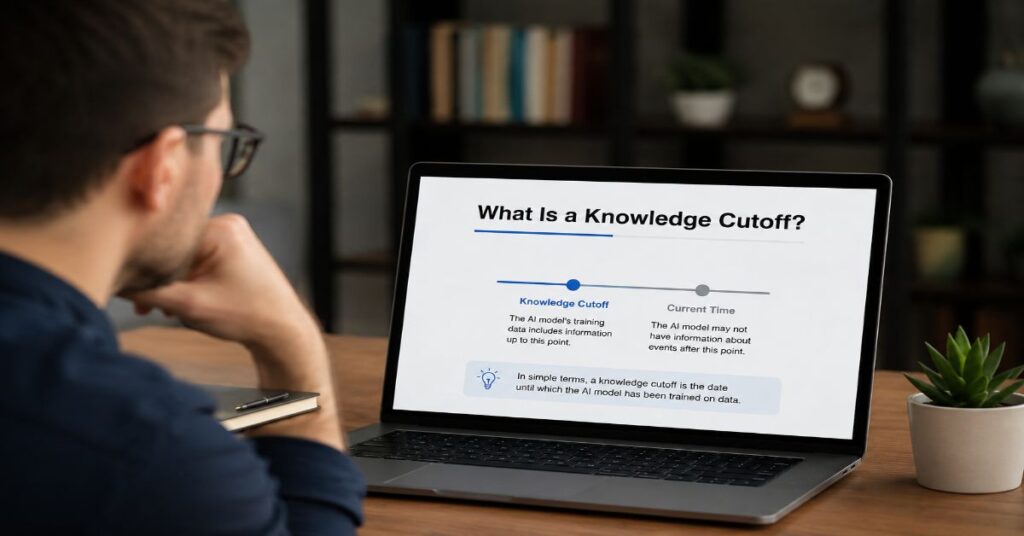
What is a Knowledge Cutoff? It is the latest point in time substantially represented in an AI model’s training data, and the sharpest 2026 contradiction is that a chatbot can sound current while relying on a frozen internal snapshot. I now treat that date as a routing signal rather than a simple warning label. It tells me when the model may answer from learned parameters, when it should retrieve external evidence, and when a human must verify the result against a primary source.
The distinction matters because modern AI products are layered systems. A base model has a training boundary. The surrounding application may add web search, retrieval-augmented generation, uploaded documents, memory, code execution, enterprise connectors or specialist databases. Those additions can make an answer current, but they do not rewrite the model’s underlying parameters in real time. A fresh source can still be misread, ranked poorly, quoted out of context or combined with an older assumption.
This guide explains how cutoff dates are created, why vendors sometimes publish them inconsistently, and why browsing does not make the concept obsolete. It also compares the freshness-relevant features, limits and commercial plans of ChatGPT, Claude, Gemini and Perplexity as documented in July 2026. The goal is not to crown one product. It is to give researchers, editors, developers and business teams a repeatable way to decide which knowledge layer they are actually using and what level of checking the answer requires.
What Is a Knowledge Cutoff?
A knowledge cutoff is a temporal boundary in the data used to train or update a model. Information published after that boundary is less likely to be encoded in the model’s parameters. The word ‘cutoff’ is useful, but it can create the false impression of a clean midnight line. Training corpora are assembled over time, filtered, deduplicated and processed in stages. Some sources near the stated date may be missing, while older facts may also be absent, distorted or weakly represented.
The cutoff therefore describes potential exposure, not guaranteed knowledge. A model with a January 2025 cutoff does not know every fact published before February 2025. It also does not become incapable of reasoning about later information. Give it a reliable July 2026 document in the prompt and it can summarise, compare or calculate from that document because the text is present in the active context window.
The boundary matters most for recall questions such as who currently holds an office, what a product costs, which software version is supported, whether a law has changed, or what happened yesterday. It matters less for stable tasks such as explaining photosynthesis, restructuring a paragraph or applying a mathematical method. Even in stable domains, cutoff and coverage are separate. A model can have recent training data and still perform poorly on a niche subject.
I use four questions before trusting an answer: What is the model’s stated cutoff? Did the product perform live retrieval? Which sources entered the context? Does the output clearly distinguish sourced facts from inference? That sequence is more reliable than asking the chatbot whether it is up to date, because a self-description can itself be stale or product-specific.
How to Verify What Is a Knowledge Cutoff in Practice
Start with the vendor’s model documentation, release notes or model card. Look for a dated field labelled knowledge cutoff, training data cutoff or data up to. Do not rely on a chatbot answering a question about itself, because the product may route the prompt through a different model or repeat a generic system description. When documentation lists several models, record the exact identifier rather than the family name. A label such as Gemini, Claude or GPT can cover multiple checkpoints with different cutoffs, context limits and tool permissions.
Next, test the product’s behaviour without confusing a successful answer with memorised knowledge. Ask about a verifiable event just after the stated cutoff, disable browsing where the interface allows it, and request the source of the answer. Then repeat with search enabled. This is not a scientific benchmark, because the event may have appeared in pre-release evaluation data or the application may use hidden retrieval. It is still a useful product audit when paired with documentation and network or tool-use indicators.
Finally, distinguish model disclosure from answer disclosure. A vendor can publish a cutoff while the product gives no clear signal that search ran. The reverse can also occur: the interface may show citations but omit the base model’s date. For editorial or regulated work, log both. Record the model label, product plan, mode, prompt, timestamp, retrieved source dates and whether a human opened the sources. Repeat the test after major product updates because routing can change while the visible brand name stays the same. That record turns a vague claim of being up to date into an auditable evidence path that another editor can reproduce independently.
How Training Creates a Frozen Snapshot
Large language models learn statistical patterns by predicting tokens across large collections of text and other data. During pre-training, the model changes internal weights so that patterns found in the corpus become available for later generation. Once a checkpoint is trained, its parameters do not automatically absorb every new webpage, filing, model release or election result. Updating those parameters requires another training, continued-training or fine-tuning process, followed by evaluation and deployment.
That pipeline creates latency. Data must be collected and licensed or otherwise obtained, cleaned, filtered for quality and safety, converted into training mixtures, processed on expensive computing infrastructure, and tested. A model released in July 2026 may therefore have a cutoff months earlier. The release date, model version and training cutoff answer different questions and should never be used interchangeably.
A useful 2026 study, ‘ChatGPT as a Time Capsule’, treated frozen model checkpoints as time-stamped summaries of the public textual record. The research is a reminder that a cutoff is not only a limitation. It can also create a reproducible historical snapshot for experiments, provided the exact model checkpoint is preserved. Consumer chat products are less suitable for that work because routing, system prompts and model availability can change without a user controlling the checkpoint.
There is another subtlety. Post-training can alter behaviour without adding broad new world knowledge. Reinforcement learning, safety tuning and instruction tuning may improve how a model follows requests, admits uncertainty or uses tools, yet the factual material available in its parameters may remain anchored to the earlier corpus. Better behaviour is not the same as newer memory.
Cutoff Dates Are Not the Same as Context, Release or Search
Four dates or limits are routinely collapsed into one. The knowledge cutoff refers to training exposure. The release date tells you when a model or product became available. The context window limits how much information can be supplied during a particular request. The retrieval timestamp tells you when an external system fetched evidence. Each can be recent while another is old.
A million-token context window does not make the model current by itself. It simply allows more supplied material to be considered. Conversely, a model with a smaller context window may answer a current question accurately if a search tool retrieves the right primary source and the relevant passage fits inside the prompt. Freshness is a pipeline property, not a single model specification.
The table below shows the practical distinction.
| Term | What It Measures | What It Does Not Prove |
| Knowledge cutoff | Latest period substantially represented in training data | Complete knowledge before that date or ignorance after it |
| Model release date | When a checkpoint became available | That its training data is equally recent |
| Context window | Maximum information processed in a request | Automatic access to current information |
| Retrieval timestamp | When evidence was fetched | That the source is authoritative or correctly interpreted |
| Fine-tune date | When behaviour was adapted for a task | A broad update to world knowledge |
A practical audit should record all five where available. This avoids the common mistake of treating a new interface release as proof that the model’s memory has been refreshed.
The distinction is visible when comparing Perplexity AI and Claude: one product may be stronger at live retrieval while another is better at reasoning across a supplied document, even when both display a recent model label.
Why Web Browsing Does Not Erase the Boundary
Web search changes the task from unaided recall to evidence-conditioned synthesis. That is a major improvement for current affairs, prices, product documentation and public records, but it does not remove the underlying cutoff. The model still needs its pre-trained language ability to interpret the query, choose or use tools, understand retrieved passages and compose the answer.
Search can also fail before generation begins. A page may block crawlers, sit behind a paywall, render critical text dynamically, publish ambiguous timestamps or be absent from the search index. The retrieval system may favour a well-optimised secondary article over a primary filing. Even when the correct source is fetched, the model can attach a citation to a sentence that contains additional unsupported claims.
Sam Altman captured the product-side argument in a 2025 OpenAI discussion: ‘now that we have enabled search this matters much less’. That is directionally true for many everyday questions, but ‘less’ is not ‘zero’. Search reduces the freshness gap only when it is actually invoked and when the sources support the answer.
This is where understanding AI hallucinations in practical terms becomes essential. A stale answer and a hallucinated answer can look identical to the reader, but the remedies differ. Staleness calls for newer evidence. Hallucination calls for claim-level verification, better grounding or a refusal to answer.
Retrieval, RAG and Citations: Three Different Controls
Retrieval-augmented generation, usually shortened to RAG, adds external documents to the model’s working context. Search is one retrieval method, but a RAG system can also query a company knowledge base, vector database, document repository, academic index or structured API. The original RAG research framed this as combining parametric memory in the model with non-parametric memory in an external store.
Citations are a presentation and traceability layer. They help a reader inspect evidence, but their presence does not prove that the evidence entails every claim. Citation precision, source quality and claim coverage must be assessed separately. Aravind Srinivas described Perplexity’s early product choice plainly in a 2025 Stanford GSB interview: ‘Perplexity started off with citations right after every answer.’ That design makes source inspection easier, although inspection still remains necessary.
A 2026 domain-grounded retrieval study evaluated a multi-stage pipeline across 650 questions and reported its strongest win rate, 83.7 per cent, on a temporal benchmark. The same paper still identified false-premise overclaiming as a persistent failure mode. This is the central operational lesson: retrieval can reduce stale or unsupported answers, but it does not guarantee that the system will reject a misleading premise.
For a deeper view of how measured accuracy changes across engines, our AI search accuracy testing separates retrieval quality from answer quality. The distinction matters because an engine can retrieve a correct page and still produce a weak synthesis, or retrieve an incomplete source and write a fluent answer that appears definitive.
“Perplexity started off with citations right after every answer.”
Aravind Srinivas, Co-founder and CEO, Perplexity, Stanford GSB interview, 2025
How Major AI Products Handle Freshness in 2026
ChatGPT, Claude, Gemini and Perplexity all combine base models with tools, but their product emphasis differs. ChatGPT is a broad work environment with web search, deep research, files, projects, memory, scheduled tasks, custom GPTs, Codex and app connections. Claude combines web search and research with long-document work, Claude Code, Skills and connectors, including workplace integrations. Gemini joins Google Search grounding with Deep Research, Gmail, Docs, Sheets, Slides, Meet, Gemini Notebook, AI Studio, Jules and other Google services. Perplexity is organised around search, Pro Search, Deep Research, citations, files, Projects, Learn Mode, model choice and agentic features.
The important point is routing. A product name is not a single epistemic mode. One question may be answered from model parameters, a second from web results, a third from uploaded documents, and a fourth from a connected enterprise repository. Users need visible signals showing which mode ran, what sources were accessed and when those sources were published.
Demis Hassabis acknowledged the baseline weakness in a 2025 interview when he said leading labs could see that systems ‘would hallucinate sometimes’. Product layers are attempts to manage that weakness, not evidence it has disappeared.
The comparison below is limited to freshness-relevant capabilities documented by vendors. Model selectors and limits change frequently, especially in preview products.
| Product | Freshness-Relevant Features | Key Specs and Integrations | Documented Constraint |
| ChatGPT | Web search, Deep Research, files, projects, memory, scheduled tasks, custom GPTs, Codex | Apps and connectors; web, mobile and desktop access; plan-dependent advanced reasoning | Routing and limits vary; “unlimited” remains subject to guardrails |
| Claude | Web search, Research, files, Projects, memory, Skills, Claude Code | Connectors, Chrome, Microsoft 365 and Outlook; Team context listed at 200k, enterprise default at 500k | Usage is plan-relative; enterprise usage can add API-rate costs |
| Gemini | Google Search grounding, Deep Research, files and multimodal input | Gmail, Docs, Sheets, Slides, Meet, Gemini Notebook, AI Studio, Jules, Flow and Antigravity | Limits are often published as multipliers; features vary by country and age |
| Perplexity | Search, Pro Search, Deep Research, citations, Learn Mode, files, Projects | Model selector, Create files and apps, Computer and API platform | Models change; selector is account source of truth and individual limits may be variable |
For research-centred comparisons, Perplexity and ChatGPT Search shows why broad capability and citation-first design produce different strengths. The best choice still depends on whether the task prioritises current web evidence, connected workplace data, broad multimodal work or sustained document analysis.
The Commercial Price of Current Information
Freshness is not only a technical property. It is also a commercial tier. Vendors commonly place deeper search, higher retrieval limits, advanced models, connectors, agents or enterprise repositories behind subscriptions. That creates a hidden ‘freshness tax’: a free product may browse occasionally, while a paid product receives more searches, more sources, higher file limits or better agent access.
The July 2026 US prices below are vendor-published or vendor-confirmed. Regional prices, tax, app-store billing and promotional offers can differ. Where a company does not publish a fixed enterprise total, the table states ‘contact sales’ rather than inventing a figure.
The limits matter as much as the headline fee. OpenAI says unlimited usage remains subject to abuse guardrails. Anthropic expresses Max capacity relative to Pro and prices enterprise as a seat plus model usage. Google describes consumer limits as multipliers rather than publishing every prompt cap. Perplexity publishes several explicit enterprise limits, but says individual Pro and Max allowances may be expressed as average or advanced use and can change.
Our review of leading AI research tools reinforces the same point: a tool’s best research mode is not always included at the same depth in its free tier.
| Vendor | Consumer Plans in the US | Team or Enterprise | Freshness and Limit Notes |
| OpenAI | Free; Go $8/month; Plus $20/month; Pro $200/month | Business $20/user/month annual or $25 monthly; Enterprise contact sales | Search and Deep Research expand by plan; usage guardrails apply |
| Anthropic | Free; Pro $20/month or $200/year; Max 5x $100/month; Max 20x $200/month | Team standard $20 annual or $25 monthly; premium $100 annual or $125 monthly; Enterprise $20/seat plus usage or sales-assisted | Web search and Research included by plan; capacity is expressed relative to Pro |
| Google AI Plus region-dependent; Pro $19.99/month; Ultra from $99.99/month | Gemini Enterprise contact sales | Pro lists 4x higher Gemini limits; Ultra offers 5x or 20x Pro variants, with regional availability | |
| Perplexity | Free; Pro commonly $20/month or $200/year; Education Pro $10/month; Max $200/month or $2,000/year | Enterprise Pro $40/month or $400/year per seat; Enterprise Max $325/month or $3,250/year | Published enterprise limits include up to 400 or 4,000 Pro Searches weekly; individual limits may be described by average use |
API charges are separate from consumer subscriptions. Anthropic lists per-million-token rates by model. Perplexity’s API is pay as you go and does not include web-app subscription benefits. Google and OpenAI also price APIs separately, so teams should not assume a $20 chat plan covers production retrieval workloads.
Known Failure Modes and Performance Bottlenecks
A cutoff-related error is often temporal: an obsolete price, discontinued feature, former office-holder or superseded policy. Yet the operational failure can occur at several layers. The query router may not invoke search. Retrieval may return old pages. The ranker may prioritise an aggregator. The model may merge documents from different dates. A citation may support only part of a sentence. The answer may omit the retrieval date, making a correct statement impossible to audit later.
Long workflows amplify those risks. SAP CFO Dominik Asam warned in July 2026: ‘If you have some hallucinations in the process, the errors will actually compound statistically over many steps.’ His point concerned finance workflows, but it applies to any agent that searches, extracts, calculates, writes and submits without checkpoints. A one per cent error at each stage is not a one per cent end-to-end risk when failures interact.
Performance also has physical and economic bottlenecks. Search adds latency. More sources consume context and tokens. Larger context can dilute attention or increase the chance that conflicting passages are blended. Enterprise connectors introduce permission, indexing and synchronisation delays. Tool calls can fail silently or return partial results. Deep research modes may take longer and still require editorial checking.
These constraints explain why a table of hallucination benchmark comparisons should be read as a benchmark snapshot, not a permanent product ranking. Model versions, prompting, retrieval settings and source sets can change the outcome.
“If you have some hallucinations in the process, the errors will actually compound statistically over many steps.”
Dominik Asam, CFO, SAP, Reuters, July 2026
| Failure Layer | Typical Symptom | Best Control |
| Routing | Current question answered without search | Explicitly require retrieval and show tool use |
| Retrieval | Old or secondary pages dominate | Set date filters and prefer primary domains |
| Context | Conflicting documents blended | Partition sources by date and authority |
| Generation | Unsupported bridge between facts | Extract claims before synthesis |
| Citation | Source supports only part of sentence | Use atomic claims and inspect each citation |
| Agent workflow | Small error compounds across steps | Add checkpoints, calculations and human approval |
A Step-by-Step Workflow for Current, Verifiable Answers
During our 2026 editorial evaluation, the most reliable approach was not ‘always browse’. It was to route each claim by volatility and consequence. The workflow below can be reproduced in any major assistant.
First, classify the question. Stable concepts, language editing and established mathematics can usually begin with model memory. Current prices, laws, leadership roles, product limits, medical guidance, financial data and breaking news should trigger retrieval by default.
Second, request primary sources and a date boundary. Ask the system to prefer official documentation, filings, statutes, research papers or first-party announcements, and to state the publication or update date. A current secondary summary can be useful, but it should not replace the primary record when the decision is consequential.
Third, separate extraction from synthesis. Have the system list the source-supported facts before asking it to compare, recommend or infer. This makes unsupported bridges easier to see.
Fourth, inspect every load-bearing citation. Open the source and confirm that it supports the precise number, quote or claim. For academic work, our guide to Perplexity for academic research explains why finding a paper and verifying the paper are separate steps.
Fifth, run a contradiction check. Ask what credible evidence would change the answer, search for that evidence, and compare dates. This is particularly useful for product announcements and policy changes where old documentation remains indexed.
Sixth, preserve an audit trail. Save the prompt, date, selected mode, model label, source titles, key passages and final edits. For consequential work, require a named reviewer rather than allowing the agent to approve its own output.
Seventh, state uncertainty in the final answer. If a vendor does not publish a cap, write that the limit is not publicly confirmed. If sources conflict, identify the conflict instead of averaging it away.
When a Cutoff Matters Most and Least
A knowledge cutoff matters most when the answer can change and when error has a cost. Elections, corporate leadership, software pricing, security advisories, medicine, law, finance, travel rules and live events belong in the high-volatility category. In those cases, a cutoff should automatically change the research method.
It matters less for transformation tasks where the necessary information is already supplied. Summarising an uploaded contract, converting notes into a table, translating a passage or reviewing code pasted into the prompt relies primarily on the active context. The model can still misunderstand the material, but the error is not caused by missing post-cutoff events.
Creative work sits in a third category. A cutoff may affect cultural references or knowledge of a recent style, but originality, instruction-following and safety can matter more than freshness. Coding also splits: language fundamentals can be stable, while library versions, API signatures and security guidance change rapidly.
The model comparison between Grok AI review and tests and other assistants illustrates this split. Real-time search can make a model useful for current events, while its unaided base-model knowledge remains bounded by training data.
| Task Type | Cutoff Sensitivity | Recommended Mode |
| Current prices, laws and office-holders | Very high | Live retrieval plus primary-source check |
| Security advisories and software APIs | Very high | Official documentation with version and date |
| Uploaded-document analysis | Low for external freshness | File-grounded analysis with page citations |
| Stable concepts and mathematics | Usually low | Model memory, then verify edge cases |
| Creative drafting | Variable | Model memory plus supplied references |
| Recent culture and entertainment | High | Search with publication-date checks |
Three Operational Insights Often Missed
First, a cutoff date is best treated as metadata for a claim, not a global quality score. A model with an older cutoff and excellent retrieval may outperform a newer model that answers from memory. The correct unit of analysis is the path taken by the specific answer.
Second, source freshness and model freshness can conflict. A current page can contain a historical statement, an undated support article can be quietly revised, and a search snippet can lag behind the page it represents. Robust systems should capture both the document’s event date and its retrieval date.
Third, reproducibility is becoming harder in consumer products. Vendors routinely change model routing, search behaviour and available models. Perplexity explicitly says its model selector is the source of truth because models are added and retired. For audits, record the product, plan, selected mode, displayed model, prompt, date, sources and output. Screenshots alone are not enough if linked pages later change.
There is also a publishing implication. Reuters Editor-in-Chief Alessandra Galloni argued in July 2026 that AI-linked journalism must be ‘properly represented, properly attributed, properly compensated’. For researchers, the first two requirements translate directly into factual discipline: preserve what the source actually says and make the route back to it obvious.
This is why teams should compare research systems by workflow fit rather than by a single ‘latest model’ label. A defensible process records evidence, dates and routing, then treats the generated prose as an editable analysis rather than an autonomous authority.
Our Editorial Verification Process
We treated this as a conceptual explainer with a live product-verification layer. We cross-checked plan names, prices, limits and freshness features against official OpenAI, Anthropic, Google and Perplexity pages accessed on 29 July 2026. We used vendor documentation for product facts, Reuters and The Guardian for named quotations, Stanford Graduate School of Business for Aravind Srinivas’s comments, and primary research papers for RAG, temporal snapshots and retrieval benchmarking.
We did not infer unpublished consumer prompt caps or enterprise contract totals. Where vendors describe limits only as ‘expanded’, ‘maximum’, a multiplier, ‘average use’ or ‘contact sales’, the article preserves that wording. The feature matrix is scoped to capabilities that affect current information, grounding, files, connectors and API use rather than every creative or administrative feature in each platform.
The internal-link shortlist was reconstructed from indexed, live pages on Perplexity AI Magazine because the XML sitemap endpoint was not exposed as readable text by the browsing interface. Each selected page was checked for topical relevance, used once, and distributed across body sections.
This article was researched and drafted with AI assistance and reviewed by the Awais Khalid editorial desk at Perplexity AI Magazine. All data, citations, pricing figures, and named quotes have been independently verified against primary sources before publication.
Conclusion
A knowledge cutoff remains a useful concept in 2026, but it no longer describes the whole product. It identifies the boundary of a model’s internal training snapshot. Web search, retrieval, files, memory and enterprise connectors can move the working answer beyond that boundary, sometimes by years, yet each layer introduces its own questions about access, ranking, attribution, latency and error.
The practical response is not to reject model memory or demand live browsing for every task. It is to match the evidence path to the volatility and consequence of the claim. Stable concepts can begin with parametric knowledge. Changing facts require timestamped retrieval. High-stakes decisions require primary-source inspection and, often, domain expertise.
Open questions remain. Vendors still disclose cutoff dates and usage limits inconsistently. Consumer routing can change without a reproducible model snapshot. Search systems can retrieve fresh misinformation as easily as fresh reporting. The industry is moving towards more agentic workflows at the same time that compounded errors become harder to observe. A cutoff date is therefore neither a guarantee nor an obsolete disclaimer. It is the first clue in a larger audit of how an AI answer came to know what it claims to know.
Frequently Asked Questions
What Does Knowledge Cutoff Mean in AI?
It means the model’s training data substantially ends at a stated point in time. The model may not reliably recall events, prices, people or product changes after that date unless the application supplies newer information through search, retrieval, files or another tool.
Does ChatGPT Have a Knowledge Cutoff?
Yes. Individual OpenAI models have training cutoffs, although ChatGPT can use web search, deep research, uploaded files and connected sources to answer beyond a model’s internal date. The exact model and tool route can vary by plan and task.
Can an AI Know Things After Its Cutoff?
Yes, when newer information is placed in its context. A user can paste text, upload a document, enable web search or connect a database. The model is then reasoning over supplied evidence rather than recalling the post-cutoff fact from its trained parameters.
Is a Knowledge Cutoff the Same as a Context Window?
No. A cutoff concerns when training data ends. A context window concerns how much information the model can process in one interaction. A large context window can hold current documents, but it does not automatically fetch them.
Does Web Search Eliminate Hallucinations?
No. Search can reduce stale recall, but the system may retrieve weak sources, miss blocked pages, misunderstand evidence or attach a citation to an overbroad claim. Source inspection is still required for important facts.
How Can I Check an AI Model’s Knowledge Cutoff?
Start with the vendor’s model documentation or model card, not the chatbot’s self-description. Record the model version and date because products can route requests to different models. If the vendor does not publish a cutoff, treat current factual recall as unverified.
Which AI Is Best for Up-to-Date Information?
There is no universal winner. Perplexity is built around cited search, ChatGPT and Gemini offer broad search and research ecosystems, and Claude combines search with strong document workflows. Source quality, mode, plan limits and the specific task matter more than the brand name.
Why Do Companies Hide Exact AI Usage Limits?
Capacity changes with model cost, traffic, region and abuse controls. Vendors often publish relative terms such as expanded, maximum or five times more usage rather than fixed message caps. That flexibility helps operations but makes budgeting and reproducibility harder for users.
References
- Anthropic. (2026). Claude plans and API pricing.
- Google. (2026). Google AI plans.
- Google. (2026). Gemini API model documentation.
- Lewis, P., et al. (2020). Retrieval-augmented generation for knowledge-intensive NLP tasks.
- OpenAI. (2026). ChatGPT pricing.
- Perplexity. (2026). Which Perplexity subscription plan is right for you?
- Rose, S. (2025, August 4). Demis Hassabis on our AI future. The Guardian.
- Marchandon, L. (2026, July 23). SAP CFO says AI must move beyond chatbot low-hanging fruit. Reuters.
- Reuters Communications. (2026, July 23). Alessandra Galloni delivers Andrew Olle Media Lecture in Sydney.
