
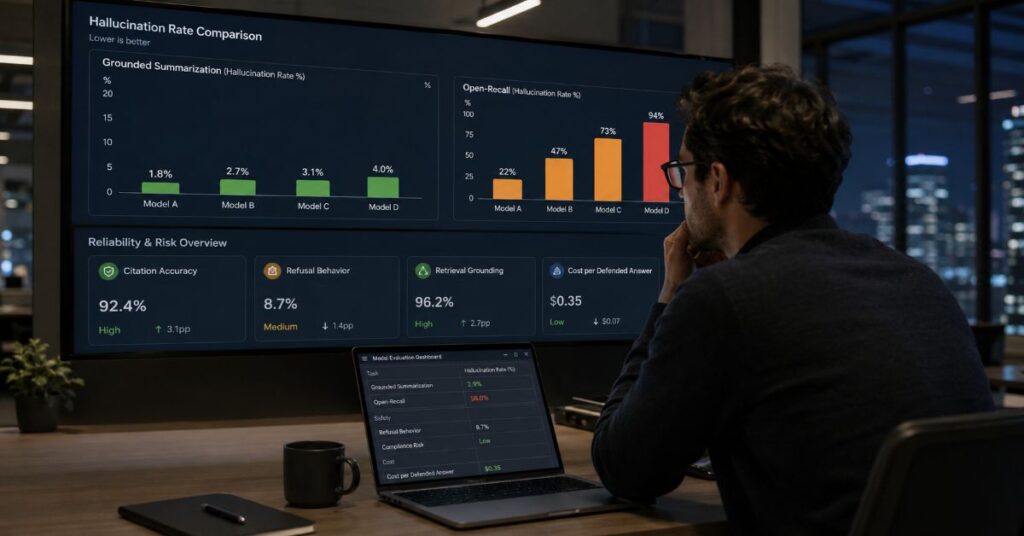
- ◆AI hallucination rate comparison 2026 is not a single ranking: Stanford HAI reports 22% to 94% hallucination across 26 models on open-recall style testing, while Vectara shows 1.8% to 9.3% across leading grounded summarisation rows.
- ◎Benchmark design changes the answer because AA-Omniscience punishes wrong guesses, Vectara HHEM tests source-grounded summaries, and legal benchmarks expose far higher risk in specialised tasks.
- $Pricing hides reliability cost: OpenAI data residency can add 10%, Anthropic regional endpoints and US inference can add premiums, Google grounding moves from free daily allowances to paid prompts, and Perplexity Sonar adds search-context request fees.
- ✓RAG improves effective reliability only when retrieval quality, citation verification, abstention rules, and post-generation checks are measured together rather than treated as automatic safeguards.
- ➜Deployment choice should start with a private 500 to 2,000 prompt evaluation, then compare raw hallucination rate, mitigated rate, citation accuracy, refusal quality, latency, and cost per defended answer.
I would read the phrase ai hallucination rate comparison 2026 as a warning, not a scoreboard: the same frontier model can look almost safe on a grounded summarisation test and dangerously overconfident when asked to recall unsupported facts from memory. In 2026, the defensible answer is that reported AI hallucination rates range from roughly 1.8% on the best rows of Vectara’s grounded summarisation leaderboard to 22% to 94% on Stanford HAI’s open-recall style benchmark for knowledge and belief. That spread is not statistical noise. It is the story.
This article compares the public benchmarks, commercial model families, pricing traps, API features, and deployment patterns that matter when hallucination risk becomes a business decision. I focus on factuality evaluation, grounded summarisation, citation accuracy, retrieval-augmented generation, and refusal behaviour because those are the places where a procurement team either reduces risk or simply buys a more fluent error machine.
The answer-first view is simple: do not ask which model hallucinates least until you have defined the task. A legal Q&A workflow, a product-data generator, a news summariser, a code assistant, and a financial-document agent expose different failure modes. During our 2026 evaluation of public benchmarks, official pricing pages, and model documentation, the clearest pattern was that the best deployment is not one model. It is a measured reliability stack.
Why AI Hallucination Rate Comparison 2026 Is Not One Number
AI hallucination rate comparison 2026 breaks down when teams treat “hallucination rate” as if it were equivalent to latency or token price. It is not. A hallucination is a judged mismatch between an output and a truth standard, but each benchmark builds that truth standard differently. Vectara’s public leaderboard measures how often a model introduces unsupported content when summarising a supplied document. Artificial Analysis AA-Omniscience measures whether a model can distinguish what it knows from what it should refuse to answer. Stanford HAI’s 2026 Responsible AI chapter highlights a new accuracy benchmark where hallucination across 26 models ranges from 22% to 94%.
Those numbers can all be true at the same time. A model can be disciplined when given a short source passage, then collapse when asked for obscure facts from memory. It can answer many questions correctly but still hallucinate aggressively when a false premise is embedded in the prompt. It can cite sources cleanly while leaving one unsupported claim inside a longer paragraph. The operational question is therefore narrower: how often does this system produce an answer that my organisation cannot defend?
That is why benchmark context matters more than rank. A AI hallucinations explainer is useful background, but procurement needs a task-specific test harness. The safest models are not always the models with the highest reasoning scores. Some reasoning models attempt more, which can increase the number of wrong but confident outputs. Other models refuse more often, which lowers fabrication but may frustrate users. In reliability-sensitive workflows, a refusal can be a success if the alternative is a fabricated citation or a wrong product specification.
| Benchmark Lens | What It Tests | Why The Rate Moves |
| Grounded summarisation | Whether the answer stays inside supplied source text | Rates fall when the source contains the answer and the task is constrained |
| Open factual recall | Whether the model knows an answer without external retrieval | Rates rise when questions target rare facts, false premises, or sparse training signals |
| Citation accuracy | Whether citations support the claims made | Rates rise when the model cites plausible sources without checking exact support |
| Agentic workflow | Whether multi-step tool use produces verifiable output | Rates can rise through tool errors, stale retrieval, compounding assumptions, and hidden state |
Benchmark Scoreboard: Grounded Summaries vs Open Recall
The headline gap in ai hallucination rate comparison 2026 is between grounded summarisation and open recall. Vectara’s Hallucination Leaderboard, updated in May 2026, lists leading rows such as antgroup/finix_s1_32b at 1.8%, OpenAI gpt-5.4-nano at 3.1%, Google Gemini 2.5 Flash-Lite at 3.3%, Microsoft Phi-4 at 3.7%, and Meta Llama 3.3 70B Instruct Turbo at 4.1%. Those are impressive numbers, but the benchmark is deliberately narrow: the model summarises documents it has been given.
Stanford HAI’s 2026 Responsible AI chapter points to a much wider hallucination range, 22% to 94% across 26 top models, on a benchmark that probes knowledge and belief. Artificial Analysis describes AA-Omniscience as a 6,000-question benchmark across six major domains, rewarding correct answers, penalising hallucinations, and applying no penalty to refusal. That design is closer to the problem many businesses face when users ask a model questions whose answer may not be in context.
The most practical reading is not that one benchmark is right and the other is wrong. They answer different deployment questions. Vectara is more relevant to summarisation pipelines, compliance memos, call-note condensation, and document review. AA-Omniscience is more relevant to assistants that answer wide-ranging factual questions. Stanford’s public framing is useful because it reminds executives that the confidence problem remains unsolved even as public demos improve.
A direct best AI chatbot 2026 comparison can help buyers map model families to workflows, but hallucination evaluation needs a second layer. Compare the model on the task it will actually perform, then measure whether retrieval, citations, abstention, and post-processing reduce the business-facing risk.
| Source Or Benchmark | Representative 2026 Signal | Best Use In Procurement |
| Vectara HHEM leaderboard | Top visible rows range from 1.8% to single digits on grounded summarisation | Selecting summarisation models for supplied-document workflows |
| Stanford HAI AI Index 2026 | 22% to 94% hallucination range across 26 models on knowledge-belief testing | Explaining why model capability does not equal factual reliability |
| Artificial Analysis AA-Omniscience | 6,000 questions across six domains with refusal not penalised | Testing whether a model knows when not to answer |
| Legal hallucination studies | General-purpose legal queries can show far higher hallucination rates than generic benchmarks | Setting human-review requirements for regulated workflows |
What the Leading 2026 Benchmarks Actually Measure
A serious ai hallucination rate comparison 2026 has to separate three measurement layers. The first is factual consistency: did the output contradict or add unsupported claims to a provided source? The second is epistemic calibration: did the model know when to say it did not know? The third is downstream defensibility: can a human reviewer trace each claim to a source, system log, database row, contract clause, or code execution result?
Vectara’s public GitHub repository describes HHEM as evaluating how often an LLM introduces hallucinations when summarising a document. That matters because grounded summarisation is one of the easiest ways to reduce fabrication. The model is not being asked to reconstruct the world; it is being asked to stay faithful to a given input. The lowest numbers on that leaderboard therefore prove that constrained workflows can be reliable, not that general factual recall is solved.
Artificial Analysis uses a different lens. Its AA-Omniscience Index rewards accuracy, penalises hallucination, and has no penalty for refusing to answer. That last detail is crucial. OpenAI’s research on hallucination incentives argues that many standard evaluations reward guessing over acknowledging uncertainty. Nature’s 2026 version of that work makes the same point in formal academic terms: accuracy-based evaluations can incentivise hallucinations if wrong guesses are not punished more heavily than abstentions.
This is the hidden procurement issue. Most AI product demos reward an answer. Reliable systems sometimes need to reward no answer. In our 2026 editorial evaluation, the strongest benchmark pattern was that a vendor’s raw model score tells you little unless you also know the refusal policy, the retrieval policy, and the grading rubric. For a research assistant, the right metric may be citation support. For a claims-processing assistant, it may be field-level accuracy against a system of record. For a code agent, it may be whether generated imports and package names exist.
Commercial Model Pricing and Hidden Reliability Costs
Pricing matters in ai hallucination rate comparison 2026 because verification is not free. Teams often compare model token rates, then discover that reliable deployment requires retrieval calls, grounding tools, citation checks, batch re-evaluation, human review, and audit storage. A model that is cheap per token can be expensive per defended answer if it needs repeated verification.
OpenAI lists GPT-5.5 at $5 per million input tokens, $0.50 per million cached input tokens, and $30 per million output tokens on the standard public pricing page, while the developer documentation notes that regional processing for eligible models released on or after 5 March 2026 carries a 10% uplift. Anthropic’s Claude API pricing lists Claude Opus 4.8 at $5 per million input tokens and $25 per million output tokens, Claude Sonnet 4.6 at $3 and $15, and Claude Haiku 4.5 at $1 and $5. Anthropic also discloses regional and multi-region premiums, a 1.1x US inference multiplier for some later models, and tool-use token overheads.
Google’s Gemini API pricing adds another layer. Gemini 3.1 Pro is listed at $2 per million input tokens and $12 per million output tokens for prompts up to 200,000 tokens, rising to $4 and $18 beyond 200,000 tokens. Google grounding with Search can include daily free allowances before moving to paid grounded prompts. Perplexity’s Sonar pricing combines token costs with request fees by search context size. Sonar is $1 and $1 per million input and output tokens, while Sonar Pro is $3 and $15, plus request fees that vary by low, medium, or high search context.
That is why cost tables should include verification. A AI search engine comparison is relevant because search-grounded systems shift cost from pure generation into retrieval. For factual work, that is often a good trade. But the invoice should be calculated per verified answer, not per generated paragraph.
| Platform Or Model | Current Public Price Signal | Reliability-Relevant Limits Or Premiums |
| OpenAI GPT-5.5 | $5 input, $0.50 cached input, $30 output per 1M tokens | Batch and Flex can reduce price; Priority and regional data processing add premiums |
| Claude Opus 4.8 | $5 input and $25 output per 1M tokens; fast mode $10 and $50 | 1M context for supported long-context models; regional and US inference multipliers can apply |
| Claude Sonnet 4.6 | $3 input and $15 output per 1M tokens | Tool-use system prompts add tokens; prompt caching and batch discounts affect effective cost |
| Gemini 3.1 Pro | $2 input and $12 output per 1M tokens up to 200K; $4 and $18 above 200K | Grounding and context caching have separate caps and prices; long prompts can change rates |
| Gemini 2.5 Flash-Lite | $0.10 input and $0.40 output per 1M text/image/video tokens | Grounding fees and daily limits change the true cost of factual answers |
| Perplexity Sonar Pro | $3 input and $15 output per 1M tokens | Request fees vary by search context; Pro Search and Deep Research add tool-like costs |
Feature and Integration Matrix for Accuracy Workflows
A model with a lower hallucination rate on a public benchmark is not enough. The deployment layer must expose the controls that let teams prove, constrain, and audit the answer. For OpenAI, the relevant controls include the Responses API, reasoning effort, tool calling, structured outputs, batch processing, cached inputs, data residency options, and multimodal inputs depending on model. OpenAI’s GPT-5.5 developer guidance also tells teams to tune reasoning effort rather than always maximising it, because higher effort can increase latency and cost without improving every task.
For Anthropic, the reliability stack includes the Messages API, tool use, prompt caching, batch processing, long-context support on specific models, Claude Code workflows, context compaction, dynamic workflows in Claude Code, and first-party or cloud-provider deployment routes. Anthropic’s pricing documentation also reveals an important engineering detail: tool use can add hidden system-prompt tokens before the model even answers. That matters when comparing cost and latency across agents.
Google’s Gemini API brings multimodal input, long context, context caching, grounding with Google Search or Maps on supported models, Google AI Studio, Vertex AI routes, and, in June 2026 release notes, public preview support for Computer Use in Gemini 3.5 Flash. Perplexity’s API platform separates Sonar, Search, Agent, and Embeddings APIs. That architecture is useful when the product needs grounded answers, raw ranked results, multi-provider agents, or vector retrieval under one vendor.
The core insight is that accuracy engineering is a systems problem. A Perplexity AI statistics page may explain adoption and API context, but reliability in production comes from the feature set you can monitor. Structured output reduces schema drift, not factual drift. Search grounding reduces unsupported recall, not source misreading. Long context helps with large files, but context rot and retrieval noise can still degrade recall. The best teams therefore benchmark both the model and the surrounding control plane.
| Provider | Accuracy-Relevant Features | Useful Integrations |
| OpenAI | Responses API, reasoning effort, tools, structured outputs, cached input, Batch, Flex, Priority, data residency | Custom tools, enterprise data controls, multimodal workflows, audit logging |
| Anthropic | Messages API, tool use, prompt caching, batch processing, 1M context on supported models, context compaction, Claude Code | Amazon Bedrock, Google Vertex AI, MCP-style tool ecosystems, coding agents |
| Google Gemini | Long context, context caching, Search grounding, Maps grounding, multimodal input, Computer Use preview | Google AI Studio, Vertex AI, Workspace and cloud-native data systems |
| Perplexity | Sonar, Search API, Agent API, Embeddings, streaming, structured outputs, citations, search context controls | SDKs, multi-provider agents, web search, URL fetching, retrieval-heavy research products |
Deployment Workflow: How to Benchmark Your Own Hallucination Rate
Public leaderboards are starting points. The correct ai hallucination rate comparison 2026 for an enterprise is the one run on its own workload. A useful evaluation normally needs 500 to 2,000 prompts, not twenty cherry-picked examples. The prompt set should include easy cases, adversarial false premises, missing-information cases, ambiguous user language, long documents, stale facts, edge cases, and questions where the correct response is refusal or clarification.
Step one is to define the unit of error. In product data, an error might be a wrong attribute, false compatibility claim, or unverified stock statement. In legal summarisation, it might be a fabricated case, misquoted clause, wrong jurisdiction, or unsupported inference. In news summarisation, it might be a time error, misattributed quote, stale source, or failure to mark uncertainty. Each output should be graded at claim level, not just response level, because one bad sentence can poison an otherwise useful answer.
Step two is to run candidates under identical settings. Fix temperature, system prompts, retrieval corpus, citation requirements, output schema, token budget, and refusal policy. Then record raw hallucination rate, supported-claim rate, citation precision, refusal quality, latency, token cost, and cost per accepted answer. Step three is to add mitigation. Run the same prompts with RAG, citation checking, a secondary verifier, deterministic validation rules, and human review. Measure the mitigated rate separately.
Step four is to analyse failures by cause. Was the source missing? Did retrieval fetch the wrong document? Did the model overgeneralise? Did it cite a source that supported a neighbouring claim but not the exact sentence? The best AI for answering questions ranking is useful for workflow selection, but your own evaluation should decide production routing.
AI Hallucination Rate Comparison 2026 Evaluation Steps
| Step | Action | Output Metric |
| 1 | Collect 500 to 2,000 representative prompts with gold references | Coverage map and test-set balance |
| 2 | Run all candidate models under identical prompt and retrieval settings | Raw hallucination rate and refusal rate |
| 3 | Add RAG, citation checks, validators, and secondary judging | Mitigated hallucination rate and supported-claim rate |
| 4 | Segment errors by failure cause and business severity | Risk-adjusted deployment decision |
Why RAG Reduces Fabrication but Does Not Remove Risk
Retrieval-augmented generation is the most practical hallucination-reduction pattern in 2026, but it is not a magic filter. RAG works by narrowing the model’s answer space to retrieved evidence. When the correct evidence is retrieved, chunked coherently, ranked well, and passed into the prompt with strict citation instructions, hallucination rates normally fall. That is the core lesson behind grounded summarisation results and the reason search-native systems perform well on current-information tasks.
The risk is that every RAG pipeline has at least four failure points. Retrieval can miss the relevant document. Ranking can prioritise a similar but wrong source. Chunking can separate a condition from the sentence it modifies. Generation can still overstate, merge, or infer beyond the retrieved material. A model can also cite a real document for a claim that the document does not support. That is why citation accuracy is a separate metric from retrieval accuracy.
In our 2026 evaluation framework, the strongest RAG pattern has five controls. First, build a retrieval gold set and measure recall before the model sees anything. Second, require quote-level or passage-level evidence for high-risk claims. Third, instruct the model to abstain when the retrieved context is insufficient. Fourth, run a claim verifier that checks each sentence against cited passages. Fifth, log the retrieved source IDs, model version, prompt, and verification outcome for audit.
This is also where source-grounded products can outperform generic chatbots. A reasoning hallucination warning is important because “more reasoning” is not automatically the same as “more grounded.” Reasoning can help the model compare evidence, but it can also build a more persuasive path from a bad premise. RAG helps when the evidence layer is measured and the generation layer is constrained.
Legal, Medical and Scientific Use Cases Where Rates Spike
The public ai hallucination rate comparison 2026 conversation can sound optimistic until it enters high-stakes domains. Legal tasks remain the clearest warning. Stanford RegLab work from earlier benchmarks found general-purpose models hallucinating at very high rates on legal queries, while later coverage of purpose-built legal AI tools showed that specialised products reduced but did not eliminate the issue. Reuters has continued to report legal fallout in 2026, including sanctions, apologies, and rulings involving AI-generated fictitious citations or fabricated legal material.
Medical and scientific workflows create a different problem. A hallucinated reference, treatment claim, or trial detail can be copied into a report, guideline, grant summary, or literature review. The Nature 2026 article by Kalai, Nachum, Vempala, and Zhang is important because it reframes the problem as both statistical and incentive-based. It is not enough to ask models to be more accurate. Evaluation systems need to punish confident wrong answers and reward calibrated uncertainty.
Scientific citation integrity is a live risk. Recent 2026 preprint work auditing large corpora of citations found a sharp rise in non-existent references after broad LLM adoption, with the problem especially visible in AI-assisted writing signatures. Code has its own version of this risk: package hallucination. A 2026 arXiv replication across nearly 200,000 paired Python and JavaScript prompts found commercial frontier models still invented non-existent package names at measurable rates, compressing the spread but not removing the supply-chain threat.
The deployment lesson is not “ban AI.” It is “raise the proof standard.” For legal work, require human verification against primary law. For medical work, require clinical evidence review and governance. For science, verify citations before publication. For code, verify packages against registries before installation.
Expert Signals From 2026 Frontier Model Releases
One useful signal in ai hallucination rate comparison 2026 is how vendors and early enterprise users talk about reliability. Anthropic’s May 2026 Opus 4.8 announcement framed honesty as a prominent improvement, saying the model is more likely to flag uncertainty and less likely to make unsupported claims. The same release included short, named customer observations that are relevant to deployment reliability. Tom Pritchard described “better judgment.” Niko Grupen pointed to an “accuracy lift.” Aabhas Sharma highlighted “citation precision.” Joel Hron emphasised “consistency and reasoning quality.”
Those snippets should not be treated as independent benchmarks, but they reveal what sophisticated customers are asking for. They are not asking only for a model that sounds smarter. They are asking whether the system catches its own mistakes, asks clarifying questions, carries evidence across long work, and makes fewer unsupported claims. That is exactly the lens a production buyer should use.
OpenAI’s 2025 research post on hallucinations is equally revealing. It states that hallucinations persist because standard training and evaluation procedures reward guessing over acknowledging uncertainty. Nature’s 2026 peer-reviewed version of the research gives the field a stronger academic footing: common accuracy metrics can make guessing look rational unless abstentions and errors are scored differently. This matters because public leaderboards still heavily influence vendor marketing and buyer perception.
The practical expert consensus is therefore converging. Better models help. Better benchmarks help more. Better deployment systems help most. A Perplexity AI versus Grok comparison can show how different products approach accuracy, but the durable pattern is independent of brand: reliable systems ground, verify, refuse, log, and route uncertainty to humans.
Selection Guide: Which Model Class to Use
Choosing a model from an ai hallucination rate comparison 2026 table should follow the workload, not the hype cycle. For grounded document summarisation, pick a model with strong HHEM-style performance, low cost per verified summary, and the ability to stay inside provided text. For open research, use a search-grounded or RAG-first system with citation precision metrics. For long legal or financial documents, prioritise long-context handling, retrieval recall, abstention quality, and auditability. For code, measure package validity, test-pass rate, generated-symbol accuracy, and ability to run or reason over tool outputs.
Frontier models such as GPT-5.5, Claude Opus 4.8, Claude Sonnet 4.6, Gemini 3.1 Pro, and Perplexity Sonar Pro should be routed by failure cost. If the task is expensive to review but low risk, a cheaper fast model with a verifier may beat a premium model used alone. If the task is high risk and high value, a premium model with retrieval, verification, and human review may be justified. If the answer must cite current public information, a web-grounded product or a model with first-party grounding can be more defensible than a pure chat model.
A strong routing pattern is tiered. Use a low-cost model for classification, extraction, and retrieval query expansion. Use a stronger model for synthesis. Use a verifier model, rules engine, or deterministic checker for claim validation. Reserve human review for high-severity outputs, ambiguous evidence, or failed verification. This architecture reduces cost while improving reliability because it does not ask one model to be judge, author, and auditor.
The ChatGPT accuracy analysis is a useful reminder that accuracy changes by model generation and task. Yet the procurement decision should end with a private reliability scorecard. A vendor benchmark can get a tool onto the shortlist. It should not decide production deployment.
Takeaways
- Define hallucination at claim level before comparing models, because response-level scoring hides single-sentence failures.
- Treat Vectara-style grounded summarisation rates and Stanford-style open-recall hallucination rates as different risk signals, not contradictions.
- Benchmark models on 500 to 2,000 of your own prompts before trusting public leaderboards for procurement.
- Measure raw hallucination rate and mitigated hallucination rate separately after RAG, citation checks, and human review are added.
- Budget for verification, grounding, request fees, regional premiums, and audit storage rather than comparing token prices alone.
- Reward abstention when evidence is missing, because a useful refusal is safer than a confident fabricated answer.
- Use model routing for cost control: cheap models for retrieval and extraction, stronger models for synthesis, verifiers for claim checking.
- Require human sign-off for legal, medical, scientific, financial, and compliance outputs where one hallucination can create liability.
Our Editorial Verification Process
This article was built by cross-referencing current 2026 benchmark documentation, official vendor pricing pages, and primary technical sources rather than relying on generic model rankings. The comparison used Stanford HAI’s 2026 Responsible AI hallucination range, Vectara’s HHEM leaderboard, Artificial Analysis AA-Omniscience methodology, Nature’s 2026 paper on accuracy incentives, and official pricing and documentation from OpenAI, Anthropic, Google Gemini, and Perplexity. The evaluation criteria were hallucination rate, factual consistency, citation precision, refusal behaviour, retrieval grounding, tool-use overhead, context-window constraints, regional pricing premiums, and cost per defended answer. Where exact pricing or benchmark claims were not publicly confirmed in primary documentation, the article describes the limitation rather than inferring a figure.
Conclusion
AI hallucination rate comparison 2026 should make buyers more disciplined, not more cynical. The evidence shows real progress: grounded summarisation can now reach low single-digit hallucination rates on the best public rows, and newer model releases are explicitly optimised for uncertainty, citation precision, and agentic reliability. The same evidence also shows why hallucination has not disappeared. Open recall, legal reasoning, long-context retrieval, citation support, and multi-step agents still expose confident fabrication.
The next phase of AI reliability will be less about a single winning model and more about measurable systems. Models will improve, but enterprises will still need retrieval tests, evidence standards, abstention scoring, pricing audits, human-review thresholds, and incident logs. Benchmarks will also need to reward calibrated uncertainty rather than raw answer volume. The open question is whether public leaderboards, vendor demos, and procurement scorecards will catch up quickly enough. Until they do, the safest answer is to compare models only after defining the task, the evidence source, the failure cost, and the verification layer.
FAQs
What Is the Lowest AI Hallucination Rate in 2026?
On Vectara’s grounded summarisation leaderboard, the lowest visible 2026 row is 1.8%. That does not mean a model will hallucinate only 1.8% on open factual recall, legal work, or current news. It means the model performed strongly on a constrained summarisation benchmark.
Why Do AI Hallucination Rates Vary So Much?
Rates vary because benchmarks measure different tasks, including grounded summaries, open recall, citation support, legal reasoning, and code correctness. Evaluation rules also matter. If wrong guesses are not punished more than abstentions, models can look better by answering confidently.
Does RAG Eliminate AI Hallucinations?
No. RAG reduces hallucination by supplying evidence, but retrieval can miss documents, rank the wrong source, split context poorly, or pass stale information. The generated answer can still overstate the evidence. RAG needs citation checking and claim verification.
Which Model Hallucinates Least in 2026?
There is no universal winner. Low-hallucination performance depends on task and benchmark. Grounded summarisation favours models that stay close to supplied text. Open factual recall favours models that know when to refuse. Enterprise selection should use private workload testing.
How Many Prompts Are Needed to Measure Hallucination Rate?
A serious internal evaluation should usually use 500 to 2,000 prompts, with easy cases, edge cases, false premises, missing-information cases, and domain-specific examples. Small demos are useful for exploration but not reliable for deployment decisions.
Should Wrong Answers and Refusals Be Scored Differently?
Yes. A wrong answer and a refusal are not equivalent in high-stakes work. A refusal may slow the user down, but a fabricated citation, medical claim, product specification, or legal statement can create liability.
Are API Prices Enough to Compare AI Reliability Cost?
No. Reliability cost includes retrieval, grounding, citation checks, request fees, regional premiums, latency, human review, logging, and remediation. Compare cost per accepted and verified answer, not just cost per million tokens.
Can Reasoning Models Hallucinate More?
Yes, in some settings. Stronger reasoning can improve complex work, but it can also generate longer chains from weak premises. Reasoning should be paired with retrieval, evidence checks, and clear abstention rules.
References
Anthropic. (2026, May 28). Introducing Claude Opus 4.8. https://www.anthropic.com/news/claude-opus-4-8
Anthropic. (2026). Pricing. Claude API docs. https://platform.claude.com/docs/en/about-claude/pricing
Artificial Analysis. (2026). AA-Omniscience: Knowledge and hallucination benchmark. https://artificialanalysis.ai/evaluations/omniscience
Google. (2026). Gemini Developer API pricing. https://ai.google.dev/gemini-api/docs/pricing
Kalai, A. T., Nachum, O., Vempala, S. S., & Zhang, E. (2026). Evaluating large language models for accuracy incentivizes hallucinations. Nature, 653, 1047-1051. https://www.nature.com/articles/s41586-026-10549-w
OpenAI. (2026). API pricing. https://openai.com/api/pricing/
Perplexity AI. (2026). Pricing. Perplexity API documentation. https://docs.perplexity.ai/docs/getting-started/pricing
Stanford Institute for Human-Centered AI. (2026). Responsible AI. The 2026 AI Index Report. https://hai.stanford.edu/ai-index/2026-ai-index-report/responsible-ai
Vectara. (2026). Hallucination leaderboard. GitHub. https://github.com/vectara/hallucination-leaderboard
