
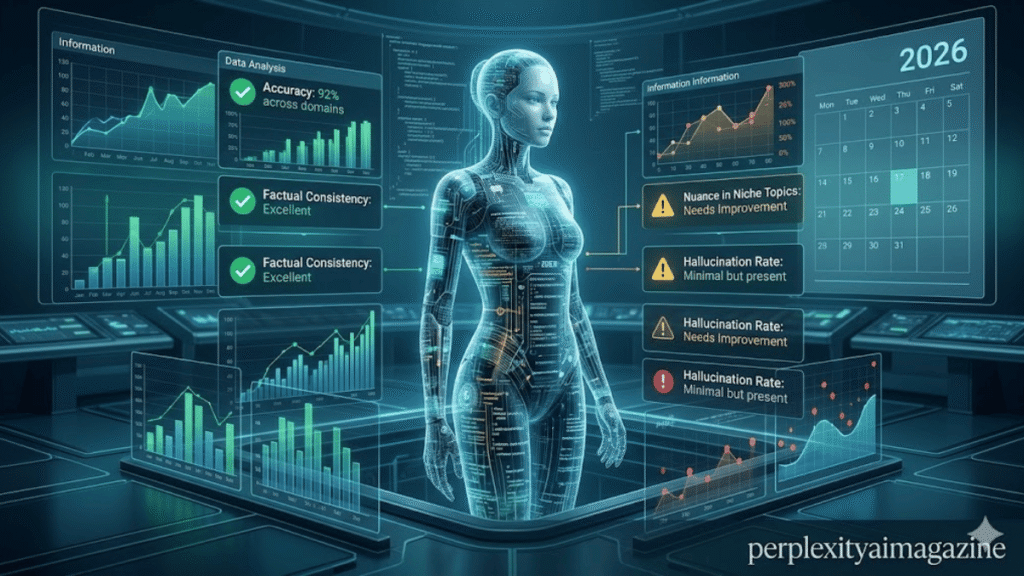
How accurate is ChatGPT in 2026? This is one of the most practically important questions for anyone using the platform for professional work — and the honest answer requires distinguishing between different task types, different model variants, and different definitions of accuracy. ChatGPT is not uniformly accurate or inaccurate. GPT-5 has significantly fewer hallucinations than GPT-4, particularly when reasoning mode is enabled. But every frontier model still hallucinates — OpenAI has publicly acknowledged this — and understanding where ChatGPT is reliable versus where it is not is essential for using it responsibly.
ChatGPT Hallucination Rates — What the Research Shows
Independent research on how accurate ChatGPT is shows significant variation depending on methodology and task type. On the Vectara hallucination leaderboard (summarisation tasks), GPT-5 has a grounded hallucination rate of approximately 1.4% — lower than GPT-4 at 1.8% and Gemini-2.5-Pro at 2.6%. These are impressive numbers for general summarisation.
However, reasoning models show a counterintuitive pattern: on the same Vectara benchmark, models using extended thinking or chain-of-thought reasoning — including GPT-5 with thinking enabled — can exceed 10% hallucination on summarisation specifically. The explanation is that reasoning mode improves accuracy on analytical tasks while potentially introducing more fabrication on tasks requiring source-faithful reproduction of provided text. The right model and reasoning level depends on the task type.
| Task Type | ChatGPT Accuracy | Recommended Verification |
|---|---|---|
| General knowledge questions | High — GPT-5 approaches near 100% on SimpleQA in standard mode | Spot-check important claims |
| Mathematical calculations | High with GPT-5.4 Thinking — extended reasoning improves maths significantly | Verify complex calculations independently |
| Academic reference generation | High hallucination risk — fabricated papers are a documented risk | Verify every citation in Google Scholar before using |
| Medical and legal information | Improving — GPT-5 with thinking reached 1.6% hallucination on HealthBench | Always verify with professional sources |
| Recent events (post-training cutoff) | Low without web search — can fabricate outdated or incorrect information | Enable web search or use Perplexity AI |
| Code generation | High for common patterns — GPT-5.4 at ~80% SWE-bench for real software engineering | Always test generated code before deploying |
| Source-faithful summarisation | Generally high — slight risk with reasoning mode enabled | Compare with original document on critical content |
ChatGPT accuracy by task type, 2026. Source: Vectara HHEM leaderboard, TechRadar, OpenAI HealthBench, and independent research.
When ChatGPT Is Most Likely to Be Wrong
- Generating specific citations and references: ChatGPT fabricates plausible-sounding but non-existent academic paper titles, author names, and DOIs at a meaningful rate. Never cite a ChatGPT-provided reference without verifying it in Google Scholar. This is the highest-risk accuracy failure for anyone doing academic or research work.
- Very recent information without web search: ChatGPT’s training has a cutoff date. On topics that changed significantly after that cutoff — AI models, market data, regulatory changes, recent events — ChatGPT can confidently state outdated information as current fact. Enable web search or use Perplexity AI for current information.
- Niche and specialist knowledge: On topics with limited training data — obscure regional regulations, niche technical standards, specialised professional procedures — hallucination risk is higher because the model has fewer patterns to draw from. Domain expert review is essential before acting on ChatGPT outputs in these areas.
- Specific statistics and numbers: ChatGPT can generate plausible-sounding statistics that do not exist or are misattributed. Treat any specific number, percentage, or research finding from ChatGPT as unverified until confirmed from a primary source.
How to Improve ChatGPT Accuracy on Your Tasks
- Enable web search for current information: Web-grounded responses dramatically reduce hallucination on recent topics. For any query about current events, prices, regulations, or recent research, enable ChatGPT’s web search or switch to Perplexity AI.
- Use GPT-5.4 Thinking for analytical tasks: Extended reasoning mode significantly improves accuracy on complex multi-step problems, coding, and analytical reasoning. GPT-5 with thinking achieved 1.6% hallucination on HealthBench versus 15.8% for GPT-4o on the same benchmark.
- Ask ChatGPT to flag uncertainty: Add “If you are not certain about any specific fact, say so clearly rather than guessing” to important prompts. ChatGPT responds to this instruction and will hedge appropriately rather than fabricating confident answers.
- Upload source documents: For tasks requiring accuracy against specific source material, upload the document and ask ChatGPT to work from it rather than from training data. Source-grounded responses are significantly more accurate than training-data-only responses on domain-specific content.
Frequently Asked Questions
How accurate is ChatGPT in 2026 compared to earlier versions?
Significantly more accurate. GPT-5 has a hallucination rate of approximately 1.4% on Vectara’s grounded summarisation benchmark — compared to 1.8% for GPT-4 and 15.8% on HealthBench medical questions for GPT-4o (versus 1.6% for GPT-5 with thinking). On coding, GPT-5.4 scores approximately 80% on SWE-bench Verified. The improvement is meaningful and measurable — but hallucination has not been eliminated and is task-dependent.
Does ChatGPT make up information?
Yes — this is called hallucination and all large language models including ChatGPT do it to some degree. The risk is higher for: generating specific academic references (high hallucination risk), very recent information without web search enabled, niche specialist knowledge, and specific statistics. Always verify specific facts, citations, and numbers from ChatGPT against primary sources before using them in any professional or academic context.
Is ChatGPT accurate for medical information?
Improving but not reliable as a primary medical source. GPT-5 with thinking mode achieved 1.6% hallucination on HealthBench medical benchmarks — a significant improvement over GPT-4o at 15.8% on the same benchmark. OpenAI describes ChatGPT as a partner to help users understand health results and ask better questions of their providers — not a replacement for professional medical advice. For medical decisions, always consult a qualified healthcare professional. ChatGPT can be useful for understanding medical concepts and preparing questions for appointments.
Unlock everything in Perplexity Hub—click here to explore the full collection.
