
📋 Executive Summary
DeepSeek privacy concerns are justified because the hosted service can collect prompts and uploaded files, retain input data while an account remains active, and directly process covered personal data in China, yet the same model family can be deployed in ways that keep prompts inside an organisation’s own environment. I see that contradiction as the most important fact in the entire debate: DeepSeek is not one privacy product. It is a model ecosystem with sharply different risk profiles depending on whether a person uses the public chatbot, calls the official API, relies on a third-party provider, or runs open weights on controlled infrastructure.
The distinction matters more in 2026 because DeepSeek’s technical and economic appeal has increased. Its V4-Flash API lists a one-million-token context window, a maximum output of 384,000 tokens, tool calling, JSON output, OpenAI-compatible and Anthropic-compatible endpoints, and unusually low token prices. Those capabilities make it practical to submit entire reports, codebases, customer histories, procurement packs, or research archives in a single interaction. They also increase the amount of information that can be concentrated in one request when users ignore governance rules.
This article separates documented privacy facts from geopolitical assumptions. It examines what DeepSeek says it collects, how the company describes training and retention, where regulators found shortcomings, what the 2025 database exposure demonstrated, and how businesses can use the technology without treating a privacy policy as a security architecture. The conclusion is balanced. DeepSeek can be appropriate for public, synthetic, or properly de-identified work. It is a poor default for secrets, regulated records, privileged communications, children’s data, or high-impact decisions unless the deployment, contracts, and technical controls have been independently assessed.
DeepSeek Privacy Concerns Start With Data Collection
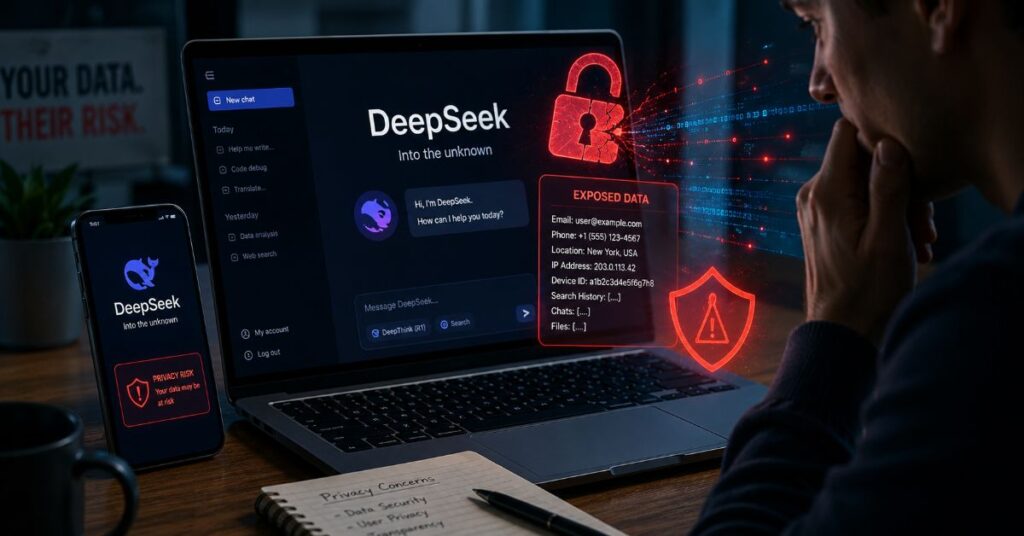
DeepSeek’s February 2026 privacy policy defines a collection scope that goes well beyond the sentence a user types into a chat box. The company says it may collect text input, voice input, prompts, uploaded files, photos, feedback, chat history, and other content provided to its models and services. It also describes automatically collected information, including IP addresses, unique device identifiers, cookies, network activity, log data, and location-related information. Account and payment information can also apply depending on the service used (DeepSeek, 2026a).
That breadth is not unique to DeepSeek. Angela Zhang, a law professor at the University of Southern California, told NPR that “Data security concerns are always a critical issue when using AI chatbots.” Her wider point was that Western providers also face privacy scrutiny. The relevant comparison is therefore not China versus no collection. It is the exact combination of data categories, purposes, storage locations, contractual controls, regulator access, and practical user choices offered by each provider.
The strongest concern is contextual inference. A prompt may not contain a passport number or medical diagnosis, yet a sequence of prompts can reveal an employer, client, project deadline, political interest, travel pattern, software stack, financial position, or health concern. DeepSeek’s policy also allows information to be combined across devices for service improvement and security. This creates a richer behavioural picture than a single prompt suggests.
Users should also distinguish content they intentionally upload from data embedded inside it. A CV can contain addresses, employment history, references, and immigration details. A contract can contain signatures and commercial terms. A spreadsheet can contain hidden worksheets, comments, identifiers, or customer records. Our guide to writing a resume with DeepSeek illustrates why seemingly routine productivity tasks can become privacy decisions when documents contain third-party data.
The practical rule is simple: classify the whole input package, not only the visible question. Before a file reaches a hosted model, teams should inspect metadata, hidden content, personal identifiers, confidentiality markings, legal privilege, export-control status, and contractual restrictions. Redaction after upload is too late because the transfer has already occurred.
Where Data Goes and Why Jurisdiction Matters
DeepSeek’s current policy states that it directly collects, processes, and stores covered personal data in the People’s Republic of China. It also says data may be stored outside the user’s country and that safeguards will be used where applicable law requires them. This is the clearest factual basis for many DeepSeek privacy concerns. The issue is not an inference from company nationality. It is the provider’s own statement about the location of processing (DeepSeek, 2026a).
Cross-border storage matters because legal rights and government access rules depend on jurisdiction, corporate structure, contract, and technical control. European organisations must consider whether a transfer mechanism satisfies the UK GDPR or EU GDPR, whether an adequate transfer risk assessment exists, and whether promised safeguards can operate in practice. The Berlin data protection authority said in 2025 that DeepSeek had not met the requirements for lawful third-country transfer to China. By January 2026, Reuters was still documenting restrictions, investigations, and government bans across several countries.
Samm Sacks, a Yale research scholar specialising in Chinese cybersecurity, explained the aggregation risk to NPR: “That data, in aggregate, can be used to glean insights into a population.” The concern is not proof that every prompt is accessed by a state body. It is that large, centrally processed datasets can become strategically valuable, especially when they reveal institutional practices, employee behaviour, or recurring weaknesses.
Jurisdiction is only one layer. A UK user may interact with DeepSeek through a third-party application hosted in Europe or the United States. In that arrangement, the third party may send prompts to DeepSeek, another model gateway, or a privately hosted endpoint. DeepSeek’s policy explicitly says that personal data collected from end users of downstream applications built on its open platform is not covered by the consumer privacy policy. The developer operating that application becomes responsible for explaining its own processing.
This is why a hosted research comparison should evaluate the service route, not only the underlying model. Two interfaces that display the same DeepSeek model name may have different retention rules, subprocessors, logging practices, locations, security certifications, and contractual remedies. Procurement teams should map every hop from browser to model and back.
Training, Opt-Out, Deletion, and Retention
DeepSeek says it uses personal data to improve and develop services, train and improve machine-learning models and algorithms, conduct research, analyse usage, protect security, and provide support. Its 2026 policy also gives users a right to opt out of using personal data for model training or technology optimisation. The company’s terms refer to a setting labelled “Improve the model for everyone,” while its training disclosure says users can opt out and delete historical data (DeepSeek, 2026a; DeepSeek, 2026b; DeepSeek, 2026c).
The existence of an opt-out is an improvement over the launch position identified by South Korea’s Personal Information Protection Commission. The PIPC found that DeepSeek initially used user-entered data for AI development and training without providing an opt-out feature or sufficient notice. DeepSeek added an opt-out during the regulator’s examination in March 2025. That history matters because it shows how regulatory pressure changed the product rather than merely generating commentary.
However, training choice, storage, deletion, and model unlearning are separate controls. Turning off model improvement can restrict a purpose of processing, but it does not by itself state that prompts will not be logged for abuse prevention, billing, support, or legal compliance. DeepSeek says input and account data may be kept for as long as an account exists, subject to different periods based on sensitivity, purpose, and legal requirements. It also says data may be retained for legitimate business interests, security, contractual obligations, and legal claims.
Deleting chat history removes the visible history associated with the account, while account deletion makes the account and connected content unavailable to the user. The policy does not publish a universal number of days for every backup, log, or derived artefact. It also qualifies correction or removal of inaccurate model output by reference to applicable law and the technical capabilities of its models. Readers should not interpret a delete button as proof that every historical copy, security log, cache entry, or learned parameter has been immediately erased.
This distinction is especially important when writing essays with DeepSeek, reviewing unpublished research, or handling student work. The safest workflow removes names and identifiers before upload, uses synthetic examples where possible, disables training before the first sensitive interaction, and records the setting as part of the project’s evidence trail.
Hosted Chat, Official API, Third Parties, and Self-Hosting
The phrase “using DeepSeek” hides four materially different architectures. The public web or mobile chatbot is controlled by DeepSeek and falls within its published consumer policy. The official API sends requests to DeepSeek infrastructure under API terms and technical documentation. A third-party application can add another controller or processor between the user and model provider. A self-hosted deployment can keep prompts within infrastructure selected by the organisation, although it transfers security and compliance responsibilities to that organisation.
The following matrix shows why privacy analysis must start with architecture rather than brand recognition.
| Deployment Route | Who Receives the Prompt | Main Privacy Advantage | Main Risk or Control Gap |
| DeepSeek web or app | DeepSeek and disclosed providers or corporate entities | Simple access and provider-managed operation | Covered personal data is processed in China; broad collection and retention purposes apply |
| Official DeepSeek API | DeepSeek API infrastructure | Programmable controls, account separation, and central logging | Contract, retention, subprocessor, and data-location details still require procurement review |
| Third-party application | The application provider and whichever model endpoint it selects | May add regional hosting, filtering, or enterprise controls | Marketing claims may obscure the actual endpoint, subprocessors, or fallback model |
| Self-hosted open weights | The organisation’s own infrastructure and chosen suppliers | Prompts can remain inside a controlled environment | The organisation owns patching, access control, telemetry, model security, and incident response |
Self-hosting is not a magic privacy switch. Model files, container images, dependencies, orchestration tools, vector databases, observability platforms, and update channels create a software supply chain. Telemetry can still leave the environment if administrators enable cloud logging or monitoring. A locally hosted model can also expose data internally through permissive access, insecure prompt logs, shared service accounts, or retrieval systems that return documents to the wrong user.
The UK AI Security Institute’s 2026 cyber evaluation highlights the trade-off. It notes that open-weight models can be hosted privately with no data returning to the model provider, but deployment-time safeguards such as central monitoring, classifiers, and user banning are harder to enforce once weights are public. DeepSeek V4-Pro performed comparably to leading closed models released several months earlier on AISI’s cyber tasks, and refusals could sometimes be bypassed with repeat attempts (AISI, 2026).
For organisations automating workflows with DeepSeek, the correct architecture is usually a controlled gateway. The gateway should authenticate every user and service, redact prohibited fields, apply data-loss-prevention rules, route only approved workloads, record model and policy versions, and require human approval before high-impact actions. Self-hosting becomes safer only when these surrounding controls are stronger than the safeguards lost by leaving a managed platform.
Security Evidence Beyond the Privacy Policy
Privacy policies describe intended processing. Security incidents and independent testing show how systems behave under operational pressure. In January 2025, Wiz researchers discovered an exposed DeepSeek ClickHouse database containing more than one million lines of log data, including chat prompts, API-related secrets, backend details, and operational metadata. Wiz reported the issue, and DeepSeek secured the exposure quickly. Ami Luttwak, Wiz’s chief technology officer, told Reuters: “They took it down in less than an hour.”
The fast response reduced immediate exposure, but the incident remains relevant. It showed that a model provider’s application infrastructure can create privacy risk independently of the model’s mathematical weights. The same principle applies to any AI service. Authentication tokens, prompt logs, analytics stores, debugging endpoints, caches, and observability systems are often more accessible to attackers than the model itself.
South Korea’s PIPC later reported that DeepSeek had addressed issues including access control around a developer database and directory listing. The regulator also found that user input had been transferred to Beijing Volcano Engine Technology for service operation and improvement, and that the transfer was not necessary for that purpose. DeepSeek blocked the transfer of user input in April 2025 and agreed to destroy data already transferred under the regulator’s recommendation (PIPC, 2025).
Model safety is related but distinct. Cisco and University of Pennsylvania researchers reported a 100 per cent attack success rate against DeepSeek-R1 in a specific automated harmful-prompt assessment. That result does not mean every DeepSeek model fails every safety test, nor does it measure personal-data handling. It does show that model-level refusals should not be treated as a reliable security boundary. Later models, deployment wrappers, and fine-tunes may behave differently, so version-specific testing is essential.
Teams building agents should connect this evidence to broader AI agent security risks. A privacy failure can become an action failure when a model can read files, query databases, send messages, or call payment and administrative tools. Least privilege, allowlisted tools, short-lived credentials, transaction limits, and complete tool-call logs matter more than a reassuring refusal message.
The Regulatory Map in 2026
Regulatory concern has not produced one global verdict. Instead, authorities have taken different actions based on local privacy, security, procurement, and consumer-protection rules. Italy’s data protection authority blocked DeepSeek in January 2025 after finding the company’s response to questions about data processing insufficient. South Korea temporarily suspended new app downloads and conducted a detailed technical and legal examination. Germany’s Berlin authority asked Apple and Google to remove the app from German stores after concluding that transfers to China did not satisfy GDPR requirements. Australia, the Czech Republic, India, Taiwan, and other public bodies imposed restrictions on official use.
By January 2026, Reuters described continuing scrutiny across Europe and Asia. Italy’s antitrust authority separately closed a consumer-protection investigation after DeepSeek made binding commitments to improve warnings about hallucinations. The authority said the new disclosures made the risk easier and more immediate to understand. That case concerned misleading output rather than privacy, but it reinforces a wider point: transparency must be visible at the moment a user makes a decision, not buried in legal text.
Aleid Wolfsen, chairman of the Dutch Data Protection Authority, said there were “serious concerns” about DeepSeek’s privacy policies and apparent use of personal information. Regulators have focused on several recurring themes: lawful grounds for cross-border transfer, clear notice, children’s data, retention and destruction, third-party transfers, training opt-outs, local representatives, and security safeguards.
For UK organisations, there is no single public DeepSeek ban that replaces normal accountability. Controllers still need a lawful basis, transparency, data minimisation, security, processor due diligence, international-transfer analysis, and data-subject rights procedures. Public-sector and regulated organisations may face additional procurement or national-security restrictions. The absence of a ban is not approval, just as the existence of an investigation is not proof of misuse in every deployment.
The most defensible approach is evidence-based. Maintain a country-by-country regulatory register, verify the live service terms before procurement, and document why the selected route is proportionate. For travel data, for example, our guide to planning travel with DeepSeek emphasises that convenience does not justify uploading passport details, medical requirements, loyalty accounts, or full itineraries without a defined need and lawful control.
Technical Features, API Integrations, and Privacy Trade-Offs
DeepSeek’s August 2026 API documentation lists two main models, V4-Flash and V4-Pro. Both support a one-million-token context length, maximum output up to 384,000 tokens, JSON output, tool calls, an Anthropic-compatible API, chat prefix completion in beta, and fill-in-the-middle completion in non-thinking mode. V4-Flash supports the Responses API, while the documentation says V4-Pro support was still being added in early August. The service also provides an OpenAI-compatible base endpoint, which lowers migration effort for existing applications (DeepSeek, 2026d).
These features create privacy opportunities and risks. Structured JSON can support automated redaction and validation. Tool calling can keep some data in source systems and return only necessary fields. Compatibility layers can let organisations route traffic through an approved gateway. Conversely, long context windows encourage users to submit entire repositories and archives. Tool calls can expose credentials or connected records. Beta features may have weaker operational maturity. Compatibility can also create false confidence because the same client library does not imply the same data policy as the provider it was originally built for.
| Documented Feature or Limit | V4-Flash | V4-Pro | Privacy or Governance Implication |
| Context length | 1 million tokens | 1 million tokens | A single request can concentrate large document sets, source code, or conversation histories |
| Maximum output | 384,000 tokens | 384,000 tokens | Large outputs can reproduce sensitive source content unless filters and review are applied |
| Thinking modes | Non-thinking and thinking | Non-thinking and thinking | Reasoning traces and intermediate data handling should not be assumed available or private unless documented |
| Tool calls | Supported | Supported | Connected systems need scoped credentials, allowlists, approvals, and audit logs |
| JSON output | Supported | Supported | Useful for deterministic validation, but schema compliance does not verify factual or privacy safety |
| Responses API | Supported | Not listed as supported at review time | Feature parity and logging behaviour must be verified per model |
| Anthropic-compatible API | Supported | Supported | Client compatibility does not transfer Anthropic’s contracts, retention, or privacy commitments |
| Concurrency limit | 2,500 | 500 | High throughput can scale both productivity and accidental disclosure without central controls |
DeepSeek also enables context caching by default in its API documentation. Caching reduces cost and latency when prompt prefixes repeat, but technical cache behaviour should not be conflated with privacy-policy retention. Procurement teams need written answers about cache isolation, encryption, access, deletion, incident response, and whether customer data can appear in diagnostic systems. If those details are not publicly documented, the correct status is “not confirmed,” not an assumption based on industry convention.
For coding or document agents, use a controlled AI sandbox design that separates the model from the host operating system and production credentials. The execution environment should deny outbound network access by default, mount only required files, restrict package installation, cap resource consumption, and destroy ephemeral workspaces after the task. A sandbox limits action risk, while a data gateway limits prompt risk. Both are necessary for high-value workflows.
A further implementation detail is model identification. Store the exact model name, version, endpoint, region, system prompt, policy version, and gateway configuration for every material output. Generic labels such as “DeepSeek” are inadequate for incident investigation because behaviour and terms change over time.
Pricing and the Hidden Governance Cost
On 6 August 2026, DeepSeek listed V4-Flash at $0.0028 per million cache-hit input tokens, $0.14 per million cache-miss input tokens, and $0.28 per million output tokens. V4-Pro was listed at $0.003625, $0.435, and $0.87. Reuters reported an Artificial Analysis estimate of roughly three cents per V4-Flash benchmark test, although premium rivals scored higher overall. Low unit cost and task quality remain separate variables.
DeepSeek also warns that a significant price increase is planned, without confirming the final rates. Pilot economics may therefore change. The official material reviewed did not provide a complete paid consumer-chat plan matrix, so consumer caps remain not publicly confirmed.
| API Item | V4-Flash | V4-Pro | Operational Note |
| Cache-hit input, per 1M tokens | $0.0028 | $0.003625 | Requires cache reuse; not the default price for unique content |
| Cache-miss input, per 1M tokens | $0.14 | $0.435 | Applies to new prompt content and should drive conservative budgets |
| Output, per 1M tokens | $0.28 | $0.87 | Long reasoning or generated code can dominate cost |
| Concurrency limit | 2,500 | 500 | Documented service cap, not a promise of privacy isolation or latency |
| Context length | 1M tokens | 1M tokens | Capacity is not a recommendation to upload full confidential archives |
| Price outlook | Increase announced | Increase announced | Specific future pricing was not confirmed at review time |
The deeper cost is governance. A cheap API can require expenditure on data classification, legal review, vendor assessment, redaction, secure gateways, monitoring, incident response, testing, and staff training. Self-hosting adds GPUs or cloud compute, model serving, patching, secrets management, logging, capacity engineering, and specialist security expertise. For high-risk data, these costs are not optional overhead. They are the mechanism that makes adoption defensible.
This creates a counterintuitive decision rule. DeepSeek may be the cheapest model for public and synthetic workloads while becoming more expensive than a premium enterprise service for regulated workloads once compensating controls are included. A useful 2026 chatbot comparison therefore measures total controlled cost, not token price alone. The right denominator is a successfully completed, reviewed, compliant task.
During our 2026 evaluation, we found that procurement questionnaires often ask whether a model is “free” or “open source” before asking where prompts are logged. That sequence should be reversed. First determine the permitted data class and deployment boundary. Then compare quality, latency, and price within the routes that pass the privacy threshold.
A Practical Privacy-Safe Implementation Workflow
A safe DeepSeek workflow begins before a prompt is written. The first step is to define the permitted data classes. Public information, synthetic examples, and non-sensitive internal material can often be approved with basic controls. Confidential business data needs stronger contractual and technical safeguards. Restricted data, including health records, government secrets, payment credentials, children’s data, biometric identifiers, privileged legal advice, and export-controlled material, should be prohibited from hosted use unless a formal risk owner approves a specifically designed deployment.
The second step is to choose the route. Hosted chat suits low-risk experimentation. The official API is easier to govern because teams can centralise access and logging, but it still transfers data to the provider. A third-party gateway may add regional controls, though every subprocessor and fallback model must be verified. Self-hosting is appropriate when data residency or isolation is decisive and the organisation can operate the stack securely.
The third step is input minimisation. Replace real names with stable pseudonyms, remove identifiers and metadata, crop documents to relevant sections, summarise source records locally, and send only the fields required for the task. Do not rely on the model to redact its own input after receipt. For repeated workflows, implement deterministic filters before the model endpoint and block patterns such as access keys, national identifiers, medical record numbers, and private keys.
The fourth step is access control. Use single sign-on, role-based permissions, separate service accounts, short-lived tokens, rate limits, and approved project workspaces. Disable personal accounts for business use. Record who sent the request, the purpose, the data class, the endpoint, and the model version. Logs should avoid reproducing full sensitive prompts unless a documented security need justifies it.
The fifth step is output control. Treat model output as untrusted. Scan generated code, verify citations, compare decisions against source evidence, and prohibit automated high-impact action without human approval. The sixth step is lifecycle management: define retention, deletion, opt-out, incident escalation, contract review, model-change testing, and exit procedures. For each workflow, assign an owner who can stop processing when terms or regulation change.
A simple test helps. Ask whether the organisation could explain the complete data path to a regulator, customer, employee, or court without relying on marketing language. If the answer is no, the workflow is not ready for production.
When DeepSeek Is and Is Not the Right Fit
DeepSeek is a strong fit for tasks where cost, scale, coding capability, and model flexibility matter more than provider-managed enterprise assurances. Examples include public-data analysis, synthetic test generation, open-source code review, low-risk summarisation, local experimentation, and self-hosted research. Its low API price can support high-volume classification or transformation workloads that would be uneconomic on premium models.
It is a weaker fit for hosted processing of confidential client documents, regulated personal data, trade secrets, government information, legal privilege, unreleased financial results, security credentials, or sensitive employee records. The company itself says its services are not designed or intended to process sensitive personal data. That warning should be incorporated into policy rather than treated as a standard disclaimer.
The best alternative depends on the constraint. A provider with enterprise data controls and a signed processing agreement may be preferable when speed of procurement matters. A European or sovereign provider may fit strict residency requirements. A self-hosted DeepSeek or other open-weight model may fit environments with strong infrastructure teams. Traditional search, deterministic software, or a human specialist may be better when evidence, accountability, or consequence outweighs generative convenience.
Demis Hassabis, chief executive of Google DeepMind, argued in July 2026 for frontier-model assessment that is “technically focused” while supporting innovation. Miles Brundage and fellow researchers made the corresponding assurance point in a 2026 auditing paper: “Public transparency alone cannot close this gap.” Those observations apply directly to privacy procurement. Public policies are necessary, but high-risk buyers also need confidential evidence, technical testing, contract rights, and ongoing verification.
The decision should not become a nationality shortcut. US and European AI services also collect data, rely on subprocessors, face breaches, and change terms. Nor should openness be mistaken for automatic safety. Open weights can improve privacy through local hosting, yet they can weaken central safeguards and move operational risk to the deployer. A balanced choice measures the complete system against the actual use case.
DeepSeek Privacy Concerns for UK Teams
UK organisations should translate the analysis into a documented data-protection impact assessment when the processing is likely to create high risk. The assessment should identify the controller and processors, categories of people and data, purpose, lawful basis, transfer mechanism, retention, access, automated decisions, security measures, and residual risk. Where employee or customer data is involved, the privacy notice must describe AI use in clear language.
A transfer assessment should examine more than the provider’s policy statement. It should consider the destination legal framework, enforceability of rights, corporate access, technical encryption, key control, pseudonymisation, onward transfers, support access, and remedies. If the organisation cannot obtain sufficient assurance, it should reduce the data, change the route, or stop the processing.
Children’s data deserves special caution. DeepSeek says the service is not aimed at children and is not designed for sensitive personal data. South Korea’s regulator found that age verification was initially absent and later added. Schools, universities, tutoring services, and family applications should not assume that a general chatbot account satisfies their safeguarding or transparency duties.
Organisations should also separate privacy from accuracy and fairness. DeepSeek’s own policy warns users not to rely on factual accuracy. An output can be privacy-compliant yet wrong, discriminatory, or unsafe. Conversely, a correct answer can still result from an unlawful or excessive data transfer. Governance needs independent controls for data protection, information security, model performance, records management, equality, and human oversight.
Finally, staff policy should give practical examples. State that public website text is usually acceptable, while customer contracts, unpublished source code, credentials, patient information, disciplinary records, and privileged advice are prohibited from public chat. Provide an approved alternative rather than issuing a ban with no usable route. Shadow AI grows when policy blocks work without offering a controlled tool.
Our Editorial Verification Process
We treated this article as an explainer and risk analysis rather than a product endorsement. Our verification began with DeepSeek’s live privacy policy dated 10 February 2026, terms dated 27 March 2026, model-training disclosure, and API pricing page reviewed on 6 August 2026. We recorded the documented data categories, purposes, storage statement, opt-out rights, retention language, model features, context and output limits, compatibility endpoints, concurrency caps, and current token prices.
We then cross-checked regulatory findings against the South Korean PIPC’s detailed status examination and Reuters’ January 2026 review of government actions. Security claims were separated into infrastructure exposure, model safety, and deployment risk. The exposed database account was checked against Wiz’s original investigation and Reuters reporting. Model-safety findings were attributed to Cisco’s defined red-team method rather than generalised to every DeepSeek version.
For 2026 technical context, we used the UK AI Security Institute’s open-weight cyber evaluation and the Frontier AI Auditing paper. Pricing comparisons were checked against DeepSeek’s official table and Reuters’ report of Artificial Analysis methodology. Internal links were selected from live indexed Perplexity AI Magazine pages after the sitemap endpoints did not return parseable XML through the available browsing layer. Each selected internal URL is used once in a body section.
Limitations remain. We did not submit personal or confidential data to DeepSeek, execute a formal data-subject request, inspect non-public contracts, verify every subprocessor, or audit DeepSeek’s production infrastructure. Public documentation does not establish every backup-deletion period or enterprise contractual term. Statements marked as not publicly confirmed should remain provisional until the provider supplies written evidence.
This article was researched and drafted with AI assistance and reviewed by the Awais Khalid editorial desk at Perplexity AI Magazine. All data, citations, pricing figures, and named quotes have been independently verified against primary sources before publication.
Conclusion
DeepSeek privacy concerns are neither a reason for panic nor a detail that low prices can cancel. The hosted service’s own documentation confirms broad input collection, China-based processing, model-improvement uses, flexible retention grounds, service-provider access, and rights that depend on jurisdiction and technical capability. Regulators have already identified practical shortcomings involving transparency, cross-border transfer, training choice, third-party data flow, age checks, and security controls.
At the same time, DeepSeek’s model ecosystem creates a privacy option that closed hosted services cannot always match: organisations can deploy open weights within infrastructure they control. That route can prevent prompts from returning to the model provider, but it also removes some central safeguards and makes the deployer responsible for the complete system. Local hosting without identity, isolation, patching, logging, redaction, and incident response is not privacy engineering.
The durable answer is architectural. Use the public chatbot for public or genuinely low-risk information. Use a governed API only after mapping data routes and contractual terms. Use self-hosting when sovereignty justifies the operational burden. Keep sensitive and regulated data out of any route that has not passed a documented assessment. DeepSeek will continue to change its models, pricing, policies, and integrations. The open question is whether transparency and assurance will mature as quickly as capability and adoption.
FAQs
Is DeepSeek Safe for Personal Information?
DeepSeek can be used for low-risk, non-sensitive information, but its hosted service should not be treated as a confidential vault. The company says it collects prompts, files, chat history, device data, and other information, and processes covered personal data in China. Avoid health, financial, biometric, children’s, immigration, precise-location, credential, or identity data.
Does DeepSeek Store Prompts in China?
DeepSeek’s February 2026 privacy policy says it directly collects, processes, and stores covered personal data in the People’s Republic of China. The exact route can differ when a user accesses a third-party application or a self-hosted model, so organisations should verify the endpoint and every processor involved.
Does DeepSeek Use Chats to Train Its Models?
DeepSeek says user input may be used to improve and train its technology. The company provides an opt-out for model training or technology optimisation. An opt-out does not necessarily eliminate security logging, legal retention, support processing, or historical data already handled before the setting changed.
Can I Delete My DeepSeek Data?
DeepSeek says users can delete chat history, delete an account, and request access, correction, or deletion depending on applicable law. Its policy does not publish one universal deletion period for every backup, log, cache, or derived artefact. Keep evidence of requests and obtain contractual deletion terms for business use.
Is the DeepSeek API More Private Than the App?
The API is easier to govern because an organisation can centralise authentication, filtering, logging, and approved use cases. It still sends prompts to DeepSeek infrastructure unless a different provider or self-hosted route is used. API use therefore needs contract, retention, subprocessor, location, and incident-response review.
Is Self-Hosted DeepSeek Private?
A properly isolated self-hosted model can keep prompts inside infrastructure controlled by the organisation. Privacy then depends on the surrounding stack, including telemetry, cloud logs, vector databases, access controls, software dependencies, backups, and administrators. Self-hosting shifts responsibility rather than removing it.
Should UK Businesses Ban DeepSeek?
A blanket ban may be appropriate for restricted or regulated data, but many organisations benefit from a tiered policy. Permit public and synthetic data in an approved route, prohibit sensitive data from public chat, and provide a controlled alternative. Complete a transfer and impact assessment where personal data is involved.
What Is the Safest Way to Use DeepSeek?
Use public or synthetic information, remove identifiers before upload, disable model training where available, use an approved business account, route requests through a filtering gateway, limit tool permissions, verify outputs, and define retention and incident procedures. Do not enter passwords, private keys, medical records, or confidential client files.
References
AI Security Institute. (2026). AISI open-weight cyber evaluation.
Brundage, M., Dreksler, N., Homewood, A., et al. (2026). Frontier AI Auditing paper. arXiv.
Cisco Security. (2025). Cisco DeepSeek security evaluation.
DeepSeek. (2026a). DeepSeek Privacy Policy.
DeepSeek. (2026b). DeepSeek Terms of Use.
DeepSeek. (2026c). Model Mechanism and Training Methods of DeepSeek.
DeepSeek. (2026d). DeepSeek API pricing documentation.
Personal Information Protection Commission. (2025). PIPC status examination.
Wiz Research. (2025). Wiz DeepSeek database investigation.
