
📋 Executive Summary
I found the decisive fact in this Chinese AI models comparison 2026 before looking at any single leaderboard: the capability gap has become small enough that architecture, price, licensing, and operational control now decide more purchases than nationality. Stanford’s 2026 AI Index measured only a 2.7% gap between the top US and Chinese models in March, while releases since then have pushed DeepSeek, Alibaba, Moonshot AI, Z.AI, and MiniMax into the same practical conversation as the leading American labs.
That does not make the five models interchangeable. DeepSeek V4 is the obvious cost benchmark. Qwen3.8-Max is the newest large-scale contender, but its commercial rollout is still less transparent than its launch headlines. Kimi K3 offers the largest announced open-weight architecture in this comparison and strong long-horizon capabilities, yet its hosted API is not cheap. GLM-5.2 concentrates on coding and sustained agent execution with an unusually permissive MIT licence. MiniMax M3 is the most integrated multimodal option, but its attractive headline rate changes once prompts cross 512,000 tokens.
This article compares the models as deployable systems rather than as isolated benchmark entries. It examines context length, output limits, reasoning modes, tool use, API compatibility, open-weight status, multimodality, pricing tiers, caching, rate constraints, governance, and the practical bottlenecks that appear in production. The central conclusion is deliberately conditional: DeepSeek is usually the best economic default, GLM is the strongest open coding candidate, Kimi is built for maximum-scale knowledge work, MiniMax is the broadest multimodal platform, and Qwen offers the richest cloud and regional ecosystem. The right answer depends on what must run, where it must run, and what failure would cost.
Why the 2026 Market Looks Different
The comparison starts with convergence. Stanford’s technical-performance chapter places Anthropic, xAI, Google, OpenAI, Alibaba, and DeepSeek in a narrow top tier on Arena ratings as of March 2026. Its broader conclusion is more important than the exact ranking: the China-US performance gap had effectively closed, while benchmark quality itself had become less dependable. The report found invalid-question rates as high as 42% on some widely used evaluations, which means a two-point advantage can be smaller than the measurement noise or harness effect.
The release cadence has also changed. DeepSeek introduced V4 in April, Moonshot released Kimi K3 in July, Z.AI shipped GLM-5.2 in June, MiniMax launched M3 in June, and Alibaba announced Qwen3.8-Max in early August. The Chinese open-weight release wave is not one laboratory copying a single recipe. It is a portfolio of competing technical strategies: sparse attention, mixture-of-experts routing, million-token training, native multimodality, reinforcement learning for agents, and aggressive caching economics.
This matters commercially because model choice no longer resembles a single procurement decision. Enterprises can route summarisation to a low-cost model, coding to a stronger agentic model, visual document work to a multimodal model, and sensitive workloads to self-hosted weights. Kai-Fu Lee captured the adoption logic when he said users choose Chinese models “not because they’re Chinese but because they’re open.” Jensen Huang made the complementary point in July: “The world needs both frontier closed models and frontier open models.” These statements do not prove that every open model is safe or cheap to operate. They show why access, auditability, and portability have become strategic capabilities alongside intelligence.
Chinese AI Models Comparison 2026 at a Glance
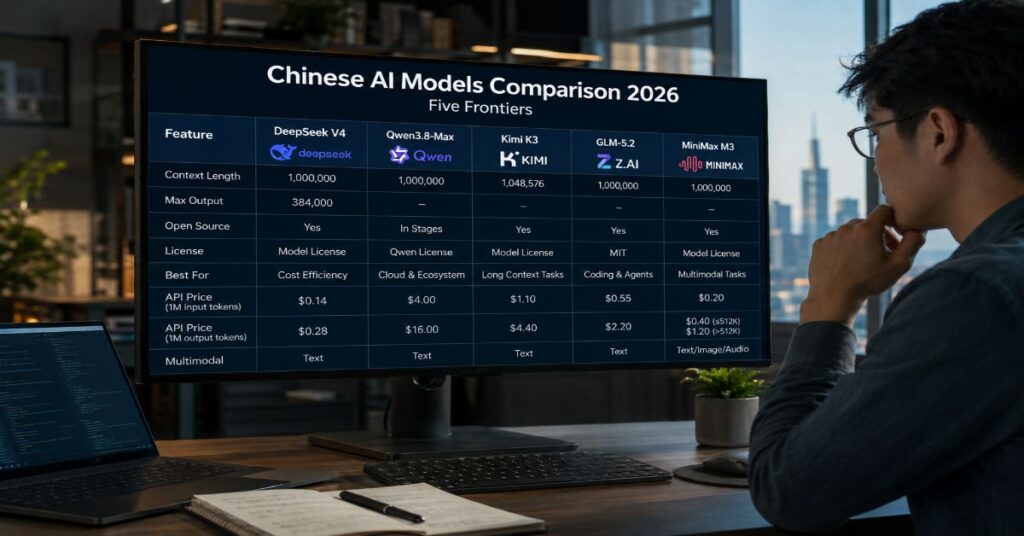
The five flagships share a one-million-token ambition, but the identical headline hides different engineering promises. DeepSeek documents a one-million-token standard context and a maximum output of 384,000 tokens for both V4 variants. Kimi K3’s paper specifies a 1,048,576-token context and 104 billion activated parameters within a 2.8-trillion-parameter mixture-of-experts architecture. GLM-5.2 emphasises stable long-horizon coding rather than merely accepting a long prompt. MiniMax guarantees at least 512K and supports up to 1M, with higher prices beyond the lower band. Qwen3.8-Max is reported at 1M, while Alibaba’s currently published Qwen3.7 API documentation provides the clearest verified commercial reference.
Openness also varies. GLM-5.2 is the cleanest procurement story because Z.AI explicitly uses the MIT licence. Kimi K3 releases full weights, while DeepSeek describes V4 as open-sourced but still requires teams to review the exact model licence and downstream obligations. MiniMax calls M3 open-weight, but hosted multimodal features and computer-use tooling remain service-layer capabilities that do not automatically travel with the weights. Alibaba announced Qwen3.8’s open-weight release in stages, so buyers should distinguish an announced licence path from files they can actually download today.
The snapshot below should therefore be read as a routing map, not a winner table. A model can lead in one operational dimension while losing badly in another. Kimi K3 has extraordinary scale but a higher output price. DeepSeek is dramatically cheaper but its official V4 API documentation is text-first. GLM offers permissive self-hosting and coding strength but less native modality breadth. MiniMax unifies more modalities but introduces a long-context price step. Qwen’s cloud reach, regional endpoints, and protocol compatibility may outweigh a small benchmark difference for organisations already committed to Alibaba infrastructure.
2026 Flagship Snapshot
| Model | Core Position | Context | Modalities | Open-Weight Status | Best-Fit Workload |
| DeepSeek V4-Pro / Flash | Cost-efficient reasoning and agents | 1M | Text in official API documentation | Weights released under provider terms | High-volume reasoning, coding, routed agents |
| Qwen3.8-Max | Large-scale general and coding flagship | 1M reported | Text, image, video reported | Announced staged open-weight release | Alibaba Cloud estates, multilingual enterprise use |
| Kimi K3 | Maximum-scale long-horizon intelligence | 1,048,576 | Text and native vision | Full weights released | Long repositories, knowledge work, visual agents |
| GLM-5.2 | Open coding and sustained execution | 1M | Text | MIT licence | Coding agents, long technical projects, self-hosting |
| MiniMax M3 | Unified multimodal agent platform | Up to 1M | Text, image, video, computer use | Open-weight model | Multimodal workflows, office agents, computer control |
Sources: Official vendor releases and documentation reviewed 6 August 2026. Qwen3.8-Max availability and pricing remained in staged rollout.
DeepSeek V4: The Economic Default
DeepSeek V4 sets the cost floor for this comparison. The official API page lists V4-Flash at $0.14 per million uncached input tokens and $0.28 per million output tokens. V4-Pro costs $0.435 and $0.87 respectively. Cache-hit input is priced at $0.0028 for Flash and $0.003625 for Pro, a difference large enough to make prompt architecture part of financial architecture. Both variants offer a one-million-token context, a 384K maximum output, thinking and non-thinking modes, JSON output, tool calls, prefix completion, and fill-in-the-middle completion in non-thinking mode.
The launch specifications explain the split. V4-Pro uses 1.6 trillion total parameters with 49 billion active, while V4-Flash uses 284 billion total and 13 billion active. Flash is the practical default for classification, extraction, summarisation, routine coding, and first-pass agents. Pro should be reserved for tasks where deeper reasoning or difficult long-horizon execution produces measurable gains. DeepSeek’s account-level concurrency limits reinforce that design: 2,500 concurrent connections for Flash versus 500 for Pro. The DeepSeek V4 launch analysis provides additional context on why the architecture matters to the wider US-China race.
The implementation advantage is compatibility. DeepSeek exposes OpenAI-format and Anthropic-format base URLs, which reduces migration work for applications and coding tools. The main integration constraint is preserved reasoning state. In thinking-mode tool conversations, the application must pass reasoning content back correctly or subsequent calls can fail. Teams should also treat one million tokens as a capacity ceiling, not an instruction to send full repositories on every turn. Retrieval, prompt caching, scoped tool outputs, and a durable external memory store still reduce latency and hallucination risk.
DeepSeek wins when the workload is high-volume, text-heavy, and cost-sensitive. It is less compelling when native image or video understanding is essential, when a buyer needs a fully documented enterprise governance package in a specific jurisdiction, or when a proprietary frontier model has a proven advantage on a narrow high-value task. The correct deployment pattern is often Flash-first routing, Pro escalation, and a separate specialist for multimodal work.
Qwen3.8-Max: The Ecosystem Bet
Alibaba announced Qwen3.8-Max on 3 August 2026 as its most capable model, with 2.4 trillion total parameters and about 95 billion activated for each request. Reuters reported one-million-token context and multimodal input across text, images, and video. The release arrived only weeks after Qwen3.8-Max-Preview appeared inside Alibaba Cloud Model Studio’s Token Plan, showing that Alibaba is using its cloud distribution layer as part of the model strategy rather than treating the model as a standalone download.
The commercial caveat is important. On 6 August, Alibaba’s public pay-as-you-go documentation still listed Qwen3.7-Max as the current priced flagship. That model supports thinking and non-thinking modes, one-million-token requests, context caching, OpenAI-compatible, Anthropic-compatible, and DashScope APIs, with global list prices commonly shown at $1.65 per million input tokens and $4.951 per million output tokens in several regions. Promotional discounts vary by geography and time of day. Qwen3.8-Max pricing was not yet published in the same standard matrix, so any precise pay-as-you-go number would be speculation.
Qwen’s strongest advantage is deployment breadth. Alibaba Cloud provides endpoints in mainland China, Hong Kong, Singapore, Tokyo, Frankfurt, and Virginia, with different deployment scopes and prices. That regional design supports data residency choices, latency optimisation, and migration through familiar API formats. It also creates complexity: the same model family can carry different rates, discount windows, free quotas, and availability conditions. Procurement must record the exact model ID, dated version, region, context tier, and promotion rather than relying on a generic “Qwen price.”
Qwen is the best fit for organisations that already use Alibaba Cloud, require broad multilingual coverage, or need one provider across text, vision, audio, image, and video families. It is not automatically the cheapest option, and the staged Qwen3.8 rollout means buyers should distinguish preview access, subscription access, pay-as-you-go access, and downloadable weights. In a fast-moving product line, version pinning is essential because an alias may move to a newer dated model without the same latency or output behaviour.
Kimi K3: Scale for Long-Horizon Work
Kimi K3 is the most ambitious model in this set by announced scale. Moonshot AI’s technical report describes a 2.8-trillion-parameter mixture-of-experts model with 104 billion activated parameters, native vision, and a one-million-token context. Its Stable LatentMoE design activates 16 of 896 routed experts per token, while Kimi Delta Attention and Attention Residuals target more efficient information flow across both sequence length and model depth. Moonshot reports roughly 2.5 times better overall scaling efficiency than Kimi K2.
The model is designed for long-horizon coding, knowledge work, agentic execution, and visual understanding. This is not merely a large chat model. Moonshot trained million-token agentic reinforcement-learning trajectories with persistent sandbox states, which is directly relevant to repository-scale work and multi-stage tool use. The official Kimi API overview supports K3 as the flagship, while Kimi Code provides a first-party environment for coding agents. The broader Chinese model usage shift helps explain why Kimi’s combination of openness and agent capability has attracted global developer attention.
Hosted pricing changes the value calculation. Kimi’s official pricing surface lists $3 per million cache-miss input tokens, $0.30 for cache hits, and $15 per million output tokens. That makes input caching valuable, but output-heavy reasoning or code generation materially more expensive than DeepSeek, GLM, or MiniMax. A million-token prompt with a long completion can be technically impressive and financially inefficient. Kimi therefore fits high-value tasks where the long context or agent quality avoids human hours, not routine bulk processing that can run on a cheaper model.
Kimi K3 also illustrates why open weights do not eliminate infrastructure cost. A 2.8-trillion-parameter model with 104 billion active parameters requires serious serving engineering, memory capacity, expert parallelism, and cache management. Most companies will use a hosted service or a specialist inference provider rather than self-host the full system. The open release still matters because it supports audit, adaptation, research, and alternative hosting, but the business case must include hardware, throughput, observability, and operations rather than treating the download as free production capacity.
GLM-5.2: The Open Coding Specialist
GLM-5.2 presents the clearest open coding proposition. Z.AI released it with a one-million-token context, multiple reasoning-effort levels, and an MIT licence. Its IndexShare method reuses a lightweight indexer across groups of sparse-attention layers, reducing per-token FLOPs by 2.9 times at one million tokens according to the vendor. An improved multi-token-prediction layer raises speculative-decoding acceptance length by up to 20%, which targets a real bottleneck: sustained long-context inference rather than benchmark-only context acceptance.
The vendor’s benchmark table places GLM-5.2 at 81.0 on Terminal-Bench 2.1, 62.1 on SWE-bench Pro, and 74.4 dominance on FrontierSWE as of 16 June. Those results make it the strongest coding candidate among the open models in this comparison, but they remain vendor-reported and depend on specific harnesses, token budgets, and tool environments. The more useful evidence is the product design: long-context coding training, effort controls, tool use, streaming tool-call parameters, and support for local inference through Transformers, vLLM, SGLang, xLLM, and ktransformers.
GLM’s API supports the Z.AI SDK and OpenAI-compatible calls. Function calling currently documents automatic tool choice rather than forced selection, and streaming tool calls require model-specific parameters. These details matter for agent frameworks that assume a wider OpenAI parameter surface. Teams should test schema adherence, repeated tool loops, reasoning preservation, cancellation, and recovery from partial tool output before adopting any “drop-in compatible” claim.
Direct global API pricing for GLM-5.2 was not fully present on Z.AI’s standard pricing table at the review date. The table still showed GLM-5.1 at $1.40 input and $4.40 output per million tokens. Alibaba Cloud Model Studio separately listed GLM-5.2 in Hong Kong at $1.10 input and $3.851 output, which is a third-party hosted rate rather than a direct Z.AI global price. That distinction belongs in procurement records. GLM is the strongest choice when open licensing, coding quality, and self-hosting matter more than native multimodal breadth.
MiniMax M3: The Multimodal Operator
MiniMax M3 combines capabilities that the other models split across product families. It supports text, image, and video input, long-context reasoning, coding, agents, and computer operation in one open-weight model. MiniMax Sparse Attention extends the context to one million tokens, with the company guaranteeing at least 512K. That integrated design is attractive for office automation, visual debugging, web agents, document workflows, and systems that need to move between perception and action without switching providers.
Pricing is competitive but tiered. For prompts at or below 512K, MiniMax lists a permanent discounted rate of $0.30 per million input tokens, $1.20 per million output tokens, and $0.06 per million cache-read tokens. From 512K to 1M, those rates double to $0.60 input, $2.40 output, and $0.12 cache read. The platform noted that capacity above 512K could be limited during rollout. This is a textbook hidden limit: the model supports one million tokens, but the commercial and capacity experience changes halfway through the window.
MiniMax offers standard APIs plus OpenAI-compatible and Anthropic-compatible interfaces across its text family. The broader platform also includes speech, video, image, music, files, and MCP tools. That makes MiniMax less of a single-model purchase and more of a multimodal service platform. It can simplify vendor management, but it can also increase lock-in if workflows depend on proprietary computer-use orchestration, hosted media models, or platform-specific quota plans.
M3 is strongest when the workflow genuinely needs multimodality and action. It is wasteful to choose it for plain text extraction that DeepSeek V4-Flash can perform at a lower rate. It is also important to separate M3 from MiniMax M2.7 in documentation because some API pages and compatible interfaces still list the older family. Buyers should verify the model identifier, modality support, context tier, rate limits, and cache accounting in the endpoint they plan to use rather than generalising from the flagship marketing page.
Benchmarks Reveal Direction, Not a Winner
The most responsible reading of 2026 benchmarks is directional. Stanford’s AI Index warns that benchmark invalidity, contamination, platform adaptation, and harness differences can distort rankings. A model can gain several points because it receives more tokens, a better coding agent, internet access, a different judge, or multiple sampled attempts. The post-training and open-model shift is real, but the exact distance between two models is often less certain than a chart suggests.
The GLM-5.2 launch table is useful because it places several Chinese models under one published methodology, yet it is still a vendor evaluation. It reports GLM-5.2 ahead of the other open models on several coding measures, MiniMax M3 ahead on GPQA-Diamond, Qwen strong on mathematics, and DeepSeek strong on tool tasks relative to its price. Kimi K3’s own technical report says it trails the most powerful proprietary models overall while outperforming other open and proprietary systems in its evaluation suite. Each vendor selects benchmarks that reflect its design goals.
A production evaluation should therefore use task suites, not generic prompts. For coding, measure issue completion, test pass rate, patch size, regressions, tool-call failures, and human review minutes. For research, measure citation validity, source coverage, unsupported claims, and freshness. For multimodal work, test visual grounding, document structure, video temporal reasoning, and failure recovery. For agents, record successful completion, number of tool calls, wall-clock time, token cost, and irreversible-action errors.
The best model is the one that passes the acceptance threshold at the lowest total cost. A two-point benchmark lead has little value if the model costs five times more, produces twice the review burden, or cannot run in the required region. Conversely, a cheap model is expensive when it fails a high-value task and triggers rework. This is why the article uses benchmark tables as a map of strengths, then relies on workflow-specific evidence for the final recommendation.
Selected Vendor-Reported Benchmarks
| Benchmark | DeepSeek V4-Pro | Qwen3.7-Max | Kimi K3 | GLM-5.2 | MiniMax M3 | Interpretation |
| GPQA-Diamond | 90.1 | 90.0 | Vendor report varies | 91.2 | 93.0 | Scientific reasoning, sensitive to prompting and tool access |
| SWE-bench Pro | 55.4 | 60.6 | Not directly comparable | 62.1 | 59.0 | Repository issue resolution under differing harnesses |
| Terminal-Bench 2.1 | 64.0 | 75.0 | Not directly comparable | 81.0 | 65.0 | Agentic terminal work, highly harness-dependent |
| MCP-Atlas | 73.6 | 76.4 | Reported separately | 76.8 | 74.2 | Tool selection and multi-step execution |
Source: Z.AI GLM-5.2 release table, supplemented by vendor technical reports. Scores are not an independent head-to-head test and should not be treated as procurement rankings.
Pricing, Caching, and the Real Cost per Task
Per-token pricing makes DeepSeek look unbeatable, and for many workloads it is. A request with 100,000 uncached input tokens and 10,000 output tokens costs roughly $0.0168 on V4-Flash at list price. The same token shape costs about $0.18 on MiniMax M3 below 512K, $0.215 on Qwen3.7-Max at the global $1.65 and $4.951 rates, and $0.45 on Kimi K3. The gap widens for output-heavy agents because Kimi charges $15 per million output tokens while DeepSeek Flash charges $0.28.
Caching can overturn simple input comparisons. DeepSeek’s cache-hit rate is tiny, Kimi reduces cached input to one tenth of its miss price, MiniMax charges separate cache-read rates, and Alibaba supports explicit and implicit context caching with model-specific discounts. Applications that repeat long system prompts, tool schemas, policies, or repositories can save more through cache design than through a small benchmark improvement. The DeepSeek pricing war shows how rapidly this dimension has become a strategic market lever.
The hidden cost is token intensity. Reasoning models may generate large internal traces or long visible completions to solve difficult tasks. A model with a cheap input rate can still be expensive if it uses ten times more output tokens, makes more tool calls, or retries failed steps. Long context also increases prefill latency, cache pressure, and opportunity cost on shared infrastructure. MiniMax’s two-tier pricing makes this explicit, while other providers may express the same constraint through concurrency limits, slower service, capacity approval, or promotional pricing.
A useful total-cost formula is: API cost plus tool cost plus infrastructure plus human review plus failure recovery. Werner Vogels framed the architectural question directly: “Do you really need to have the biggest, highest-end model to solve this?” The answer should come from an evaluation ledger. Record median and 95th-percentile task cost, time to first token, completion time, pass rate, reviewer minutes, and escalation rate. Then select a default model and a specialist fallback rather than paying frontier rates for every request.
Verified API Pricing Matrix
| Model | Input per 1M | Output per 1M | Cache Read / Hit | Context Pricing Caveat | Published Limit |
| DeepSeek V4-Flash | $0.14 | $0.28 | $0.0028 | Flat public rate | 1M context, 384K output, 2,500 concurrency |
| DeepSeek V4-Pro | $0.435 | $0.87 | $0.003625 | Flat public rate | 1M context, 384K output, 500 concurrency |
| Qwen3.8-Max | Not yet standardised publicly | Not yet standardised publicly | Not confirmed | Preview and staged rollout | 1M reported; exact public API terms pending |
| Qwen3.7-Max Global | $1.65 list | $4.951 list | Discounted where supported | Regional and promotional variation | 1M request context |
| Kimi K3 | $3.00 cache miss | $15.00 | $0.30 | Output-heavy workloads become costly | 1,048,576 context |
| GLM-5.2 | Direct global price not fully published | Direct global price not fully published | Not confirmed for direct global API | Third-party Alibaba HK rate $1.10 / $3.851 | 1M context; 128K-plus output in vendor tests |
| MiniMax M3 up to 512K | $0.30 | $1.20 | $0.06 | Rate doubles above 512K | Guaranteed 512K, up to 1M |
| MiniMax M3 512K to 1M | $0.60 | $2.40 | $0.12 | Limited long-context capacity during rollout | Up to 1M |
USD list prices reviewed 6 August 2026. Taxes, regional pricing, promotions, batch discounts, subscription quotas, and third-party hosting are excluded unless stated.
Implementation Workflow and Known Bottlenecks
A safe implementation starts with a model adapter rather than direct calls scattered through an application. The adapter should normalise messages, tool schemas, reasoning controls, streaming events, usage data, and errors. It should also preserve provider-specific fields where required. OpenAI compatibility reduces initial work, but it does not erase differences in tool-choice modes, reasoning-state round trips, unsupported penalties, output limits, or multimodal payload formats.
The first workflow step is classification. Tag each request by risk, modality, context size, latency target, and expected output length. Route low-risk text tasks to DeepSeek V4-Flash. Send complex coding to GLM-5.2 or a proven Kimi/Qwen coding path. Use MiniMax M3 when visual or computer interaction is intrinsic. Reserve Kimi K3 for long-horizon tasks whose value justifies its output rate. The DeepSeek agent implementation guide illustrates why bounded plan-act-observe loops, explicit state, validation, and approval gates matter more than giving a model unrestricted autonomy.
The second step is context engineering. Store durable state in a database, not in a growing chat transcript. Retrieve only relevant files or evidence. Place stable instructions and tool definitions where caching can reuse them. Summarise old turns, cap tool output, and reject oversized media before it consumes the window. A one-million-token context can reduce retrieval failures, but it can also bury critical constraints, raise latency, and make debugging harder.
The third step is validation. Use structured output schemas where available, verify every tool argument, sandbox code, and require human approval for payments, deletion, deployment, external communication, or changes to production data. Log model ID, version, region, prompt hash, tool calls, token usage, latency, and final outcome. Build fallback logic around specific failure classes rather than retrying blindly. Rate limits and concurrency caps should trigger queues and backpressure, not request storms.
Known bottlenecks include preserved-thinking incompatibilities, partial tool-call streams, JSON drift, provider aliases changing versions, output truncation, long-context prefill delay, multimodal file limits, and subscription quotas that differ from pay-as-you-go APIs. A model switch should be a configuration change, but each provider still needs a conformance test before production traffic.
API and Integration Checklist
| Capability | DeepSeek V4 | Qwen | Kimi K3 | GLM-5.2 | MiniMax M3 |
| OpenAI-compatible API | Yes | Yes | Yes | Yes | Yes |
| Anthropic-compatible API | Yes | Yes | Via supported tooling / provider interface | Coding endpoint and compatible tools | Yes |
| Tool calling | Yes | Yes | Yes | Yes, auto choice documented | Yes |
| Thinking control | Enabled/disabled; high/max effort | Thinking and non-thinking modes | Multiple reasoning efforts | Multiple effort levels | Reasoning model controls |
| Prompt caching | Automatic cache pricing | Explicit and implicit cache support | Cache-hit pricing | Context cache support | Cache read and write pricing |
| Self-hosting | Weights available | Staged Qwen3.8 release; earlier Qwen weights available | Full weights available | MIT weights and common runtimes | Open weights available |
| Native multimodality | Official V4 API docs are text-first | Reported text, image, video | Native vision | Text flagship | Text, image, video, computer use |
Compatibility does not guarantee identical parameter support. Validate tool-choice behaviour, reasoning fields, image formats, streaming, errors, and token accounting.
Privacy, Licensing, and Geopolitical Risk
Chinese AI model risk is not a single variable. Hosted API use raises questions about where prompts, files, logs, and account data are processed. Self-hosting changes the data path but introduces supply-chain, licence, patching, and infrastructure responsibilities. The nationality of the developer matters for legal and policy review, but deployment location, contract terms, network controls, telemetry, and data classification often determine the immediate technical risk.
Open weights improve inspectability and portability, but they do not automatically provide open training data, reproducible training, safe defaults, or an enterprise support commitment. GLM-5.2’s MIT licence is unusually clear. Other model families require a line-by-line licence review for redistribution, fine-tuning, hosted services, attribution, acceptable use, and derivative models. Qwen3.8’s staged release adds another timing issue: an announced open-weight model is not the same as a downloaded artefact with a reviewed licence and hash.
Hosted consumer products and APIs should also be separated. A free chat interface may have unpublished message limits, different model routing, different retention, and weaker service commitments than the developer API. The Perplexity and DeepSeek comparison highlights why current web retrieval, citations, privacy commitments, and model reasoning are distinct product layers. Buyers should not infer API governance from a consumer chatbot or infer self-hosted behaviour from a hosted assistant.
The policy environment can change quickly. Reuters reported in July that Beijing was considering controls on overseas access to future advanced models, while US policymakers debated restrictions on Chinese open weights. Greg Brockman argued that “having more models is a good thing,” while Dario Amodei warned that broad access does not necessarily help defenders more than attackers. Michele Catasta said a ban could “create an awful precedent” and that Chinese models could apply welcome price pressure. The practical response is portability: maintain provider abstraction, exportable prompts and evaluations, self-hosting options where justified, and an exit plan for any critical model dependency.
Which Model Should You Choose?
DeepSeek V4-Flash is the best default for high-volume text reasoning, extraction, coding assistance, and agent routing when cost matters. Move to V4-Pro only when an internal evaluation shows a meaningful quality gain. Its one-million-token context, extreme cache discount, broad protocol compatibility, and high Flash concurrency make it the easiest economic baseline against which every other model must justify itself.
Choose GLM-5.2 for open-weight coding agents, repository-scale engineering, or self-hosted technical workflows. Its MIT licence and long-horizon coding focus create a cleaner path for adaptation than models whose licensing or rollout is less settled. Choose Kimi K3 when native vision, maximum-scale context, and long-horizon knowledge work deliver enough value to offset higher output cost and serious hosting requirements.
Choose MiniMax M3 when one workflow must understand images or video, reason over long context, and operate software. It is the broadest integrated multimodal choice, but budget using the correct context tier. Choose Qwen3.8-Max when Alibaba’s regional cloud footprint, model family breadth, and enterprise ecosystem outweigh the uncertainty of a staged release. Until a standard Qwen3.8 price is published, use Qwen3.7’s documented rates for budgeting only, not as a claim about Qwen3.8.
The strongest architecture is usually a model portfolio. Start with a cheap router and default model. Escalate by task class, not by user prestige or prompt length alone. Keep a closed-model fallback for the rare tasks where it proves materially better. Re-run the evaluation whenever a dated model changes, pricing moves, a provider changes its alias, or a new licence appears. In 2026, model selection is not a permanent verdict. It is an operational discipline.
Our Research Methodology
This comparison was built from live official documentation and release materials reviewed on 6 August 2026. DeepSeek V4 specifications, prices, context, output, features, and concurrency came from DeepSeek API documentation. Qwen commercial terms came from Alibaba Cloud Model Studio documentation, while Qwen3.8 launch status was cross-checked against Alibaba’s Token Plan announcement and Reuters reporting. Kimi K3 architecture and capability claims came from Moonshot AI’s official site, Kimi API documentation, and the Kimi K3 technical report. GLM-5.2 details came from Z.AI’s release post and developer documentation. MiniMax M3 features and pricing came from MiniMax’s official release and platform pricing pages.
We compared capability across reasoning, coding, agents, context, multimodality, openness, API compatibility, and production constraints. Vendor benchmarks were treated as directional evidence rather than independent rankings. Where the GLM-5.2 release table provided a common comparison, we preserved its limitations and did not merge scores from incompatible harnesses. Stanford’s 2026 AI Index informed the reliability analysis, including its warning about invalid benchmark questions and the narrowing US-China gap.
No paid API credentials were available for a controlled live benchmark across all five models, so this article does not claim hands-on latency, quality, or reliability scores. Pricing was recorded only when a primary source or clearly identified official hosted platform published it. Qwen3.8-Max and direct global GLM-5.2 prices were marked as unconfirmed where standard public matrices had not yet caught up with the releases.
This article was researched and drafted with AI assistance and reviewed by the Awais Khalid editorial desk at Perplexity AI Magazine. All data, citations, pricing figures, and named quotes have been independently verified against primary sources before publication.
Conclusion
The Chinese AI market in 2026 is no longer defined by one DeepSeek moment. It is a competitive frontier with five distinct propositions. DeepSeek V4 compresses the cost of reasoning and agent workloads. Qwen3.8-Max links frontier ambition to Alibaba’s global cloud estate. Kimi K3 pushes open-weight scale, native vision, and long-horizon execution. GLM-5.2 turns permissive licensing and coding quality into a credible self-hosting option. MiniMax M3 combines multimodality and computer operation in a single model family.
The unresolved questions are operational. Vendor benchmarks still outrun independent replication. Million-token contexts create new latency, cache, and review problems. Pricing pages can lag releases, regional discounts complicate budgeting, and policy decisions could alter access. Open weights reduce one form of dependency while increasing responsibility for infrastructure, security, and model governance.
A balanced decision therefore begins with a workload test, not a brand ranking. Measure pass rate, total task cost, reviewer time, latency, tool reliability, and governance fit. Use the cheapest model that clears the acceptance threshold, preserve a specialist fallback, and keep the application portable. The frontier will change again, but that evaluation discipline will remain useful after today’s model names are replaced.
Frequently Asked Questions
Which Chinese AI model is best in 2026?
There is no universal winner. DeepSeek V4-Flash is the strongest cost default, GLM-5.2 is compelling for open coding, Kimi K3 suits maximum-scale long-horizon work, MiniMax M3 leads for integrated multimodality, and Qwen fits Alibaba Cloud environments.
Is DeepSeek V4 better than Qwen3.8-Max?
DeepSeek V4 is easier to recommend for verified low-cost API use because its pricing and limits are public. Qwen3.8-Max is newer and broader in reported multimodality, but its standard public pricing and full rollout details were still incomplete on 6 August 2026.
Are Chinese AI models open source?
Many are open-weight, which means model parameters are downloadable, but that is not identical to fully open-source development. Licences, training data, code, safety tooling, and commercial rights vary. GLM-5.2 uses the clearest licence in this set: MIT.
Which Chinese model is cheapest for API use?
DeepSeek V4-Flash has the lowest verified flagship rate in this comparison at $0.14 per million uncached input tokens and $0.28 per million output tokens. Cache hits cost substantially less, but total task cost still depends on token use and retries.
Which model is best for coding agents?
GLM-5.2 is the strongest open coding candidate based on its design, licence, long-context training, and vendor-reported results. DeepSeek V4 offers a lower-cost alternative, while Kimi K3 and Qwen can be stronger for specific long-horizon or ecosystem-dependent workflows.
Do one-million-token context windows remove the need for retrieval?
No. Large contexts reduce some retrieval failures, but sending everything increases latency, cost, and distraction. Production systems still benefit from retrieval, caching, summarisation, durable external memory, scoped tool output, and explicit validation.
Can enterprises safely use Chinese AI models?
They can, but safety depends on deployment and governance. Review data location, contracts, retention, model licences, telemetry, network controls, update policy, and regulatory requirements. Self-hosting can protect data paths but transfers security and operational responsibility to the enterprise.
Should a company use one model or several?
Most companies benefit from routing. Use a low-cost model for routine work, a stronger specialist for difficult tasks, a multimodal model where perception is required, and a fallback for high-risk cases. This usually reduces cost without sacrificing critical quality.
References
DeepSeek. (2026). Models and pricing.
DeepSeek. (2026, April 24). DeepSeek V4 preview release.
Alibaba Cloud. (2026). Model Studio model inference pricing.
Kimi Team. (2026). Kimi K3: Open frontier intelligence.
Z.AI. (2026, June 16). GLM-5.2: Built for long-horizon tasks.
MiniMax. (2026, June 1). MiniMax M3: Frontier coding, 1M context, native multimodality.
Forlini, E. (2026, July 28). Top AI companies say they want Chinese models to stay available.
