
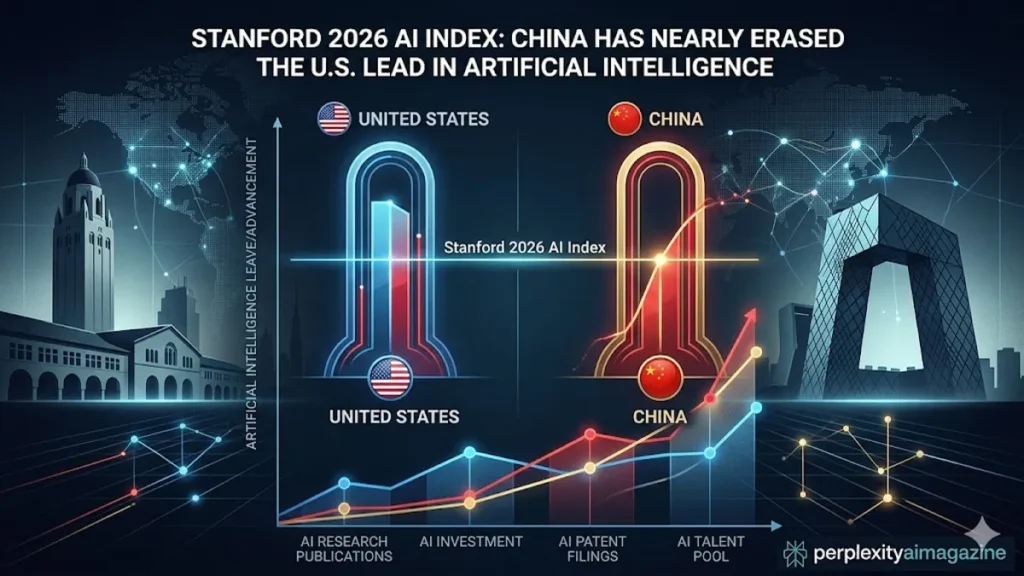
STANFORD, CA — April 16, 2026 — The Stanford University Institute for Human-Centered Artificial Intelligence (HAI) has released its landmark 2026 AI Index Report, a 423-page annual assessment of the global state of artificial intelligence. The Stanford 2026 AI Index delivers a striking finding: China has nearly erased the United States’ lead in AI model performance, with the top American model holding just a 2.7% advantage over its Chinese counterpart as of March 2026.
The 2.7% Gap
According to the Stanford 2026 AI Index, Anthropic’s Claude Opus 4.6 leads China’s ByteDance Dola-Seed 2.0 Preview by just 39 Arena points on the Chatbot Arena Leaderboard — a 2.7% margin. In May 2023, the equivalent gap was more than 300 points. The compression has been rapid and bi-directional: U.S. and Chinese models have traded the top spot multiple times since early 2025, when DeepSeek-R1 briefly matched the best American model. Stanford’s own framing describes the performance race as “effectively closed.”
Where China Leads
While the U.S. still produces more notable AI models — 50 in 2025 versus China’s 30 — China leads in several other dimensions tracked by the Stanford 2026 AI Index. China accounts for 20.6% of global AI paper citations in 2024, compared to 12.6% for the U.S. It also leads the world in industrial robot installations, deploying 295,000 units in 2024 compared to 34,200 in the U.S. South Korea, meanwhile, has emerged as the leader in AI patents per capita. The number of countries with state-backed supercomputing clusters has grown to 44, reflecting a broader global push for AI sovereignty.
Talent and Trust Concerns
The report raises two structural concerns for the United States. First, the flow of AI researchers into the country has dropped 89% since 2017, eroding the talent advantage that underpinned U.S. model dominance. Second, just 31% of Americans trust their government to regulate AI properly — the lowest figure of any surveyed nation except China at 27%. By contrast, 53% of EU citizens express confidence in their government’s ability to oversee AI. The report also found that global corporate AI investment reached $581.7 billion in 2025, a 130% increase from the prior year, with the U.S. accounting for $285.9 billion — more than 23 times China’s disclosed private investment figure.
Click Here to Read More About AI Related News!
