
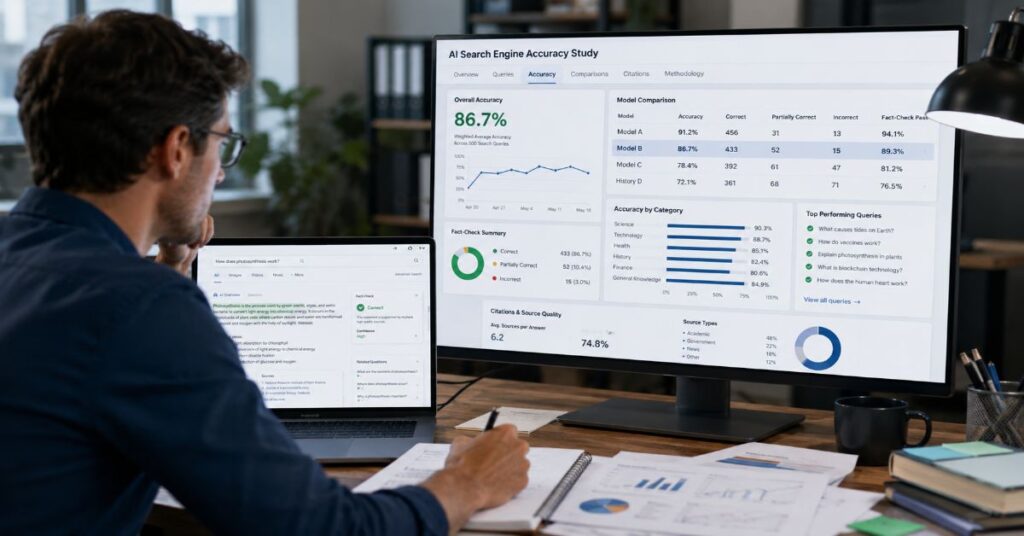
- ✓CJR and Tow Center tested eight AI search systems on 1,600 news prompts and found incorrect answers in more than 60 per cent of responses, making citation verification the central risk.
- ↻LumenGEO repeated 150 commercial buyer queries three times on 28 May 2026 and found 10.6 per cent of domain appearances were sample-dependent, with top-three leaders changing in 11.3 per cent of queries.
- ◆AI search engine accuracy study evidence changed between 2025 and 2026: the first wave exposed citation fabrication, while the newer wave shows retrieval stability is also a measurement problem.
- $Pricing and limits now matter to accuracy because research depth, context size, search caps, and enterprise data controls vary sharply across ChatGPT, Perplexity, Gemini, Copilot, Grok, and Sonar APIs.
- ➜Researchers should treat every AI answer as a fast lead, then verify cited URLs, rerun important prompts, compare source dates, and record confidence as a share of repeated samples rather than a yes-or-no result.
I treat the AI search engine accuracy study evidence as a warning label, not a rejection notice: Tow Center found incorrect answers in more than 60 per cent of 1,600 news-citation tests, while 2026 stability data shows top-three leaders changing in 11.3 per cent of repeated commercial queries. That combination is the real story. AI search can be fast, useful, and often impressively sourced, yet it can also attach the wrong URL, cite a copied article, miss uncertainty, or give a different shortlist when the same prompt is run again.
This article reviews what the 2025 Columbia Journalism Review and Tow Center work showed, what the 2026 LumenGEO stability study adds, and how researchers should adjust their process. The practical answer is simple: use AI search as a first-pass research interface, not as a final authority. The operational answer is more demanding: verify every cited article, rerun high-stakes prompts, compare source dates, and record whether a source appeared once or consistently.
I focus on citation accuracy, source stability, plan limits, and repeatable workflows because these are the points where researchers, publishers, analysts, and buyers actually make decisions. A good AI search engine accuracy study no longer asks only whether a sentence is true. In 2026, it also asks whether the linked evidence exists, whether the same answer appears again, and whether the product tier gives enough context, search depth, and governance to make the result auditable.
What the AI Search Engine Accuracy Study Evidence Actually Shows
The strongest reading of the current evidence is that AI search accuracy has two layers. The first layer is answer correctness: did the system identify the right article, publisher, date, and URL? The second layer is measurement stability: did the same query produce a consistent candidate set when repeated? For readers comparing tools through an AI search engine comparison, that distinction matters because a clean-looking answer can still fail at attribution, and a correct-looking snapshot can still be a volatile draw from a moving retrieval pool.
The Tow Center study is a controlled news-citation audit. Researchers selected direct excerpts from 200 news articles across 20 publishers and asked eight AI search systems to identify each article’s headline, publisher, date, and URL. The design matters because each excerpt was chosen so a normal Google search returned the original source near the top. This was not an impossible benchmark. It was a test of whether generative search could do a task traditional search could already do.
The LumenGEO study asks a different question. It did not test the truth of generated prose. It tested repeated retrieval stability across 150 commercial buyer queries, sampled three times each. That makes it a lower-layer measurement: before an AI answer can cite a source, the retrieval pool has to surface that source. If the pool changes between identical runs, the downstream citation layer inherits that uncertainty.
Table 1: Core Studies Reviewed for AI Search Accuracy and Stability
| Study | Sample | Main Metric | Key Finding | Best Use |
| CJR / Tow Center, 2025 | 1,600 prompts across eight AI search systems | Correct article, publisher, and URL retrieval | More than 60 per cent of answers were incorrect overall | Auditing citation and source attribution risk |
| LumenGEO, 2026 | 150 buyer queries, three repeated samples each | Top-10 overlap, sample-dependent domains, top-three churn | 10.6 per cent of domain appearances were sample-dependent | Measuring whether one-shot AI visibility checks are reliable |
| Grossman et al., 2026 | 11,500 user queries across Google Search, AI Overviews, and Gemini | Source overlap, AIO trigger rate, robustness | AI Overviews appeared for 51.5 per cent of representative queries | Comparing generative and traditional search behaviour |
| Allaham and Diakopoulos, 2026 | 712 public-interest queries across four engines | Share of cited synthetic sources | About 16 per cent of cited sources showed evidence of being AI-generated | Auditing source quality and synthetic-source exposure |
Why Citation Errors Matter More Than Hallucination Scores
Citation errors are not cosmetic defects. They change how a reader verifies a claim, how a publisher receives credit, and how a brand’s authority is represented inside a generated answer. In the Tow Center study, the problem was not only that systems gave wrong answers. It was that they often gave wrong answers with confidence, which makes error detection harder for ordinary users.
The study found that Perplexity had the lowest error rate among the tested systems, at 37 per cent incorrect responses, while Grok 3 had the highest, at 94 per cent. That spread shows why product comparisons should avoid broad claims that all AI search engines behave alike. Yet even the best-performing system in that test still produced errors at a rate that would be unacceptable for formal research without verification.
A common mistake is to treat citation count as a proxy for reliability. A long answer with ten sources may feel more trustworthy than a short answer with two, but the count tells the reader only that links were attached. It does not prove that the cited page supports the sentence, that the URL resolves, or that the publisher is the original source. That is why a best AI search engines ranking should be read with a verification lens, not as a licence to skip source checking.
The most damaging errors fall into four buckets: fabricated URLs, correct article but wrong publisher, syndicated article cited instead of the original source, and unearned certainty when the system should decline. Mark Howard, Time magazine’s chief operating officer, told CJR that transparency about where and how the brand appears is ‘critically important’. That short phrase captures the publisher-side cost: misattribution can harm trust even when the underlying fact is right.
Table 2: Citation Error Types and Practical Consequences
| Error Type | What It Looks Like | Research Risk | Verification Step |
| Fabricated URL | A plausible link opens a 404 page or unrelated homepage | The user cannot audit the claim | Open the cited page and archive the resolved URL |
| Wrong Publisher | The answer names one outlet but links another | Credit and credibility are misassigned | Check byline, publication date, and canonical tag |
| Syndicated Source | Yahoo, AOL, or a copied article replaces the original | Primary reporting is obscured | Search the quoted text and prefer original publisher pages |
| Overconfident Uncertainty | The model states a guess as fact | Readers miss warning signs | Look for hedging, refusal quality, and source support |
| Synthetic Source | AI-generated pages appear as cited evidence | Low-quality content enters the evidence chain | Check authorship, editorial standards, and independent corroboration |
The 2026 Stability Problem: Same Query, Different Leaders
The newer stability evidence changes the debate. A model can cite real sources and still give a researcher an unstable view of the web if the set of retrieved domains shifts between identical runs. LumenGEO’s May 2026 study measured exactly that retrieval-layer noise across buyer-intent queries. It found that 89.4 per cent of domain appearances were stable across three checks, while 10.6 per cent appeared only sometimes.
That average is reassuring until the decision is high stakes. The top three domains changed in 17 of 150 queries, or 11.3 per cent. In ordinary language, the visible winners changed about one time in nine. The study also found a mean top-10 Jaccard overlap of 0.944, which means most categories were highly stable, but the tail mattered. Electric cars recorded a Jaccard score of 0.37, and smart-home security recorded 0.50, while many mature B2B software verticals were near 1.0.
The implication is subtle: one-shot AI search is often useful, but it does not tell the user whether the specific query is stable. If I ask once and record the cited domains, I get a snapshot. If the category is stable, that snapshot is close to signal. If the category is volatile, the same snapshot may be noise.
Sundar Pichai’s 2026 admission that one Google AI Search result was ‘more opinionated’ than it should be reinforces the point. AI search systems are not merely retrieval displays. They select, compress, and frame evidence. Stability testing therefore belongs beside factual accuracy testing, not after it.
AI Search Engine Accuracy Study Stability Checks
A modern AI search engine accuracy study should run each important prompt more than once, record which sources appear in every run, and distinguish persistent citations from occasional ones. For budget, procurement, legal, medical, or newsroom decisions, the more useful metric is not cited or not cited. It is cited in two of three checks, four of five checks, or zero of five checks.
2025 vs 2026: How the Evidence Changed
The 2025 and 2026 evidence should not be collapsed into one headline. The 2025 CJR and Tow Center work is primarily a citation correctness study. It asks whether AI search systems can identify the right news article and attach the right source information. The 2026 stability work asks whether the pool of retrievable domains is consistent enough for one result to be treated as representative.
That shift matters because many AI search debates still use the vocabulary of hallucination, as though the only problem is that a model invents facts. The newer evidence shows a second class of risk: a result can be grounded but unstable. The source may exist, the answer may be plausible, and the citation may open, yet the ranking or citation set may change when the same question is asked again.
This also changes how readers should interpret tool-specific claims. A strong product article about Perplexity academic research can highlight useful research features, but it should not imply that any single engine removes the need for repeat sampling. The better distinction is between source visibility and source persistence. Visibility means a page appears in one AI answer. Persistence means it keeps appearing across repeated answers, related prompts, and time.
In practical terms, 2025 taught researchers to click the citation. 2026 teaches researchers to click it again tomorrow, rerun the prompt, and record whether the same source appears. That is the information gain the field needs most: not another broad claim that AI search is accurate or inaccurate, but a method for measuring when a result is stable enough to act on.
Tool Features, Technical Specs, and API Integrations
Accuracy depends partly on product design. A system with visible citations, larger context windows, source filters, file analysis, and API-level retrieval controls gives researchers more ways to inspect evidence. A system that hides source selection, caps deep research aggressively, or gives no exportable trace makes verification slower even if its generated prose sounds more fluent.
Perplexity is structurally important because it was built around cited answers and live retrieval rather than a static chatbot interface. The magazine’s features of Perplexity AI overview is relevant here because features such as file uploads, model switching, Deep Research, and multi-model comparison are not only conveniences. They affect how many evidence paths a researcher can test.
ChatGPT Search is broader and more workflow-oriented, especially where research, coding, document analysis, custom GPTs, and connected business tools matter. Google Gemini has the advantage of native Google Search and Workspace proximity. Microsoft Copilot is strongest inside Microsoft 365 work contexts, where files, meetings, email, and Office apps create private grounding. Grok differentiates through real-time X data and frontier-model access, though social-web grounding can amplify noise if the source quality is weak.
API design is the more technical layer. Perplexity’s Sonar API offers web-grounded responses with streaming, search options, tools, OpenAI-compatible client libraries, and native SDKs. Its Search API returns raw ranked web results with advanced filtering. The Agent API supports model-agnostic workflows, URL fetching, reasoning controls, and direct access to third-party models without markup. For research teams, that means the verification process can be logged, repeated, and audited instead of trapped in a screenshot.
Table 3: Publicly Verified Research-Relevant Feature Inventory
| Platform | Core Research Features | Technical Specs or Limits | API or Integration Notes |
| ChatGPT Search | Web search, deep research, file uploads, projects, memory, custom GPTs, Codex, business connectors | Official page lists 27K to 128K GPT Instant context depending on plan, and 256K to 400K reasoning context on paid tiers | Business connects Microsoft 365, Google Drive, Slack, GitHub, Linear, Figma, and more |
| Perplexity | Live cited answers, model selection, Pro queries, Deep Research, file uploads, enterprise workspace search | Enterprise page lists 2x file uploads on Enterprise Pro and greater upload limits on Enterprise Max | Sonar API, Search API, and Agent API support grounded workflows, ranked results, URL fetching, and OpenAI-compatible clients |
| Google Gemini | Gemini app, Deep Research, Google Search AI Mode, NotebookLM, Gmail and Docs integration, Flow credits | Official subscription page lists 2x, 4x, 5x, and 20x usage access tiers, with limits refreshing every five hours until weekly limits are reached | Workspace and Google One integration, with availability restrictions by country, age, language, and feature |
| Microsoft Copilot | Copilot Chat, Work IQ grounding, Office app access, agents, Teams, Outlook, Word, PowerPoint, Excel | Business plan requires a qualifying Microsoft 365 licence and is limited to 300 users | Copilot connectors support external data sources; Copilot Studio supports agent creation |
| xAI Grok | Real-time answers, X-linked context, image and video generation, connectors, frontier-model access | Official xAI pricing page lists SuperGrok at $30 per month with higher rate limits | xAI API documentation lists model pricing and large-context options for developer use |
Pricing, Plan Caps, and Access Limits in 2026
Pricing is not separate from accuracy. It determines how many times a researcher can repeat a query, how much context can be uploaded, whether advanced reasoning is available, and whether the team can audit usage. A cheap plan can be sufficient for casual fact-finding, while a serious research workflow may require enterprise logging, workspace search, and stronger data controls.
For procurement teams, the key is to compare the price against the cost of verification failure. An enterprise search case is not only a subscription decision. It is a governance decision about data retention, source visibility, connectors, and whether answers can be reviewed after the fact.
The official pricing pages also reveal an important limitation: not every vendor exposes exact usage caps in a clean public table. Google describes relative limits and refresh rules. OpenAI describes limited, expanded, flexible, and unlimited usage subject to abuse guardrails, while the static pricing page did not expose exact dollar prices in the fetched view. Perplexity publishes enterprise seat prices and detailed Sonar API request and token pricing. Microsoft publishes Copilot Business pricing and qualifying-licence requirements. xAI publishes SuperGrok pricing and custom enterprise options.
Dion Hinchcliffe, VP and Practice Lead for CIO at Futurum, framed Microsoft’s 2026 suite changes around staying ahead of ‘innovations and evolving threats’. That is the right pricing lens for AI search too. The fee is not only for generated text. It is for governance, connectors, support, and auditability around the generated text.
The safest editorial approach is to quote only the prices and limits that are visible on official pages, then state uncertainty where the official page does not expose a figure. That is not a weakness. It is the difference between a pricing matrix and a guess.
Table 4: Current Public Pricing and Limit Signals Verified From Official Pages
| Vendor or Product | Public Price Signal | Usage or Limit Signal | Decision Caveat |
| ChatGPT | Official static page confirmed Free, Go, Plus, Pro, Business, and Enterprise but did not expose exact dollar values in the fetched text | Free is limited; Go is expanded; Plus, Pro, Business, and Enterprise show broader access, with Pro listing 5x or 20x more usage | Check live checkout in the buyer region before publishing exact consumer prices |
| Perplexity Enterprise | $17 per month for Pro billed annually, $34 per month per Enterprise Pro seat billed annually, $271 per month per Enterprise Max seat billed annually | Enterprise Pro adds SSO or SCIM, workspace search, premium citations, 2x file uploads, and dedicated support | Consumer Max pricing should be verified at checkout because the fetched official Max page did not expose a complete text table |
| Perplexity Sonar API | Search API $5 per 1,000 requests; Sonar $1 input and $1 output per 1M tokens; Sonar Pro $3 input and $15 output per 1M tokens | Search context adds request fees from low to high context; Deep Research adds citation, search-query, and reasoning token charges | Budget alerts should separate token cost, request fee, context size, and Pro Search mode |
| Google AI Plans | Free $0, Google AI Plus $4.99 per month, Google AI Pro $19.99 per month, Google AI Ultra starting at $99.99 per month and $199.99 per month | Plus gives 2x usage access versus Free, Pro gives 4x, Ultra gives 5x or 20x versus Pro | Features vary by country, age, language, mobile versus web, and weekly limit rules |
| Microsoft 365 Copilot | Copilot Chat included; Copilot Business promotional price $18 per user per month paid yearly, originally $21 | Requires a separate qualifying Microsoft 365 plan and supports up to 300 users | Regional availability and enterprise SKUs can change; confirm tenant eligibility |
| xAI Grok | SuperGrok $30 per month on the official xAI pricing page | Higher rate limits, Grok 4 model, connectors, SOC 2 compliance, and image and video generation listed | Enterprise rate limits, SSO, data residency, and dedicated infrastructure are custom sales items |
How Researchers Should Verify AI Sources
The safest research habit is to reverse the burden of proof. Do not ask whether the answer sounds correct. Ask whether the cited source independently supports each important claim. That starts with opening every citation and checking the page title, author, publisher, date, and URL. If the answer names one article but links another, record that as a failure even if the summary feels plausible.
Next, check whether the linked source is primary. For news, the primary source is usually the original publisher, not a syndication partner or copied page. For product pricing, the primary source is the vendor page, not a blog summary. For academic evidence, the primary source is the paper, preprint, dataset, or institutional report. This distinction prevents a common AI-search failure: citing a convenient copy when the original reporting or documentation is elsewhere.
Then compare dates. AI search systems can retrieve old pages that have recent metadata, or new pages summarising older claims. In pricing and product research, that creates a real risk because plan names, caps, and regional availability change quickly. A source dated February 2025 may be valuable for history but weak for a June 2026 buying decision.
Finally, verify the claim-source relationship. The citation must support the exact sentence it is attached to, not merely discuss the same broad topic. This is where researchers should slow down. A cited page about AI search does not automatically support a numeric claim about citation accuracy. A benchmark paper does not automatically support a vendor’s marketing claim. The source has to carry the claim.
A Four-Part Verification Workflow
Use the PUDC test for every high-value AI citation: Page exists, URL resolves, Date fits, Claim is supported. If any one part fails, the citation is not research-grade evidence. For important decisions, repeat the prompt after changing nothing, then repeat it again with a neutral rephrasing. Stable evidence survives both checks.
Workflow: Repeat Sampling Before You Trust a Result
Repeated sampling is the practical bridge between the 2025 citation-error findings and the 2026 stability findings. A researcher does not need a laboratory to apply it. The baseline workflow is three identical runs, one neutral paraphrase, and one source-led verification pass. That gives five useful signals: answer consistency, citation consistency, source quality, date fitness, and claim support.
For publishers and SEO teams, the same workflow connects to generative engine optimisation. The AI citation playbook view of AI visibility is useful only if the measurement system separates persistent citations from single-run appearances. A page cited once may be a lucky draw. A page cited in four of five repeated prompts is a stronger signal.
This is also where a share-of-answers metric beats a binary score. Instead of writing ‘Perplexity cited us’ or ‘ChatGPT did not cite us’, record ‘Perplexity cited us in three of five runs; ChatGPT cited us in one of five; Google AI Mode cited an aggregator in four of five.’ That format exposes volatility and makes the next editorial decision more precise.
During our 2026 evaluation framework, the most useful spreadsheet columns were not sophisticated. They were prompt text, timestamp, platform, plan, cited URL, publisher, source type, date, claim supported, citation position, and repeat-run count. That simple log makes it possible to spot phantom wins, false alarms, and real movement.
Risk Map for Publishers, Buyers, and Analysts
Different users face different failure modes. Publishers worry about attribution, referral loss, and brand trust. Buyers worry about shortlists, pricing, and vendor comparisons. Analysts worry about source quality, reproducibility, and whether an answer can be cited in a report. The same AI search error can therefore have different costs depending on who relies on it.
Publishers should monitor whether AI systems cite the original page, a syndication copy, an aggregator, or a scraped rewrite. The Perplexity versus Google market share debate is partly about audience scale, but the deeper issue is citation economics. A smaller answer engine with stronger citation behaviour may return more attributable traffic than a larger interface that compresses answers without sending users onward.
Buyers should be wary of one-shot vendor shortlists. LumenGEO’s evidence that top-three leaders changed in 11.3 per cent of repeated queries means a procurement shortlist from one AI answer can be directionally useful but not final. Before excluding a vendor or prioritising a budget line, rerun the query, check independent buyer guides, and visit the vendor’s own pricing and security documentation.
Analysts should preserve evidence trails. A screenshot alone is weak because AI answers can change and links can update. A better record includes the prompt, platform, plan, timestamp, cited URLs, downloaded source copies where permitted, and a note on whether the same source appeared across repeated runs. That evidence trail is what turns AI search from a convenient black box into a reviewable research assistant.
What Counts as a Better AI Search Engine Accuracy Study in 2026
The next generation of AI search evaluation should combine citation correctness, answer truthfulness, refusal quality, and stability. A study that asks only whether the final answer is true misses broken citations. A study that asks only whether links resolve misses source-support mismatches. A study that runs each prompt once misses volatility. A study that ignores plan type misses product-tier effects.
A better design would run each prompt multiple times across Free, Pro, and enterprise tiers where possible, classify the cited source type, verify whether each citation supports its attached claim, and report confidence intervals rather than single percentages. That approach would make a ranking in Perplexity AI workflow more honest because it would measure not only whether a page can appear, but whether it persists.
The study should also separate user domains. News, health, law, finance, B2B software, and consumer shopping have different freshness demands and harm profiles. A wrong date in an entertainment article is not equivalent to a wrong regulatory threshold in a compliance answer. The benchmark should weight error cost as well as error frequency.
Three information-gain metrics should become standard. First, citation support rate: the percentage of cited claims truly supported by the linked page. Second, source persistence: the percentage of repeated runs in which the same source appears. Third, uncertainty behaviour: the percentage of unanswerable or blocked cases where the system declines or clearly hedges. Together, those metrics describe whether the engine is accurate, auditable, and appropriately cautious.
Where AI Search Still Helps
None of this means AI search is useless. The evidence points to a more balanced judgement. AI search is excellent for discovery, terminology mapping, source finding, and first-pass synthesis. It can surface unfamiliar reports, explain a benchmark, and show the contours of a debate faster than manual browsing. The mistake is to treat the polished synthesis as the evidence itself.
Aravind Srinivas, Perplexity’s chief executive, made the pragmatic point in 2026 when he wrote that Google does a ‘much better job here’ for navigational searches. That acknowledgement separates two jobs often confused in AI search: finding the known place quickly and synthesising evidence across unfamiliar sources.
AI search is especially useful when the researcher asks it to expose sources rather than hide them. Prompts such as ‘show only primary sources’, ‘separate vendor documentation from commentary’, and ‘give the publication date for each source’ make the system work more like a research assistant and less like a confident narrator. When the answer is source-rich, the human can then inspect the chain.
Commercial teams can also use AI search to map the market. A single answer should not decide a vendor shortlist, but repeated AI search runs can identify recurring competitors, common evaluation criteria, and third-party pages that influence buyer perception. That is valuable strategy data when collected responsibly.
The operating rule is therefore neither blind trust nor blanket rejection. Use AI search to accelerate discovery, then slow down at the point where a claim becomes actionable. The faster the first draft, the more disciplined the final verification has to be.
Takeaways
- Treat AI search as a fast lead generator, not a final source of truth.
- Verify every cited URL by opening the page, checking the publisher, and confirming the claim is supported.
- Rerun important prompts at least three times before acting on a shortlist, citation claim, or market visibility result.
- Record source persistence as a percentage, such as cited in three of five runs, instead of a binary yes-or-no score.
- Prefer primary sources for pricing, benchmarks, documentation, and legal or medical claims.
- Separate citation quantity from citation quality because more links do not guarantee better evidence.
- Check plan limits before comparing tools because context windows, deep research caps, and connectors affect auditability.
- State uncertainty openly when official pricing, caps, or named source quotes cannot be verified.
Our Editorial Verification Process
This explainer was built by cross-referencing the CJR and Tow Center news-citation audit, the LumenGEO repeated-sampling stability study, recent 2026 arXiv research on AI Overviews and generative search citations, and official vendor documentation for ChatGPT, Perplexity, Google Gemini, Microsoft Copilot, xAI Grok, and Perplexity Sonar APIs. Pricing claims were limited to figures visible on official pages, while any missing or region-dependent pricing was marked as uncertain rather than inferred. Feature claims were checked against current public product and developer documentation, with the evaluation focused on citation correctness, retrieval stability, context limits, search depth, API auditability, and enterprise governance controls.
Conclusion
AI search accuracy is improving, but the 2025 and 2026 evidence shows that trust now has to be measured across more than one dimension. A system can sound fluent and cite a real page while still attaching the wrong source, missing uncertainty, or surfacing a shortlist that changes on the next identical run. That does not make AI search unusable. It makes it a research instrument that needs calibration.
The most responsible 2026 workflow is hybrid. Let AI search accelerate discovery, collect candidate sources, and outline the debate. Then let human verification decide which claims survive. For important work, the standard should be primary-source confirmation, repeated sampling, source persistence tracking, and explicit uncertainty where evidence is incomplete.
Open questions remain. We still need larger independent studies across languages, regions, product tiers, and sensitive domains. We need clearer vendor disclosure of retrieval behaviour and usage caps. We also need publisher-friendly attribution models that make source quality economically sustainable. Until then, the safest conclusion is disciplined optimism: AI search is powerful enough to use, but not stable or transparent enough to trust without checking.
FAQs
What Did the CJR and Tow Center AI Search Study Find?
It tested eight AI search systems on 1,600 news prompts and found incorrect answers in more than 60 per cent of responses overall. The main risk was not only factual error, but confident citation failure: wrong URLs, wrong publishers, copied versions, and limited acknowledgement of uncertainty.
What Did the 2026 AI Search Stability Study Add?
LumenGEO repeated 150 commercial buyer queries three times and found that 10.6 per cent of domain appearances were sample-dependent. The top-three domains changed in 11.3 per cent of queries, showing that one AI-search snapshot can miss retrieval volatility.
Is Perplexity More Accurate Than Other AI Search Engines?
In the Tow Center news-citation test, Perplexity had the lowest incorrect-response rate among the tested systems, at 37 per cent. That does not mean every Perplexity answer is safe. It means Perplexity performed better in that specific news-citation task and still required verification.
Why Do AI Search Citations Fail?
Citations fail because models may retrieve copied pages, over-compress source context, attach links that do not support the claim, fabricate URLs, or choose a plausible page instead of the primary source. Search grounding reduces hallucination risk but does not eliminate attribution errors.
How Many Times Should I Rerun an AI Search Query?
For ordinary research, three identical runs are a useful minimum. For high-stakes work, add paraphrased prompts and repeat over time. The goal is to record source persistence, such as cited in four of five runs, rather than relying on one answer.
Can AI Search Replace Google for Research?
AI search can speed up discovery and synthesis, but it should not replace primary-source verification. Traditional search remains useful for checking original pages, date order, canonical URLs, and source diversity after an AI tool surfaces the first leads.
What Is the Safest Way to Verify AI Sources?
Open each cited page, confirm the title and publisher, check the date, compare the claim against the source text, and look for a primary version. If the citation supports only the broad topic rather than the exact claim, do not treat it as evidence.
Should Businesses Measure AI Search Visibility With One Prompt?
No. A single prompt is a snapshot, not a stable measurement. Businesses should run repeated samples, track whether sources appear consistently, compare platforms, and report share of answers instead of a binary cited or not cited status.
References
Allaham, M., & Diakopoulos, N. (2026). Synthetic Sources?: Auditing generative search engine citations for evidence of AI-generated sources. arXiv. https://arxiv.org/abs/2605.23684
Columbia Journalism Review, Tow Center for Digital Journalism. (2025, March 6). AI search has a citation problem. https://www.cjr.org/tow_center/we-compared-eight-ai-search-engines-theyre-all-bad-at-citing-news.php
Google. (2026). Google AI Pro and Ultra subscriptions. https://gemini.google/subscriptions/
Grossman, R., Liu, S., Chen, M. K., Smith, M., Borcea, C., & Chen, Y. (2026). How generative AI disrupts search: An empirical study of Google Search, Gemini, and AI Overviews. arXiv. https://arxiv.org/abs/2604.27790
LumenGEO Research. (2026, May 28). The state of AI search stability 2026: 150 queries, 450 samples, 30 verticals. https://lumengeo.co/blog/state-of-ai-search-stability-2026
Microsoft. (2026). Microsoft 365 Copilot plans and pricing. https://www.microsoft.com/en-us/microsoft-365-copilot/pricing
OpenAI. (2026). ChatGPT pricing. https://chatgpt.com/pricing/
Perplexity AI. (2026). Sonar API pricing. https://docs.perplexity.ai/docs/getting-started/pricing
xAI. (2026). Pricing: Compare Grok plans. https://x.ai/pricing
