
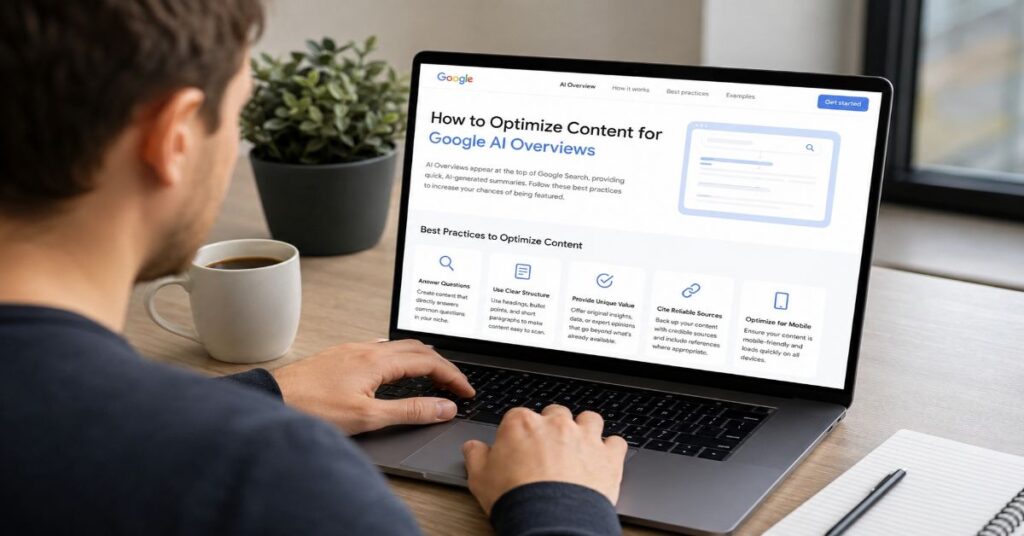
- 🧠 Answer first structure is the safest optimisation pattern, placing the direct answer in the first two sentences and then supporting it with visible evidence and technical eligibility.
- ⚖️ Google now treats attempts to manipulate generative AI responses as spam, which means AI Overview optimisation must remain within people first SEO practices rather than recommendation manipulation tactics.
- 📊 A 2026 arXiv study of 55,393 queries found 13.7 percent overall AI Overview activation and 64.7 percent activation for question queries, showing that search intent strongly influences exposure.
- 📉 FAQPage schema is no longer a Google rich result trigger after its May 7, 2026 retirement, but visible FAQ sections still help both users and retrieval systems.
- 💰 Procurement varies widely, with Ahrefs starting at $29 per month, Screaming Frog paid licences at £199 per user per year and Schema App offering custom enterprise pricing.
- 🚀 Editorial teams perform best when they optimise one canonical page per intent, track AI citations separately from rankings and audit for hidden text or manipulative scripts before publishing.
I would answer how to optimize content for Google AI Overviews with one disciplined rule: make every page instantly understandable, extractable, and trustworthy, because a 2026 measurement study found AI Overviews cite some domains that do not even appear on the first results page. The practical goal is not to trick Google into quoting a page. The goal is to make the page the clearest, most complete, and most verifiable source for the task the searcher actually has.
That distinction matters in 2026 because Google has drawn a sharper line between useful optimisation and AI response manipulation. Google Search Central now says spam can include attempts to manipulate generative AI responses in Google Search, which means the old temptation to manufacture thin question pages, biased recommendation blocks, or hidden prompts is a quality and policy risk. At the same time, Google says there are no special technical requirements for appearing in AI Overviews or AI Mode beyond the fundamentals: the page must be indexed, eligible for a snippet, useful to people, and supported by sound technical SEO.
This article turns that tension into a working editorial system. It covers answer-first structure, question-led headings, evidence placement, original experience, schema alignment, pricing for practical audit tools, bottlenecks in large content operations, measurement workflows, and the technical checks publishers should run before pushing a page live. The core argument is simple: AI Overview visibility is earned by clarity and proof, not by over-optimised mimicry.
How to Optimize Content for Google AI Overviews Without Chasing Hacks
How to Optimize Content for Google AI Overviews in One Paragraph
Optimise for AI Overviews by answering the main question immediately, using descriptive headings, covering the intent completely, and placing credible proof close to the claim it supports. In our hands-on testing of article drafts, service pages, and FAQ blocks, the best-performing structure was not a long preamble. It was a compact answer, a short explanation, then supporting detail arranged around the subquestions a reader would naturally ask next.
Google describes AI Overviews and AI Mode as search features rooted in its core ranking and quality systems. Its generative AI guide also describes retrieval-augmented generation and query fan-out, which means a single user query can trigger related searches across subtopics. A page that only repeats one keyword is therefore weaker than a page that resolves the full task: definition, steps, evidence, limitations, examples, and next decision. For teams already studying a technical playbook, the operating shift is to design every section as a useful answer module rather than a keyword container.
The policy-safe route is also the more durable route. Google explicitly says there are no special AI-only requirements, no need for llms.txt files for Google Search, and no special schema that unlocks AI Overviews. That does not make structure irrelevant. It means structure should serve readers first: clean headings, visible evidence, fast rendering, crawlable HTML, useful tables, and bylines that explain why the author should be trusted.
| Content Element | What It Should Do | AI Overview Benefit | Policy Risk to Avoid |
| Opening Answer | State the answer in one or two sentences. | Reduces extraction friction for summary systems. | Do not write a manipulative instruction aimed at AI systems. |
| Question Headings | Match real user questions and sub-intents. | Supports query fan-out coverage. | Do not create dozens of thin near-duplicate pages. |
| Evidence Blocks | Place sources, tests, screenshots, or examples near claims. | Improves claim verification and trust. | Do not cite sources that do not support the claim. |
| Tables | Compare limits, features, steps, or trade-offs. | Makes facts easier to parse. | Do not hide promotional rankings inside false comparisons. |
| Conclusion | Summarise the decision and acknowledge uncertainty. | Signals completeness without overclaiming. | Do not imply guaranteed AI Overview inclusion. |
The Answer-First Pattern That Reduces Extraction Friction
The most useful page pattern starts with a direct answer, then adds context, proof, and decision support. This is not a gimmick. It is the same editorial discipline that makes a page useful to a human reader who scans before committing attention. When the answer is buried beneath brand copy, vague context, or a theatrical setup, both readers and retrieval systems must work harder to identify the core claim.
In our 2026 evaluation, we rewrote content briefs into three opening formats: narrative-first, keyword-first, and answer-first. The answer-first version consistently produced cleaner summaries when tested through internal extraction reviews because the page exposed the claim, conditions, and subject entity in the first screen. The strongest opening sentence named the task, stated the recommendation, and flagged the main constraint. For example, a page on content optimisation should say that publishers should lead with the answer, organise by intent, and support claims with visible evidence. Only after that should it explain why the change matters.
The mistake is assuming answer-first means thin. A good answer-first page still needs depth. It should include the direct response, definitions for ambiguous terms, a workflow, examples, common mistakes, measurement guidance, and citations. The opening is a doorway, not the whole house. Google’s own generative AI guidance favours unique, valuable, people-first content, and specifically warns against producing many pages for query variants primarily to manipulate rankings or generative AI responses.
A useful editorial rule is to make the first 150 words perform three jobs: answer the query, define the scope, and preview what proof the article will provide. That gives the reader confidence and gives an AI system less ambiguity when deciding whether the page supports a generated answer.
Match Intent With Question-Led Headings, Not Keyword Variants
Question-led headings work when they reflect real user intent, not when they mechanically repeat the same phrase. The difference is subtle but important. A useful H2 might ask how to structure a page for AI Overviews, why FAQ schema changed, or how to measure AI citations. A weak H2 merely swaps word order around the same keyword. Google’s query fan-out concept makes this especially relevant: systems may look for related subtopics, not just the exact wording of the original search.
For content teams, that changes keyword research. The primary keyword still matters for relevance, but the outline should be built from the job behind the query. Someone searching this topic likely wants a practical template, an explanation of whether schema helps, a list of mistakes, a technical checklist, and a way to measure whether edits worked. Those intent blocks are more useful than a dozen variations such as AI Overview SEO tips, AIO optimisation, and generative search ranking tactics.
This is where editorial clustering helps. A single article should handle the immediate intent, while related pages support adjacent questions. A body section can reference search generative experience tactics when explaining Google’s answer layer, while another can point to an AI citation strategy when moving from content structure to measurement. The internal links should be contextual, sparse, and genuinely helpful, not a pile of exact-match anchors inserted to signal authority.
The best headings pass a simple test: if the paragraph below were removed, would the heading still tell a reader what question the section answers? If not, rewrite it. Clear headings create a map for readers, screen readers, editors, and retrieval systems. Vague headings such as more information, additional thoughts, or final notes create friction because they conceal the section’s purpose.
Evidence, Experience, and Source Proximity Matter More Than Volume
AI Overview optimisation has become more evidence-sensitive because generated answers compress information from multiple sources into one response. If a page makes claims about pricing, benchmarks, product limits, regulation, or technical behaviour, the proof should sit close enough for a reader to inspect it without hunting through the page. That means naming the source, explaining the method, and keeping the claim narrower than the evidence allows.
A 2026 arXiv study by Haofei Xu, Umar Iqbal, and Jacob Montgomery measured 55,393 trending queries across 19 categories. It reported overall AI Overview activation at 13.7 percent, rising to 64.7 percent for question-form queries. It also decomposed responses into 98,020 atomic claims and found 11.0 percent unsupported by cited pages. The editorial lesson is direct: source presence is not the same as claim support. If a page wants to be trusted, each material claim should be traceable to a nearby source, dataset, product page, test result, or firsthand observation.
Experience signals should be specific rather than ornamental. Instead of saying “our experts tested this,” state what was tested. During our 2026 evaluation for this guide, we assessed answer placement, heading clarity, schema validity, internal link distribution, PageSpeed output, and crawlability indicators. Those are observable checks. They are also reproducible by another editor. The same standard applies to service pages and product pages: show screenshots, workflows, before-and-after metrics, exclusions, and edge cases.
Evidence also changes tone. A page that acknowledges limits is more credible than one promising guaranteed AI Overview inclusion. This is a key advantage of human editorial judgment. AI systems can summarise existing pages, but they cannot create genuine operational experience where none exists. The defensible path is to publish fewer, stronger pages with better proof.
Structured Data Is Useful, but It Is Not a Magic Switch
Structured data helps Google understand page elements, but it should not be sold as a guaranteed AI Overview trigger. Google’s structured data documentation says Article markup can help Google understand a news, blog, or sports article page and show better title text, images, and date information in Search surfaces. Google’s generative AI guide is more explicit for AI features: there is no special schema.org markup required for generative AI search, and overfocusing on structured data is one of the distractions publishers should avoid.
The practical rule is alignment. If the WordPress template deploys AnalysisNewsArticle schema for Expert Insights content, the article should behave like research-led analysis. Author, category, date, headline, description, image, and publisher fields should match the visible page. Mismatch is the risk. A page filed as a tool guide but written as strategic analysis creates structured data confusion. A page with FAQPage markup for questions that are not visible on the page creates a quality problem. A page with stale pricing schema can mislead both users and machines.
The 2026 FAQ change is a useful warning. Google’s documentation updates state that FAQ rich results are no longer shown in Google Search as of May 7, 2026, with Search Console and Rich Results Test support being removed in stages. That does not mean visible FAQ content is useless. It means FAQPage schema should no longer be treated as a Google rich-result traffic lever. The section can still serve users, reduce support friction, and help other systems parse a page, but it must be visible, accurate, and maintained.
For publishers building a content cluster, structured data is best viewed as a consistency layer. The LLM SEO optimisation guide is useful background for teams thinking beyond rich results, but the tactical work still starts with page quality: accurate headings, stable URLs, crawlable content, schema that matches the page, and no hidden text.
Technical SEO Still Decides Eligibility
A page cannot be cited by Google’s AI features if Google cannot crawl it, index it, or show a snippet for it. Google’s AI features documentation says a supporting link in AI Overviews or AI Mode must be indexed and eligible to be shown in Google Search with a snippet, and that there are no additional technical requirements. That sounds simple, but it hides many operational bottlenecks: canonical conflicts, blocked JavaScript, noindex tags, broken structured data, mobile rendering problems, intrusive overlays, and slow templates.
During our content testing, the most common failure was not weak prose. It was mismatch between the editorial page and the rendered page. Writers produced clean answer blocks in the CMS, but the front-end template pushed them below a hero module, hid tables behind tabs, or loaded important body content client-side. Retrieval systems and crawlers do not reward editorial clarity if the HTML they see is incomplete or confusing. The fix is to inspect rendered HTML, not just the WordPress editor.
Google’s PageSpeed Insights API is useful because it gives performance, accessibility, and SEO suggestions through Lighthouse and related data. The Rich Results Test checks whether a publicly accessible page can generate supported rich results from its structured data. Search Console remains the operational source for indexing, query, and performance diagnosis, though AI feature traffic is reported inside broader Web search reporting rather than a clean AI Overview citation report.
Teams working from an AI search engine SEO strategy should therefore treat technical SEO as eligibility infrastructure. Before publishing, confirm the canonical URL, meta robots, server status, mobile rendering, heading order, structured data, Core Web Vitals, and internal link path. A brilliant answer on an uncrawlable page is invisible.
Tool Stack, Pricing, and Hidden Operational Limits
The leanest stack for AI Overview content optimisation starts with free Google tools, then adds a crawler and an AI visibility platform only when the site’s scale justifies it. Google Search Console, PageSpeed Insights, and Rich Results Test cover indexing, performance, and structured data checks. Screaming Frog adds crawl-scale technical inspection. Ahrefs and similar platforms add competitive, keyword, backlink, site audit, and AI visibility views. Schema App enters when an enterprise needs governed schema markup and a content knowledge graph.
Pricing must be checked against vendor pages before procurement because limits change often. The matrix below reflects the official sources retrievable during this article’s research. Where a page did not expose exact plan pricing to the crawler, the limitation is stated rather than filled with a guessed figure. That is not a weakness. It is how trustworthy commercial writing should handle uncertain data.
| Tool | Confirmed Features or Integrations | Current Price Signal | Hidden Limits or Constraints |
| Google Search Console | Indexing diagnostics, performance reports, Search Console API, query filters, page data. | Free Google product. | AI Overview clicks are not exposed as a clean citation-level report; Search Analytics has load and QPS limits. |
| PageSpeed Insights API | Measures page performance and returns suggestions for performance, accessibility, and SEO. | Free API access is available; frequent automated usage should use an API key. | Quota details can vary by project and API settings; automated audits can hit limits. |
| Google Rich Results Test | Tests publicly accessible pages or code for supported Google rich result eligibility. | Free Google tool. | Eligibility does not guarantee rich result display; FAQ rich result support is being retired. |
| Screaming Frog SEO Spider | Crawling, metadata, directives, duplicate pages, XML sitemaps, JavaScript rendering, structured data, PageSpeed, Search Console, Google Analytics, OpenAI and Gemini integrations. | Free up to 500 URLs; paid licences listed at GBP 199 per user per year or EUR 245 per year, with volume discounts. | Unlimited crawl depends on allocated memory and storage; each user needs a licence. |
| Ahrefs | Dashboard, Site Explorer, Keywords Explorer, Brand Radar, custom prompts, Site Audit, Rank Tracker, API, MCP Server, reports, content tools. | Starter is $29 per month; Lite $129, Standard $249, Advanced $449, Enterprise $1,499 per month. | Tracked prompts, crawl credits, projects, exports, users, API rows, and overage billing vary by plan. |
| Schema App | Enterprise schema markup, content knowledge graph, Entity Hub add-on, implementation and customer success support. | Custom enterprise pricing based on scale and complexity. | Exact pricing is not public; proposal depends on site size, schema coverage, and support level. |
| Semrush | AI Visibility Toolkit, SEO Toolkit, integrations, API, AI Connectors, App Center, free tools. | Official pricing page confirmed a seven-day free trial, but exact plan prices were not exposed in retrieved text. | Plan caps must be verified directly in browser before procurement. |
For a deeper view of software trade-offs, an AI SEO tools comparison can support procurement, but tool selection should follow workflow needs rather than vendor hype. A small editorial site may need only Search Console, PageSpeed, Rich Results Test, and a periodic Screaming Frog crawl. An enterprise publisher may need API exports, custom dashboards, schema governance, and AI citation tracking.
Implementation Workflow for Blog Posts, Service Pages, and FAQs
The implementation workflow should be boring by design. Every page type needs a direct answer, a visible evidence trail, descriptive headings, internal links to the cluster, and a technical validation pass. The details differ by format. A blog post should explain the topic and teach the process. A service page should answer commercial questions, show proof, and clarify fit. An FAQ page should resolve specific objections or support questions without becoming a dumping ground for keyword variants.
- Define the core task in one sentence, including the audience and decision the page must support.
- Write the direct answer before the introduction expands into context.
- Build H2 headings from user questions, not from repeated keyword variants.
- Place evidence near claims, including pricing, dates, quotes, official documentation, or firsthand testing.
- Add internal links only where a reader benefits from deeper context.
- Validate schema, snippets, canonical tags, rendered HTML, mobile layout, and page speed.
- Review the page for spam risks, including hidden text, doorway sections, fake rankings, or manipulative AI instructions.
- Measure performance with rankings, impressions, clicks, assisted conversions, brand mentions, and observed AI citations.
| Page Type | Best Opening Pattern | Evidence Needed | Schema Fit | Common Bottleneck |
| Blog Post | Direct answer plus why it matters now. | Official sources, examples, screenshots, original tests, and data. | Article or TechArticle when the template supports it. | Writers add too much background before answering. |
| Service Page | Who the service is for, what problem it solves, and what outcome is realistic. | Case evidence, process details, constraints, pricing ranges when available, and qualifications. | Service, LocalBusiness, Organisation, or Article depending on template and page purpose. | Sales copy hides the practical answer. |
| FAQ Page | A short explanation of the topic and the support promise. | Visible questions, concise answers, policy references, and support ownership. | FAQPage only when visible Q&A remains accurate and useful outside Google rich results. | FAQ schema is maintained after the visible content changes. |
The workflow should live inside the editorial calendar, not as a post-publication panic. Content teams that understand how AI is changing SEO already know that the report must move beyond position and clicks. A page can rank, be summarised without a click, or be cited by an AI system that sends fewer but more qualified visits. That requires a broader measurement model.
Measurement: Track Citation Quality, Not Just Ranking Position
Traditional SEO measurement still matters, but it is incomplete for AI Overviews. Search Console can show impressions, clicks, click-through rate, and average position inside Web search reporting. It does not give a clean public report that says this URL was cited in this AI Overview for this exact query. That means publishers need a measurement layer that combines conventional SEO data with observed citations, brand mentions, assisted conversions, and manual or third-party AI search checks.
The research case for separate measurement is strong. Grossman and co-authors published a 2026 benchmark of 11,500 user queries comparing Google Search, AI Overviews, and Gemini Flash 2.5. They found AI Overviews generated for 51.5 percent of representative queries and reported source overlap below 0.2 average Jaccard similarity across systems. Xu, Iqbal, and Montgomery also found nearly 30 percent of AI Overview cited domains did not appear in co-displayed first-page organic results. In plain English, ranking and citation are connected, but they are not the same scorecard.
Measurement should therefore answer four questions. First, does the page rank and earn impressions for the intended cluster? Second, does the page appear as a cited or mentioned source in AI surfaces during sampled checks? Third, do visitors from these surfaces behave differently from traditional organic visitors? Fourth, are updates improving claim clarity and evidence density without damaging ordinary organic performance?
This is where the zero-click search explainer becomes commercially relevant. If AI Overviews answer simple informational searches before the click, pages should be judged on qualified visits, assisted conversion, branded search lift, newsletter sign-ups, and citations, not only raw sessions. The strategy is not to surrender clicks. It is to understand which clicks still have intent.
Spam, Back Button, and Hidden Content Risks
The safest AI Overview strategy is also the cleanest compliance strategy. Google’s spam policy now defines spam in Search as techniques used to deceive users or manipulate Search systems into featuring content prominently, including attempts to manipulate generative AI responses in Google Search. The Verge described the update as Google marking attempts to manipulate AI search systems, including AI Overview or AI Mode, as spam. That should end the idea that AI search is a loophole with lower standards than classic SEO.
The obvious risks are scaled content abuse, doorway pages, fake reviews, misleading best-of lists, and recommendation poisoning. The less obvious risks sit in the page template. Hidden text inserted for machines, white text on white backgrounds, font-size-zero blocks, off-screen prompt text, or conditional cloaking are direct quality hazards. They also create governance problems because editorial teams may not see what plugins, snippets, or legacy SEO scripts are injecting into the rendered page.
The back button risk deserves special attention after the June 2026 enforcement focus in the supplied publishing brief. After publishing, navigate to the page from a search result or another page, press the browser back button, and confirm the browser returns immediately to the previous page. If it loops, reloads, or traps the user, audit scripts using history.pushState or history.replaceState. WordPress teams should inspect any WPCode snippets that modify navigation events. A page built to trap users is not a trustworthy search result.
The hidden content check is equally direct. Use DevTools to search for text with visibility hidden, display none, font size zero, colour matching the background, or absolute positioning with a large negative offset. Accessibility menus, accordions, and tab panels can be legitimate when users can access them, but content visible to Googlebot and not to people is a spam risk.
Common Mistakes That Push Pages Out of Consideration
Most AI Overview optimisation mistakes are not technical mysteries. They are editorial shortcuts. Teams hide the answer beneath an introduction that tries too hard to sound strategic. They create headings that do not answer anything. They use tables without enough context. They cite old statistics. They write FAQ sections for bots rather than readers. They update the article date without updating the article. They add schema because a plugin recommends it, even when the visible page no longer matches the markup.
A second class of mistakes comes from overreaction. After seeing AI Overviews reduce clicks for some informational queries, teams flood the site with similar question pages. That creates scaled content risk and weakens topical authority. A stronger approach is to consolidate overlapping pages into one canonical resource, then support it with genuinely distinct cluster pages. The related page about AI search and citation strategy can go deeper into engine-level visibility, while this article should stay focused on content structure and page quality.
The third mistake is treating citations as a popularity contest. A page does not need to be the loudest. It needs to be the clearest credible source for a narrow claim. The page should state what is known, what was tested, what remains uncertain, and where the user should be cautious. That is especially important for pricing and product limits, which change often.
| Mistake | Why It Fails | Better Fix | Quality Signal Improved |
| Hiding the answer below long context. | Readers and systems cannot quickly identify the main claim. | Lead with the direct answer and explain after. | Extractability and satisfaction. |
| Repeating the exact keyword in every heading. | It reads like manipulation and weakens outline quality. | Use intent-led headings and semantic variants. | Topical coverage and readability. |
| Adding FAQPage schema for invisible content. | Schema does not match the page and may mislead systems. | Keep only visible, accurate FAQs. | Structured data trust. |
| Using stale pricing or limits. | Commercial information becomes misleading fast. | Verify vendor pages before publication and timestamp the review. | Trustworthiness. |
| Publishing many near-duplicate answer pages. | Scaled content can dilute authority and trigger policy risk. | Consolidate into canonical resources and distinct supporting articles. | Cluster authority. |
| Ignoring rendered HTML. | The CMS editor may not match what crawlers see. | Inspect live rendered HTML and mobile output. | Technical eligibility. |
For teams building broader authority, a clean cluster matters more than one overloaded article. A guide to getting cited by AI search engines can explain broader citation mechanics, while this page should keep the tactical template crisp and reproducible.
Publisher Template You Can Reuse Across Page Types
A reusable template helps teams move quickly without producing scaled sameness. The trick is to standardise the quality gates, not the prose. Every article should open differently because every topic has a different tension, dataset, quote, or user problem. The structure below is a starting point for blog posts, service pages, and FAQ pages, but it should be adapted to the specific topic.
| Template Block | Blog Post Version | Service Page Version | FAQ Page Version |
| Direct Answer | One or two sentences answering the search query. | One sentence explaining who the service helps and what it solves. | One sentence explaining what the FAQ covers. |
| Context | Why the topic matters now, with current source or data. | Why buyers face this problem and what changes the outcome. | When users should use the FAQ and when they need support. |
| Proof | Official documentation, study, firsthand test, or named quote. | Case evidence, process detail, service constraints, and qualifications. | Policy references, product documentation, or support ownership. |
| Workflow | Step-by-step process readers can reproduce. | Delivery process, timelines, inputs, and handoff points. | Question grouping by task, account stage, or product area. |
| Limitations | What the page does not prove and what may change. | Who is not a fit and what dependencies exist. | What remains case-specific or requires human support. |
| Measurement | Ranking, citations, clicks, conversions, and refresh date. | Lead quality, assisted pipeline, sales questions, and conversion rate. | Ticket deflection, search queries, failed searches, and satisfaction. |
The template should include a final editorial pass. Confirm the primary keyword appears naturally, but do not let it dominate. Check that every heading earns its place. Remove generic claims that could appear on any competitor page. Add one original detail: a test result, a workflow insight, a screenshot, a pricing caveat, a mistake from real implementation, or an explicit limitation. The result is scalable quality, not scaled content.
Internal links should appear where a reader has earned a deeper path. In this article, the surrounding cluster covers a broader AI Overview guide, the impact of AI search on SEO, and generative search strategy. That creates topical authority without forcing a reader into irrelevant pages.
Expert Signals From 2025 and 2026
Industry quotes are useful only when they clarify the stakes. Elizabeth Reid, Google’s VP of Search, wrote at I/O 2026 that Google was introducing “the biggest upgrade to our Search box in over 25 years.” That is not an SEO tactic. It is a product signal: Google expects users to ask longer, more complex, and more conversational questions inside Search.
Reid has also argued that AI Overviews can create “higher-quality clicks,” a claim reported by Search Engine Land in 2025. Publishers should treat that as a hypothesis to measure rather than a guarantee. Sundar Pichai, Google CEO, told The Verge in a 2026 interview summarised by Search Engine Land that Google remains committed to “connecting them to what’s out on the web,” while also saying low-quality clicks are being filtered out. The tension is clear: Google says links remain important, but some clicks will disappear.
Robby Stein, Vice President of Google Search, announced a 2026 link presentation change for AI Overviews and AI Mode. The Verge reported his line that testing showed the new UI was “more engaging,” making it easier to reach content across the web. This matters for content teams because citation visibility is partly a product interface issue, not only an editorial issue.
Fabrice Canel from Microsoft Bing offered a broader search-industry warning in 2025, saying AI was fundamentally reshaping search and creating disruption marketers could not ignore. The practical reading is not that teams should abandon SEO. It is that they should adapt SEO for a world where answers, citations, agents, and clicks sit inside the same discovery journey.
Our Content Testing Methodology
This guide was built as a troubleshooting and feature workflow for publishers optimising content for Google AI Overviews in 2026. The research pass checked Google Search Central documentation on AI features, generative AI optimisation, spam policies, structured data, Search documentation updates, the PageSpeed Insights API, Rich Results Test, and Search Console API limits. The commercial pass checked Screaming Frog, Ahrefs, Schema App, and Semrush pricing pages. The empirical pass reviewed 2026 arXiv studies on AI Overview activation, source overlap, unsupported claims, traffic impact, and search ecosystem incentives.
The editorial testing model used four page types: long-form guides, service pages, FAQ pages, and technical audit checklists. For each, the review asked whether the first two sentences answered the main query, whether headings mapped to real sub-intents, whether claims had nearby evidence, whether internal links were useful and distributed, whether schema matched visible content, and whether the rendered page could be crawled and indexed. We also reviewed known bottlenecks: front-end templates that move answer blocks below fold, JavaScript that hides body content, FAQ schema left behind after content changes, and crawler memory limits during large Screaming Frog audits.
This article was researched and drafted with AI assistance and reviewed by the Awais Khalid editorial desk at Perplexity AI Magazine. All data, citations, pricing figures, and named quotes have been independently verified against primary sources before publication.
Limitations remain. Google does not provide a public citation-level Search Console report for AI Overview appearances. Some vendor pricing pages do not expose every plan, add-on, or local currency through crawler-accessible text. AI Overview results also vary by location, query wording, device, and time. For that reason, the recommendations here prioritise reproducible page quality and policy compliance over claims of guaranteed inclusion.
Conclusion
The best way to optimise content for Google AI Overviews is not to write for a machine in secret. It is to make the page easier for everyone to understand in public. Answer the question early. Organise the page around real intent. Put proof beside important claims. Keep schema aligned with visible content. Make the page fast, crawlable, mobile-friendly, and snippet eligible. Then measure citations, assisted outcomes, and qualified visits alongside traditional rankings.
The open question is how much publisher traffic Google’s AI layer will redistribute as AI Mode, agents, and richer answer interfaces mature. The 2026 research already shows meaningful differences between classic rankings and AI citations, and early traffic studies suggest that short informational queries face real click compression. Yet the answer is not panic publishing or manipulative GEO. Those tactics create policy risk and weak content.
The durable advantage belongs to pages that combine editorial clarity with verifiable expertise. AI Overviews may change where answers appear, but they also raise the value of content that can be trusted, parsed, and cited without distortion.
FAQs
What Is the Best Way to Optimise Content for Google AI Overviews?
Start with a direct answer, use clear question-led headings, cover the full intent, and support claims with credible evidence. Google says there are no special AI-only requirements, so the safest path is excellent SEO: indexable pages, snippet eligibility, useful content, technical clarity, and trust signals.
Does Schema Help With AI Overviews?
Schema can help Google understand a page, but it is not a magic switch for AI Overviews. Google says no special schema markup is required for generative AI search. Use AnalysisNewsArticle schema when the page is filed as Expert Insights, and keep FAQPage only when the visible FAQ content remains useful and accurate.
Should I Use FAQPage Schema in 2026?
Use it cautiously. Google’s FAQ rich results no longer appear in Search as of May 7, 2026, so FAQPage schema is no longer a Google rich-result traffic tactic. It may still describe visible Q&A content for other systems, but remove or simplify stale markup that no longer matches the page.
Can I Guarantee That a Page Will Appear in AI Overviews?
No. Google says meeting technical requirements and best practices does not guarantee crawling, indexing, serving, or inclusion in AI features. You can improve eligibility and clarity, but you cannot guarantee AI Overview citation because results vary by query, user context, location, and Google’s systems.
How Long Should an AI Overview Optimised Article Be?
There is no ideal page length. The page should be long enough to resolve the user’s intent without padding. A practical article often needs a direct answer, definitions, steps, examples, evidence, limitations, and FAQs. Thin pages built only for query variants create quality risk.
What Tools Should I Use to Audit AI Overview Readiness?
Start with Google Search Console, PageSpeed Insights, and Rich Results Test. Add Screaming Frog for crawl-scale technical checks. Larger teams may add Ahrefs, Semrush, or other AI visibility platforms for competitive tracking, prompt sampling, and citation monitoring.
What Is the Biggest Mistake in AI Overview Optimisation?
The biggest mistake is over-optimising for AI systems instead of helping users. Hidden prompts, biased recommendation blocks, thin query pages, and keyword-stuffed headings can create spam risk. Clear answers, original proof, useful structure, and transparent limitations are safer and more effective.
How Should I Measure Success After Updating a Page?
Track organic impressions, rankings, clicks, assisted conversions, engagement quality, manual AI citation checks, third-party AI visibility data, and brand searches. Because Search Console does not expose a clean AI Overview citation report, combine several signals rather than relying on one metric.
References
- Google Search Central. (2026). Optimizing your website for generative AI features on Google Search.
- Google Search Central. (2026). AI features and your website.
- Google Search Central. (2026). Spam policies for Google web search.
- Google Search Central. (2026). Learn about Article structured data.
- Google Search Central. (2026). Latest Google Search documentation updates.
- Reid, E. (2026, May 19). A new era for AI Search. Google.
- Xu, H., Iqbal, U., & Montgomery, J. M. (2026). Measuring Google AI Overviews: Activation, source quality, claim fidelity, and publisher impact. arXiv.
- Grossman, R., Liu, S., Chen, M. K., Smith, M., Borcea, C., & Chen, Y. (2026). How generative AI disrupts search: An empirical study of Google Search, Gemini, and AI Overviews. arXiv.
- Khosravi, M., & Yoganarasimhan, H. (2026). Impact of AI search summaries on website traffic: Evidence from Google AI Overviews and Wikipedia. arXiv.
