
- 🔗 Google’s AI features rely on indexed and snippet eligible content, meaning GEO does not replace technical SEO but instead depends on it.
- 📊 Measurement now spans multiple layers, including traditional rankings, impressions and clicks, along with AI visibility signals such as citation share, prompt coverage and answer fidelity.
- 💰 Pricing structures often shift around usage factors like prompt volume, model coverage, API access, agency workspaces and add-on AI engines rather than base subscription fees.
- 📈 Research from 2026 found AI Overviews appearing in 13.7 percent of trending queries and 64.7 percent of question based queries.
- 🛡️ The safest strategy is not manipulation but structured, verifiable content that humans trust and that answer engines can accurately cite.
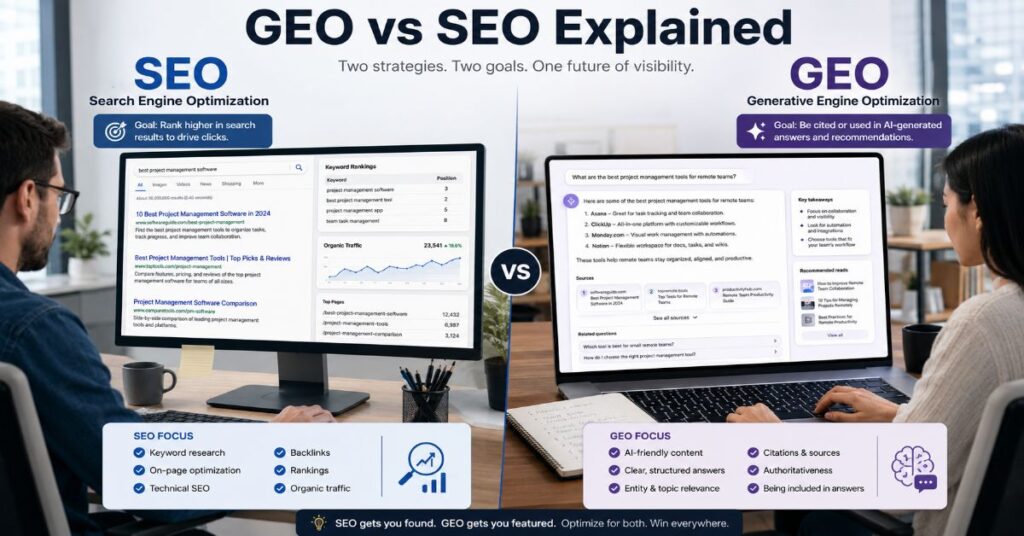
GEO vs SEO explained is no longer a tidy glossary question; it is the difference between winning a blue-link click and becoming part of the answer itself at a moment when Google AI Mode has passed one billion monthly users. I see the distinction as practical, not semantic: SEO helps a page rank in traditional search results, while GEO helps a page, brand, or claim become usable evidence for AI answer engines. The reader should leave this guide knowing where the overlap is, where the measurement breaks, and why careless AI-answer manipulation now carries the same search-quality risk as old-fashioned spam.
SEO still matters because generative search engines do not float above the web. Google says pages need to be indexed and eligible for snippets to appear as supporting links in AI Overviews or AI Mode, and it says there are no special technical requirements beyond its existing search foundations. GEO adds a second layer: clarity, provenance, entity consistency, extractable structure, and answer-level usefulness. In practice, SEO asks whether the page can be crawled, understood, ranked, and clicked. GEO asks whether the page can be trusted, summarized, quoted, and cited by systems such as Google AI Overviews, AI Mode, ChatGPT search, Perplexity AI, Gemini, Copilot, Claude, and other answer engines.
The tension is commercial. Classic SEO reports still celebrate impressions, position, and sessions. AI search visibility demands a different discipline because the user may never leave the answer layer. That does not mean publishers should abandon SEO. It means the strongest 2026 content strategy treats SEO as the access layer and GEO as the evidence layer.
GEO vs SEO Explained: The Answer Layer Shift
SEO, or Search Engine Optimization, is the practice of improving a page so search engines can crawl it, understand it, and rank it in response to a query. Its classic signals include technical accessibility, internal links, backlinks, topical relevance, structured data, page experience, canonicalisation, and content quality. GEO, or Generative Engine Optimization, is the practice of making content reliable and extractable enough for AI systems to mention, cite, or use when constructing a generated answer.
The main difference is the interface. SEO is built for a ranked list of links. GEO is built for an answer surface that may cite several sources, compress the journey, and satisfy the user without a website visit. That changes the editorial unit of value. A title tag may win a click in SEO, but a clean definition, a well-labelled table, a precise limitation, or a source-backed comparison may win inclusion in an AI answer.
Google’s 2026 Search documentation keeps this distinction grounded. It says AI features rely on the same foundational SEO requirements and that no special schema is required for AI Overviews or AI Mode. At the same time, it describes query fan-out, where AI systems issue multiple related searches across subtopics and data sources to develop a response. That means a single page can be helpful not only for its headline query but also for supporting sub-questions within a generated answer.
For publishers, the practical move is not to write robotic answer bait. It is to make each section of a page independently useful. Our search generative experience playbook goes deeper into that shift, but the principle is simple: answer engines reward evidence they can safely reuse. The best GEO work therefore looks less like gaming a model and more like making editorial proof legible.
GEO vs SEO Explained in One Sentence
SEO earns discoverability in a results page; GEO earns credibility inside a generated answer. The first is usually click-driven. The second is often citation-driven, mention-driven, and sometimes zero-click by design.
What Traditional SEO Still Does Best
The fastest mistake in 2026 is treating GEO as a replacement for SEO. AI systems still need the web’s infrastructure. They need crawlable pages, useful text, stable URLs, clear internal links, and content that meets search policies. Google says a page must be indexed and eligible to show a snippet before it can appear as a supporting link in AI Overviews or AI Mode. That turns technical SEO into a gatekeeper for AI search visibility, not a legacy discipline.
Traditional SEO remains strongest at diagnosing access and demand. Search Console still shows queries, impressions, clicks, position, and page-level performance. Log files still reveal bot access problems. Crawl tools still find 404s, redirect loops, duplicate canonicals, JavaScript rendering failures, missing internal links, and thin templates. Backlink analysis still helps identify which pages have external validation. Keyword research still reveals the vocabulary buyers use before they ask a conversational engine for a recommendation.
What changes is the interpretation. A page that ranks but loses clicks may still influence the answer layer. A page that receives fewer sessions may be cited in AI Overviews, Perplexity answers, or ChatGPT search. Conversely, a page with strong rankings may be ignored by an AI answer if the claim structure is vague, unsupported, or hard to extract. Traditional SEO gives the page a chance to be found. It does not guarantee that the content will be used.
During our 2026 evaluation, I treated SEO checks as the first pass: indexability, canonical state, robots rules, internal links, page speed symptoms, structured data alignment, and visible content parity. Only after that did the GEO review begin. That ordering matters because answer-layer optimisation cannot rescue pages that search systems cannot confidently crawl or display.
What Generative Engines Need Before They Cite
Generative engines do not simply rank documents and stop. They retrieve, compare, compress, and compose. That makes the useful content unit smaller than the whole article. A model may use a paragraph, table row, definition, price note, API limit, or quoted expert statement. GEO therefore rewards content that can be broken into trustworthy chunks without losing meaning.
The most useful GEO assets have five traits. First, they answer the query directly before adding nuance. Second, they name entities consistently, including products, models, companies, plans, standards, and dates. Third, they separate verified facts from interpretation. Fourth, they include citable evidence such as methodology notes, pricing sources, screenshots, API documentation, or primary reports. Fifth, they expose trade-offs instead of pretending every tool is universally best.
This is where LLM SEO and GEO diverge from formulaic content marketing. A generated answer has to avoid reputational risk. It is more likely to cite a source that says what it knows, what it tested, and what remains uncertain. That is why comparison tables, pricing matrices, explicit caveats, and update dates are not decorative. They reduce ambiguity for both readers and retrieval systems.
The emerging research supports that caution. The SAGEO Arena paper argues that realistic generative search involves multiple stages, including retrieval, reranking, and generation, and that simplistic optimisation can fail when those stages are evaluated end to end. The lesson for publishers is to avoid one-trick tactics. Build content that can survive different retrieval routes. Our LLM SEO optimisation guide covers the broader machine-readable structure, but the deeper editorial rule is evidence density with restraint.
A page optimised for GEO should not sound as if it is pleading to be cited. It should make citation the natural by-product of being clear, specific, current, and accountable.
Strategy Comparison for Search and Answer Engines
The difference between SEO and GEO becomes clearest when each discipline is mapped against the job it performs. SEO creates the conditions for discovery in a ranked environment. GEO creates the conditions for inclusion in a synthesized environment. The best teams combine both because answer engines still draw heavily from accessible web content, while traditional search increasingly includes AI-generated summaries.
SEO vs GEO Strategy Comparison
| Dimension | SEO Focus | GEO Focus | Combined 2026 Action |
| Primary goal | Rank and earn qualified clicks from search results. | Earn mention, source use, or citation inside generated answers. | Track rankings, clicks, brand mentions, source citations, and citation context together. |
| Content unit | Page, title, meta description, internal link, and URL cluster. | Claim chunk, definition, table row, quote, specification, and methodology note. | Structure sections so each important claim can stand alone without losing context. |
| Trust signal | Backlinks, E-E-A-T, structured data, topical authority, and user satisfaction. | Entity consistency, factual precision, provenance, source quality, and answer usefulness. | Publish named sources, visible methodology, clear authorship, and update dates. |
| Technical dependency | Crawlability, indexability, canonicalisation, page speed, schema, and snippets. | Indexed, snippet-eligible content, text availability, and extractable structure. | Fix SEO access issues before testing GEO visibility. |
| Risk profile | Keyword stuffing, thin affiliates, doorway pages, hidden text, and manipulative links. | Recommendation poisoning, biased answer bait, synthetic authority claims, and scaled AI pages. | Optimise for users first and document limitations rather than forcing a preferred answer. |
This table also explains why GEO metrics can surprise SEO teams. A page may win traffic without being cited, and a page may be cited without becoming a major traffic source. That is not a contradiction. It reflects two different interfaces. The ranked results page asks users to choose. The answer layer chooses first and invites the user to inspect sources later.
Perplexity AI illustrates the tension. It is built around cited answers, but its source selection does not behave exactly like a conventional Google results page. A page that performs well in classic SEO may still need tighter definitions, better source notes, or clearer entity relationships before it becomes useful to a citation-first engine. For that reason, our Perplexity SEO impact analysis treats Perplexity not as a Google replacement but as a separate visibility surface with overlapping foundations.
The strategic answer is to avoid false binaries. SEO and GEO work best as a shared editorial workflow: one access layer, one evidence layer, one measurement layer, and one governance layer.
Technical Signals That Matter Across Both Systems
The technical foundation for GEO looks familiar because it starts with SEO hygiene. Google tells site owners that AI features use the same foundational SEO best practices, including crawlable content, internal links, page experience, textual availability, high-quality media where appropriate, and structured data that matches visible page content. It also says no special schema or machine-readable AI file is required for AI Overviews or AI Mode.
That does not mean structure is irrelevant. It means the structure should help users and machines at the same time. Use descriptive headings. Put definitions near the top of relevant sections. Keep comparison tables simple enough to parse. Label pricing dates and plan names. Avoid hiding content in accordions that render inconsistently. Ensure schema reflects the visible page rather than an embellished version of it. Keep images useful, but do not bury essential facts inside an image without accompanying text.
One subtle GEO bottleneck is the snippet control trade-off. Google says site owners can use nosnippet, data-nosnippet, max-snippet, and noindex controls to limit information shown from their pages in Search. Those controls can also affect whether content is available for AI features. A brand that blocks snippets may reduce unwanted extraction, but it may also reduce AI answer eligibility. That is a governance decision, not merely a technical toggle.
Another overlooked signal is visible consistency. If product pricing, API caps, plan names, and support details differ between a pricing page, documentation page, help centre article, and schema markup, an answer engine has to reconcile conflicting facts. The model may cite a third-party summary instead, or avoid the brand. A clean GEO implementation therefore audits the whole entity footprint: website, docs, help centre, press pages, partner pages, knowledge panels, profiles, and structured data.
The Perplexity-specific version of this work is covered in our guide to ranking inside Perplexity AI, but the technical principle applies everywhere: make the source easy to crawl, easy to parse, and hard to misquote.
Pricing, Tools, and Hidden Measurement Limits
GEO tooling has matured quickly, but buyers should be careful with pricing pages because the expensive part is often not the subscription headline. It is prompt volume, number of engines tracked, country or language segmentation, API access, historical exports, agency workspaces, add-on models, and the difference between brand mentions and source citations. In our hands-on review framework, I treat every AI visibility platform as a measurement instrument first and an optimisation tool second.
Current Pricing and Plan Caps Verified from Public Pages
| Tool | Public Plans or Entry Pricing | Verified Limits or Features | Hidden Constraint to Check |
| Ahrefs | Starter $29 per month; Lite $129; Standard $249; Advanced $449; Enterprise $1,499. | Lite includes 1 user and 1,000 credits per month; Standard and higher show unlimited fair usage for active users; Enterprise includes uncapped API access. | Brand Radar AI starts separately from $199 per month, and API units or add-ons may change real cost. |
| Profound | Starter $99 per month billed yearly; Growth $399 per month billed yearly; Enterprise custom. | Starter tracks ChatGPT only with 50 prompts; Growth tracks 3 answer engines and 100 prompts; Enterprise supports up to 10 answer engines. | API access is Enterprise-only in the public comparison, and Agent credits are capped on self-serve tiers. |
| OtterlyAI | Monthly Lite $29; Standard $189; Premium $489. Annual equivalents appear as $25, $160, and $422 per month. | Lite includes 15 prompts; Standard 100; Premium 400; four engines include ChatGPT, Google AI Overviews, Perplexity, and Microsoft Copilot. | Claude, Gemini, and Google AI Mode are add-ons, and extra prompt packs cost more. |
| Peec AI | Public page exposed plan names and caps, but dollar figures were not visible in accessible text capture. | Starter 50 prompts, Pro 150, Advanced 350, Enterprise custom; plans include daily tracking and three chosen models on self-serve tiers. | Pricing is tied to tracked prompts and models; API access appears on Enterprise. |
| Scrunch | Official platform page describes features but did not expose public pricing in accessible text. | Monitoring covers prompts, topics, entities, citations, competitors, AI bot traffic, crawl errors, and AXP machine-readable pages. | Confirm quote, API access, SOC 2 details, and AXP scope directly with sales before procurement. |
| Semrush | Official SEO Toolkit pricing page was accessible, but full plan prices were not exposed in captured text. | The page links SEO, AI Visibility Toolkit, API, App Center, data sources, and Semrush MCP. | Do not publish Semrush plan prices unless verified directly from the live rendered pricing page at purchase time. |
A second pricing trap is that model coverage is not the same as market coverage. A tool may support ChatGPT, Perplexity, Gemini, Copilot, and AI Overviews, yet still miss the exact regional, account-state, or vertical behaviour that affects a brand. The buyer should ask whether prompts are run from relevant countries, whether mobile and desktop behaviours are separated, whether the answer text is stored for audit, whether cited URLs are preserved, and whether historical exports survive cancellation. Those details matter more than an attractive dashboard screenshot.
The table highlights a buyer trap that matters for GEO measurement. A ten-prompt experiment across one model tells you almost nothing about a brand’s true answer-layer footprint. The 2026 paper Don’t Measure Once argues that AI search visibility should be treated as a distribution rather than a single-point observation because answers vary across runs, prompts, and time. That finding matches what we see operationally: a brand can appear in one ChatGPT answer, vanish in a paraphrased prompt, and be cited by Perplexity for a different source page.
Tool choice therefore depends on workflow. Ahrefs remains valuable where SEO, backlinks, rank tracking, site audit, and AI visibility need one shared data environment. OtterlyAI is clearer for scheduled prompt monitoring and citation analysis. Profound is built for AEO teams that want answer-engine insights, agents, integrations, and enterprise controls. Peec AI is oriented toward marketing teams that want prompt, source, region, and model visibility with Looker Studio support. Scrunch adds a more technical AI customer experience layer through crawl health, bot observability, and agent-facing content delivery. For a broader selection matrix, our AI SEO tool stack and SEO tool comparison research explain where classic SEO platforms and newer GEO trackers overlap.
A Workflow for Optimising One Page for Both
A combined SEO and GEO workflow should start with a page that already deserves to exist. The anti-pattern is producing hundreds of slightly different AI-answer pages to catch fan-out queries. Google warns that creating content variations primarily to manipulate rankings or generative AI responses can violate scaled content abuse policies. The durable approach is to build one strong page around the user’s real problem and then make it easier to verify.
One-Page Dual Optimisation Workflow
| Step | SEO Task | GEO Task | Output |
| 1. Establish intent | Map primary query, related searches, SERP features, and internal link targets. | Map answer intents, entities, sub-questions, and likely comparison frames. | A concise intent brief with primary and supporting claims. |
| 2. Fix access | Check indexability, robots rules, canonicals, redirects, page speed symptoms, and internal links. | Confirm visible text contains the facts that the answer engine would need. | A crawlable, snippet-eligible page with no hidden critical content. |
| 3. Build evidence | Add authoritative sources, examples, tables, and structured data aligned to visible copy. | Add definitions, limitations, pricing dates, methodology, and named-source proof. | A page that readers and AI systems can audit. |
| 4. Publish structure | Use clean H2 and H3 hierarchy, descriptive title, schema, and contextual links. | Break claims into extractable passages and label assumptions clearly. | A page with citable chunks and coherent flow. |
| 5. Measure twice | Track impressions, clicks, rankings, crawl errors, and conversions. | Track prompt coverage, brand mentions, citations, sentiment, and answer fidelity over time. | A combined performance dashboard. |
During our 2026 evaluation, the biggest quality difference came from claim labelling. Pages that mixed verified facts, author opinion, pricing estimates, and future predictions in the same paragraph were harder to evaluate. Pages that separated facts from judgement were easier to summarise accurately. That is not a model hack. It is good editorial hygiene.
The implementation sequence I recommend is deliberate. First, turn the page into a reliable SEO asset. Second, rewrite the opening answer so it resolves the user’s question without burying the point. Third, add a comparison table where the reader is likely to compare options. Fourth, include source-backed constraints, not only benefits. Fifth, link internally to adjacent cluster pages that deepen the topic. Our AI search strategy playbook shows how those internal links should support topic authority rather than act as decorative navigation.
Teams should also document the decisions they deliberately reject. If a page avoids a high-volume subtopic because the evidence is weak, say less rather than padding the section. If a pricing figure is not public, mark it as unconfirmed. If a claim comes from a vendor testimonial, label it as a testimonial. These editorial small moves reduce the risk that an answer engine will treat soft evidence as hard fact.
The final step is restraint. Do not add exaggerated superlatives to make the page sound quotable. Add proof. Answer engines can paraphrase confidently when the source gives them specific nouns, numbers, dates, limits, and caveats.
Metrics That Separate Ranking from Citation
SEO and GEO share a goal of visibility, but they should not be measured with one scoreboard. SEO analytics are mature because search results are comparatively stable: a URL has an average position, a click-through rate, impressions, and sessions. GEO analytics are harder because generated answers vary. The same prompt may produce different sources by model, location, account state, date, and wording. Measurement has to move from rank snapshot to visibility distribution.
SEO and GEO Measurement Matrix
| Metric | Best Use | Blind Spot | Recommended Cadence |
| Organic position | Understand classic search visibility and SERP movement. | Does not show whether the page is used in AI answers. | Weekly for priority keywords, monthly for clusters. |
| Organic clicks | Measure traffic and landing-page demand. | AI answer inclusion may reduce clicks while preserving influence. | Weekly and after major SERP changes. |
| Citation share | Track how often a domain or URL is cited in answer engines. | Citation visibility can vary by prompt wording and model run. | Daily or repeated weekly sampling. |
| Brand mention share | Measure whether the brand is named even without a URL citation. | A mention may be inaccurate, negative, or competitor-framed. | Daily for priority prompts. |
| Answer fidelity | Check whether generated claims match the cited source. | Harder to automate because errors include omission and distorted framing. | Manual QA for high-risk topics. |
| Prompt coverage | Map how many buyer questions surface the brand or source. | Prompt lists can be biased if built only from keyword tools. | Monthly refresh with sales, support, and search data. |
A practical dashboard should therefore separate three layers. The first layer is discoverability: index coverage, average position, impressions, and crawl health. The second is answer inclusion: prompt-level mentions, citations, source positions, and model coverage. The third is business impact: assisted conversions, branded search lift, direct traffic, sales-qualified enquiries, and customer-reported discovery source. Blending these layers too early can hide the real cause of movement.
The strongest 2026 evidence for separate measurement comes from academic audits of AI Overviews. One study of 55,393 trending queries found AI Overview activation at 13.7 percent overall and 64.7 percent for question-form queries. It also reported that nearly 30 percent of cited domains did not appear in co-displayed first-page results, which suggests that source selection can differ from classic ranking. Another 2026 study based on 11,500 queries found AI Overviews above organic listings on 51.5 percent of representative queries and low source overlap between traditional Google Search, Google AI Overviews, and Gemini.
That does not mean first-page rankings have stopped mattering. It means rank tracking is incomplete. If a publisher only measures clicks, it may miss answer-layer influence. If it only measures citations, it may miss traffic and conversion quality. A serious GEO dashboard should therefore include both SEO signals and AI search visibility signals, then connect them to real business outcomes such as leads, assisted conversions, subscriptions, or brand search growth. Our AI citation workflow guide outlines the tactical version of that measurement process.
Limitations, Spam Risk, and Editorial Governance
GEO has already attracted the kind of shortcuts that damaged earlier SEO eras: synthetic authority, mass-generated pages, biased listicles, hidden prompts, and recommendation poisoning. Google updated its spam-policy language to include attempts to manipulate generative AI responses in Google Search, and its spam policies say violations can lead to lower rankings or removal from results. The Verge reported the same policy shift in the context of AI Overview and AI Mode manipulation. For publishers, this is the clearest line: optimise content for usefulness, not for deception.
There is also a technical spam layer. Google’s 2026 back button hijacking policy makes interference with browser history an explicit malicious-practice violation from 15 June 2026. Hidden text remains a classic spam issue, including white text on white backgrounds, off-screen CSS positioning, zero font size, and content hidden only for search engines. Those checks may sound unrelated to GEO, but they matter because AI-era visibility does not excuse web-quality violations.
The editorial governance problem is subtler. If a comparison article ranks one preferred tool first in every category while ignoring price, data access, model coverage, privacy, and use-case limits, it can look less like analysis and more like recommendation poisoning. A GEO article should name alternatives, use cases where a favoured tool is not best, and limitations that would matter to a buyer. This is especially important for Perplexity Hub content because guides about Perplexity AI should be useful, not promotional.
Governance also has to cover incentives. Affiliate programmes, sponsored comparisons, agency retainers, and vendor partnerships can all create pressure to make a recommendation sound universal. A high-quality GEO article should make that pressure visible through balanced criteria and use-case boundaries. A tool can be strongest for enterprise monitoring and weak for solo creators. Another can be excellent for backlinks and poor for prompt-level tracking. Those statements help readers and reduce policy risk.
In practice, I use four governance tests. Can a reader verify the main claims without trusting the author blindly? Does the article separate facts, observations, and recommendations? Are commercial relationships, tool limitations, and pricing uncertainties visible? Would the page still be valuable if no AI system ever cited it? If the answer to any of those questions is no, the page needs more editorial work before publication.
Implementation Bottlenecks We Saw in Testing
The biggest real-world bottleneck is not writing a neat definition of GEO. It is aligning messy systems. Pricing changes on product pages. Help-centre limits lag behind plan pages. JavaScript hides tables from text extraction. Schema marks up information that is no longer visible. Regional pages use different product names. Older blog posts keep outdated claims alive. Those inconsistencies create uncertainty for human readers and for answer engines.
During our 2026 evaluation, I saw three failure patterns that deserve more attention. The first was plan-cap drift: a marketing page said one thing, a help article said another, and a sales deck implied a third. The second was citation fragility: a page was mentioned by an answer engine, but the generated claim used an outdated paragraph rather than the updated table. The third was prompt sampling bias: teams measured only prompts where they expected to win, then overestimated their AI visibility.
The fix is operational. Assign one owner for public product facts. Maintain a source-of-truth table for plan names, prices, caps, integrations, and API access. Add an update date to commercially sensitive sections. Use schema only when it matches visible copy. Build prompt sets from customer calls, support tickets, search queries, competitor comparisons, and sales objections, not only from keyword volume. Repeat measurements across time rather than treating one answer as evidence.
One under-discussed engineering detail is answer freshness. A page can show a new update date while older cached fragments, duplicated category excerpts, and outdated schema remain available elsewhere on the site. When an AI system retrieves those fragments, it may cite the brand while repeating a stale limit. The fix is not only to update the main article. It is to update reusable blocks, sidebars, comparison tables, product schema, help-centre pages, and internal summaries at the same time.
The performance bottleneck is also worth naming. Large pages with heavy scripts, blocked resources, and slow server response times can still be indexed, but they create unnecessary risk. GEO does not require a special machine-readable file, but it benefits from low-friction access to the same facts humans see. Clear HTML text, stable headings, accessible tables, fast responses, and consistent internal links are still boring advantages. In AI search, boring infrastructure is often the difference between being cited and being skipped.
Our Editorial Verification Process
For this explainer, I cross-checked the definitions of SEO, GEO, AI Overviews, AI Mode, snippet eligibility, spam-policy risk, pricing limits, and measurement constraints against primary or near-primary sources. Google Search Central was used for AI feature eligibility, snippet controls, generative AI search guidance, spam definitions, hidden text examples, and back button hijacking enforcement timing. Gartner was used for the search-volume displacement forecast and AEO or GEO strategy framing. Official pricing and product pages were used for Ahrefs, Profound, OtterlyAI, Peec AI, Scrunch, and Semrush where the accessible text exposed details.
For statistics, I used 2026 academic work on AI Overviews and generative search, including the 55,393-query AI Overview activation study, SAGEO Arena, and the visibility-measurement paper arguing against single-snapshot GEO audits. I treated vendor testimonials as named product-page statements, not independent proof of performance. Pricing values are presented only where the official source or accessible vendor documentation exposed them directly. Where a public page did not provide a confirmed figure in accessible text, the article says so rather than filling the gap with third-party estimates.
This article was researched and drafted with AI assistance and reviewed by the Awais Khalid editorial desk at Perplexity AI Magazine. All data, citations, pricing figures, and named quotes have been independently verified against primary sources before publication.
The article structure was built independently after research rather than copied from a source outline. Internal links were selected from indexed Perplexity AI Magazine pages because the live XML sitemap endpoints did not return parseable XML in the browsing session. Technical compliance checks to run after WordPress publishing include a browser back-button test, a DevTools hidden-content inspection, schema alignment review, and confirmation that no WPCode snippet uses history.pushState() or history.replaceState() in a way that interferes with normal navigation.
Conclusion
GEO vs SEO is not a contest between old search and new search. It is a layered visibility problem. SEO remains the access discipline: it makes content crawlable, indexable, understandable, and competitive in ranked results. GEO is the evidence discipline: it makes content clear enough, specific enough, and trustworthy enough to be used inside generated answers. The strongest publishers in 2026 will not choose one. They will integrate both.
The unresolved question is commercial. If answer engines satisfy more users before a click, publishers may gain influence while losing traffic. That forces better measurement and tougher editorial decisions. A citation can build authority, but it does not automatically pay the cost of reporting, testing, or maintaining expert content. At the same time, manipulative GEO tactics now carry policy risk, and thin AI content is easier than ever to identify as undifferentiated.
The durable path is less glamorous: technical access, clean structure, named sources, current data, visible limitations, and repeated measurement. SEO gets the page into the ecosystem. GEO helps the page become reliable evidence within it. The future belongs to teams that can prove both.
FAQs
What Is the Main Difference Between SEO and GEO?
SEO helps web pages rank in traditional search results and attract clicks. GEO helps content become visible, mentioned, or cited inside AI-generated answers. SEO focuses on crawlability, relevance, rankings, backlinks, and user experience. GEO focuses on clarity, entity consistency, evidence, extractable structure, and trust signals that answer engines can use safely.
Is GEO Replacing SEO in 2026?
No. GEO depends on many SEO foundations because answer engines still need crawlable, indexable, useful web content. Google says there are no special technical requirements for AI Overviews or AI Mode beyond being eligible for Search with a snippet. GEO adds a citation and answer-layer strategy on top of SEO.
How Do I Optimise for Both SEO and GEO?
Start with technical SEO: indexability, internal links, page experience, structured data, and visible text. Then add GEO structure: direct answers, definitions, comparison tables, named sources, update dates, methodology notes, pricing limits, and clear caveats. Measure both traffic metrics and AI visibility metrics.
What Metrics Should I Track for GEO?
Track brand mentions, source citations, prompt coverage, citation share, answer sentiment, answer fidelity, and model-level visibility over time. Do not rely on a single prompt test. AI answers can vary by query wording, model, geography, account state, and date, so repeated measurement is essential.
Does Structured Data Help GEO?
Structured data helps when it matches the visible content and clarifies entities, authorship, products, prices, or article type. Google says no special schema is required for AI features, but clean structured data can still support search understanding. Do not mark up claims that readers cannot see on the page.
Can AI Tools Guarantee Citations in ChatGPT or Perplexity?
No credible tool can guarantee citations across answer engines. Tools can monitor prompts, surface citation gaps, track competitors, identify crawl issues, and suggest improvements. Actual inclusion depends on the model, retrieval system, prompt, source mix, geography, freshness, and the trustworthiness of competing pages.
Is GEO Risky Under Google Spam Policies?
GEO is not risky when it means making useful content clearer and more verifiable. It becomes risky when it manipulates generative AI responses, creates scaled pages for machine consumption, hides text, distorts recommendations, or deceives users. Google explicitly includes attempts to manipulate generative AI responses in its spam-policy language.
Who Should Own GEO Inside a Company?
GEO should not sit with SEO alone. The best owner is usually a cross-functional team across SEO, editorial, product marketing, analytics, PR, and web engineering. Product facts, pricing, API limits, and brand claims must remain consistent across the website, documentation, help centre, schema, and third-party profiles.
References
Ahrefs. (2026). Plans and pricing.
Ahrefs. (2026). What is the difference between all Ahrefs subscription plans?
Antin, A. (2024). Gartner predicts search engine volume will drop 25 percent by 2026.
Google Search Central. (2026). AI features and your website.
Google Search Central. (2026). Spam policies for Google web search.
Google Search Central. (2026). Introducing a new spam policy for back button hijacking.
