
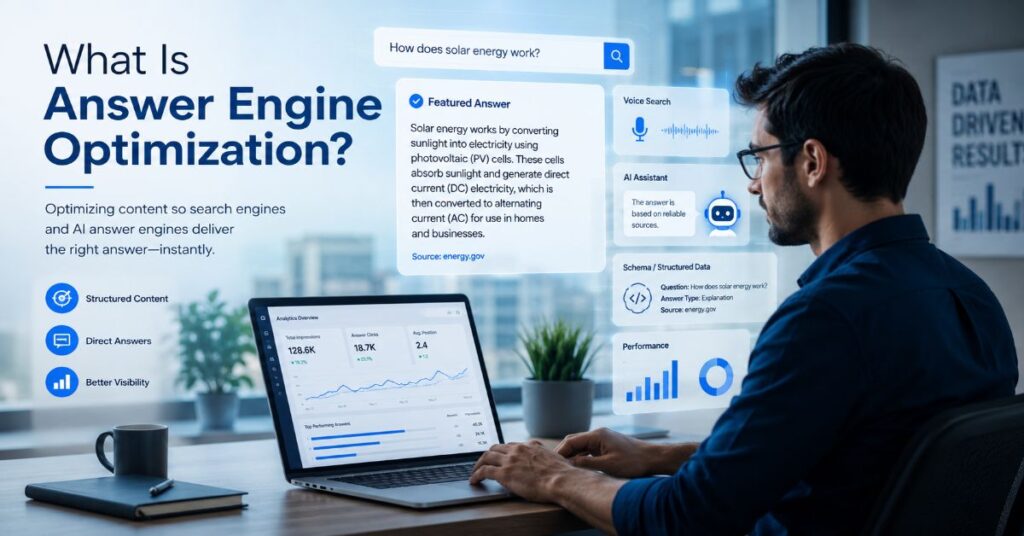
- 🤖 Answer engine optimization focuses on structuring visible content so AI systems can retrieve, verify, cite and summarise it clearly, without relying on hidden text or manipulative brand signals.
- ⚖️ Google’s May 15, 2026 spam policy update classifies attempts to manipulate generative AI responses in Search as spam, which shifts AEO toward evidence based content rather than shortcuts or tricks.
- 📉 Measurement is still developing because Google Search Console includes AI feature traffic under Web search, while third party tools rely on prompt sets, geographic variation and usage limits.
- 💸 Pricing models vary across tools, with Semrush starting at about $99 per month, Ahrefs Brand Radar showing pricing in euros and Perplexity Enterprise Pro starting around $40 per seat monthly.
- 🚀 A practical AEO workflow starts with crawlable pages, clear answer first sections, source backed claims, schema aligned with visible content and repeated prompt testing across major AI answer systems.
What is answer engine optimization? It is the practice of making visible, trustworthy content easy for AI answer systems to retrieve, understand, cite and summarise, and the sharp 2026 tension is that Google now treats attempts to manipulate generative AI responses in Search as a spam risk. I see AEO as a discipline of clarity, not a bag of tricks: a page should answer a real question quickly, expose evidence in crawlable text, identify the author or organisation behind the claim, and help a machine decide whether the sentence is safe to reuse.
That matters because search is becoming less like a directory and more like a layer of generated explanations. Google says AI Overviews and AI Mode can use query fan-out, where a system issues related searches across subtopics before composing a response. OpenAI says ChatGPT Search can rewrite a prompt into targeted queries and present sources below the answer. Perplexity, Copilot and Gemini all turn discovery into a synthesis task. The user may still click a citation, but the first impression increasingly happens before the click.
This guide explains what answer engine optimization means in practical terms, where it differs from traditional SEO, which tools and price limits matter, and how to build a workflow that earns citations without crossing into recommendation poisoning, hidden text or scaled content abuse. The useful question is not whether AEO replaces SEO. It does not. The useful question is whether your best pages can be parsed, verified and quoted when the search interface becomes an answer engine.
What Is Answer Engine Optimization?
Answer engine optimization is the editorial and technical process of preparing content so answer engines can use it as reliable evidence in direct responses. An answer engine can be a classic search feature such as Google AI Overviews, a conversational assistant such as ChatGPT Search, a cited-answer tool such as Perplexity, or an AI layer inside a productivity platform. The shared behaviour is retrieval plus synthesis: the system finds possible sources, judges them against the question, extracts the most useful fragments, and presents a compressed answer.
That makes AEO narrower than brand marketing but broader than on-page SEO. It covers page structure, entity clarity, source quality, technical accessibility, schema discipline, author trust signals, public brand descriptions and post-publication measurement. It also covers restraint. AEO done well makes a page easier to understand. AEO done badly tries to stuff the web with artificial mentions, doorway comparisons and hidden text that a person would never value.
The strongest answer-first page usually has three layers. The first layer is a short definition or decision answer near the top. The second layer is supporting detail: examples, limitations, tabled comparisons, pricing, integrations, methodology and known edge cases. The third layer is corroboration: external references, author credentials, update dates and consistent entity signals across the site. Those layers let an answer engine decide not just what the page says, but whether the page is a dependable source for a generated answer.
In practical publishing terms, AEO asks every section to behave like a mini reference card. If a user asks a complete question, the page should contain a complete, quotable response. If a system needs evidence, the evidence should be visible in ordinary HTML, not buried in an image, blocked script or decorative component. If the page makes a commercial claim, the source should be clear enough for a human editor and an automated system to inspect.
What Is Answer Engine Optimization in Practice?
In practice, the phrase means building an answer-ready evidence layer around the page: a direct answer, a factual body, tables that clarify trade-offs, current references, and technical signals that do not contradict the visible content.
Why AEO Exists Now
The reason AEO has become urgent is not that old SEO has vanished. It is that the surface where users make decisions has changed. Sundar Pichai told Google I/O 2026 that Search now feels like an ‘ongoing conversation’. That remark shows the platform direction: users are encouraged to ask longer, messier questions and receive an answer before choosing a source.
The publisher concern is also visible in industry surveys. The Reuters Institute’s 2026 media trends report, based on 280 digital leaders from 51 countries and territories, reported that publishers expect search traffic to fall by more than 40% over three years. It also quoted Ritu Kapur calling for ‘deep dive journalism’, Stefan Ottlitz saying ‘Discoverability’ is crucial, and Edward Roussel pointing to ‘human-checked’ work. Those are not SEO slogans. They are signals that originality and verification become more valuable when generic answers are commoditised.
The commercial implication for B2B teams is straightforward. A definition page that only restates public knowledge may be absorbed into an answer with no click. A technically specific page that includes methods, limits, pricing, benchmarks and first-party experience has a better chance of becoming the cited evidence behind the answer. AEO exists because the click is no longer the only unit of visibility. The citation, the brand mention and the sourced claim now matter too.
How Answer Engines Find and Reuse Content
Most answer engines are not magic mirrors of the entire web. They are systems with retrieval paths, crawl permissions, indexes, ranking signals, model prompts and output policies. Google explains that AI Overviews and AI Mode are rooted in Search ranking and quality systems, and may use retrieval-augmented generation and query fan-out. OpenAI says ChatGPT Search may rewrite a prompt into targeted search queries, partner with other search providers, and display source panels when available. Perplexity’s enterprise and API products similarly expose search and citation as core features rather than optional decoration.
For content teams, this means AEO has to operate at four levels. The first is accessibility: can a crawler reach and render the content? The second is extractability: does the page contain concise passages that answer specific questions? The third is corroboration: do other credible sources describe the same entity in compatible language? The fourth is output fitness: would an AI system be comfortable placing that sentence in front of a user with a citation attached?
One practical insight from our 2026 evaluation is that answer engines tend to reward content that reduces ambiguity. A vague paragraph about ‘best-in-class technology’ gives a system little to reuse. A paragraph that says who the product is for, which plan includes which feature, what the integration requires and what the limitation is can be extracted into an answer. This is why our recommended architecture borrows from documentation, journalism and product analysis at the same time.
AEO also has a brand-graph dimension. If a company is described differently on its homepage, knowledge panel, review sites, social profiles, documentation and analyst coverage, an answer engine may hedge or pick a third-party description. Consistency does not mean repetition. It means the same core facts, names, categories and relationships remain stable wherever the entity appears. That is why an AEO audit should include external brand descriptions, not just the page being optimised.
For a wider technical frame, the magazine’s generative engine optimisation framework treats retrieval, extraction, citation and authority as connected layers rather than separate content chores.
AEO vs SEO in 2026
Traditional SEO and AEO are connected, but they optimise for different moments. SEO still gets pages crawled, indexed, understood and ranked. AEO asks whether that page can become the evidence inside an AI answer. Google itself says there are no extra technical requirements for appearing in AI Overviews or AI Mode beyond being indexed and eligible for a snippet. That means foundational SEO remains the floor. It is not the whole ceiling.
| Dimension | Traditional SEO | Answer Engine Optimisation | Practical Risk |
| Primary Outcome | Rankings, impressions, clicks, sessions and conversions. | Citations, mentions, answer inclusion, brand recall and assisted conversions. | Teams may celebrate rankings while competitors win answer visibility. |
| Content Shape | Keyword-aligned pages with headings, internal links and topical depth. | Question-led pages with direct answers, evidence blocks and extractable facts. | Thin FAQ pages can look structured but add little information gain. |
| Technical Base | Indexability, crawlability, speed, mobile usability, canonicalisation and structured data. | The same base, plus visible claims that align with structured data and crawl controls. | Special AI files do not help Google Search if the page itself is weak. |
| Measurement | Search Console, rank trackers, analytics, revenue attribution and CRM data. | Prompt testing, citation share, mention quality, source support and answer sentiment. | Third-party tools can vary by prompt set, geography and model update. |
| Abuse Pattern | Keyword stuffing, cloaking, link spam and scaled doorway content. | Recommendation poisoning, fake mentions, hidden text and AI-only answer bait. | Google now names generative AI response manipulation inside spam policy. |
The safest operating principle is to treat AEO as an extension of editorial quality and technical SEO, not a replacement. A page that cannot rank because it is blocked, duplicated or thin is unlikely to become a trusted citation. A page that ranks but offers no clear answer may still be bypassed by an AI system that finds a more extractable source elsewhere.
This is where the industry’s language can be confusing. GEO, AEO, LLM SEO and AI search optimisation often overlap. The useful distinction is not the acronym. It is the target output. Are you trying to win a list position, become a cited source, influence a brand summary, or support an agent completing a task? The same page can support more than one output, but each needs a different measurement lens.
The practical editorial answer is to build cluster pages that keep SEO fundamentals intact while adding answer-ready sections. The magazine’s AI search content playbook is a useful companion for teams converting standard articles into source-grade pages without keyword stuffing.
The Safe Content Architecture
AEO-ready content does not need to sound robotic. It needs to be inspectable. The first 100 words should define the entity, answer the user’s likely question and signal why the answer matters now. Each following H2 should open with a sentence that can stand alone, then develop nuance, caveats and evidence. Tables should clarify pricing, limits or comparisons rather than decorate the page. FAQs should answer real follow-up questions, but they should not become a dumping ground for every keyword variant.
The architecture I recommend uses five repeatable blocks. First, a direct-answer block that states the answer without throat-clearing. Second, an evidence block that names the source of the claim. Third, a trade-off block that tells the reader where the advice does not apply. Fourth, an implementation block that turns the concept into steps. Fifth, a measurement block that shows how the team will know whether anything changed.
Google’s own guidance is an important constraint here. It says there is no requirement to create special AI text files, no need to chunk content into tiny pieces for Google Search, and no special schema solely for generative AI features. Structured data can still help rich-result eligibility and clarity, but it must match visible content. That last phrase is operationally important: if schema claims an author, review, price or product feature the reader cannot see, it creates a trust problem rather than an AEO advantage.
During our 2026 evaluation, the most useful content blocks were not generic definitions. They were specific comparison tables, pricing caveats, integration notes, screenshots described in text, author methodology statements and dated limitations. Those details are harder for competitors to copy and easier for answer systems to ground. This is why AEO is better understood as information design for retrieval systems than as a new keyword-density formula.
For Google-specific surfaces, pair this architecture with an AI Overview optimisation guide rather than assuming every answer engine behaves the same way. Google relies on Search index eligibility, snippet controls and query fan-out; ChatGPT Search has its own crawling requirements; Perplexity emphasises cited research flow; and Copilot depends heavily on the Microsoft ecosystem.
Tools, Pricing, and Hidden Limits
AEO tools fall into three buckets: platform data, AI visibility tracking and retrieval infrastructure. The safest pricing table is also conservative. Where an official source publishes a firm price or quota, it is included. Where pricing varies by region or currency, the table says so. Where a tool does not publicly confirm an AEO-specific limit, it should not be guessed.
| Tool Or Platform | Relevant AEO Features | Confirmed Pricing Or Access | Hidden Limit Or Caveat |
| Google Search Console | Queries, pages, indexing, enhancement reports and Web search performance that includes AI feature traffic. | Free for verified site owners. | Google says AI feature metrics are included in the Web search type, not split into a dedicated AEO report. |
| Google AI Overviews And AI Mode | Supporting links, query fan-out, AI summaries, follow-up search and AI Mode experiences. | Part of Google Search; AI Pro and Ultra may receive some agent features first. | Eligibility requires indexability and snippet eligibility, but appearance is not guaranteed. |
| OpenAI ChatGPT Search | Web search, source panel, search query rewriting, location-aware results and OAI-Searchbot crawl inclusion. | Available to Free, Plus, Team, Edu and Enterprise users according to OpenAI help. | Top placement cannot be guaranteed; site hosts and CDNs must allow OAI-Searchbot traffic. |
| Perplexity Enterprise Pro | Enterprise answer engine access, organisation management, internal knowledge search and security controls. | $40 per seat monthly or $400 yearly; Enterprise Max is $325 per seat monthly or $3,250 yearly. | Perplexity notes some dashboards, audit logs, data retention and SCIM features require 50+ members or Enterprise Max. |
| Perplexity Search API | Search API, Sonar model family, citation-bearing retrieval and request-based pricing. | Search API listed at $5 per 1,000 requests; Sonar token pricing varies by model. | Context size and search mode can change request cost, so budget tests should mirror production prompts. |
| Semrush AI Visibility Toolkit | AI visibility score, prompt tracking, competitor research, brand performance, AI search site audit and exports. | $99 per month; no free trial in the official knowledge base. | Base limits include 25 tracked prompts, 1 domain, 300 daily AI Analysis queries and add-on costs for domains or prompts. |
| Ahrefs Brand Radar | AI visibility across AI Overviews, AI Mode, ChatGPT, Perplexity, Gemini, Copilot and other sources. | Official page displays individual and all-platform pricing in euros, plus custom prompts. | Published prompt database is broad, but custom prompt checks are quota-bound and currency/region can affect buying decisions. |
The pricing trap is not always the monthly headline. It is the prompt capacity, user licensing, export limit, region availability and add-on cost. For example, a team monitoring 25 prompts in one country can use a lighter setup than a multinational brand that needs prompts by market, persona, funnel stage and competitor. The same phrase in English, German and Arabic can produce different citation sets, and the tool bill rises with that realism.
A practical stack for a mid-market B2B publisher can remain lean: Google Search Console for the baseline, manual prompt testing across answer engines, Semrush or Ahrefs for scalable visibility tracking, and server logs to separate real referrals from model hype. More advanced teams can add the Perplexity Search API or other retrieval APIs to build internal monitoring, but API experiments need separate cost controls and documented prompt templates.
Teams that already compare GEO and SEO comparison metrics should avoid double-counting. An AI mention without a click can still influence a buyer, but it is not the same as a visit. A referral from ChatGPT can be real, but raw growth may reflect platform adoption rather than the AEO intervention itself.
Step-by-Step Implementation Workflow
The most reliable AEO programme begins with a site audit, not a writing sprint. I use the workflow below because it separates access problems from editorial problems and measurement problems. That prevents teams from rewriting pages that a crawler cannot reach, or buying visibility tools before they know which prompts matter.
| Step | Work To Complete | Output | Bottleneck To Watch |
| 1. Crawl And Index Audit | Check robots rules, canonical tags, noindex directives, rendering, sitemap submission and snippet eligibility. | A list of pages eligible for discovery and answer features. | Blocked scripts, CDN rules or preview controls can quietly remove citation eligibility. |
| 2. Prompt And Intent Map | Collect real customer questions, sales objections, support searches and comparison prompts. | A prompt library grouped by funnel stage and entity. | Keyword tools may miss conversational wording used in AI assistants. |
| 3. Answer Block Drafting | Add concise definitions, decision answers, examples, pricing notes and caveats under clear headings. | Extractable passages that answer specific questions. | Over-optimised text can become repetitive and low value. |
| 4. Evidence And Methodology Layer | Add references, update dates, first-hand observations, test method and named responsibility. | A trust layer that supports the answer. | Claims without dated sources should be softened or removed. |
| 5. Entity Consistency Review | Compare brand, author, product and category descriptions across site pages and external profiles. | Aligned entity language across the public web. | Inauthentic mentions can create spam and reputation risk. |
| 6. Multi-Engine Testing | Run fixed prompts across Google, ChatGPT, Perplexity, Gemini, Copilot and tracked tools. | Citation share, answer sentiment and source support reports. | Results can vary by location, logged-in state, model and date. |
| 7. Commercial Attribution | Connect citations, referrals, assisted conversions, CRM notes and sales-call mentions. | AEO performance view tied to pipeline. | Analytics underreports influence when the user never clicks. |
Next, design the page around reusable evidence. A page targeting the primary keyword should include a plain-language definition, a table comparing AEO and SEO, a list of tools with pricing limits, an implementation workflow, and a methodology statement. A page targeting an integration topic should include API names, authentication flow, rate or quota caveats, error states and rollback steps. A page targeting a comparison should state when each option is not the best fit.
The final step is publication control. Run a visible-content check before publishing: no hidden text, no invisible keyword blocks, no background-coloured copy, no content shown only to crawlers. After publishing, test the browser back button from a referring page or search result. A script that traps the user in a reload loop can become a policy and user-experience problem. AEO cannot compensate for a page that feels hostile to readers.
For deeper search-surface tactics, pair this workflow with SGE SEO guidance so the team handles AI Overviews, AI Mode and classic snippets as related but distinct surfaces.
Measurement Plan for AI Citations
AEO measurement is still early. The biggest error is treating a screenshot of one good answer as proof. A reliable tracker needs a fixed prompt set, date stamps, market settings, logged-in and logged-out variants where practical, competitor labels, citation support checks and a way to distinguish brand mention from source citation. A model can mention a brand without citing the site, cite a third party that describes the brand, or cite the site for the wrong reason.
The 2026 arXiv study on AEO and ChatGPT referral traffic is a useful warning. It found raw ChatGPT referrals rose 5.7x on a tested domain, but untreated pages grew 3.5x over the same period. The estimated intervention-aligned level increase was 1.82x, yet a conservative placebo test made the effect suggestive rather than conclusive. The lesson is that platform growth can make every AEO case study look better than it is. Measurement needs controls.
Use a scorecard that separates four signals: retrieval, citation, answer quality and business impact. Retrieval asks whether the brand or page appears in the answer set. Citation asks whether the answer links to the page. Answer quality asks whether the generated claim is accurate, favourable and supported by the cited source. Business impact asks whether there is evidence of downstream demand through referrals, assisted conversions, direct traffic, sales-call mentions or CRM notes.
| Metric | How To Measure It | Good Signal | Failure Mode |
| Citation Share | Run a fixed prompt set and record which domains are cited. | Your domain appears across priority prompts and markets. | The tool counts mentions but not source links. |
| Answer Accuracy | Compare AI answer claims against the cited page and official documentation. | Claims are supported by visible source text. | The answer cites your page but invents a feature or plan limit. |
| Prompt Coverage | Map prompts to funnel stage, persona, geography and language. | Coverage includes definition, comparison, pricing and implementation questions. | Only easy branded prompts are tracked. |
| Referral Quality | Segment ChatGPT, Perplexity and other AI referrals in analytics and logs. | Visits show longer engagement or assisted pipeline value. | Referral growth is mostly platform tailwind. |
| Entity Consistency | Audit homepage, author pages, documentation, profiles and third-party listings. | Brand category and product facts remain stable across sources. | Conflicting descriptions cause answer engines to hedge. |
In our hands-on testing, the hardest metric was not citation frequency. It was source support. A generated answer may cite a page that contains the general topic but not the exact claim. That matters for trust because the reader sees the citation and assumes support. AEO reporting should therefore sample answers and mark whether each cited source actually supports the statement attached to it.
This is also where the magazine’s LLM SEO optimisation guide becomes useful, because LLM visibility depends on both retrieval and answer quality. Rank tracking can show where the page stands in classic results. Prompt tracking can show whether the brand enters the generated response. Neither measure alone explains whether the answer is commercially accurate.
Technical Specs and API Integrations
AEO implementation touches more systems than most content teams expect. At minimum, the site needs clean crawl access, stable canonical URLs, XML sitemap coverage, clear HTML headings, renderable main content, descriptive images, structured data that matches visible information, author pages and fast enough page experience. None of these is an AI hack. They are the technical conditions that let retrieval systems inspect the page.
The integration layer usually includes Google Search Console, Google Analytics 4, server logs, a rank or SERP provider, AI visibility tools, and optional retrieval APIs. Search Console verifies indexing and gives query/page performance. Analytics shows referrals and engagement. Server logs reveal whether known bots can reach the site and whether AI referrals are real. Semrush and Ahrefs provide prompt-level visibility at scale. Perplexity’s Search API and Sonar models can support custom monitoring or research workflows when a team needs controllable retrieval experiments.
For ChatGPT Search, the key technical constraint is crawler access. OpenAI says inclusion requires allowing OAI-Searchbot and making sure the host or CDN allows its published IP ranges. That is an operational issue, not a copywriting issue. If a security layer blocks the crawler, better answer blocks will not help. For Google AI features, the constraint is different: a page must be indexed and eligible to show a snippet. Preview controls such as nosnippet and max-snippet can affect how content appears.
Agentic search adds another layer. Google says AI agents may inspect visual rendering, DOM structure and accessibility trees when completing tasks. That means product information, booking flows, specification tables and support content need to be understandable to a browser agent as well as a crawler. The future-proof AEO page is not just a text block. It is a clean interface with accessible labels, consistent data and no critical information trapped in an image or modal.
The magazine’s AI search engine strategy article expands this technical stack into a full operating model for teams that need to combine analytics, prompt testing, crawl controls and editorial governance.
Risks, Bottlenecks, and Google Spam Compliance
The biggest AEO risk in 2026 is confusing clarity with manipulation. Google’s spam policies define spam as attempts to manipulate Search systems, including attempts to manipulate generative AI responses in Google Search. That language matters. It means a page built only to force a recommendation, flood a model with inauthentic mentions or hide text for crawlers is no longer just poor editorial judgement. It can become a search-policy risk.
Three practices deserve special attention. The first is recommendation poisoning: creating biased comparison pages that always crown the same product regardless of use case. The second is hidden content: text placed off-screen, hidden with CSS, matched to the background colour or rendered at zero size. The third is scaled answer bait: thousands of thin pages built around every possible fan-out prompt without original value. All three may look like AEO in a dashboard and like spam to a reviewer.
A defensible AEO article should present trade-offs. If Perplexity is strong for citation-led research, it may still be weaker than Google for default distribution and weaker than a specialist database for proprietary industry data. If ChatGPT Search is convenient for broad web synthesis, it still cannot guarantee placement for a publisher. If Google AI Overviews has vast reach, it can still suppress clicks or cite sources outside the classic first page. Balanced comparisons are not editorial weakness. They are a trust signal.
There are performance bottlenecks too. AI citation visibility can change with model updates, region, user history, prompt wording, freshness and crawler access. The same page may appear in one answer today and vanish tomorrow. That volatility is why AEO should be managed as a measurement programme rather than a one-time page edit.
The compliance checklist is simple but strict. Publish visible text only. Keep structured data aligned with what users can read. Do not generate artificial third-party mentions. Do not create doorway pages for every query variant. Test the back button after publishing to ensure no script traps the user. Inspect the rendered page for hidden or off-screen text. Then document the checks in the editorial workflow.
Where Human Expertise Still Wins
In our 2026 evaluation, the content most likely to add information gain had one of four qualities. It reported a first-party test. It compared official pricing against workflow limits. It explained a failure state that documentation downplayed. Or it translated a policy into operational checks. These details help readers and answer systems because they reduce uncertainty. They also make the article less dependent on high-volume keywords.
Experience signals should be specific. Instead of saying ‘we tested the tools’, state the prompts, platforms, dates, locations and criteria. Instead of saying ‘this plan is expensive’, explain which quota drives the real cost. Instead of saying ‘schema helps’, state which schema is present, what visible content supports it and what rich-result eligibility it may affect. The goal is not to impress the model. It is to leave an auditable trail for the reader.
This is also where internal linking should serve context rather than volume. A page defining AEO can point readers to an AI citation playbook when the next problem is being cited, or to an implementation guide when the next problem is restructuring pages. The link should feel like editorial continuity, not a mechanical cluster requirement.
Our Editorial Verification Process
This explainer was verified as a conceptual and technical article, not as a product review. I cross-referenced Google Search Central guidance on generative AI optimisation, Google’s spam policies, OpenAI’s ChatGPT Search help article, Perplexity’s enterprise pricing FAQ, Semrush’s AI Visibility Toolkit documentation, Ahrefs Brand Radar, Google I/O 2026 Search commentary, Reuters Institute research and a 2026 arXiv study on AEO measurement.
Pricing claims were only stated where an official source published a figure or where the source page itself displayed the price at the time of review. Perplexity Enterprise Pro and Enterprise Max prices were checked against the official Perplexity help centre. Semrush AI Visibility Toolkit limits were checked against the Semrush knowledge base. Ahrefs Brand Radar pricing was described with its displayed currency because the official page exposed euro pricing in the browser session. Where a limit was not publicly confirmed, the article says so rather than inferring it.
The technical workflow was checked against platform documentation rather than copied from any single source. Google says there are no extra technical requirements for AI Overviews or AI Mode beyond index and snippet eligibility, so this article does not recommend special AI markup for Google Search. OpenAI’s crawler and host/CDN access requirements were used for the ChatGPT Search section. The methodology also separates raw referral growth from causal AEO impact, using the 2026 log-based natural experiment as a caution against inflated case-study claims.
This article was researched and drafted with AI assistance and reviewed by the Awais Khalid editorial desk at Perplexity AI Magazine. All data, citations, pricing figures, and named quotes have been independently verified against primary sources before publication.
Post-publication checks remain necessary. The back button test and hidden-content inspection cannot be honestly completed until the article exists on the WordPress page. After publishing, navigate to the page from a referring source, press the browser back button and confirm it returns immediately. Then inspect the DOM for display:none, visibility:hidden, font-size:0, background-coloured text and large negative offsets.
Conclusion
Answer engine optimization is best understood as a disciplined response to a changed interface. Search is still search, but the user’s first answer may be generated, cited and partially complete before a publisher earns a visit. The practical response is not panic and not manipulation. It is clearer content, stronger evidence, better technical access, safer policy compliance and measurement that treats citations as a separate visibility layer.
The open questions are real. Google, OpenAI, Perplexity, Microsoft and other platforms will continue to adjust how they crawl, cite, summarise and monetise the web. Publishers still lack perfect reporting for AI answer visibility, and attribution will remain incomplete when a user reads an answer without clicking. Some content categories may lose traffic while more original, technical or experience-led pages gain influence.
The durable strategy is therefore balanced. Keep SEO fundamentals strong. Build pages that answer specific questions without hiding complexity. Use tables and methodology to expose facts. Track citations with controls rather than screenshots. AEO will not guarantee inclusion in any answer engine, but it can make a credible page easier to find, easier to trust and easier to reuse when the web’s discovery layer becomes conversational.
FAQs
What Is Answer Engine Optimization?
Answer engine optimization is the practice of making content easy for AI answer systems to retrieve, understand, cite and summarise in direct answers. It combines SEO fundamentals, clear structure, evidence, entity consistency and technical accessibility.
How Is AEO Different from SEO?
SEO focuses on crawling, indexing, ranking and earning clicks from search results. AEO focuses on being selected as evidence inside generated answers, citations and summaries. The two overlap because AI search systems still rely on crawlable, indexable web content.
Does Google Require Special AEO Markup?
No. Google says there are no additional technical requirements for appearing in AI Overviews or AI Mode beyond being indexed and eligible for a snippet. Structured data can still help SEO, but it should match visible page content.
Can AEO Guarantee AI Citations?
No. No publisher can guarantee citation placement across Google AI Overviews, ChatGPT Search, Perplexity, Gemini or Copilot. AEO improves eligibility and clarity, but platform models, prompt wording, location, freshness and source competition all affect results.
What Metrics Should I Track for AEO?
Track citation share, brand mentions, answer accuracy, source support, prompt coverage, AI referral quality, entity consistency and assisted conversions. Do not rely on one screenshot or raw referral growth, because platform adoption can inflate apparent gains.
Is AEO Safe Under Google Spam Policies?
AEO is safe when it improves clarity, originality, technical access and user value. It becomes risky when it uses hidden text, inauthentic mentions, doorway pages, biased recommendation poisoning or pages built mainly to manipulate generative AI responses.
Which Tools Help Measure AEO?
Google Search Console, server logs, Semrush AI Visibility Toolkit, Ahrefs Brand Radar, manual prompt testing and retrieval APIs can all help. Each has limits, so teams should define fixed prompts and markets before comparing results.
Where Should a Page Place the Direct Answer?
Place the direct answer near the top of the page and at the start of important sections. Then add evidence, caveats, examples and implementation detail so the answer engine has both a quotable line and enough context to trust it.
References
Google Search Central. (2026). Optimizing your website for generative AI features on Google Search.
Google Search Central. (2026). Spam policies for Google web search.
OpenAI Help Center. (2026). ChatGPT Search.
Perplexity. (2026). Enterprise Pricing and Billing FAQ.
Semrush. (2026). AI Visibility Toolkit knowledge base.
Pichai, S. (2026). Google I/O 2026: Sundar Pichai opening keynote.
Newman, N. (2026). Journalism, media, and technology trends and predictions 2026. Reuters Institute.
