
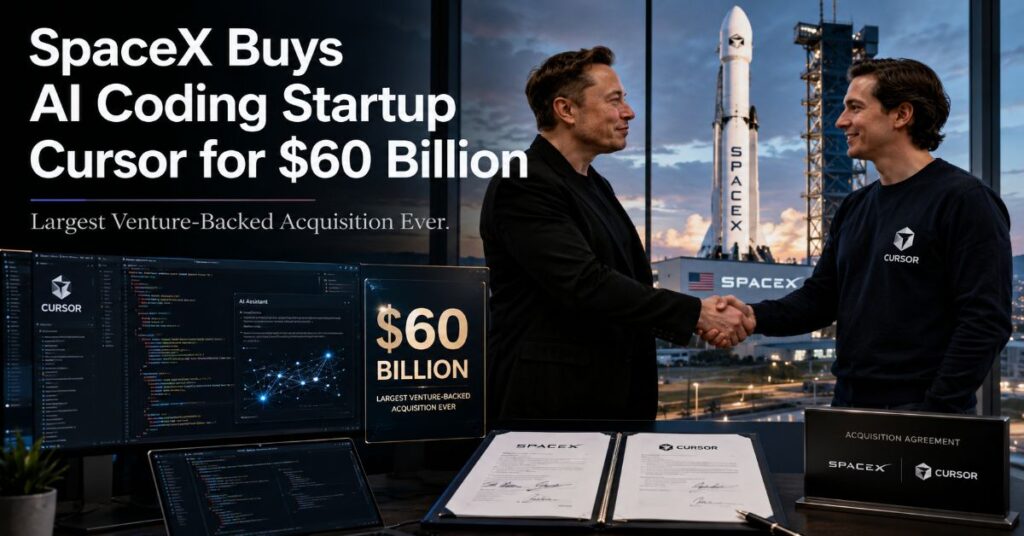
Three days ago, SpaceX was a rocket company that happened to own a chatbot. On Tuesday, it became the most aggressive buyer in the AI coding market, agreeing to pay $60 billion — entirely in stock — for a four-year-old startup that several of its richest rivals had already circled and walked away from.
Space Exploration Technologies Corp. has agreed to acquire Anysphere, the maker of the AI coding assistant Cursor, in an all-stock deal that values the startup at $60 billion — the largest acquisition of a venture-backed company in history. The agreement, filed with the US Securities and Exchange Commission on Tuesday, comes four days after SpaceX’s own record-breaking $75 billion initial public offering on the Nasdaq, and gives Elon Musk’s company a direct foothold in one of the few corners of the AI industry already generating serious enterprise revenue.
For Cursor, the deal closes out 18 months as one of the most fought-over startups in software: the company had already turned down two separate approaches from OpenAI and watched Microsoft study an acquisition before declining to make a formal bid.
Key Developments
- SpaceX agreed June 16, 2026 to acquire Anysphere (Cursor) for $60 billion in an all-stock deal — the largest-ever acquisition of a venture-backed startup.
- The deal exercises an option SpaceX secured in April 2026; closing is expected in Q3 2026, pending regulatory approval in the US, EU and elsewhere.
- It lands four days after SpaceX’s own $75 billion Nasdaq IPO — the largest IPO in history — which pushed its market value above $2 trillion.
- Cursor becomes a subsidiary of SpaceXAI, the AI division SpaceX formed after absorbing Elon Musk’s xAI in February 2026.
What Happened
Under the merger agreement, filed as an 8-K with the SEC, each share of Cursor’s common and preferred stock will convert into SpaceX Class A common stock, with the exchange ratio set by the volume-weighted average closing price of SpaceX shares over the seven trading days immediately before the deal closes. No cash changes hands; Cursor’s shareholders become SpaceX shareholders outright, and Cursor will continue to operate as a wholly owned subsidiary.
The agreement formalizes an option SpaceX disclosed in April: the right to either acquire Cursor outright for $60 billion later in the year, or pay $10 billion for a more limited partnership if it chose not to exercise the buyout. According to Reuters, SpaceX has now confirmed it is exercising the full acquisition rather than the partnership alternative. Should the transaction fail to close, Cursor is entitled to a $1.5 billion cash payment plus $8.5 billion worth of SpaceX computing resources — break-up terms that give a sense of how much value both sides have already assigned to the relationship even before signing.
Cursor chief executive Michael Truell framed the deal in characteristically ambitious terms, saying in a statement that the company was excited “to build the world’s most useful AI models” as part of SpaceX. The transaction is expected to close during the third quarter of 2026, pending customary regulatory approvals.
The Mechanism: Why a Rocket Company Wants a Code Editor
Cursor is a fork of Visual Studio Code that uses large language models to help developers write, edit, and review software through natural-language prompts, and it has become one of the rare AI products with revenue to match its hype. The company said it crossed $1 billion in annualized revenue in November 2025; by early June 2026 that figure had reportedly grown further, with outlets citing annualized revenue anywhere from roughly $2.6 billion to $4 billion depending on the measurement window and source, a discrepancy that itself reflects how fast the business has been moving in recent months.
That revenue is exactly what SpaceX’s AI division has struggled to produce on its own. SpaceXAI, the unit formed when SpaceX absorbed xAI in February 2026 and rebranded internally in May, has poured resources into Grok and Grok Build, its own coding agent, but has not matched Cursor’s traction among professional software engineers at companies including Stripe, Adobe, and Nvidia, whose chief executive Jensen Huang has called Cursor his favorite enterprise AI service. Buying outright the tool its own engineers couldn’t out-build is a more direct route to developer distribution than competing for it from scratch.
SpaceX has also confirmed that SpaceXAI has spent the past several months jointly training a model with Cursor on its Colossus supercomputing infrastructure in Memphis, with the resulting model expected to ship inside both Cursor and Grok Build. That detail matters more than it might first appear: it suggests the acquisition formalizes a technical integration already underway rather than starting one from a blank page, which should shorten the runway between signing and any product changes users actually notice.
The Backstory
Anysphere was incorporated in 2022 by four MIT students — Michael Truell, Sualeh Asif, Arvid Lunnemark, and Aman Sanger — and raised an $8 million seed round the following year led by the OpenAI Startup Fund. Cursor’s valuation then rose with unusual speed even by AI standards: roughly $2.5 billion at the start of 2025, climbing to $29.3 billion at a $2.3 billion Series D in November, and finally to the $60 billion implied by Tuesday’s deal.
The company had no shortage of suitors along the way. CNBC reported that Microsoft examined a potential acquisition before deciding against a formal bid, and Cursor twice rebuffed approaches from OpenAI as its leadership prioritized staying independent. At the time SpaceX first floated its option in April, Cursor was separately in the middle of raising a $2 billion round that would have valued it above $50 billion, with Andreessen Horowitz, Nvidia, and Thrive Capital set to participate — a round the SpaceX offer ultimately superseded entirely.
SpaceX, meanwhile, has been assembling an unusual corporate shape of its own. It absorbed Musk’s xAI in February 2026 in a deal that valued the combined entity at roughly $1.25 trillion, folding in Grok, the X platform, and the Colossus supercomputer cluster, before rebranding the unit internally as SpaceXAI in May. Its own Nasdaq debut last week, pricing 555,555,555 shares at $135 each to raise $75 billion, was itself described as the largest IPO on record, part of a trio of mega AI-sector listings this year that also includes OpenAI’s own confidential IPO filing and Anthropic’s parallel move toward public markets.
Reactions
Truell’s statement leaned into the scale of the ambition rather than the mechanics of the deal itself, describing the move as advancing SpaceX’s goal of building “the world’s most useful AI models” rather than framing Cursor as simply being absorbed into a larger balance sheet. SpaceX has not issued an extensive public statement beyond the filing itself, letting the regulatory paperwork and Truell’s comments carry the announcement.
The deal lands in the same week as Fox’s announced $22 billion acquisition of Roku, part of what several outlets have characterized as a fresh wave of large-scale tech consolidation, and follows a string of competing efforts by AI-developer-tools startups like PlayerZero to differentiate themselves against Cursor specifically, underscoring how central the company had become to the broader competitive map of agentic coding tools even before this acquisition was announced.
The Dispute: Integration Risk and Regulatory Scrutiny
A $60 billion all-stock acquisition of this scale, arriving days after the acquirer’s own debut on public markets, is close to unprecedented, and several specifics invite scrutiny rather than settle it. Merging a rocket and satellite manufacturer, a social media platform, and a developer-tools company under one roof has been described by industry commentators as operationally unprecedented, and SpaceX has offered no detailed integration plan beyond confirming Cursor will operate as a subsidiary.
The size of the deal, combined with SpaceX’s newly inflated stock as the currency, is also likely to draw close antitrust attention in the US, EU, and other jurisdictions, particularly given the breakup fee structure already built into the agreement in anticipation of regulatory friction. And while SpaceX frames the move as accelerating its AI ambitions, the fact that its own internal coding tool reportedly could not match Cursor’s traction raises a fair question about whether this is a strategic bet on AI coding specifically, or a more general use of a suddenly liquid stock price to buy capability the company could not build fast enough on its own.
What Happens Next
SpaceX expects the transaction to close in the third quarter of 2026, contingent on regulatory clearance that is unlikely to be a formality given the deal’s size and the current political attention on AI-sector consolidation. In the meantime, the jointly trained model built on Colossus infrastructure is expected to ship inside both Cursor and Grok Build, giving the first concrete signal of what the combination actually changes for users on either product before the legal close of the deal.
Why It Matters
The acquisition marks the moment a company built on rockets and satellites became, almost overnight, one of the largest direct owners of enterprise AI software — not through years of product development, but through the acquisition leverage created by its own record-setting stock debut. It also extends a pattern that has defined 2026’s AI sector: founders who built genuinely profitable, widely adopted products are increasingly being absorbed into the balance sheets of much larger AI players flush with newly raised or newly public capital, rather than scaling as independent companies. Whether that pattern compounds the AI industry’s gains or simply concentrates them in fewer hands is the question this deal leaves for regulators and competitors alike to answer.
Sources
Reuters; CNBC (June 16, 2026); CBS News; NPR; Yahoo Finance / Qz; ghacks Tech News; AI Magazine.
