
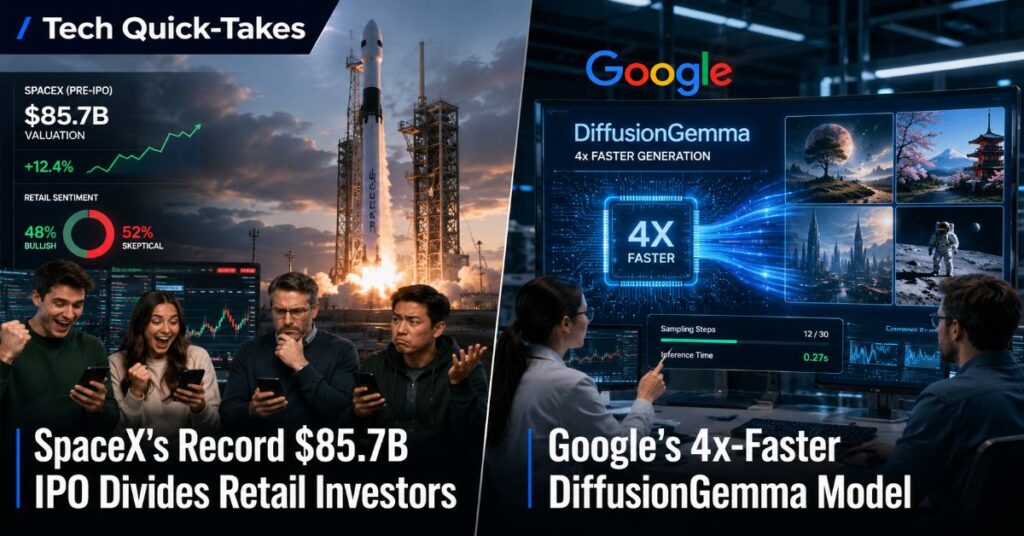
SpaceX’s initial public offering has grown to $85.7 billion in total proceeds after underwriters fully exercised the “greenshoe” overallotment option, purchasing an additional 83.3 million shares on top of the original offering. The IPO had already priced at $135 per share, selling roughly 555.6 million shares before the overallotment brought the total to nearly 639 million shares sold.
Shares jumped 19.6 percent on their Nasdaq debut and continued climbing afterward, pushing SpaceX’s market capitalization above $2.5 trillion and making the offering the largest IPO on record globally, surpassing Saudi Aramco’s 2019 listing. Elon Musk has said he expects SpaceX revenue to reach roughly $1 trillion by 2030.
Not everyone got the allocation they wanted. Retail investors who requested large share counts through brokerages like Robinhood and Charles Schwab received only a fraction, with some receiving as little as a single share. Reactions have split: some investors sold immediately into the debut, citing valuation concerns, while others are holding for the long term despite the stock’s volatility as lockup restrictions approach. Morningstar had separately argued before the listing that SpaceX was significantly overvalued relative to its discounted cash flow estimate, citing uncertainty around the profitability of SpaceX’s AI-focused ventures as a key risk to the bull case.
In a separate filing, SpaceX said it will release quarterly and annual financial results, along with other material news, only through its own website and its X account, bypassing traditional wire distribution services such as Business Wire and PR Newswire. Material information will still be filed with the Securities and Exchange Commission as required, but the move marks a departure from how most large public companies distribute earnings and corporate announcements, and raises questions about how broadly that information will reach investors who don’t follow Musk’s companies on X.
Google Releases DiffusionGemma, a 4x-Faster Open Text Model
Google DeepMind released DiffusionGemma on June 10, 2026, a 26-billion-parameter open-weights model that generates text using diffusion rather than the standard token-by-token approach used by models like GPT, Claude, and Gemini. Instead of predicting one word at a time, DiffusionGemma starts from a canvas of random placeholder tokens and refines blocks of up to 256 tokens in parallel, a technique borrowed from image-generation models, though applied here entirely to text output.
The model is built on the Gemma 4 architecture as a 26B mixture-of-experts model with 3.8 billion active parameters, and Google reports it can achieve over 1,000 tokens per second on a single H100 GPU, up to four times faster than standard Gemma 4 on the same hardware. It is released under an Apache 2.0 license on Hugging Face, Kaggle, and Google Cloud’s Vertex AI Model Garden, with Nvidia providing day-zero NVFP4 quantization support that allows it to run locally on consumer RTX 4090 and 5090 GPUs within 18GB of memory.
Google is explicit about the tradeoff: DiffusionGemma scores lower than standard Gemma 4 on established benchmarks including MMLU and coding evaluations, and the company recommends Gemma 4 for production use cases where output quality matters more than raw generation speed. The release is positioned as experimental, aimed at speed-critical workflows such as code infilling and in-line editing rather than general-purpose deployment, and is multimodal on the input side, able to process interleaved text, image, and video inputs even though its output remains text only.
Why It Matters
Both stories reflect the same underlying tension shaping AI infrastructure and tooling in mid-2026: scale is colliding with scrutiny. SpaceX’s IPO demonstrates enormous demand for AI-adjacent infrastructure plays even as analysts and retail investors openly question whether the valuation reflects fundamentals, while DiffusionGemma shows major labs experimenting with fundamentally different generation architectures in pursuit of speed, even at the cost of accuracy, as the cost of serving AI at scale becomes a more visible constraint across the industry.
Sources
Reuters; CNBC; Benzinga; MLQ.ai; Fortune; Google AI for Developers.
