
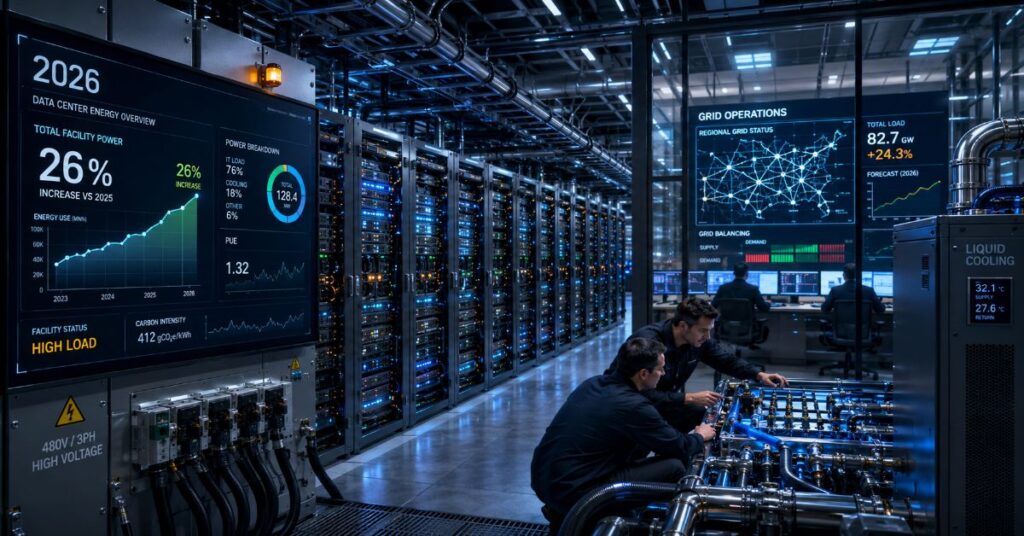
Global data center electricity consumption is projected to reach 565 terawatt-hours (TWh) in 2026, a 26 percent increase over the 447 TWh recorded in 2025, according to a new Gartner forecast published June 10, 2026. The research firm says the surge is being driven almost entirely by the rapid adoption of AI-optimized servers, and that power availability, not chip supply or capital, is fast becoming the binding constraint on how much AI infrastructure can be built.
The Numbers Behind the Surge
Gartner estimates AI-optimized servers will account for 31 percent of total data center electricity consumption in 2026, up from roughly 20 percent in 2025. The contrast with conventional servers is sharp: their electricity use grew less than 1 percent in 2025 and is projected to grow just 1.2 percent in 2026, while AI-optimized servers grew consumption by more than 83 percent in 2025 and are forecast to grow a further 84 percent this year, reaching 175 TWh. By 2027, Gartner projects AI-optimized servers will surpass conventional hardware entirely, consuming 258 TWh against 200 TWh for conventional servers.
Worldwide data center power demand, measured in capacity rather than consumption, is expected to rise 27 percent in 2026, reaching 132 gigawatts, up from 104 gigawatts in 2025. Gartner projects this could climb to 290 gigawatts by 2030, with total electricity consumption potentially exceeding 1,200 TWh annually by the same year. Cooling infrastructure adds further strain: electricity used for cooling systems is forecast to jump 22.6 percent in 2026 alone, to roughly 195 TWh.
Gartner Director Analyst Linglan Wang described the dynamic plainly: surging demand for compute-intensive AI workloads is producing unprecedented data center power growth, while AI capacity is now constrained by power availability itself, making power security, in Wang’s framing, the new competitive battleground for scaling AI operations and protecting margins.
The Grid Bottleneck Behind the Numbers
Part of why power has become the binding constraint is timing, not just volume. Connecting a new data center to the power grid can take four to ten years in many regions, while AI data centers are typically planned and built within two to three, according to analysis from the World Economic Forum. That mismatch is increasingly determining which projects can move forward and which stall waiting on grid capacity, regardless of how much capital or chip supply a developer has secured.
US regulators are responding directly. The Federal Energy Regulatory Commission named the deployment of advanced demand response and dynamic line ratings as a critical 2026 priority, building on a 2024 order requiring transmission providers to consider grid-enhancing technologies in regional planning. A separate industry analysis of 51 US investor-owned utilities found planned capital expenditure of at least $1.4 trillion through 2030, more than 21 percent higher than the same utilities projected a year earlier, with more than 30 of them citing data centers as a top growth driver.
The Mitigation: A Different Approach to Cooling
Against that backdrop, cooling technology has become one of the most active areas of AI infrastructure investment. MIT spinoff Ferveret has developed a nuclear-reactor-inspired liquid cooling system designed to dramatically cut both the energy and water typically required to keep AI chips at safe operating temperatures, an approach the company has positioned as a direct response to the kind of resource strain Gartner’s forecast describes.
Other operators are already seeing measurable gains from similar approaches. Microsoft’s integration of direct liquid cooling across its AI data center campuses has reduced energy overhead by up to 30 percent in disclosed benchmarks while significantly increasing compute density per square meter, illustrating how cooling design choices now have a direct, multiplying effect on a facility’s total energy footprint, since cooling-related electricity use is growing nearly as fast as compute itself.
Why It Matters
Gartner’s framing of power security as a competitive battleground signals a shift in how AI companies will need to plan capacity going forward: site selection, grid agreements, and cooling technology choices are becoming as central to scaling AI as chip procurement itself. With electricity consumption potentially nearly tripling by 2030 and grid connection timelines running years behind data center construction schedules, infrastructure operators who solve the energy and cooling equation more efficiently than competitors may gain a structural advantage independent of which AI models they ultimately run.
Sources
Gartner; World Economic Forum; Data Centre Magazine; Energy Digital; VoicenData; TechEdgeAI.
