
Summary of Major Developments
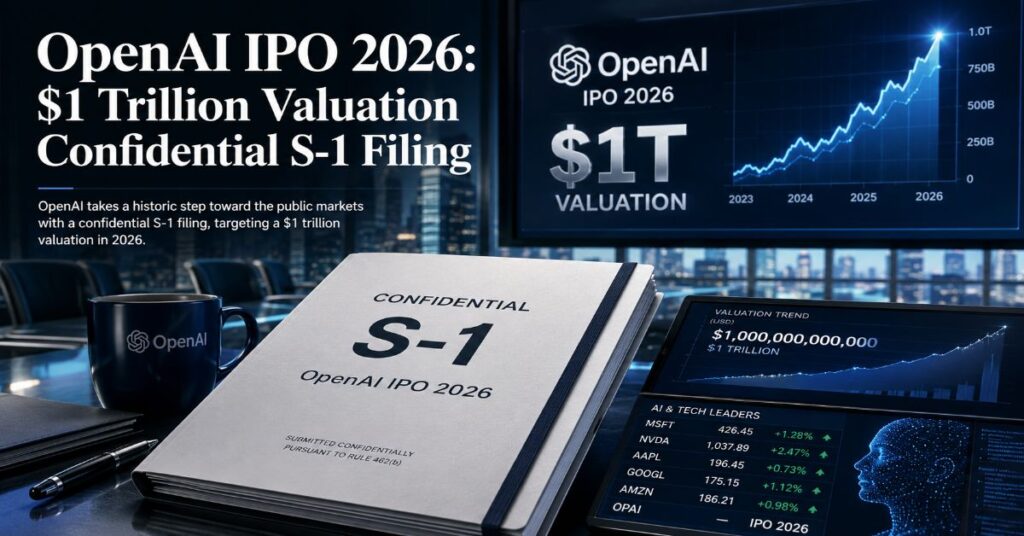
- Confidential S-1 submitted to the SEC on June 8, 2026: OpenAI submitted a confidential draft S-1 registration statement to the US Securities and Exchange Commission on June 8, 2026. The company preemptively announced the filing in a brief blog post: ‘We recently submitted a confidential S-1. We expect it to leak so we’re just announcing it. We have not decided on timing yet; it may be a while because there are things we want to do that are likely easier as a private company.’ Goldman Sachs and Morgan Stanley are serving as lead financial advisers on the offering.
- Targeting a public valuation of up to $1 trillion: OpenAI’s most recent private funding round in March 2026 valued the company at $852 billion. The confidential S-1 targets a public market valuation of up to $1 trillion — a premium of approximately 17% above the last private round. At $1 trillion, OpenAI would be the most valuable company to list on US public markets at IPO.
- Filed exactly one week after Anthropic’s own confidential S-1: Anthropic filed its own confidential S-1 on June 1, 2026 — one week before OpenAI. Anthropic’s most recent private valuation reached $965 billion after a $65 billion Series H that closed June 1. The one-week sequencing is not coincidental: both companies are racing to establish their IPO narratives with institutional investors before the other defines the comparative frame.
The Financial Architecture of the Filing
The confidential S-1 mechanism — available under the JOBS Act for emerging growth companies — allows companies to submit their prospectus to the SEC for private review before public disclosure. This is now standard practice for high-profile technology IPOs. Anthropic used the same mechanism one week earlier. Goldman Sachs and Morgan Stanley as lead advisers signals OpenAI is targeting the deepest institutional placement relationships available — sovereign wealth funds, pension funds, and the major asset managers that anchor trillion-dollar public offerings.
OpenAI’s most recent private valuation of $852 billion was set in its March 2026 funding round. Against Anthropic’s current private valuation of $965 billion — which now exceeds OpenAI’s own — the $1 trillion IPO target represents an aggressive public market premium. The valuation inversion between the two companies is striking: as recently as March 2026, OpenAI led Anthropic’s Series G valuation of $380 billion by a factor of more than two. The rapid catch-up reflects Anthropic’s disclosed $47 billion in annualised revenue growing from $9 billion at end-2025.
CFO Sarah Friar — who joined OpenAI from Nextdoor in 2024 with public-company CFO experience the company previously lacked — is the primary architect of OpenAI’s financial readiness for public markets. Friar has spent the past 18 months building the financial reporting infrastructure, audit relationships, and investor relations capability that a trillion-dollar offering requires. The employee tender offer — allowing staff to liquidate shares at the $852 billion private valuation — is one of her visible contributions to the IPO preparation: it relieves employee liquidity pressure and clears the cap table overhang before the public offering price is set.
Strategic Pivots That Prepared OpenAI for Public Scrutiny
The S-1 filing follows a period of deliberate product rationalisation that reads, in retrospect, as IPO preparation. The most visible decision was the closure of Sora — OpenAI’s short-form video generation application — in April 2026. Sora consumed significant GPU compute infrastructure without generating proportional enterprise revenue. Its closure freed resources that have been redirected toward Codex — OpenAI’s agentic coding product generating over $1 billion in annualised recurring revenue from approximately 4 million weekly users — and enterprise services.
The logic is straightforward from an investor relations perspective. Public market analysts value enterprise software revenue at premium multiples. Consumer video generation is a category with limited near-term monetisation clarity and high infrastructure cost. A company preparing to list at $1 trillion needs its S-1 financials to tell a clear, high-margin enterprise revenue story. Shutting Sora and concentrating resources on Codex and enterprise AI is the product rationalisation of a company that knows what institutional investors are looking for and has restructured its portfolio accordingly.
Sam Altman told CNBC on the day of the filing: ‘I think there is a race to deliver the best technology and build the best business.’ The statement is simultaneously a product claim, a competitive signal directed at Anthropic, and a framing of OpenAI’s public market narrative: that the race it is running is not just to build the most capable AI but to build the most commercially sustainable AI business.
| Metric | OpenAI (June 2026) | Anthropic (June 2026) | Gap |
| S-1 filing date | June 8, 2026 | June 1, 2026 | Anthropic filed 7 days first |
| Last private valuation | $852B (March 2026) | $965B (Series H, June 1) | Anthropic $113B higher |
| IPO valuation target | Up to $1 trillion | Not disclosed | OpenAI publicly targets $1T |
| Lead advisers | Goldman Sachs + Morgan Stanley | Not disclosed | OpenAI has named advisers |
| Disclosed ARR | Not disclosed for IPO | $47B (May 2026) | Anthropic ARR significantly higher |
| Consumer users | 1B monthly active app users | 56M monthly active app users | OpenAI dominant on consumer scale |
| Enterprise depth | Codex: $1B+ ARR, 4M weekly users | 1,000+ accounts >$1M/yr | Anthropic more concentrated in enterprise spend |
| CFO | Sarah Friar (ex-Nextdoor CEO) | Not named publicly | OpenAI has credentialled public-market CFO |
| Product rationalisation | Closed Sora April 2026, focused on Codex | Dynamic Workflows, Opus 4.8 | OpenAI more aggressive product cuts for IPO narrative |
| Employee liquidity | Tender offer at $852B valuation | Series H participation | Both managing staff liquidity ahead of IPO |
The Three-Company Race and What It Means
OpenAI and Anthropic filing within a week of each other creates a competitive IPO narrative dynamic that neither company can fully control. The company that goes public first sets the valuation benchmark that analysts use to price the second. Elon Musk’s SpaceX — targeting a $1.77 trillion Nasdaq IPO under the ticker SPCX on June 12, 2026 — adds a third dimension: a listing that, if it proceeds at its target valuation, will absorb institutional capital that might otherwise anchor OpenAI or Anthropic. The sequencing of three landmark AI-adjacent listings in the same quarter creates a capital allocation competition that favours whichever company reaches its roadshow first with the most compelling financial narrative.
OpenAI’s blog post language — ‘it may be a while because there are things we want to do that are likely easier as a private company’ — is the most honest IPO communication from a major technology company in recent memory. It signals that OpenAI’s S-1 is a placeholder that preserves the option to list, not a committed listing with a defined timeline. This preserves flexibility while satisfying employees and investors who have been waiting for a liquidity event. It also signals that OpenAI may be watching Anthropic’s listing process before committing to its own roadshow — a rational sequencing strategy given that Anthropic’s higher private valuation creates a benchmark that OpenAI can only meet by going public after Anthropic at a premium or before Anthropic before the comparison crystallises.
“OpenAI’s S-1 announcement is the most carefully managed IPO communication in twenty years. ‘It may be a while’ from the company targeting $1 trillion tells you exactly how much they still need to accomplish privately before they can sustain public market scrutiny quarter after quarter. Sora’s closure was necessary. The tender offer was necessary. But there are more decisions like those still to come.” — Technology IPO Market Analyst, institutional investment research, June 9, 2026
“The race Sam Altman is describing is not just against Anthropic. It is against the public market discipline that quarterly reporting imposes. A private OpenAI can make strategic bets at infrastructure scale without disclosing the losses. A public OpenAI cannot. The things they ‘want to do that are likely easier as a private company’ are the bets that define the next generation of AI leadership — and they know that once they list, those bets become subject to quarterly earnings calls.” — Enterprise AI Financial Analyst, technology equity research, June 9, 2026
Frequently Asked Questions
What is OpenAI’s IPO timeline and when will it list?
OpenAI filed a confidential S-1 with the SEC on June 8, 2026, but explicitly stated: ‘We have not decided on timing yet; it may be a while because there are things we want to do that are likely easier as a private company.’ Sam Altman has previously indicated a Q4 2026 target, but the June 8 blog post signals a potentially extended timeline. Goldman Sachs and Morgan Stanley are lead advisers. The confidential filing process typically precedes listing by three to six months, but OpenAI has reserved the right to delay significantly.
How does OpenAI’s IPO compare to Anthropic’s filing?
Anthropic filed its confidential S-1 on June 1, 2026 — one week before OpenAI. Anthropic’s most recent private valuation of $965 billion (Series H, June 1) exceeds OpenAI’s $852 billion March 2026 private round. OpenAI’s IPO targets up to $1 trillion public market valuation. Anthropic has disclosed $47 billion in annualised revenue; OpenAI has not. Both companies are racing to establish their IPO narrative before the other’s roadshow defines the comparative frame for institutional investors.
Why did OpenAI close Sora before its IPO filing?
OpenAI closed Sora in April 2026, approximately two months before filing its confidential S-1. Sora consumed GPU infrastructure without generating proportional enterprise revenue. Its closure freed resources for Codex — generating over $1 billion in ARR from 4 million weekly users — and enterprise AI services. From an IPO preparation standpoint, concentrating resources on high-margin recurring enterprise revenue segments allows OpenAI’s S-1 to tell a clear software valuation story that institutional investors reward with premium multiples.
Sources
OpenAI. (2026, June 8). Blog: We recently submitted a confidential S-1. https://openai.com/blog/openai-s1
CNBC. (2026, June 8). OpenAI files confidential IPO paperwork — Sam Altman interview. https://www.cnbc.com/2026/06/08/openai-ipo-confidential-s1-filing.html
Reuters. (2026, June 8). OpenAI files confidential IPO registration. https://www.reuters.com/technology/openai-files-confidential-ipo-registration-june-2026/
Bloomberg. (2026, June 8). OpenAI files confidential IPO, targets $1 trillion valuation. https://www.bloomberg.com/news/articles/2026-06-08/openai-files-confidential-ipo
Anthropic. (2026, June 1). Series H — $65B raised at $965B valuation, IPO filing confirmed. https://www.anthropic.com/news/series-h
Financial Times. (2026, June 8). OpenAI moves toward IPO with Goldman and Morgan Stanley. https://www.ft.com/content/openai-ipo-2026
