
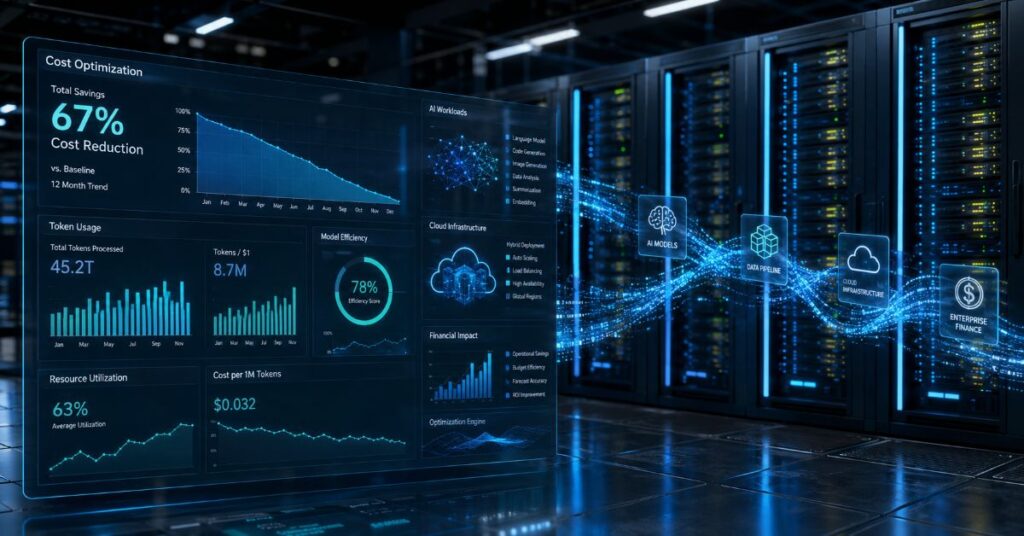
Twelve months ago, a company routing a million tokens through a frontier AI model was paying $18.40 for the privilege. Today, that same company — if it has adopted the architecture that the data now shows is becoming the enterprise default — is paying $6.07. A 67 percent cost reduction in enterprise software infrastructure spending over twelve months is unusual enough that it is worth examining not just as a number but as a structural signal about how the AI market is actually maturing underneath the headline announcements about new models and new capabilities.
AI.cc, the Singapore-based unified AI API aggregation platform, published its 2026 AI API Infrastructure Report in May 2026, drawing on anonymised data from more than 2.4 billion API calls processed across 8,000-plus developers and enterprises between January and April 2026. The report is notable not for the headline cost number but for what it reveals about the mechanism behind it — and those mechanisms are more instructive than the figure itself.
Key Developments
- AI.cc’s 2026 AI API Infrastructure Report, drawn from 2.4 billion API calls across 8,000+ developers and enterprises (January–April 2026), documents enterprise AI token costs falling 67% year-over-year — from $18.40 per million tokens to $6.07.
- Three distinct mechanisms drove the cost reduction: model price deflation from frontier providers, intelligent task-routing to cheaper models, and a structural shift toward open-source models, which grew from 11% to 38% of enterprise token volume in one year.
- Average models per enterprise account rose 124% — from 2.1 to 4.7 — confirming that multi-model deployment has crossed from experimental to default architecture across virtually all enterprise customer segments.
- Agent-pattern API calls now represent 41% of new enterprise integrations (up from 18% in Q1 2025), with five dominant agent architectures identified: research and synthesis, document processing, code generation, customer interaction, and data analysis agents.
What the Report Found
The AI.cc 2026 AI API Infrastructure Report identifies three distinct mechanisms that drove the 67 percent cost reduction, each operating independently and compounding in combination. The first is model price deflation: frontier AI providers including OpenAI and Anthropic reduced their API pricing multiple times through the 12-month period as production efficiency improved and competition intensified. The second is intelligent task routing: enterprises stopped sending every query through the most expensive frontier model and began routing simple, high-volume tasks to cheaper or open-source alternatives. The third is structural open-source adoption: the share of enterprise token volume running through open-source models rose from 11 percent to 38 percent over the year. Together, these three mechanisms produced a cost reduction that the report describes as ‘one of the fastest cost deflations ever recorded in enterprise software infrastructure.’ Effective discounts versus direct retail API pricing across the AI.cc platform averaged 23 percent in Q1 2026, with the highest-volume enterprise accounts achieving 35–40 percent discounts on specific model categories through volume consolidation.
The Multi-Model Architecture: From Experiment to Default
How Task Routing Works
The architectural shift the report documents is straightforward in concept and surprisingly recent in widespread adoption: instead of routing every AI query through a single frontier model regardless of the task’s complexity, companies are implementing intelligent routing that matches task requirements to model capabilities and costs. A customer service chatbot handling a simple billing question does not require GPT-5.6 or Claude Fable 5. A Llama-3 variant or a fine-tuned Mistral model handles that task at one-tenth the cost with comparable accuracy. The same routing logic reserves expensive frontier models for genuinely complex reasoning tasks — contract analysis, multi-step planning, long-context synthesis — where their capabilities produce measurably better outputs than cheaper alternatives. The average enterprise account on AI.cc went from calling 2.1 distinct models in Q1 2025 to calling 4.7 distinct models in Q1 2026 — a 124 percent increase in model diversity within a single year. That is not experimentation; that is production architecture.
The Open-Source Inflection
The open-source model adoption figure is the most structurally significant finding in the report. At 11 percent of enterprise token volume in early 2025, open-source models were a niche preference associated with companies that had the engineering capacity to self-host and maintain model infrastructure. At 38 percent by early 2026, they have become a core component of mainstream enterprise AI cost strategy. The models driving this adoption are largely the Meta Llama family, Mistral variants, and — particularly in Asia-Pacific — DeepSeek, Qwen, GLM, and Doubao, which the report notes represent 43 percent of token volume in that region. The common thread is that these models have reached a quality threshold where they handle a significant fraction of enterprise AI tasks acceptably well, and their marginal cost in a self-hosted or dedicated-instance deployment is low enough that the total cost advantage over frontier API pricing is decisive for high-volume production use cases.
The Agentic AI Signal
Beyond the cost and architecture findings, the report documents a major shift in how AI is being used inside enterprise systems. Agent-pattern API calls — defined as sequences exhibiting multi-turn reasoning, tool call invocation, result processing, and iterative refinement within a single coordinated workflow — represented 41 percent of new integration use cases registered on the AI.cc platform in Q1 2026, up from 18 percent in Q1 2025. Five dominant agent architectures have emerged as production patterns: research and synthesis agents that retrieve and analyse multiple information sources; document processing agents that extract, transform, and route information from unstructured documents; code generation agents that write, test, and iterate on software; customer interaction agents that handle multi-turn service conversations; and data analysis agents that query, interpret, and report on structured datasets. The 41 percent figure for agentic integrations reflects the same structural shift documented in our earlier analysis of how AI agents are replacing traditional SaaS workflows — but confirms it is no longer a forward-looking thesis. It is a current production reality across the enterprises in this dataset.
Three Mechanisms in Detail
1. Model Price Deflation
The first and most passive cost reduction mechanism is the series of pricing cuts that frontier AI providers made through 2025 and into 2026. OpenAI, Anthropic, and Google each reduced API pricing on their flagship models multiple times as inference efficiency improved — through better hardware utilisation, improved serving software, and the scale economies that come from processing dramatically higher volumes of enterprise tokens. The report does not attribute a specific share of the 67 percent total cost reduction to provider price cuts alone, but it identifies this as a baseline mechanism operating before any intelligent routing is applied. Even enterprises that did not change their AI architecture at all saw meaningful cost reductions simply because the models they were already using became cheaper.
2. Task-Specific Routing
The second mechanism is the active architectural decision to implement task-specific routing. This requires engineering investment — identifying which tasks in a production workflow can tolerate a lower-capability model, building the routing logic, validating output quality, and maintaining the expanded model portfolio — but the return on that investment at scale is substantial. The report’s 67 percent average cost reduction across the dataset significantly understates what well-implemented routing achieves for specific workloads: companies that have invested most deeply in multi-model routing report effective cost reductions for their highest-volume, lowest-complexity tasks well above 90 percent, offset by no change in frontier model spend for the complex reasoning tasks where those models remain necessary.
3. Open-Source Adoption
The third mechanism is the structural shift to open-source models for workloads where they perform acceptably. Self-hosted or dedicated-instance open-source deployment has lower marginal cost per token than frontier API pricing for high-volume workloads, once the fixed costs of model serving infrastructure are amortised. As open-source model quality has improved — particularly for task-specific fine-tunes of Llama and Mistral variants, and for the DeepSeek and Qwen models in Asia-Pacific — the set of workloads for which this trade-off makes financial sense has expanded rapidly. The 38 percent open-source volume share represents the point at which open-source is not a cost-saving last resort for price-sensitive customers but a deliberate architectural component for sophisticated enterprise AI deployers.
The AI Cost Trajectory and Its Broader Implications
The 67 percent cost reduction documented in this report is the supply side of the equation. The demand side is equally important for understanding where enterprise AI spending is heading. As the cost of AI token consumption falls, more use cases become economically viable at scale — tasks that were borderline unprofitable to automate at $18.40 per million tokens are clearly profitable at $6.07, and potentially transformative at the $2–3 per million tokens that the current trajectory suggests is reachable within the next 12 to 18 months. Falling inference costs change the economics of enterprise AI deployment in the same way that falling memory costs changed the economics of software in the 1990s: the applications that become possible when AI inference costs drop by another order of magnitude are not simply cheaper versions of today’s AI applications, they are structurally different applications that only make sense at very low per-token costs. This has direct implications for the ROI question facing enterprise AI leaders, documented in our earlier reporting on why most CEOs reported zero ROI from AI investments in 2026: some of those zero-ROI deployments were built on architectures that have since been structurally cheaper, and the ROI calculation for re-evaluating those deployments under the new cost structure is materially different from the one that produced the original decision.
Regional Patterns
The Americas remains the largest region by customer count at 44 percent of active accounts, but the report identifies Europe as the fastest-growing region in the dataset. Asia-Pacific markets — Singapore, India, Australia, Japan, South Korea, and Indonesia are the top six by account volume — show the highest concentration of Chinese-origin model usage: DeepSeek, Qwen, GLM, and Doubao collectively represent 43 percent of token volume in the Asia-Pacific region, reflecting both language requirements and cost optimisation priorities. That figure is a concrete data point in the broader competition between US-developed frontier models and Chinese open-source alternatives that has been one of the defining competitive dynamics of 2025 and 2026.
What Happens Next
The report’s trajectory — 67 percent year-over-year cost reduction, 124 percent increase in model diversity per enterprise, 38 percent open-source volume share — suggests an enterprise AI market that is simultaneously becoming cheaper, more architecturally complex, and more dependent on sophisticated routing and model management infrastructure. The companies that benefit most from the next cost reduction cycle are those that have already implemented multi-model routing, because they are positioned to incorporate new, cheaper model options into an existing routing architecture rather than rebuilding from a single-model baseline. The companies that have not made this architectural shift are operating at a cost disadvantage that is compounding quarterly as the cost gap between frontier API pricing and optimised multi-model deployments continues to widen.
Why It Matters
The AI.cc report matters because it provides empirical confirmation — from 2.4 billion real API calls, not surveys or projections — of the structural shift that practitioners have been describing anecdotally for the past year. Enterprise AI is not becoming simpler; it is becoming more architecturally demanding as the optimal deployment strategy shifts from ‘pick the best model and call it for everything’ to ‘route intelligently across a portfolio of models calibrated to task complexity and cost.’ That shift rewards engineering sophistication over spending power, and it suggests that the companies building durable competitive advantages in AI are not necessarily the ones spending the most on frontier model access but the ones building the best routing, evaluation, and model management infrastructure around a diversified model portfolio.
Sources
AI.cc 2026 AI API Infrastructure Report, published May 9, 2026 (data period: January 1 – April 30, 2026). EINPresswire distribution, May 9–10, 2026. National Law Review summary. AI.cc platform (ai.cc).
