
Haejin Lee, founder and chairman of NAVER, did not frame his company’s $10 billion announcement in San Francisco on July 25, 2026, as a data center capacity expansion. He framed it as a democratic principle. ‘The internet world NAVER dreams of,’ he told the audience, ‘is not a world where the internet and AI are dominated by a few countries or companies.’ The statement preceded an announcement that commits $10 billion to ensuring Korea has the AI computing infrastructure to be a producer rather than merely a consumer of the AI era — backed by the financial firepower of Brookfield Asset Management, the semiconductor leadership of NVIDIA, and the implicit endorsement of a South Korean President who flew to San Francisco specifically to be present when the deal was confirmed.
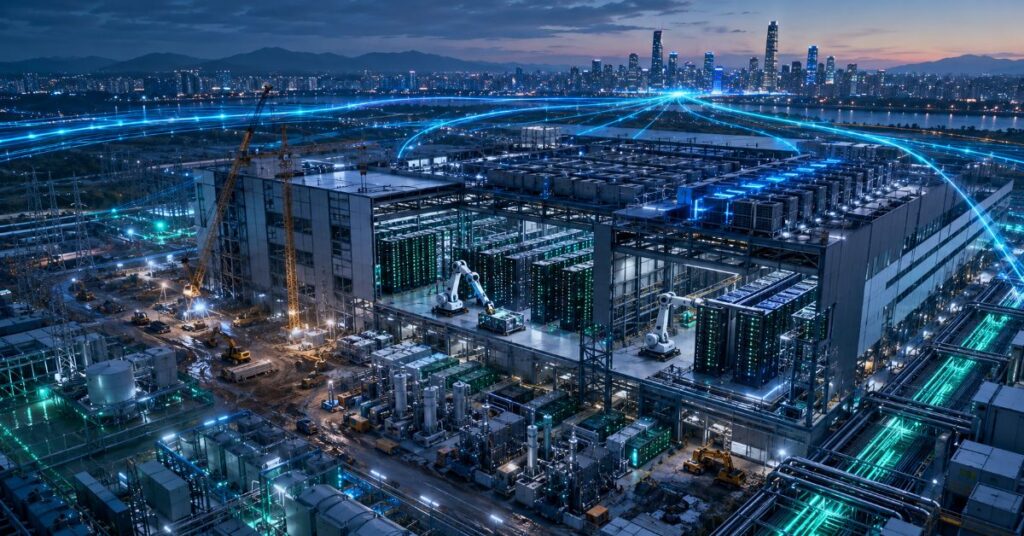
NAVER, NVIDIA, and Brookfield announced a proposed expansion of Korea’s sovereign AI factory infrastructure that will scale the initial NVIDIA DSX AI factory at NAVER’s GAK Sejong hyperscale data center from 55 megawatts to 200 megawatts by 2028, more than tripling its initial deployment. The $10 billion project is structured with Brookfield as the exclusive capital partner providing up to $9 billion, NVIDIA making a direct $1 billion investment into NAVER, and NAVER funding the remaining amount from its own resources.
Key Developments
- NAVER, NVIDIA, and Brookfield announced on July 24-25, 2026, a $10 billion expansion of Korea’s sovereign AI infrastructure, scaling the NVIDIA DSX AI factory at NAVER’s GAK Sejong data center from 55 megawatts to 200 megawatts by 2028.
- Brookfield will fund up to $9 billion as the exclusive capital partner (via a nonbinding term sheet); NVIDIA will invest $1 billion directly into NAVER (subject to customary closing conditions and NAVER securing at least $9 billion in project financing); NAVER funds the remainder.
- The announcement was made during South Korean President Lee Jae-myung’s visit to the AI Summit in San Francisco, giving it explicit government-level endorsement as part of Korea’s national AI sovereignty strategy.
- NAVER’s long-term target is 1 gigawatt of sovereign AI infrastructure — more than tripling the announced 200 megawatt expansion — positioning GAK Sejong as a multi-tenant AI cloud for Korean enterprises, industries, government, and global AI customers.
What Was Announced
NAVER issued the announcement via GlobeNewswire and PRNewswire simultaneously from San Francisco, describing the project as a ‘proposed expansion’ of Korea’s sovereign AI factory infrastructure. The GlobeNewswire release confirmed the capital structure: Brookfield has signed a nonbinding term sheet to provide up to $9 billion as the exclusive capital partner; NVIDIA has committed to invest $1 billion directly into NAVER, subject to customary closing conditions including NAVER securing at least $9 billion of committed project financing; NAVER will fund the remaining amount. The expanded infrastructure will be built on the NVIDIA DSX platform — NVIDIA’s full-stack AI factory architecture — and will provide both Korea- and US-based AI innovators with access to production-scale AI compute for building next-generation models, agents, and AI-powered services. Jensen Huang, CEO of NVIDIA, said the expansion makes Korea ‘the leading hub for sovereign AI in Asia’ and that the NVIDIA DSX platform would enable Korean enterprises, innovators, and the government to ‘own their AI future.’
The announcement was made during South Korean President Lee Jae-myung’s attendance at the AI Summit in San Francisco, giving the deal an unusually direct political endorsement. President Lee’s presence at the announcement confirms that the Korean government views NAVER’s sovereign AI infrastructure investment as a national strategic priority, not merely a commercial data center project. Haejin Lee separately noted that NAVER is pursuing a long-term target of 1 gigawatt of sovereign AI infrastructure — a scale that would make GAK Sejong one of the largest dedicated AI compute facilities in the Asia-Pacific region — with the 200 megawatt milestone representing the next phase of a multi-decade build-out plan.
What the NVIDIA DSX Platform Is
Full-Stack AI Factory Architecture
The NVIDIA DSX platform — Data Center eXperience — is NVIDIA’s system-level architecture for what the company calls ‘AI factory’ deployments: data center facilities optimised from the ground up for AI training and inference workloads rather than general-purpose cloud computing. DSX encompasses GPU hardware (Blackwell and future generations), high-speed networking (InfiniBand and NVLink), storage architecture, and the software stack — including CUDA, NIMS, and NVIDIA’s AI model deployment tools — into a unified, co-engineered system. NVIDIA has been deploying the DSX platform in partnership with national telecoms operators, sovereign wealth funds, and government-backed AI initiatives across multiple countries, positioning it as the reference architecture for countries that want to build domestic AI compute capability on a foundation that NVIDIA validates and supports. For NAVER, the DSX architecture provides the assurance that the hardware, networking, and software components are designed to work together at the performance levels that production-scale AI model training and inference require.
From 55MW to 200MW to 1GW
The phased capacity roadmap is the clearest signal of how seriously NAVER and the Korean government are taking the sovereign AI infrastructure ambition. The initial 55-megawatt NVIDIA DSX AI factory at GAK Sejong, announced in June 2026, is already among the largest dedicated AI compute facilities in Korea. The 200-megawatt target by 2028 roughly triples that initial capacity. The 1-gigawatt long-term vision, which NAVER Chairman Haejin Lee has now stated publicly twice, would make NAVER’s GAK Sejong campus comparable in AI compute density to the largest hyperscaler data center campuses being built by Amazon, Google, and Microsoft globally. That scale is required not just for NAVER’s own AI products but for NAVER’s stated ambition to serve as a multi-tenant AI cloud for Korean enterprises, industries, government agencies, and global AI customers who want low-latency compute capacity in North Asia.
The Capital Structure and What It Signals
Brookfield’s $9 Billion Role
Brookfield Asset Management’s involvement as the exclusive capital partner, providing up to $9 billion of the project’s total cost, is the financial architecture that makes the scale of this announcement possible. Brookfield is one of the world’s largest alternative asset managers, with a specific focus on infrastructure assets — data centers, power generation, transmission grids, and the physical infrastructure that digital economies run on. Its investment in NAVER’s AI factory is consistent with a pattern Brookfield has pursued globally: providing the capital required to build digital infrastructure at a scale that corporate balance sheets cannot absorb alone, in exchange for the long-term contracted cash flows that AI factory infrastructure generates. The nonbinding term sheet — not yet a committed contract — means the $9 billion is contingent on finalising the specific investment terms, though the public announcement at a summit attended by Korea’s president signals that both parties expect the terms to be finalised. The broader context of institutional capital flowing into AI infrastructure projects at scale is directly relevant: Brookfield’s entry into the Korea AI factory market follows similar patterns of institutional infrastructure finance entering AI data center projects in North America, Europe, and the Gulf.
NVIDIA’s $1 Billion Equity Investment
NVIDIA’s $1 billion direct investment into NAVER is structurally different from its technology supply relationship. When NVIDIA invests equity into a company that will then purchase NVIDIA hardware to build AI infrastructure, it is both deepening the commercial relationship and taking a financial stake in the success of the sovereign AI model NAVER is building. The investment is subject to conditions — notably, NAVER securing at least $9 billion in committed project financing, which effectively makes NVIDIA’s investment contingent on Brookfield finalising its term sheet — but its announcement alongside Brookfield’s commitment creates the appearance of a closed funding package even before the legal instruments are executed. For NAVER, NVIDIA equity investment provides both capital and a reputational signal: the world’s dominant AI chip company is confident enough in NAVER’s AI factory model to take a direct financial stake in its success.
The Sovereign AI Concept and Why Korea Wants It
Haejin Lee’s framing of the investment as a democratic internet principle is not just rhetoric. It reflects a specific geopolitical and economic anxiety that Korea shares with many other technologically advanced nations: the concern that if domestic companies must access AI compute entirely through US-owned hyperscaler platforms, the data generated by Korean companies, the models trained on Korean-language content, and the AI products serving Korean consumers all run on infrastructure controlled by foreign entities. Sovereign AI infrastructure — compute that is owned, operated, and governed domestically — is the mechanism by which a country retains both the competitive benefits of AI and the data sovereignty that its regulations and citizens expect. NAVER’s previous coverage in our reporting on NVIDIA’s South Korea AI deals across SK Hynix, telecom, and Naver documented the earlier phases of the NAVER-NVIDIA collaboration that today’s $10 billion expansion is built on. The July 25 announcement represents the scale-up from a pilot infrastructure relationship into a national AI infrastructure programme with direct government endorsement.
Reactions
Haejin Lee, NAVER Founder and Chairman, confirmed: ‘NVIDIA’s strategic investment and our infrastructure supply agreement with Brookfield have propelled NAVER’s vision for the AI Factory business into a robust execution phase.’ Jensen Huang described the planned GAK Sejong expansion as making Korea ‘the leading hub for sovereign AI in Asia.’ Connor Teskey, CEO of Brookfield Asset Management, called the collaboration ‘a milestone in transforming South Korea into a global AI leader and an important step in Brookfield’s strategy of deploying capital in partnership with leading tech companies to develop next generation AI infrastructure globally.’ President Lee Jae-myung, present at the San Francisco announcement, framed the investment as evidence of Korea’s ambition to become a major player in the global AI industry rather than a passive consumer of AI technologies developed elsewhere.
What Happens Next
The immediate priority is converting Brookfield’s nonbinding term sheet into a binding investment commitment and satisfying the closing conditions on NVIDIA’s $1 billion equity investment. NAVER has confirmed that the first phase of the GAK Sejong AI factory — the initial 55-megawatt NVIDIA DSX deployment — is planned to go live in the first half of 2027. The 200-megawatt expansion target represents the next phase, with a 2028 completion date. Between those two milestones, NAVER will need to manage a construction programme of significant complexity: doubling-plus the power capacity of a hyperscale data center while keeping the initial 55-megawatt deployment operational and onboarding the enterprise, government, and AI startup customers that will generate the revenue justifying Brookfield’s capital commitment. The 1-gigawatt long-term vision creates a capital planning horizon that extends well into the 2030s, suggesting that today’s $10 billion announcement is the first tranche of a much larger cumulative infrastructure investment that NAVER and its partners envision.
Why It Matters
The NAVER-Brookfield-NVIDIA announcement matters because it confirms that the sovereign AI infrastructure model — building domestic, nationally owned AI compute capacity rather than relying entirely on US hyperscaler platforms — is now funded and executing in Korea at a scale that makes it commercially real. South Korea is not a developing economy building its first data center; it is a technologically sophisticated country with world-class semiconductor manufacturing, advanced telecom networks, and a domestic AI industry that has already produced globally competitive products. The combination of that existing technology base with a committed $10 billion AI factory investment, NVIDIA’s platform and capital backing, and Brookfield’s infrastructure finance capacity creates a sovereign AI infrastructure programme that other countries in Asia — Japan, India, Singapore, Taiwan — will study closely as they make their own decisions about how much AI compute sovereignty they want and how to fund it.
Sources
GlobeNewswire (NAVER official release), July 25, 2026. PRNewswire (NAVER official release), July 25, 2026. Seoul Economic Daily (en.sedaily.com), July 25, 2026. Quiver Quantitative/NVIDIA investor release, July 25, 2026. StockTitan NVDA news, July 25, 2026.
