
Summary of Major Developments
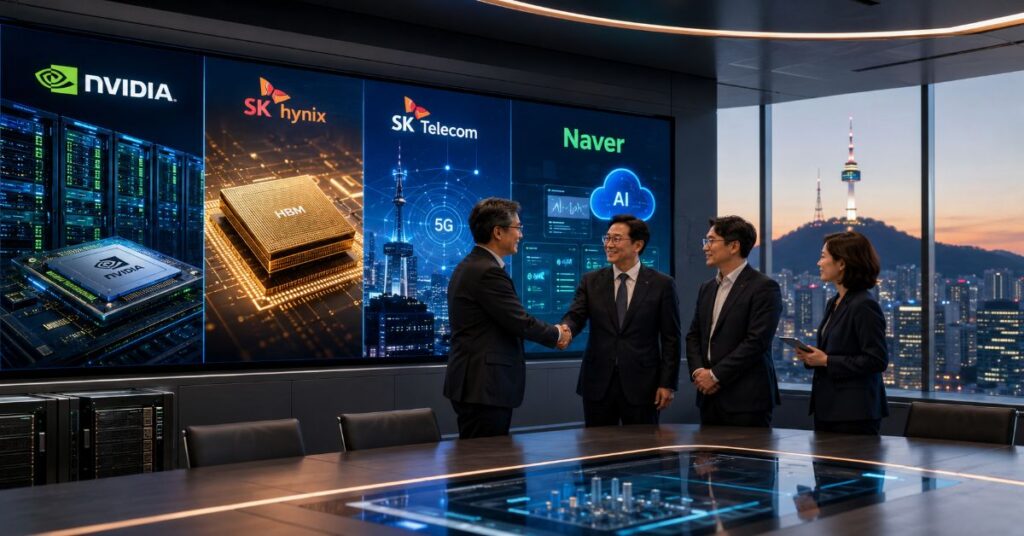
- Multi-company agreements announced June 8 in Seoul: NVIDIA CEO Jensen Huang announced a series of strategic AI agreements with major South Korean technology companies on June 8, 2026, during a high-profile visit to Seoul that began on June 5. The deals involve SK Hynix, SK Telecom, Naver, and Doosan Group. Financial terms were not disclosed by any of the parties. Huang met with SK Group Chairman Chey Tae-won at SK’s Seoul headquarters, with both executives confirming the deals publicly at a joint media briefing.
- SK Hynix named NVIDIA’s largest memory partner: SK Hynix — the world’s second-largest memory chip maker — signed a multi-year technology partnership with NVIDIA focused on co-developing advanced high-bandwidth memory (HBM) for global AI data centres. Huang confirmed that NVIDIA already purchases ‘billions and billions of dollars’ from SK Hynix each year and stated that this volume ‘is going to grow substantially.’ The partnership spans more than two years with extension options, making SK Hynix NVIDIA’s largest and most strategically committed memory supplier.
- SK Telecom commits to gigawatt-scale AI cloud by 2027: SK Telecom announced it will build a gigawatt-scale AI cloud infrastructure in South Korea using NVIDIA technology, with the first mega data centre slated to go live in 2027. The collaboration is structured as a full-stack AI cloud partnership based on NVIDIA’s DSX platform, spanning from chips to data centre operations. Naver and Doosan Group also confirmed agreements to use NVIDIA technology for AI data centre construction.
Technical Breakdown: What Each Partnership Delivers
The SK Hynix-NVIDIA memory partnership is the most strategically significant agreement in the June 8 announcement package because it addresses the binding constraint in NVIDIA’s ability to fulfil demand for its Blackwell and future GPU generations. High-bandwidth memory — the specialised DRAM stacked directly on GPU dies using through-silicon vias — is not a commodity component that NVIDIA can source from multiple interchangeable suppliers at the volumes required for AI data centre deployment. HBM is manufactured at production scale by three companies globally: SK Hynix, Samsung, and Micron. Of these, SK Hynix produces the HBM3E memory used in NVIDIA’s current H200 and B200 GPU platforms and has been the supplier most capable of meeting NVIDIA’s yield and delivery requirements at the pace of the AI infrastructure build-out.
The multi-year partnership with extension options transforms the SK Hynix-NVIDIA relationship from a vendor-customer transaction into a co-development programme. The agreement’s focus on ‘next-generation advanced memory solutions for NVIDIA GPUs’ indicates that SK Hynix engineers will be working alongside NVIDIA’s hardware teams to design the memory architecture for GPU generations beyond the current Blackwell platform — giving NVIDIA visibility and influence over the memory specifications that will define the performance envelope of its next-generation AI accelerators. An analyst at NH Investment and Securities characterised this shift as transforming memory chips from ‘a commodity product into a more customer-specific business.’
The SK Telecom gigawatt-scale AI cloud is the most infrastructure-significant commitment in the announcement. A gigawatt of AI data centre capacity — 1,000 megawatts of continuous power — represents a data centre footprint larger than most national AI infrastructure programmes. For context: Microsoft’s Project Stargate, one of the largest AI infrastructure commitments in the United States, targets approximately 100 megawatts of initial capacity. SK Telecom’s gigawatt target, structured as an AI factory model using NVIDIA’s DSX platform, is designed to serve not just SK Telecom’s internal AI workloads but to offer AI infrastructure as a service to Korean enterprises, government agencies, and potentially regional customers across Asia. The first data centre going live in 2027 sets the immediate commercial timeline.
Doosan Group’s role in the partnership adds a dimension that goes beyond the standard chip-and-cloud agreements. Doosan is developing robots and manufactures materials used in NVIDIA’s Blackwell chips — specifically substrate materials used in advanced packaging. The Doosan agreement includes deployment of Doosan’s energy solutions in NVIDIA data centre platforms and use of NVIDIA’s physical AI technology in Doosan’s robotics operations, creating a bidirectional technology relationship that extends NVIDIA’s reach into industrial AI and advanced manufacturing.
| Partner | Agreement Type | Primary Focus | Timeline | NVIDIA’s Gain |
| SK Hynix | Multi-year technology partnership + extension options | Co-develop next-gen HBM for AI data centres globally | 2+ years — already supplying billions/year | Secured largest memory supply chain; co-design influence on future GPU memory |
| SK Telecom | Full-stack AI cloud collaboration (NVIDIA DSX platform) | Build gigawatt-scale AI cloud — chips to data centre ops | First data centre 2027 | New hyperscale cloud customer; national AI infrastructure anchor in South Korea |
| Naver | AI data centre technology agreement | Use NVIDIA technology to build AI data centres | Not disclosed | Major internet platform adoption; Korean AI market presence |
| Doosan Group | Bilateral AI and energy agreement | Energy solutions for NVIDIA DCs; NVIDIA physical AI for Doosan robotics | Not disclosed | Industrial AI partner; advanced packaging material supply security |
Commercial and Enterprise Market Impact
The timing of Huang’s South Korea visit — coming alongside NVIDIA’s Computex 2026 announcements and the simultaneous global chip stock rout that saw Samsung shares fall 7.8% and SK Hynix shares drop 4.1% on June 8 before partial recovery — is commercially deliberate. NVIDIA is demonstrating that its demand for AI chips remains structurally robust regardless of short-term market volatility, and that its supply chain relationships with Korean memory manufacturers are deepening rather than diversifying away. When asked about the chip stock decline at a media briefing, Huang responded: ‘Everybody should be very excited; they can now buy stock at a cheaper price, and it’s absolutely true that the future of AI is very bright.’ The statement was simultaneously a market signal, a product pitch, and a supply chain confidence message.
For enterprise buyers evaluating AI infrastructure investments, the SK Telecom gigawatt AI cloud announcement establishes South Korea as a significant new Asian AI infrastructure hub to add to Japan, Singapore, and Australia as regional data centre options for enterprises with Asian operations. The full-stack nature of the SK Telecom partnership — covering chips, networking, data centre operations, and software through NVIDIA’s DSX platform — means it will be positioned as a turnkey enterprise AI infrastructure offering rather than raw colocation, making it directly competitive with AWS Korea, Azure Korea, and Google Cloud Korea for AI workloads.
“The SK Hynix deal is NVIDIA’s most important supply chain move since the Blackwell ramp-up began. Locking in a multi-year co-development partnership with billions in annual volume gives NVIDIA the memory supply certainty it needs to commit to the next GPU generation roadmap without worrying about HBM availability becoming the bottleneck. The extension options mean this relationship outlasts any individual product cycle.” — Semiconductor Industry Analyst, enterprise technology research, June 8, 2026
“Jensen Huang’s South Korea trip is the AI equivalent of a state visit. He is meeting chairmen, not procurement managers. The deals being struck at this level — gigawatt clouds, multi-year memory co-development — are infrastructure commitments that will shape the Korean AI market for the next decade. South Korea is positioning itself as the AI memory capital of the world, and NVIDIA is the anchor customer that makes that positioning credible.” — Asia Pacific Technology Infrastructure Analyst, institutional research, June 8, 2026
Frequently Asked Questions
What did NVIDIA announce in South Korea on June 8, 2026?
NVIDIA CEO Jensen Huang announced a series of strategic AI agreements with four South Korean companies during a visit to Seoul on June 8, 2026: a multi-year memory co-development partnership with SK Hynix (named NVIDIA’s largest memory partner), a gigawatt-scale AI cloud collaboration with SK Telecom (first data centre 2027), an AI data centre technology agreement with Naver, and a bilateral AI and energy agreement with Doosan Group. Financial terms were not disclosed by any party. Huang confirmed NVIDIA already purchases billions of dollars annually from SK Hynix and that this volume will grow substantially.
What is SK Telecom’s gigawatt-scale AI cloud and when will it launch?
SK Telecom’s gigawatt-scale AI cloud is a planned national AI infrastructure programme built on NVIDIA’s DSX platform, covering chips, networking, and data centre operations. The programme targets gigawatt-scale capacity — 1,000 megawatts of continuous power — making it one of the largest planned AI infrastructure programmes outside the United States. The first mega data centre is scheduled to go online in 2027. The cloud is designed to serve Korean enterprises, government agencies, and regional customers across Asia, positioning SK Telecom as an AI-as-a-service provider rather than just a telecommunications company.
Why did Samsung and SK Hynix shares fall on the day NVIDIA announced deals with SK Hynix?
Samsung shares fell 7.8% and SK Hynix shares fell 4.1% on June 8, 2026, as part of a broader global chip stock rout driven by separate market factors unrelated to the NVIDIA deals. The SK Hynix decline occurred despite the positive strategic partnership announcement, reflecting broader investor concerns about memory chip supply-demand dynamics and global semiconductor market conditions. Huang addressed the decline at his Seoul media briefing, stating: ‘Everybody should be very excited; they can now buy stock at a cheaper price, and it’s absolutely true that the future of AI is very bright.’ Both stocks partially recovered from their session lows by market close.
Sources
Reuters / Geo.tv. (2026, June 8). Nvidia clinches deals with South Korean giants including SK Group to advance AI boom. https://www.geo.tv/latest/667729-nvidia-clinches-deals-with-south-korean-giants-including-sk-group-to-advance-ai-boom
Reuters / Rappler. (2026, June 8). Nvidia clinches deals with South Korean giants including SK Group to advance AI boom. https://www.rappler.com/technology/nvidia-deals-south-korea-sk-group-artificial-intelligence/
Reuters / Investing.com. (2026, June 8). Nvidia announces deals with South Korea’s SK Hynix, Naver and Doosan for AI data centres. https://www.investing.com/news/stock-market-news/nvidia-announces-deals-with-south-koreas-sk-hynix-naver-and-doosan-for-ai-data-centres-4729739
Seoul Economic Daily. (2026, June 8). Breaking News: SK Telecom, Nvidia Launch Gigawatt-Scale AI Factory Project. https://en.sedaily.com/technology/2026/06/07/breaking-news-sk-telecom-nvidia-launch-gigawatt-scale-ai
YourNews. (2026, June 8). Nvidia Expands AI Chip Alliances in South Korea. https://yournews.com/2026/06/08/7039309/nvidia-expands-ai-chip-alliances-in-south-korea-as-ceo/
ResultSense. (2026, June 8). Nvidia signs sweeping AI deals with South Korean giants. https://www.resultsense.com/news/2026-06-08-nvidia-south-korea-ai-deals/
