
Summary of Major Developments
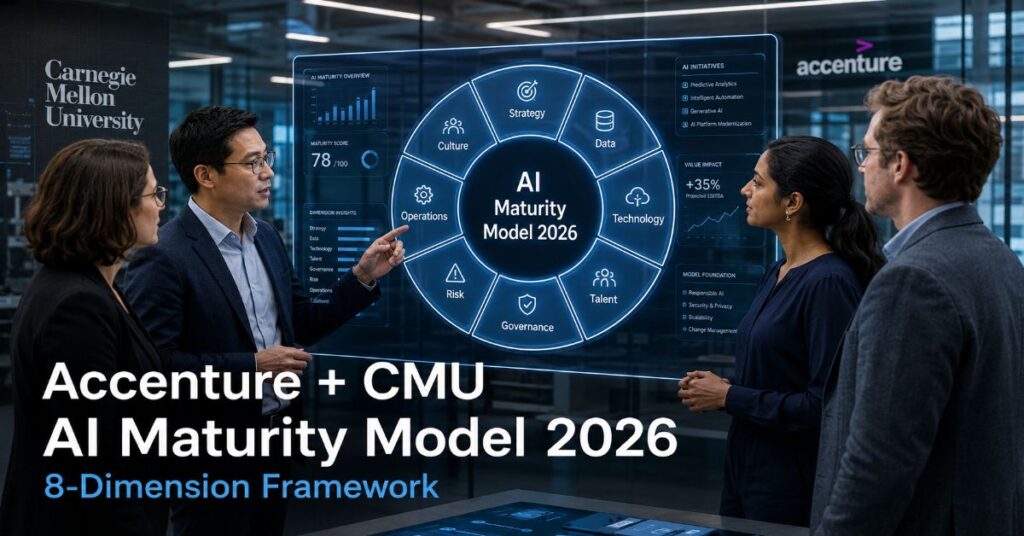
- AI Adoption Maturity Model v1.0 launched June 8: Accenture and the Carnegie Mellon University Software Engineering Institute (SEI) jointly launched the AI Adoption Maturity Model v1.0 on June 8, 2026. The model is an empirically validated framework developed through executive interviews, a systematic review of more than 100 existing AI maturity efforts worldwide, pilots with Fortune 500 companies, and an extensive industry survey. It is available for free download from the SEI Digital Library and is designed for both commercial enterprises and government organisations.
- The problem it solves: 86% raised budgets, 95% see no returns: The launch addresses a specific and well-documented enterprise AI failure pattern. 86% of C-suite leaders plan to increase AI spending in 2026 — but Accenture research shows that 95% of organisations are realising no measurable returns on their AI investments. Only 21% of organisations are redesigning end-to-end processes with AI at the core. In most cases, the barrier is not the technology — it is mismatched expectations, misaligned applications, and poorly executed implementation practices.
- Eight-dimension framework for measuring AI readiness: The AI Adoption Maturity Model assesses organisations across eight core dimensions: organisational strategy, workforce and culture, workflow re-engineering, risk and governance, data, engineering, operations, and ecosystem. These eight dimensions are designed to assess an organisation’s ability to perform and sustain specific technical practices to achieve two high-level goals: organisational change and AI lifecycle engineering. The model is free, publicly available, and is backed by an early adopter programme for organisations that want community engagement and feedback channels.
Technical Breakdown: What the Eight-Dimension Model Measures
The AI Adoption Maturity Model’s most significant architectural decision is its grounding in software engineering discipline rather than strategic aspiration. The SEI — the federally funded research and development centre behind the Capability Maturity Model (CMM) that defined software engineering quality standards from the 1990s onward — brings five decades of maturity modelling expertise to the AI adoption challenge. The original CMM transformed how the software industry measured and improved its engineering processes; the AI Adoption Maturity Model applies the same discipline to the enterprise AI implementation problem.
The eight dimensions address the full lifecycle of enterprise AI rather than the technical capability of AI models in isolation. Organisational strategy covers how AI goals align with business objectives and how AI investment decisions are made. Workforce and culture covers whether the organisation has the human capability and cultural readiness to adopt, use, and govern AI effectively. Workflow re-engineering assesses whether the organisation is redesigning its processes around AI capabilities rather than retrofitting AI into existing workflows. Risk and governance covers the policies, accountability structures, and monitoring mechanisms that ensure AI operates safely and compliantly.
The data dimension addresses the quality, governance, and accessibility of the data that AI systems depend on — a factor that Accenture’s implementation experience consistently identifies as the most common failure point in enterprise AI projects. The engineering dimension covers whether the organisation applies rigorous software engineering practices to AI system development, including testing, validation, version control, and deployment automation. The operations dimension assesses whether AI systems are monitored, maintained, and continuously improved in production rather than deployed and forgotten. The ecosystem dimension covers how the organisation manages its relationships with AI vendors, open source communities, and technology partners.
The model’s most commercially important finding from its Fortune 500 pilot validation is that most organisations attempting to scale AI are failing not because of technology limitations but because they are skipping the engineering discipline that makes AI systems trustworthy and resilient. The $250 billion in enterprise AI investment that Accenture estimates has generated no measurable return in 2026 reflects projects where AI was selected for its capabilities without an assessment of whether the organisation had the engineering practices, data infrastructure, and governance structures to sustain it in production. The maturity model is designed to surface these gaps before investment is committed rather than after it is lost.
| Dimension | What It Measures | Common Failure Pattern |
| 1. Organisational Strategy | Alignment of AI goals with business objectives; AI investment decision quality | AI initiatives without clear business outcome metrics or executive ownership |
| 2. Workforce and Culture | Human capability, AI literacy, and cultural readiness for AI adoption | Technical AI deployment without training, change management, or adoption support |
| 3. Workflow Re-engineering | Whether processes are redesigned around AI rather than retrofitted | AI added to existing workflows without process redesign — marginal gains only |
| 4. Risk and Governance | Policies, accountability, and monitoring for safe, compliant AI | No governance framework — AI deployed without risk assessment or compliance review |
| 5. Data | Data quality, governance, accessibility, and lineage for AI systems | Poor data quality or inaccessible data — most common AI project failure point |
| 6. Engineering | Rigorous software engineering applied to AI: testing, validation, CI/CD | AI systems not tested, validated, or version-controlled — production failures |
| 7. Operations | Production monitoring, maintenance, and continuous improvement of AI | AI deployed then forgotten — model drift and performance degradation undetected |
| 8. Ecosystem | Vendor relationships, open source engagement, technology partner governance | Single-vendor lock-in or unmanaged open source dependencies — strategic risk |
Commercial and Enterprise Market Impact
The timing of the Accenture-CMU model launch is commercially calibrated. The IBM AI control gap study published the same day confirms that 77% of organisations’ AI adoption is already outpacing their governance capabilities. The Linux Foundation’s European report published the same day confirms that security and privacy concerns are the top barrier to AI adoption. The Accenture-CMU maturity model provides the diagnostic tool that connects these findings to a remediation pathway — giving enterprise CIOs a structured methodology for identifying which of the eight dimensions are creating their specific control, governance, or adoption gaps.
The free public availability of the model is a deliberate commercial strategy for both Accenture and the SEI. Accenture benefits from enterprises using the framework to discover their AI maturity gaps, because those gaps create consulting engagement opportunities for Accenture to address them. The SEI benefits from the model being adopted as a standard, extending the CMU Software Engineering Institute’s quality model legacy into the AI era. For enterprise technology buyers, the free availability means there is no cost barrier to using the model as a starting point for an internal AI maturity assessment — the question is whether the organisation has the internal capability to conduct a rigorous self-assessment or needs external facilitation.
“The Accenture-CMU model does something that most AI maturity frameworks avoid: it tells you specifically what you need to be able to do, not just what strategic posture you should adopt. Strategy frameworks tell you to ’embrace AI’ or ‘build a data culture.’ The maturity model tells you that if you cannot version-control your AI models or monitor them in production, you are at level one engineering maturity and you will experience production failures. That specificity is what makes it useful.” — Enterprise AI Programme Director, Fortune 500 manufacturing company, June 8, 2026
“The 95% no-returns figure from Accenture’s research is the number that every board presenting an AI strategy needs to engage with. It means that the current approach to enterprise AI investment — selecting a model, building a proof of concept, declaring success — is not working. The organisations seeing returns are the 5% who have done the unglamorous work of redesigning processes, building data foundations, and applying engineering discipline to AI deployment. The maturity model is a map to that 5%.” — Enterprise Digital Transformation Analyst, management consulting research, June 8, 2026
Frequently Asked Questions
What is the Accenture and Carnegie Mellon AI Adoption Maturity Model?
The AI Adoption Maturity Model v1.0 is an empirically validated framework jointly developed by Accenture and Carnegie Mellon University’s Software Engineering Institute (SEI), launched on June 8, 2026. It provides a structured approach for commercial enterprises and government organisations to assess their AI readiness across eight dimensions: organisational strategy, workforce and culture, workflow re-engineering, risk and governance, data, engineering, operations, and ecosystem. The model is free to download from the SEI Digital Library and is backed by an early adopter programme. It was developed through executive interviews, review of 100+ existing AI maturity frameworks, Fortune 500 pilot testing, and industry surveys.
Why are 95% of organisations seeing no return on their AI investments?
Accenture’s research accompanying the maturity model launch finds that while 86% of C-suite leaders increased AI budgets in 2026, 95% of organisations are realising no measurable returns. Only 21% of organisations are redesigning end-to-end processes with AI at the core. Accenture’s analysis identifies three primary causes of the return gap: mismatched expectations (AI is selected for its capabilities without assessing organisational readiness), misaligned applications (AI is deployed on the wrong problems or without clear business outcome metrics), and poorly executed implementation practices (lack of engineering rigour, data quality, and governance). The maturity model is designed to diagnose these gaps before investment is committed.
How can an enterprise use the AI Adoption Maturity Model?
The model is available as a free PDF download from the CMU SEI Digital Library at sei.cmu.edu/library/ai-adoption-maturity-model/. Organisations can use it to conduct an internal self-assessment across the eight dimensions, identify the specific capability gaps creating their AI adoption challenges, and build a roadmap for addressing those gaps in priority order. Accenture provides facilitated assessments through its consulting practice for organisations that need external facilitation. An early adopter programme is available for organisations that want to engage with the model’s ongoing development, provide feedback, and join the community of practice.
Sources
Accenture / BusinessWire. (2026, June 8). Accenture and the Carnegie Mellon University Software Engineering Institute Launch AI Adoption Maturity Model. https://www.businesswire.com/news/home/20260608890124/en/Accenture-and-the-Carnegie-Mellon-University-Software-Engineering-Institute-Launch-AI-Adoption-Maturity-Model-to-Help-Organizations-Scale-AI-with-Predictable-Outcomes
CMU SEI / PRNewswire. (2026, June 8). SEI and Accenture Release AI Adoption Maturity Model to Help Organizations Scale AI with Predictable Outcomes. https://www.prnewswire.com/news-releases/sei-and-accenture-release-ai-adoption-maturity-model-to-help-organizations-scale-ai-with-predictable-outcomes-302793088.html
CMU SEI Digital Library. (2026, June 8). The AI Adoption Maturity Model v1.0. https://www.sei.cmu.edu/library/ai-adoption-maturity-model/
Accenture Newsroom. (2026, June 8). Accenture and CMU SEI Launch AI Adoption Maturity Model. https://newsroom.accenture.com/news/2026/accenture-and-the-carnegie-mellon-university-software-engineering-institute-launch-ai-adoption-maturity-model-to-help-organizations-scale-ai-with-predictable-outcomes
Yahoo Finance / PRNewswire. (2026, June 8). SEI and Accenture Release AI Adoption Maturity Model. https://finance.yahoo.com/sectors/technology/articles/sei-accenture-release-ai-adoption-120500639.html
StockTitan / ACN. (2026, June 8). Accenture, SEI launch AI Adoption Maturity Model. https://www.stocktitan.net/news/ACN/accenture-and-the-carnegie-mellon-university-software-engineering-si4ti67efjpf.html
MarketScreener. (2026, June 8). Accenture and Carnegie Mellon University Software Engineering Institute Launch AI Adoption Maturity Model. https://www.marketscreener.com/news/accenture-and-carnegie-mellon-university-software-engineering-institute-launch-ai-adoption-maturity-ce7f5dd3d98af120
