
Summary of Major Developments
- First-ever State of Tech Talent Europe report published June 8: The Linux Foundation, in partnership with LF Research, released its inaugural 2026 State of Tech Talent Europe report on June 8, 2026. The report, produced in Brussels, surveys European organisations on AI deployment, technology recruitment, and skills gaps. It is the European counterpart to the Linux Foundation’s annual global State of Tech Talent report and represents the first dedicated European data set on AI’s impact on technology employment at regional scale.
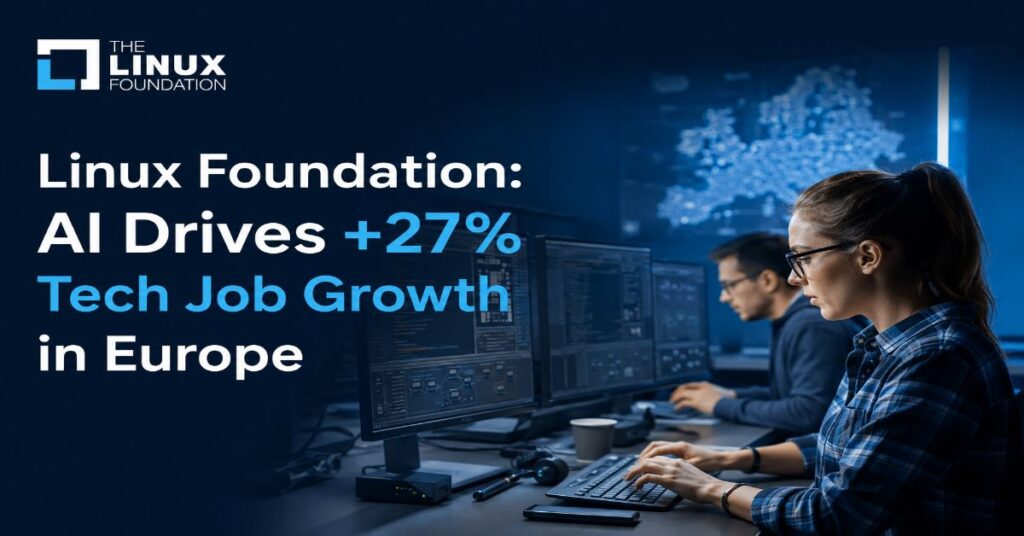
- AI is a net driver of tech job creation — not displacement: Contrary to dominant fears about AI-driven workforce displacement, the report’s headline finding is that AI is a net driver of IT job creation in Europe. European organisations project a positive net hiring effect of +27% in 2026 and +17% in 2027, driven by AI deployment creating demand for new technical roles faster than it eliminates existing ones. The report explicitly states that AI-related layoffs are primarily concentrated at companies with more than 20,000 employees and do not reflect the overall European technology employment picture.
- Upskilling beats external hiring 3.7x across strategic tech domains: 63% of European organisations identify upskilling existing staff as their primary response to AI-created talent gaps — ahead of external hiring (59%). Organisations are 3.7 times more likely to upskill than to hire across strategic technological domains. The preference for upskilling is driven by specific advantages: upskilling outperforms hiring for understanding business context (7.9x advantage), team cohesion (6.3x), total cost (5.8x), and staff retention (5.6x).
Technical Breakdown: Where AI Is Creating Jobs and What Skills Are in Demand
The Linux Foundation’s positive employment picture for European technology workers requires contextual framing to be correctly interpreted. The +27% net hiring effect is a projected figure based on organisational survey responses about expected hiring plans, not a measured outcome from completed recruitment cycles. It represents the aggregated balance of expected new hires and expected role eliminations across European organisations deploying AI — and it is a net figure, meaning that individual organisations may be simultaneously expanding in AI-related roles while reducing headcount in roles that AI has automated. The net figure is positive, but it obscures significant variation across organisation size, sector, and AI maturity.
The sectoral breakdown of job creation demand reveals where the AI employment opportunity is concentrated. Demand for AI-specific technical roles is growing fastest in AI and machine learning engineering and operations — where 68% of organisations already report being understaffed. Cybersecurity and compliance are the second most understaffed area at 65%, driven by the security and privacy concerns that the report identifies as the top barrier to AI adoption for European organisations. FinOps and cost optimisation follow at 61%, cloud computing at 59%, and platform engineering at 56%. These are the domains where European organisations are actively trying to hire and consistently failing to find sufficient qualified candidates.
Security and privacy have emerged as the top barrier to new technology adoption for European organisations — displacing budget constraints, which held the top position in previous surveys. This shift reflects the combination of the EU AI Act’s implementation timeline (key obligations taking effect through 2026 and 2027), GDPR’s ongoing enforcement pressure, and the specific security risks associated with AI systems that process sensitive data. 54% of European organisations identify open source as their top strategy for implementing AI, citing reduced licensing costs and reduced vendor lock-in risk — a finding that reflects both the cost sensitivity of European enterprise procurement and the sovereignty concerns that have driven European preference for technology independence from US cloud providers.
The upskilling-over-hiring preference — 3.7 times more likely across strategic domains — is the finding that has the most direct implication for enterprise talent strategy. The advantages IBM quantifies go beyond cost: organisations that upskill existing staff for AI roles retain institutional knowledge about business context, industry-specific processes, and regulatory requirements that external AI talent hires lack. A data scientist hired from a general AI talent pool does not know a manufacturing company’s quality control processes, a bank’s regulatory reporting requirements, or a hospital’s clinical workflow constraints. An existing employee trained in AI has that context from day one. At a 7.9x advantage in business context retention, the upskilling case is overwhelming for organisations with high process complexity or regulatory exposure.
| Finding | European Data (2026) | Global Comparison | Enterprise Implication |
| Net tech hiring effect from AI | +27% in 2026 | +34% globally | AI is creating more tech jobs than it eliminates in Europe |
| Net tech hiring effect forecast | +17% in 2027 | +25% globally | Multi-year positive trend — not a one-time spike |
| Primary talent gap response | Upskilling (63%) | Consistent with global trend | Internal development preferred over external recruitment |
| Upskill vs hire likelihood | 3.7x more likely to upskill | Not separately reported for global | Institutional knowledge retention driving preference |
| Business context advantage (upskill) | 7.9x vs external hire | Not separately reported | Most understaffed domain: AI/ML engineering (68%) |
| Top AI adoption barrier | Security and privacy concerns | Budget constraints globally | EU regulatory environment elevating security priority |
| Open source AI strategy adoption | 54% of European organisations | Lower globally | Sovereignty and cost concerns driving open source preference |
| AI-specific role demand growth | High — fastest growing category | Consistent globally | AI talent gap widening faster than hiring can close it |
Commercial and Enterprise Market Impact
The Linux Foundation’s report arrives at a moment when European enterprise CIOs face simultaneous pressure from three directions: accelerating AI deployment mandates from CEOs and boards, tightening EU regulatory requirements under the AI Act and GDPR, and a talent market where the specific skills needed to implement AI securely and compliantly are in critically short supply. The +27% net hiring effect projected for 2026 is encouraging at the aggregate level, but it does not close the gap between AI deployment ambitions and AI implementation capability — because the new roles being created are specialist positions that take months to recruit and onboard, while the AI deployment mandates are arriving now.
The security and privacy barrier finding has specific commercial implications for enterprise AI vendors selling into the European market. Features and capabilities that are standard selling points in the US market — cloud-based AI processing, third-party model routing, continuous data learning from user interactions — face heightened scrutiny from European enterprise buyers who are concerned about GDPR compliance, AI Act obligations, and data sovereignty. European enterprise AI procurement cycles will increasingly require vendors to provide privacy impact assessments, data processing agreements, and EU AI Act conformity documentation as standard procurement deliverables rather than optional additions.
“The upskilling preference in European enterprises is not just a cost decision — it is a regulatory compliance strategy. An AI specialist hired from the general market does not come with pre-loaded knowledge of your company’s data classification policies, your industry’s regulatory reporting requirements, or your organisation’s AI governance framework. At 7.9 times the advantage in business context, upskilling is not just cheaper — it is safer from a compliance perspective.” — European Enterprise AI Adoption Specialist, technology talent advisory, June 8, 2026
“The security and privacy barrier overtaking budget as the top AI adoption concern is the most significant finding in the Linux Foundation’s European report. It means that European enterprise AI budgets are not the binding constraint — trust and compliance capability are. Vendors who solve for security and privacy first will close European enterprise deals that competitors with technically superior products are losing.” — Enterprise Technology Sales Analyst, European market research, June 8, 2026
Frequently Asked Questions
Is AI creating or eliminating jobs in European technology organisations?
According to the Linux Foundation’s 2026 State of Tech Talent Europe report, AI is a net creator of technology jobs in Europe. European organisations project a positive net hiring effect of +27% in 2026 and +17% in 2027 from AI deployment. The report notes that AI-related layoffs are primarily concentrated at companies with more than 20,000 employees and do not represent the overall European technology employment picture. AI is eliminating some roles while creating demand for new AI-specific technical roles — but the net balance is positive at the regional level. Globally, the net hiring effect is slightly higher at +34% for 2026.
Why are European organisations choosing to upskill existing staff instead of hiring AI talent externally?
The Linux Foundation’s report finds that organisations are 3.7 times more likely to upskill existing staff than hire externally across strategic technological domains. The advantages of upskilling over external hiring include: business context understanding (7.9x advantage — existing staff know company processes and industry requirements), team cohesion (6.3x), total cost (5.8x), and staff retention (5.6x). Security and privacy concerns also favour upskilling: existing staff are already trained on data classification policies, regulatory requirements, and governance frameworks that external AI hires must learn from scratch.
What is the biggest barrier to AI adoption for European organisations in 2026?
Security and privacy concerns have become the top barrier to AI adoption for European organisations in 2026, displacing budget constraints from the top position in previous surveys. This reflects the combined pressure of EU AI Act implementation obligations (key requirements taking effect through 2026 and 2027), GDPR enforcement, and the specific privacy risks associated with AI systems that process sensitive personal data. 54% of European organisations identify open source as their primary AI implementation strategy, citing reduced licensing costs and reduced vendor lock-in risk as drivers — reflecting both cost sensitivity and European data sovereignty concerns.
Sources
Linux Foundation / PRNewswire. (2026, June 8). New Linux Foundation Report Finds AI is Driving Positive Tech Hiring Trends in Europe Amid Growing Security and Skills Gaps. https://www.prnewswire.com/news-releases/new-linux-foundation-report-finds-ai-is-driving-positive-tech-hiring-trends-in-europe-amid-growing-security-and-skills-gaps-302793382.html
Linux Foundation. (2026, June 8). 2026 State of Tech Talent Europe report. https://www.linuxfoundation.org/press/new-linux-foundation-report-finds-ai-is-driving-positive-tech-hiring-trends-in-europe-amid-growing-security-and-skills-gaps
TechRadar. (2026, June 8). AI could actually be driving positive tech job growth in Europe. https://www.techradar.com/pro/ai-could-actually-be-driving-positive-tech-job-growth-in-europe-but-still-presents-growing-security-risks-and-skills-gap
Techzine Global. (2026, June 8). AI actually boosts demand for tech talent, says Linux Foundation. https://www.techzine.eu/news/devops/141907/ai-actually-boosts-demand-for-tech-talent-says-linux-foundation/
Linux Foundation. (2026). 2026 State of Tech Talent Europe — full report download. https://www.linuxfoundation.org/research/open-source-jobs-report-2025
