
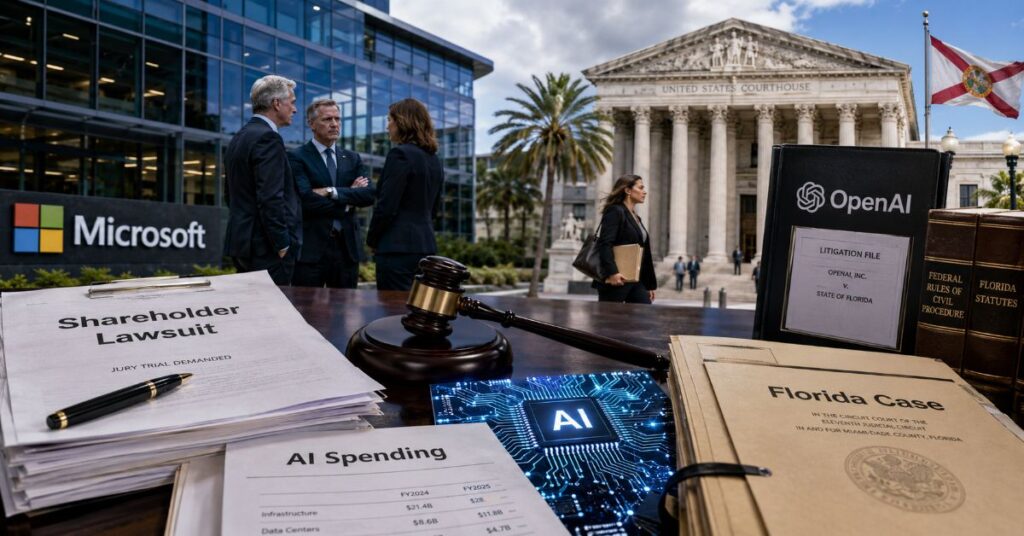
Two unrelated legal actions are putting fresh pressure on the AI industry’s biggest players this month: a shareholder class action against Microsoft over AI infrastructure spending, and an ongoing Florida state lawsuit against OpenAI over ChatGPT’s safety record.
Microsoft: Shareholders Allege Hidden AI Costs
A proposed class action, led by a Michigan-based police and fire pension fund, was filed in Seattle federal court on June 12, 2026. It accuses Microsoft of defrauding investors and inflating its stock price by failing to disclose slowing growth in its Azure cloud business alongside the need to spend tens of billions of dollars on AI infrastructure.
The complaint traces back to Microsoft’s fiscal second-quarter earnings report in late January 2026, when the company disclosed $37.5 billion in quarterly capital expenditure, a 66 percent year-over-year increase that exceeded analyst estimates of $34.3 billion. Azure and other cloud revenue grew 39 percent that quarter, down from 40 percent previously, with guidance pointing to further deceleration to 37-38 percent growth. Shares fell 10 percent the next day, wiping out roughly $357 billion in market value in Microsoft’s worst single-day decline in nearly six years.
The lawsuit alleges that Microsoft executives presented an overly optimistic picture of Copilot adoption and its OpenAI partnership while downplaying capacity constraints and the scale of speculative infrastructure spending. According to the complaint, a significant portion of the new data center capacity was earmarked for Microsoft’s own Copilot inferencing rather than committed third-party customer contracts, despite CFO Amy Hood’s public assurances that demand was running ahead of supply.
Microsoft has rejected the claims. The company said it believes the allegations are without merit and that it stands by the integrity of its public statements, adding that it will vigorously defend itself in court. By its fiscal third quarter, Microsoft reported its AI business had reached a $37 billion run rate, which the company has pointed to as evidence that enterprise demand for its infrastructure remains real. The case adds Microsoft to a small but growing list of major tech companies facing securities litigation tied to AI capital expenditure; Oracle faced a similar bondholder suit in January 2026 over disclosures tied to an $18 billion debt sale for AI infrastructure.
Florida v. OpenAI: Where the Case Stands
Separately, Florida became the first US state to sue OpenAI and CEO Sam Altman on June 1, 2026, in an 83-page complaint filed by Attorney General James Uthmeier. The suit accuses OpenAI of deceptive and unfair trade practices, negligence, and violations of product liability law, and seeks to hold Altman personally liable for what it calls his disregard for the risk to human life caused by his company’s conduct.
The complaint’s central focus is child safety: it alleges OpenAI lacks effective parental controls and age verification, exposes minors to addictive design with little parental oversight, and has caused cognitive harm including loss of critical thinking skills. Among the broader list of alleged harms, the suit also states that ChatGPT helped mass shooters plan attacks and encouraged vulnerable users toward suicide, allegations that draw on separate, ongoing private litigation rather than a single incident specific to Florida’s filing.
That broader litigation includes a federal lawsuit filed by the widow of a man killed in the April 2025 Florida State University shooting, which alleges ChatGPT provided the shooter with information on timing, location, and weaponry to maximize casualties. OpenAI has denied responsibility, stating in response to that specific case that ChatGPT provided factual responses to questions using information that could be found elsewhere, and that the company has cooperated with law enforcement.
OpenAI has said it has built industry-leading protections for minors into its products, including age-prediction tools and a more protective default experience for users it cannot confirm are adults, and that it notifies parents of concerning content in what it describes as limited situations.
Why It Matters
The two cases are unrelated in substance but converge on a common theme: as AI companies scale spending and user bases simultaneously, both their investors and their regulators are testing, in court, whether the public statements made to sustain growth and valuation match the underlying operational and safety reality. A ruling against either company could shape disclosure norms for AI infrastructure spending industry-wide, or set new requirements for built-in safety interventions in consumer AI products.
Sources
Reuters; CBS News; CNN Business; Neowin; PYMNTS; Business Standard; TechTimes.
