
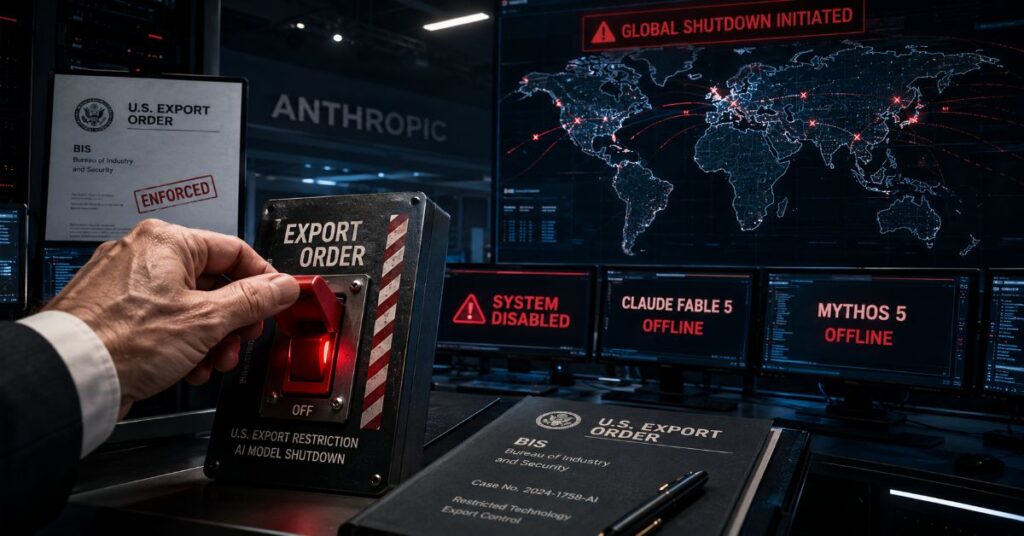
On June 9, 2026, Anthropic made Claude Fable 5 and Claude Mythos 5 generally available, describing the pair as its most capable models to date. Three days later, on the evening of June 12, the company received a US government export-control directive that forced it to disable both models for every customer on Earth, including its own foreign-national employees. The episode has become one of the first clear examples of an AI model being pulled from the market by government order, and it has triggered a sharp debate in Europe and Canada about dependence on US-controlled AI infrastructure.
What the Directive Said
According to Anthropic’s own account, the directive arrived at 5:21 p.m. ET on June 12, 2026, citing national security authorities. It ordered the company to suspend access to Fable 5 and Mythos 5 for any foreign national, whether located inside or outside the United States, including foreign nationals employed by Anthropic itself.
Because Anthropic could not verify a user’s citizenship in real time, the only way to comply within the directive’s timeline was to disable both models entirely, for all customers worldwide. Other Claude models, including Opus 4.8, were unaffected and remained fully operational throughout.
Reporting since the directive landed has filled in the backstory. According to Reuters and other outlets, Amazon CEO Andy Jassy was among those who raised concerns with the Trump administration after Amazon researchers identified a way to bypass Fable 5’s safety guardrails. Anthropic has pushed back hard on the framing, stating that the jailbreaking technique in question could only be used to find simple vulnerabilities that even older, less capable models could already spot, and that Fable 5’s safeguards remain substantially more effective than those of any previously deployed model.
Timing and Stakes
The order landed at a sensitive moment for Anthropic. The company had confidentially filed for a public listing, with a recent funding round valuing it at roughly $965 billion. A government export action targeting two of its flagship products, days after their public release, raises questions for prospective investors about whether Anthropic can continue operating at the frontier of AI development if its models remain subject to abrupt government intervention.
Anthropic posted a public apology on X, stating it believes the situation reflects a misunderstanding and that it is working to restore access as soon as possible. The company has since sent technical and policy staff to Washington to negotiate directly with Commerce Department and national security officials, and Anthropic CEO Dario Amodei is expected to raise the matter directly with other heads of state and AI executives at a G7 working lunch.
Europe’s Reaction: A Sovereignty Wake-Up Call
The reaction abroad has been pointed. Finnish MEP Aura Salla said Europe “cannot continue to increase its technical potential by relying on access that can be turned off by a foreign government overnight”. The timing sharpened the point: the European Commission had published its Technological Sovereignty Package, including a Cloud and AI Development Act, on June 3, just nine days before the shutdown.
The European Commission said on June 14 that it is assessing the practical implications of the directive for EU users. Commission spokesperson Thomas Regnier said contingency measures of this kind “should not be discriminatory against partners,” and added that the episode “further underlines Europe’s need for technological sovereignty,” pointing to the EU’s existing AI Act, Cyber Resilience Act, and NIS2 Directive as tools meant to manage exactly this kind of risk.
French political figures, including National Rally leader Jordan Bardella, called the episode a wake-up call for Europe, urging support for Paris-based Mistral AI, widely regarded as the EU’s most credible homegrown alternative to Anthropic and OpenAI, though one that still lacks the raw performance of frontier US models. Mistral CEO Arthur Mensch has previously argued that AI infrastructure needs an off switch under domestic, not foreign, control.
UK officials voiced similar concerns. Kanishka Narayan, the UK’s minister for AI and online safety, noted that the most advanced AI in the world was cut off from everyone in Britain by a decision made in another country, while British MP Tom Tugendhat said dozens of UK hospitals and companies using the model for research lost access overnight. Canadian Prime Minister Mark Carney, speaking ahead of the G7 summit, framed the episode as a lesson in the risks of overreliance on a small number of American AI providers.
Why It Matters
Export controls on physical goods like semiconductors require manufacturing and shipping; a model, by contrast, can be accessed through an API from anywhere on Earth, which is what made this directive’s effect binary and immediate rather than gradual. For governments and enterprises outside the US, the episode has reframed a previously abstract policy debate, AI sovereignty, into a concrete operational risk: the world’s most capable AI models can be disabled overnight by decisions made in Washington, with no advance warning to the millions of users affected. Other Claude models remained available throughout, which is its own reminder that even Anthropic’s broader lineup is subject to the same regulatory exposure going forward.
Sources
Anthropic; Reuters; CNBC; Fortune; Al Jazeera; Euronews; Business Standard; Artificial Intelligence News; BankInfoSecurity.
