
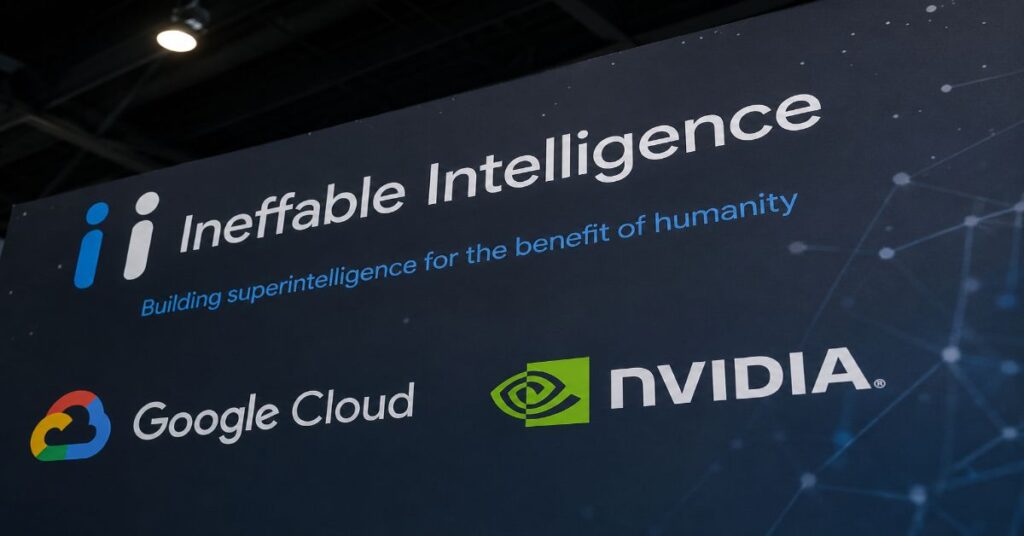
A company with no released product, no revenue, and no public roadmap just became one of the best-resourced AI labs in Europe, backed by Google, Nvidia, and the UK government. That tension sits at the center of the David Silver story unfolding out of London this week.
Six weeks after closing the largest seed round in European history, Ineffable Intelligence has named Google Cloud as the infrastructure partner for its bet on what founder David Silver calls a “superlearner” — an AI system designed to discover knowledge from its own experience rather than from text scraped off the internet. The deal, struck at Google Cloud’s London summit on June 16, 2026, gives Silver’s year-old company access to one of the largest clusters of Nvidia’s forthcoming Vera Rubin GPUs committed to any single customer so far — hardware that has not yet shipped to most buyers.
For a lab that will not have a model to show outside researchers until late this year at the earliest, the announcement says less about what Ineffable has built than about how much the AI industry is now willing to commit before there is anything to test.
What Happened
Google Cloud and Ineffable Intelligence announced the partnership at the Google Cloud Summit in London — the same city where Silver, a University College London professor and the researcher who led Google DeepMind’s reinforcement-learning group for more than a decade, built his new venture. Under the agreement, Ineffable will run on Google’s A5X instances, the cloud provider’s bare-metal offering built around Nvidia’s Vera Rubin NVL72 platform, according to the companies’ joint announcement. Both sides describe the deployment as one of the largest Vera Rubin clusters committed to a single customer to date.
Silver framed the choice as one about systems integration rather than chip counts. “We evaluated the space and chose Google Cloud as the best fit for our reinforcement learning infrastructure,” he said, adding that the lab needed “a resilient and scalable environment” rather than simply more processors. Google Cloud chief executive Thomas Kurian cast the deal as validation of the company’s full-stack approach, saying Ineffable would draw on “our full-stack AI Hypercomputer, from Jupiter networking to our optimized storage.”
Tuesday’s announcement builds on, rather than replaces, an earlier infrastructure relationship. Nvidia and Ineffable announced an engineering-level collaboration on May 13 to co-design the hardware and software pipeline reinforcement-learning systems will need at scale, with Nvidia chief executive Jensen Huang describing “superlearners” as the next frontier of AI. This week’s deal effectively tells the industry where that partnership will physically run.
The Mechanism: Why Infrastructure Looks Different for a “Superlearner”
The technical distinction driving the deal is what Ineffable calls experience-based learning, as opposed to the static-dataset training behind every major large language model on the market today. Systems like ChatGPT, Claude, and Gemini are trained primarily by predicting patterns in vast quantities of human-written text; once training ends, the model’s knowledge is fixed until a new version is built. A superlearner, in Silver’s framing, would instead generate its own experience, evaluate the outcome, and update continuously — closer to how AlphaZero taught itself chess, shogi, and Go from nothing but the rules, without studying a single human game.
That shift carries real infrastructure consequences. A model trained once on a fixed dataset can be trained in discrete batches and served separately afterward. A system that is constantly generating, evaluating, and learning from new experience needs training and inference tightly coupled in close to real time, with networking and storage built to avoid stalling the loop between an action and the model updating on its result. That is the gap Google Cloud is positioning its AI Hypercomputer architecture to fill, bundling GPUs with its proprietary Jupiter networking fabric rather than offering raw chip rental.
Nvidia’s hardware is central to that pitch, and not every cloud rival is responding the same way. Google is anchoring Ineffable’s entire build on Nvidia’s unreleased Vera Rubin platform, due to begin reaching cloud partners in the second half of 2026, while Microsoft has been pushing in a different direction with its own custom silicon — the Maia 200 inference chip — specifically to reduce its dependence on any single GPU supplier. Google’s choice to anchor a flagship reinforcement-learning lab to Nvidia hardware shows how central the chipmaker remains to the highest-profile AI infrastructure bets, even as rivals try to diversify away from it.
The Backstory
Silver’s credibility in this space rests on a specific scientific track record. He spent more than a decade at Google DeepMind leading its reinforcement-learning research, work that produced AlphaGo, the program that beat the world’s top-ranked Go player in 2016, and AlphaZero, which taught itself chess, shogi, and Go purely through self-play. In a paper written with longtime collaborator Richard Sutton, titled “The Era of Experience,” Silver argued that the next leap in AI capability would come from systems that learn predominantly through their own interaction with an environment rather than from human-generated data — the theoretical groundwork for what Ineffable is now trying to build commercially.
Silver left DeepMind in January 2026, having founded Ineffable in London two months earlier, and the company spent the following months raising capital that outpaced its own product timeline. By April 27, the lab had closed a $1.1 billion seed round at a $5.1 billion valuation, the largest seed round in European history, co-led by Sequoia Capital and Lightspeed Venture Partners with participation from Nvidia, Google, Index Ventures, and the UK’s Sovereign AI Fund, alongside roughly $20 million from the British Business Bank. The round closed despite Ineffable having no released product, no revenue, and no public roadmap — a detail that has become a recurring feature of how frontier researchers are now being funded.
Ineffable is one of several labs founded in the past year by senior researchers who left Google DeepMind or Meta to build independent ventures, a pattern that drew $18.8 billion in venture funding into newly founded AI startups across 2026, more than the $27.9 billion raised the prior year, according to Dealroom data. Tim Rocktäschel, another DeepMind alumnus, has separately sought up to $1 billion for his own venture, Recursive Superintelligence, while Yann LeCun’s AMI Labs closed a $1.03 billion round in March after he stepped down as Meta’s chief AI scientist. Nvidia has positioned itself at the center of nearly all of these bets, part of a broader pattern in which the chipmaker has funneled more than $40 billion into AI equity stakes and infrastructure deals in 2026 alone, spreading its exposure across model developers, chip partners, and now researchers betting against the dominant model-training paradigm entirely.
Reactions
For Google Cloud, landing Ineffable is as much a signaling exercise as a commercial one. Kurian’s comments framed the deal as evidence that frontier labs are choosing Google’s infrastructure at a moment when Microsoft Azure, AWS, and Oracle are all competing aggressively for the same small pool of marquee AI customers. Huang, for his part, has described the Ineffable relationship in scientific rather than purely commercial terms since May, calling the partnership an effort to “codesign the infrastructure for large-scale reinforcement learning” as the industry pushes “the frontier of AI.”
Silver has tied the company’s mission to a personal pledge rather than a typical founder narrative, telling press that any financial gains he personally makes from Ineffable will go to high-impact charities — a commitment reported as among the largest of its kind made through the Founders Pledge network. That framing has shaped how the deal is being read in London specifically: less as a startup landing cloud credits, and more as a UK-based scientist trying to convert decades of DeepMind research into infrastructure built to outlast any single funding cycle.
The Dispute: How Much Does Pedigree Alone Buy?
Not everyone treats the scale of Ineffable’s backing as proof of anything beyond investor appetite. The lab’s $5.1 billion valuation rests on Silver’s reputation and a research thesis, not a working product; the company has indicated its first model benchmarks are not expected until late 2026 at the earliest, meaning outside observers will have no way to evaluate whether the superlearner approach works for the better part of a year after this infrastructure deal closes.
That gap between funding and output is not unique to Ineffable, and recent history suggests it does not always resolve cleanly. Mira Murati’s Thinking Machines Lab raised a $2 billion seed round in 2025 with a similarly star-studded team, only to see several co-founders depart in 2026, with some returning to the very labs — Meta and OpenAI — they had left. Whether Ineffable’s reinforcement-learning thesis proves durable, or whether the lab follows a similar arc once the work moves from recruiting pitch to research grind, is precisely what a seed round, however large, cannot settle in advance.
There is also a structural question underneath the infrastructure choice itself: Ineffable is betting on Vera Rubin hardware that has not yet shipped at scale, on a cloud provider’s still-maturing Hypercomputer stack, and on a training paradigm that has so far been demonstrated mainly in constrained domains like board games rather than open-ended real-world tasks. Each of those is, on its own, an open engineering question that this week’s announcement does not resolve.
What Happens Next
The near-term timeline is concrete on at least one point: Vera Rubin systems are expected to begin reaching cloud partners, including Google Cloud, in the second half of 2026, which means Ineffable’s deployment will likely scale gradually rather than arrive as one completed cluster. Silver’s own public statements point to model benchmarks emerging no earlier than late 2026, the first moment outside researchers will have concrete evidence to evaluate the superlearner approach against. Google Cloud, meanwhile, gets to use Ineffable as a reference deployment while courting other reinforcement-learning labs weighing the same infrastructure choice Silver just made publicly. For the UK, the deal adds to a deliberate government push — including the Sovereign AI Fund’s stake in Ineffable’s seed round — to keep DeepMind-trained talent and the capital following it inside Britain rather than relocating to the Bay Area, the pattern that has defined most of the past decade of AI commercialization.
Why It Matters
The Ineffable-Google deal extends a pattern that has become routine in 2026: Nvidia hardware anchoring marquee infrastructure announcements well before the underlying chips are broadly available, a strategy the company repeated from South Korea’s SK Hynix and SK Telecom to London within the span of a single week. What makes this instance notable is the customer. Google Cloud did not choose an established model provider with paying customers to showcase its Vera Rubin readiness; it chose a year-old lab with no revenue, betting that Silver’s scientific pedigree is itself a sufficient signal. If reinforcement learning at this scale genuinely produces capability gains beyond what data-trained language models can reach, infrastructure decisions like this one will look prescient. If it does not, the deal becomes a case study in how far reputation alone now travels in AI fundraising and infrastructure procurement, independent of whether the underlying research thesis holds.
Sources
Google Cloud and Ineffable Intelligence joint announcement, PRNewswire (June 16, 2026); CNBC (April 27 and May 13, 2026); Nvidia corporate blog; Computer Weekly; The Next Web; TechCrunch; Tech Funding News.
