
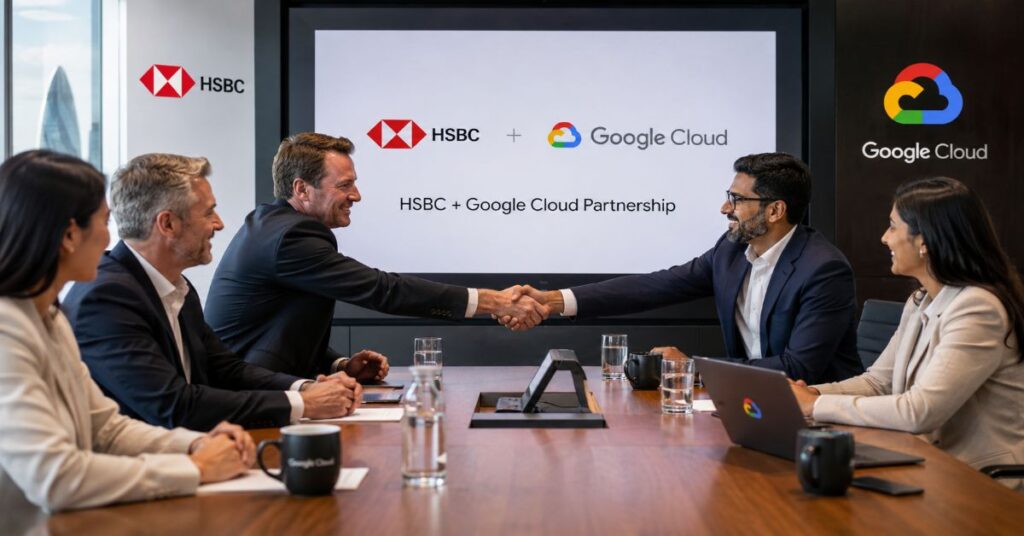
More than 600 of HSBC’s banking applications already run on Google’s servers. Starting this week, the bank wants Google’s AI to start making judgment calls inside them too — flagging suspicious transactions, drafting wealth management advice, and helping relationship managers prepare for client meetings, across a bank serving customers in 56 countries and territories.
HSBC and Google Cloud announced a multi-year partnership at the Google Cloud Summit in London on Wednesday to build and deploy AI capabilities across HSBC’s global operations, with Google DeepMind’s research teams and the Gemini Enterprise Agent Platform doing much of the underlying engineering work. The companies expect the collaboration to generate more than 200 new AI use cases over the next two years, concentrated initially on personalized wealth management advice, financial-crime risk management, and decision support for frontline staff.
It is one of the largest AI commitments any global bank has made public this year, and it arrives as HSBC faces the same question every large financial institution is now wrestling with: how much judgment an AI system should be allowed to exercise inside a regulated bank.
Key Developments
- HSBC and Google Cloud announced a multi-year partnership on June 17, 2026 at Google Cloud Summit London to deploy AI across HSBC’s global operations.
- The plan targets 200+ new AI use cases over two years, each expected to return more than $100 million in direct revenue gains or efficiency improvements.
- Initial focus areas: hyper-personalised wealth management advice, financial crime and AML risk management, and AI tools for frontline relationship managers.
- Built on Google DeepMind engineering and the Gemini Enterprise Agent Platform, layered onto more than 600 HSBC applications already running on Google Cloud.
What Happened
According to the companies’ joint announcement, HSBC will work with joint Google Cloud and Google DeepMind engineering teams, with access to Gemini models and forward-deployed Google engineers embedded directly in the bank’s technology organization rather than a standard software license relationship. The programme begins with three areas: combining AI-driven insights with relationship-manager expertise in wealth management, strengthening financial-crime risk management, and giving frontline staff AI-assisted decision support to cut time spent on administration and meeting preparation.
HSBC said each prioritized initiative is expected to return more than $100 million in either direct revenue gains or wider efficiency improvements, and that the new work builds on an existing footprint of more than 600 HSBC applications already running on Google Cloud infrastructure.
The Mechanism: From Pattern-Matching to Judgment
HSBC’s relationship with Google on financial-crime detection is not new. The bank piloted a Dynamic Risk Assessment system built on Google Cloud’s anti-money-laundering tooling as early as 2021, with broader rollout by 2023 — a system that, like most AML technology of that era, primarily scored transactions against statistical and rules-based risk patterns. What HSBC and Google are describing now is a different category of system: agentic AI built on Gemini models that can synthesize information across a client’s full relationship with the bank and generate a recommendation, rather than simply flag an anomaly for a human to review.
That shift is also why Google is positioning the deal around its Gemini Enterprise Agent Platform rather than a model API alone. The platform is designed to connect agents to a company’s existing data and systems under a central governance layer, intended to let a regulated institution audit what an AI agent did and why — a requirement that matters far more in banking, where regulators expect a documented chain of decision-making, than it does in most other generative-AI deployments.
The Backstory
HSBC’s move follows a broader pattern of large banks picking a primary AI partner rather than running shallow pilots across several vendors at once. Goldman Sachs has been working with Anthropic on custom AI agents for trade reconciliation and client onboarding, while BNY has moved to integrate Google’s Gemini Enterprise into its own internal research tooling for employees. HSBC’s decision to lean further into Google specifically reflects years of existing infrastructure investment rather than a cold start: the bank has run Google Cloud workloads since at least 2018, and used the relationship to support more than 1,700 data-analytics, customer-experience, cybersecurity, and emissions-reduction projects before this AI-specific expansion was announced.
The announcement also sits inside a broader pattern of major enterprise software providers racing to lock in Google’s AI Hypercomputer stack and Nvidia-class infrastructure for flagship customers — a dynamic visible elsewhere this year in deals such as Adobe’s new agentic AI platform, and in Nvidia’s own pattern of sweeping infrastructure announcements with major partners elsewhere in the world this same month.
Reactions
Google Cloud chief executive Thomas Kurian called the partnership “a blueprint for the future of the financial services industry,” arguing that combining Gemini, the Gemini Enterprise Agent Platform, forward-deployed engineers, and Google DeepMind’s research expertise would help HSBC build “a more intelligent, resilient and responsive bank.”
HSBC group chief executive Georges Elhedery framed the deal around retaining control rather than ceding it, saying AI is becoming one of the defining technologies of the era and that the bank intends to deliver a personalised, real-time customer experience “while keeping human judgement, decision-making, and accountability at the core.” That framing — emphasizing human oversight explicitly — is a now-familiar pattern among regulated institutions announcing deep AI integration, designed to pre-empt concerns about ceding too much control to automated systems.
The Dispute: Efficiency Gains Versus Workforce Reality
Neither company disclosed the commercial terms of the deal or a market-by-market rollout schedule, leaving the practical scope of the 200-plus promised use cases largely undefined for now. More pointedly, the announcement’s efficiency-and-revenue framing lands against a backdrop in which HSBC has separately been reported to be weighing workforce reductions of roughly 10 percent amid a wider banking-sector shift toward automation — a tension the bank’s public messaging around “empowering colleagues” does not directly address.
There is also an open regulatory question that this announcement does not resolve: as agentic AI moves from flagging suspicious transactions to generating wealth-management advice and prioritizing investment decisions, financial regulators in the UK, EU, and US are still working out how much autonomous judgment a system can exercise before it requires the same oversight as a licensed human adviser.
What Happens Next
HSBC says the partnership will begin rolling out across its three initial focus areas over the next two years, with the bank and Google jointly prioritizing which of the 200-plus identified use cases get built and deployed first. No specific country-by-country timeline has been published, and the next concrete marker for outside observers to watch will likely be HSBC’s own disclosures of measurable efficiency or revenue impact in upcoming quarterly results.
Why It Matters
The deal signals that the competition among major AI labs for banking customers has moved past pilot programmes and into long-term, infrastructure-level commitments, with Google now positioned alongside Anthropic and Microsoft as a primary AI partner for a top-five global bank. For an industry as risk-averse and heavily regulated as banking, a partnership of this scale from an institution the size of HSBC functions as a signal to peer banks that deep AI integration into core risk and advisory functions is now considered a competitive necessity rather than an experiment — even as the harder questions about accountability, oversight, and workforce impact remain largely unanswered in the announcement itself.
Sources
HSBC Holdings plc; Bloomberg; PRNewswire; FinTech Futures; Outlook Business.
