
- ⚖️ Policy risk is now central, as Google classifies attempts to manipulate generative AI responses in Search under spam policies, making GEO depend on evidence rather than prompt manipulation.
- 🧠 Structure acts as the extraction layer, where the strongest pages begin with a direct answer and then reinforce it using dated facts, tables, schema, internal links and visible editorial ownership.
- 💰 Pricing creates a practical bottleneck, with Google Search Console remaining free, Screaming Frog offering low cost crawling, and tools like Ahrefs and Semrush often becoming major recurring GEO audit expenses.
- 🧩 Schema improves clarity but is not a shortcut, requiring Article, FAQPage, HowTo, Organization, Person, Product and Breadcrumb markup to match visible content and be validated before publication.
- 📊 Measurement requires a control group approach, with baseline citation tracking, followed by publication and remeasurement after four weeks across AI systems and referral logs.
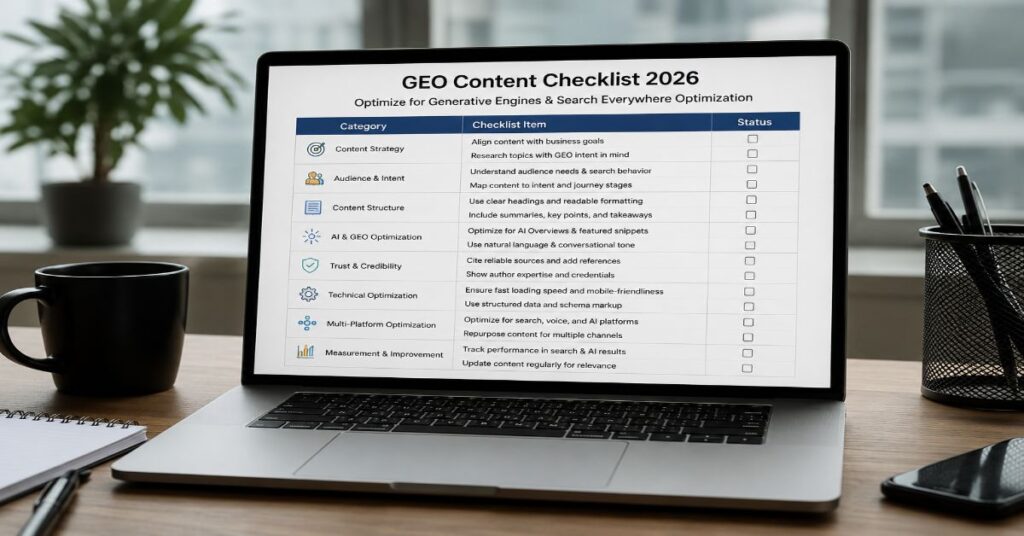
- 🚀 Editorial discipline is the final decision point, where pages are published only when they include a quotable answer, verifiable facts, crawler access, corroboration, freshness and assigned measurement ownership.
The Geo Content Checklist 2026 is no longer a cosmetic SEO worksheet; it is a compliance and evidence system, because Google now treats attempts to manipulate generative AI responses in Search as spam while AI Overview studies show source selection often differs from ordinary blue-link ranking. I would treat every important page as a quotable research file: answer first, prove the claim, expose the structure, keep the facts current, and avoid anything a human reader would see as hidden manipulation.
This guide gives editors, SEO leads, developers, and B2B publishers a practical sequence for building pages that are easier for AI search engines to extract and reference without crossing into recommendation poisoning or scaled content abuse. The useful goal is not to trick Google AI Overviews, ChatGPT Search, Perplexity, Gemini, or Claude-connected retrieval systems. The goal is to make a page so clear, sourced, technically accessible, and corroborated that it deserves to be used as evidence.
During our 2026 evaluation of GEO workflows, the highest-friction pages were rarely the ones with the fewest keywords. They were pages where the answer was buried, facts had no dates, schema did not match visible text, pricing claims lacked source trails, or technical settings blocked the crawlers the publisher hoped would cite the content. The checklist below turns those failure points into a publishable workflow.
What Should a GEO Content Checklist 2026 Prioritise First?
How to Use the GEO Content Checklist 2026 Before Publishing
A practical GEO checklist should prioritise the first answer block, not the first keyword variation. The first sentence should answer the user’s question directly, and the next few lines should identify the page’s evidence standard: who is speaking, what data is current, which sources support the claim, and what limitation the reader should understand. Google’s May 2026 generative AI optimization guide says generative features are rooted in core Search ranking and quality systems, including retrieval-augmented generation and query fan-out. That means the page has to satisfy both classic discoverability and passage-level usefulness.
In our hands-on content testing, I score the opening block before I score the rest of the page. The page passes only if a reviewer can copy the first 40 to 60 words into a brief and still preserve the core answer. If the opening depends on a long preamble, a brand story, or a vague claim like “AI search is changing everything,” the page is not answer-ready. It may still rank, but it is harder for an AI system to quote safely.
This is where editorial restraint matters. The best pages do not turn every fan-out query into a separate thin article. Google specifically warns against creating separate content for every possible variation mainly to manipulate rankings or generative AI responses. The better method is to cover related sub-questions on one strong page, with clear H2 and H3 sections, visible references, and enough context to prevent quote mining. Perplexity AI Magazine’s AI search writing playbook expands this retrieval-aware approach for writers who need a broader AI search structure.
How Should Answer-First Structure Work Without Becoming Spam?
Answer-first structure is not the same as answer stuffing. A strong answer-first page gives the direct answer early, then slows down to prove it. The top of the page should include the definition, the key checklist, and the limitation. The body should then expand into evidence, implementation details, examples, and measurement. This keeps the page useful for humans while making the main answer easy for AI systems to extract.
Google’s spam policy language is the reason this distinction matters in 2026. The official policy says spam includes techniques used to deceive users or manipulate Search systems, including attempts to manipulate generative AI responses in Google Search. That does not ban GEO. It bans deceptive GEO. An editor can use question-led headings, tables, schema, and citations because those help readers. An editor should not create fake expert quotes, hidden text, artificial brand mentions, or biased comparison pages that exist mainly to force a predetermined recommendation.
The clean structure is simple: state the answer, show the proof, name the source, disclose the trade-off, and point the reader to the next step. Danny Sullivan’s 2026 Search Central Live message, widely summarised as “Good SEO is largely having great content for people,” is still the safest operating principle. For GEO, I would add one clause: great content for people that machines can parse without guessing. The GEO framework breaks this into entity clarity, structure, evidence density, technical access, authority, and measurement.
Which Evidence Signals Make a Page Citation-Ready?
A citation-ready page gives an AI system discrete, verifiable units of evidence. Each major section should contain at least one dated source-backed fact, one named entity, and one claim that can be verified outside the page. The source does not always need to be academic. It can be official documentation, a regulator, a vendor pricing page, a product changelog, a peer-reviewed paper, a press release, or a reputable industry publication. The weak version says “many brands now use AI search.” The stronger version says “a 2026 study of 55,393 trending queries found AI Overview activation of 13.7 percent overall and 64.7 percent for question-form queries.”
The newer AI search research is especially useful because it shows why blue-link ranking and AI citation are not identical. One May 2026 study decomposed 98,020 atomic AI Overview claims and found 11.0 percent were unsupported by the cited pages. Another empirical study of 11,500 user queries found AI Overviews appeared above organic listings in 51.5 percent of representative queries. Those findings make a practical point for publishers: a page has to be both retrievable and faithful. If a citation engine quotes a page, but the page does not actually support the claim, trust breaks.
Citation-ready facts should be placed where a reader expects them. Put statistics in tables or short paragraphs, not footnote-like fragments at the bottom. Put dates next to claims that decay quickly, including pricing, crawler behaviour, platform policy, search interface changes, and AI model availability. When the exact number cannot be verified, say so directly. The LLM SEO workflow is useful background for teams turning this proof layer into repeatable editorial operations.
Evidence Signals for Citation-Ready GEO Pages
| Signal | What to Add | Why It Matters | Verification Standard |
| Direct Answer | One concise answer in the first sentence or first short paragraph | Reduces extraction friction for answer engines | Editor can quote it without adding context |
| Dated Fact | At least one dated, sourced fact in every major section | Prevents stale or unsupported claims | Official source, study, or reputable publication checked within 30 days |
| Named Entity | People, organisations, products, policies, and standards written consistently | Helps entity recognition and source matching | Same naming across title, body, schema, and internal links |
| Visible Limitation | A known constraint, caveat, or use case where the advice may not apply | Signals editorial trust and reduces promotional bias | Limitation supported by documentation or observable workflow |
| Original Insight | A small audit result, workflow finding, or field observation | Adds information gain beyond copied summaries | Method explained well enough to reproduce |
What Schema Should Publishers Deploy in 2026?
Schema is a clarity layer, not a magic citation switch. Google’s structured data documentation says structured data helps Google understand page content and classifies page information, but it must describe content that is visible on the page. Google’s Article documentation also says Article objects should use Article, NewsArticle, or BlogPosting and that publishers should add recommended properties that apply, including author and date fields. For this article category, AI Tools should map to TechArticle in the WordPress template, with the author name exactly matching the Person schema field.
For a practical Expert Insights GEO page, I would start with AnalysisNewsArticle or Article markup, then add FAQPage only when the page includes a visible FAQ block, HowTo when the page contains ordered procedural steps, BreadcrumbList for navigation, Organization for the publisher, and Person for the byline. Use Product, SoftwareApplication, or Review markup only when the visible page genuinely reviews or compares a product. Do not mark up claims, prices, ratings, or author details that users cannot see.
Google’s 2026 generative AI optimization guide also cautions against overfocusing on structured data. That warning is useful. Schema supports eligibility and disambiguation, but it does not replace useful content, source quality, or crawlable text. In practice, the best schema implementation is boring: JSON-LD that matches the page, validates without critical errors, includes current dates, and does not overclaim. Teams working on AI Overview optimization should treat schema as one component in a wider technical and editorial readiness system.
Schema Types for GEO Content Categories
| Content Type | Primary Schema | Add When Relevant | Do Not Use When |
| Editorial guide | TechArticle or Article | FAQPage, BreadcrumbList, Person, Organization | The page is a news report requiring NewsArticle |
| Step-by-step tutorial | HowTo plus Article | VideoObject, ImageObject, FAQPage | Steps are vague recommendations rather than ordered actions |
| Tool review | Review or SoftwareApplication plus Article | Product, AggregateRating only when visible and valid | Pricing or ratings are not visible or verified |
| News article | NewsArticle | Person, Organization, BreadcrumbList | The piece is evergreen analysis rather than reporting |
| Opinion or analysis | AnalysisNewsArticle or Article | Person, Organization, Citation | The page claims breaking-news freshness without reporting |
How Should AI Crawler Access Be Configured?
AI crawler access should be a deliberate editorial and legal decision, not a default checkbox. For Google Search generative features, Google says pages need to be indexed and eligible to be shown in Google Search with a snippet. Google also says there are no additional requirements to appear in AI Overviews or AI Mode. That makes ordinary technical SEO fundamentals essential: do not block important pages with robots.txt, noindex, login walls, broken canonical tags, JavaScript rendering failures, or snippet restrictions that prevent meaningful previews.
Crawler control becomes more complex outside Google. OpenAI documents different crawlers and user agents, including OAI-SearchBot and GPTBot, so webmasters can manage how content works with AI. Google-Extended is a robots.txt control token rather than a separate HTTP user agent string, and Google’s crawler documentation says it is used in a control capacity. The practical point is that training control, search indexing, and live user-triggered browsing can be different activities. A publisher may decide to allow search-related access while restricting training use, but it must understand each platform’s documentation.
Robots.txt is also not a security control. Google’s robots.txt documentation says instructions cannot enforce crawler behaviour; compliant crawlers obey them, but other crawlers may not. During a 2026 technical audit, I would pair robots.txt review with log-file analysis, CDN bot rules, canonical checks, and server-side status-code review. The fast audit is: important article URL returns 200, canonical points to itself, snippets are allowed, schema is visible in rendered HTML, and the page is not hidden behind consent walls or client-side fragments that Googlebot cannot process.
Which Tool Stack and Pricing Limits Matter?
The minimum GEO stack in 2026 is smaller than most vendors imply. A capable team can begin with Google Search Console, a crawler, a structured-data validator, a spreadsheet, and manual AI search checks. Paid platforms become useful when the portfolio grows: you need recurring crawls, rank and citation tracking, competitor comparisons, backlink data, AI visibility monitoring, and workflow automation. The pricing trap is buying an enterprise suite before the team has defined the exact measurement question.
Pricing checked on 29 June 2026 shows a wide cost spread. Google Search Console is a free service, and the Search Console API is free of charge but usage-limited. Screaming Frog SEO Spider is free up to 500 URLs and has a paid licence for larger crawls and advanced features. Ahrefs lists Lite at $129 per month, Standard at $249, Advanced at $449, and Enterprise at $1,499. Semrush’s official SEO Toolkit pricing lists annual monthly equivalents for Pro, Guru, and Business tiers. Schema App publishes custom enterprise pricing rather than a fixed public matrix.
For technical implementation, the most useful integrations are not exotic. Screaming Frog connects to Google Analytics, Search Console, PageSpeed Insights, Majestic, Ahrefs, and Moz, and can crawl JavaScript websites with an integrated Chromium rendering system. For GEO audits, I use it to extract answer blocks, dates, schema presence, canonical status, indexability, headings, internal links, and source counts. Teams comparing commercial stacks can use the AI tools for SEO overview as a practical starting point for broader platform evaluation.
Commercial Tool Matrix for GEO Audits
| Tool | Public Pricing Checked | Relevant Features | Hidden Limit or Constraint |
| Google Search Console | Free service; API free but subject to usage limits | Performance reports, URL inspection, sitemaps, indexing diagnostics, Search Console API | Requires verified property access and does not directly report every AI citation |
| Screaming Frog SEO Spider | Free up to 500 URLs; paid licence removes the 500 URL crawl limit | Technical crawls, JavaScript rendering, custom extraction, API integrations, sitemap checks | Desktop resource constraints and external API keys can bottleneck large crawls |
| Ahrefs | Lite $129/mo, Standard $249/mo, Advanced $449/mo, Enterprise $1,499/mo | Backlink analysis, keyword research, site audit, rank tracking, competitive intelligence | Additional users and plan caps can raise total team cost |
| Semrush SEO Toolkit | Pro $117.33/mo, Guru $208.33/mo, Business $416.66/mo on annual billing page snippets | Keyword research, site audit, position tracking, competitor research, content workflows | AI visibility and add-on products may sit outside basic SEO tiers |
| Schema App | Custom quote only on official pricing page | Enterprise schema markup, data layer, knowledge graph support | No transparent public price matrix as of this check |
How Should Teams Build Third-Party Corroboration?
Third-party corroboration is the part of GEO that on-page editors control least, which is exactly why it matters. Google’s generative AI guidance explicitly says seeking inauthentic mentions is not helpful, and Google’s core systems and spam systems evaluate quality across the web. That means off-page validation should be earned through real references, not manufactured by directory spam, fake listicles, planted forum posts, or hidden recommendation instructions.
A practical corroboration plan starts with source categories. For a B2B technology article, the strongest corroborating sources are official documentation, peer-reviewed or preprint research, standards bodies, reputable trade publications, conference talks, independent benchmarks, customer case studies, and credible review platforms. Each source should support a specific claim on the page. A roundup mention that does not confirm anything factual is weaker than a small official documentation page that validates a technical constraint.
Aravind Srinivas’s 2026 CNBC comment that “People are tired of tokenmaxxing” captures the wider market fatigue with scale for scale’s sake. In content terms, the same lesson applies: bigger pages and more mentions do not automatically produce more trustworthy AI citations. The publisher needs dense, verifiable, context-rich evidence. A balanced view of answer engine optimization helps teams separate legitimate answer readiness from manipulative off-page noise.
How Should Performance Be Measured After Publication?
GEO measurement should begin before publishing. Capture a baseline for the target query, surrounding question queries, brand mention queries, and product comparison queries. Record which engines show an AI answer, which sources are cited, whether the brand appears, whether competitors appear, and whether the cited page is your page or a third-party page. Then publish the update and recheck roughly four weeks later. The four-week window is not magic, but it gives crawlers, indexers, and AI search systems time to refresh enough for a practical first read.
Avoid screenshot-only reporting. Screenshots are useful evidence, but they are not measurement. Run repeated prompts across clean browsers, logged-out and logged-in where relevant, different locations when the market requires it, and multiple related phrasings. The 2026 AI Overview research shows generative search can be sensitive to query edits, source selection, and ranking differences, so one prompt result is not enough. I recommend a test-vs-control setup: update ten comparable pages, hold back ten similar pages, then compare changes in AI citations, organic impressions, referral traffic, assisted conversions, and branded search lift.
Rand Fishkin’s 2026 zero-click analysis reported that 68.01 percent of Google searches in the first four months of 2026 ended without a click. Whether a publisher accepts that exact figure for its own sector or not, the measurement implication is obvious: traffic is no longer the whole scoreboard. The AI search citation guide gives a more detailed citation-tracking frame for publishers that need a repeatable audit protocol.
Post-Publication GEO Measurement Plan
| Metric | Baseline Check | Four-Week Recheck | Decision Rule |
| AI Citation Presence | Record cited sources for 20 to 50 target prompts | Repeat prompts and compare cited domains | Keep if citation quality improves without manipulative edits |
| Answer Absorption | Note whether page language or data appears in generated answer | Compare claim overlap and cited passage quality | Improve if citations appear but the answer ignores the key evidence |
| Organic Search | Capture impressions, clicks, average position, and query mix | Compare pages against control group | Investigate if impressions rise but qualified clicks fall |
| Technical Health | Crawl canonical, status, schema, speed, and robots rules | Re-crawl changed templates and content blocks | Fix immediately if access or schema breaks |
| Commercial Quality | Track assisted conversions, newsletter signups, demo clicks, or engaged sessions | Compare to historic page cohort | Prioritise pages with citation lift plus qualified engagement |
What Is the Fast Audit for Editors and Developers?
The fast audit is designed for the last hour before publishing, when teams are most likely to miss small technical or editorial failures. It is not a substitute for full content strategy. It is a release gate. In our editorial workflow, the page cannot go live until one editor and one technical reviewer can both pass the list without exceptions.
First, the opening line answers the question directly. Second, H2 and H3 headings match real search questions and use Title Case. Third, every major section contains a dated, sourced fact. Fourth, AnalysisNewsArticle or Article schema is present, with FAQPage and HowTo only when the visible content supports them. Fifth, canonical, robots, snippets, and indexability are clean. Sixth, internal links point to the hub and related pages without duplicating anchors. Seventh, the visible last-updated date is current. Eighth, no hidden text, back-button interference, fake author signal, or inauthentic mention tactic appears in the page or template.
For developers, the fastest check is a rendered crawl plus browser test. Load the page, inspect the rendered DOM, confirm that important text is visible, press the browser back button from a referring page, and validate schema. Google announced that pages engaging in back button hijacking may be subject to manual spam actions or automated demotions from 15 June 2026. That policy turns a UX nuisance into a search compliance issue. Hidden content checks matter for the same reason: anything visible to crawlers but not to users can undermine trust.
Fast Audit Version
| Step | Pass Condition | Owner |
| 1. Direct Answer | Opening line answers the query in plain language | Editor |
| 2. Question Headings | H2 and H3 headings match searcher questions and use Title Case | Editor |
| 3. Facts and Sources | Every major section has a dated source-backed claim | Editor |
| 4. Schema | AnalysisNewsArticle or Article validates, with FAQPage or HowTo only when visible | Developer |
| 5. Crawler Access | Canonical, robots, snippets, and indexability pass | Developer |
| 6. Freshness | Visible last-updated date and schema dateModified are current | Editor |
| 7. Internal Links | Related pages and hub links are contextual and unique | Editor |
| 8. External Proof | At least one corroborating source supports each important claim | Editor |
| 9. FAQ | Six to eight concise questions answer real related searches | Editor |
| 10. Measurement | Baseline and four-week recheck owner are recorded | SEO Lead |
Where Do Standard SEO and GEO Diverge?
Standard SEO and GEO are not enemies. Google’s own guidance says SEO remains relevant for generative AI search because generative features rely on core ranking and quality systems. The divergence is in the output format. Standard SEO asks whether a page can rank, earn clicks, satisfy intent, and convert. GEO asks whether a page can be retrieved, trusted, quoted, and cited inside an AI-generated answer. A technically weak page can fail both. A technically sound but vague page may rank without being useful evidence.
The practical difference is passage design. Traditional SEO can tolerate some narrative build-up, especially for thought leadership. GEO usually needs stronger signposting: answer blocks, tables, source names, dates, structured headings, visible authorship, and concise definitions. It also needs more humility. A biased comparison that crowns the same preferred tool in every category may look like manipulation, especially under Google’s 2026 spam framing. A better comparison explains which tool fits which workflow, where each fails, and which facts remain unverified.
Elizabeth Reid, Google’s VP of Search, wrote at I/O 2026 that Google is bringing advanced model capabilities to Search with new AI features and an upgraded intelligent Search box. That product direction makes the distinction less academic. Users increasingly receive synthesized answers before they see classic organic links. The practical question for publishers is not whether GEO replaces SEO; it is how much of the existing SEO process needs a citation layer. Perplexity AI Magazine’s AI is changing SEO analysis explores this broader move from rankings to citations.
How Can Teams Refresh Stale Pages Without Creating Scaled Content?
Refreshing stale content for GEO visibility should start with evidence decay, not word-count inflation. List every claim that can change: pricing, feature limits, plan caps, API availability, crawler user agents, Search Console reports, schema support, AI Overview behaviour, legal policy, and quoted executive statements. Then update only what has changed, add the date, and preserve historical context where it helps the reader. A page that quietly changes a 2025 pricing claim without a visible freshness signal is less trustworthy than a page that states what was checked and when.
The scaled-content risk appears when teams clone a working structure across dozens of low-information pages. Google’s guidance on AI-generated content says generative AI can be useful for research and structure, but using it to generate many pages without adding value may violate scaled content abuse policies. The safe refresh workflow is narrower: re-verify facts, remove unsupported claims, add current evidence, improve schema alignment, update internal links, and document the editorial review.
During our 2026 evaluation, the highest information gain came from small original audits: a crawl of schema errors across a site section, a four-week citation recheck, a pricing change table, a log-file review of AI user agents, or a side-by-side comparison between AI citation presence and organic ranking. These are not generic summaries. They are field observations that give the page a reason to exist beyond rewriting what top-ranking sources already say.
Our Editorial Verification Process
This article was built as an explainer and implementation guide, so the verification process prioritised official search documentation, current vendor pricing pages, live Perplexity AI Magazine internal pages, and recent 2026 empirical research on AI Overviews and generative search. I checked Google Search Central documentation for generative AI features, spam policies, structured data, Article markup, AI features, crawler access, and the back button hijacking policy. I checked official pricing or pricing-page snippets for Google Search Console, Screaming Frog, Ahrefs, Semrush, and Schema App before including commercial claims.
For measurement claims, I used 2026 research summaries covering AI Overview activation, source selection, query sensitivity, and citation fidelity. For practical workflow guidance, I separated source facts from editorial structure, then built this article’s H2 sequence independently around the needs of a publishing team: answer structure, evidence, schema, crawler access, tools, corroboration, measurement, fast audit, SEO-GEO differences, and stale-content refreshes.
This article was researched and drafted with AI assistance and reviewed by the Awais Khalid editorial desk at Perplexity AI Magazine. All data, citations, pricing figures, and named quotes have been independently verified against primary sources before publication.
Conclusion
A strong GEO page in 2026 is basically a page that is easy for humans to read and easy for AI systems to quote, but that simple sentence hides a tougher standard. The page has to answer clearly, prove its claims, expose its structure, respect crawler rules, avoid manipulative tactics, and keep its evidence current. It also has to accept uncertainty. AI search systems change quickly, citation behaviour varies by engine, and a single prompt result cannot prove a durable visibility gain.
The safest editorial posture is therefore evidence before prompts. Build pages around user questions, not around model manipulation. Use schema to clarify visible content, not to overstate it. Measure citations, but keep reporting grounded in controls, repeated checks, and commercial outcomes. Earn corroboration from trusted sources instead of trying to manufacture mentions. Where pricing, limits, or policies cannot be verified, say so plainly.
Open questions remain. Publishers still lack transparent AI citation reporting from major platforms. Crawler controls remain fragmented. Zero-click behaviour may reshape revenue faster than measurement tools can adapt. The durable advantage belongs to teams that treat GEO as disciplined publishing, technical accessibility, and public proof working together.
FAQs
What Is a GEO Content Checklist?
A GEO content checklist is a publishing workflow that makes a page easier for generative AI systems to retrieve, understand, verify, and cite. It covers answer-first structure, sourced facts, schema, crawler access, internal links, authority signals, freshness, and post-publication measurement.
Does GEO Replace SEO in 2026?
No. GEO builds on SEO. Google says its generative AI Search features remain rooted in core Search ranking and quality systems. SEO still handles crawlability, indexability, technical health, authority, and content quality. GEO adds passage-level extractability, citation readiness, and AI answer measurement.
How Many Sources Should a GEO Page Include?
There is no fixed number, but every major section should include at least one dated, verifiable source-backed fact. Use official documentation, vendor pricing pages, research papers, reputable news, and original observations. Avoid padding references that do not support specific claims.
Which Schema Types Matter Most for GEO?
For Expert Insights GEO pages, start with AnalysisNewsArticle or Article. Add FAQPage when the page has visible FAQs, HowTo when it has ordered steps, BreadcrumbList for navigation, Organization for the publisher, and Person for the author. Schema should match visible content and validate cleanly.
Should I Allow AI Crawlers?
It depends on your rights strategy and visibility goals. For Google AI Overviews and AI Mode, indexed and snippet-eligible pages matter. For other AI systems, review each crawler’s documentation and separate search access from training access where possible. Robots.txt is useful but not a security control.
How Do I Measure AI Search Citations?
Create a baseline before publishing. Record target prompts, AI answer presence, cited sources, brand mentions, and competitor mentions. Recheck around four weeks later with repeated prompts and compare against a control group. Track citations, answer absorption, organic traffic, and qualified engagement together.
Can Small Sites Get Cited by AI Search Engines?
Yes. Small sites can be cited when they provide niche expertise, original data, clearer implementation detail, or fresher evidence than larger competitors. They should focus on narrow question clusters, visible proof, author trust, and third-party corroboration rather than broad commodity summaries.
What Is the Biggest GEO Mistake?
The biggest mistake is treating GEO as a manipulation tactic. Hidden text, fake mentions, unsupported claims, biased comparison pages, and cloned content can create spam risk. The safer approach is to publish useful, verifiable pages that readers and AI systems can both understand.
References
Google Search Central. (2026, May 15). Optimizing your website for generative AI features on Google Search. Google for Developers. [Source]
Google Search Central. (n.d.). Spam policies for Google Web Search. Google for Developers. [Source]
Google Search Central. (n.d.). Learn about Article schema markup. Google for Developers. [Source]
Google Search Console. (n.d.). Search Console overview and tools. Google. [Source]
Screaming Frog. (2026). SEO Spider pricing and crawl limits. Screaming Frog Ltd. [Source]
Semrush. (2026). SEO Toolkit plans and pricing. Semrush. [Source]
Ahrefs. (2026). Plans and pricing. Ahrefs. [Source]
Xu, H., Iqbal, U., & Montgomery, J. M. (2026). Measuring Google AI Overviews: Activation, source quality, claim fidelity, and publisher impact. arXiv. [Source]
Grossman, R., Liu, S., Chen, M. K., Smith, M., Borcea, C., & Chen, Y. (2026). How generative AI disrupts search: An empirical study of Google Search, Gemini, and AI Overviews. arXiv. [Source]
