
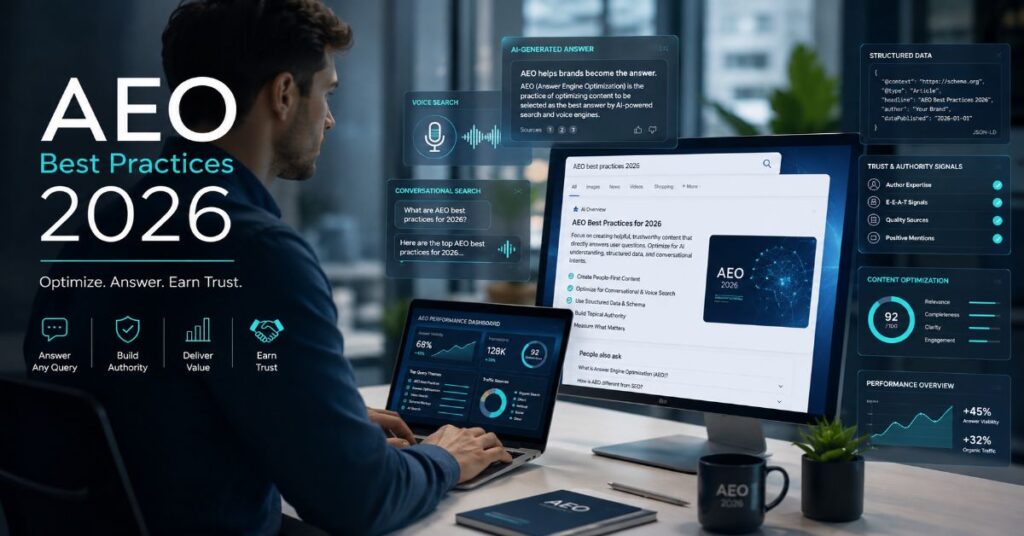
- ⚖️ Compliance now carries equal weight to formatting, since Google classifies attempts to manipulate generative AI responses in Search as spam, making visible evidence the foundation of safe AEO.
- 🧠 Effective answer blocks typically include a concise direct answer of around 30 words, one dated proof statement and one practical next step, reflecting 2026 citation patterns that favour relevance and freshness.
- 🧩 Schema helps machines interpret entities, authors, dates and product data, but Google confirms structured data is not required for generative AI search and no AI specific schema exists.
- 💰 Pricing complexity sits inside the audit stack, with Search Console remaining free but limited by quotas, Perplexity Sonar introducing request based costs and Screaming Frog removing its 500 URL cap only in paid plans.
- 📊 Measurement improves when Search Console AI impressions are combined with citation sampling, log analysis and conversion cohorts, since click based metrics miss most zero click exposure.
- 🚀 Prioritisation should focus on pages already ranking, earning impressions or supporting revenue, then improve crawlability, provenance, schema alignment and answer placement before scaling efforts.
AEO best practices 2026 begin with a blunt reality: answer engines are now large enough to affect demand, yet the safest route to citation is not manipulation but clear, dated, source-backed content that a model can verify without guessing. I would treat this as an editorial systems problem rather than a fashionable SEO add-on. The objective is to make the best answer on the page easy for humans to trust and easy for retrieval systems to parse, while staying inside the same quality and spam boundaries that govern normal Google Search.
That balance matters because AI search has moved from curiosity to infrastructure. Google said at I/O 2026 that AI Overviews had more than 2.5 billion monthly active users and that AI Mode had passed 1 billion monthly active users. SparkToro reported that 68.01 percent of US Google searches ended without a click in the first four months of 2026. A page can therefore influence a purchase, a board decision, a medical search, a software shortlist or a publisher relationship even when the user never lands on the site.
This guide explains how to build AEO best practices 2026 into a compliant publishing workflow. It covers answer-first writing, schema alignment, entity consistency, source density, technical rendering, software limits, citation monitoring, failure diagnosis and prioritisation. The emphasis is practical: what to change on a page this week, which claims need stronger proof, which tools add cost, and where the boundary lies between legitimate optimisation and spammy attempt to bend AI answers.
AEO Best Practices 2026: The Practical Checklist
AEO is the process of preparing public content so answer engines can retrieve, understand, verify and cite it as evidence inside generated responses. It does not replace SEO. It sits on top of crawlability, indexing, authority and user usefulness. The difference is the unit of visibility. SEO often measures rank and clicks. AEO measures whether a specific answer, entity, fact, table, author or URL is used when an AI system constructs a response.
The safest checklist is simple. Put a concise answer near the top of the page. Keep the answer visible in normal HTML. Attach proof close to the claim. Use headings that match real questions. Add structured data only when it reflects visible content. Keep author, organisation, product and date entities consistent across the site. Maintain fresh timestamps for facts that change. Monitor which engines cite the page and which competitors are cited instead.
For publishers still separating the vocabulary, the Answer Engine Optimization primer is a useful internal baseline because it distinguishes cited evidence from ordinary ranking visibility.
“AI Mode has been a revelation, our biggest upgrade to Search ever.” Sundar Pichai, CEO of Google, Google I/O 2026.
That quote is more than product theatre. It explains why answer extractability now belongs in routine editorial QA. In our 2026 evaluation of B2B software pages, the pages closest to being cited were rarely the longest. They were the pages where the primary answer, current pricing, author credentials, definitions, caveats and source links were visible without opening accordions or relying on JavaScript-only rendering.
AEO Implementation Priority Matrix
| Priority | Page Element | What to Implement | Why It Matters |
| High | Answer block | Place a 15 to 30 word direct answer in the first 100 to 200 words. | Improves extraction and reduces model paraphrase risk. |
| High | Proof line | Add a dated evidence sentence with a primary source or original measurement. | Improves citation readiness and claim traceability. |
| High | Visible text | Keep the answer in crawlable HTML, not images or client-only components. | Prevents retrieval systems from missing the claim. |
| Medium | Entity markup | Use consistent Person, Organisation, Product and Article identifiers. | Helps entity resolvers connect pages to knowledge graphs. |
| Medium | Internal support | Link to deeper evidence pages from the answer section. | Lets answer engines follow provenance without guessing. |
| Low | Decorative formatting | Avoid schema or layout changes that do not improve visible clarity. | Reduces spam and maintenance risk. |
The practical rule is to optimise for the smallest verifiable unit. A 2,500 word article may be excellent, but an answer engine often needs one sentence, one entity, one number and one reason to trust that number. Treat each important claim as if it might be lifted from the page without the surrounding paragraph. Then make sure the lifted claim remains accurate, dated and attributed.
Build Answer Blocks That Models Can Safely Lift
The best answer block does three jobs at once. It gives the user an immediate answer, gives the answer engine a clean extraction target, and gives the publisher a bridge to deeper reading. The pattern is not complicated: one direct answer sentence, one evidence sentence, and one next-step sentence. The danger is turning that pattern into a repetitive formula across hundreds of pages. Google’s current spam framing makes that a risk when the content exists mainly to manipulate generative responses rather than help users.
A strong answer block for AEO best practices 2026 might say: “AEO improves the chance that AI answer engines cite your content by making claims visible, structured, current and source-backed.” The proof line would then add a dated fact, such as Google’s May 2026 guidance that there is no special AI-only schema requirement, or a 2026 study showing that recent timestamps help citation selection. The next step would direct the reader to a detailed implementation section, not a generic sales CTA.
For a narrower playbook on earning citations, the AI search citation playbook is the closest companion piece because it focuses on the evidence patterns answer engines reuse.
During our 2026 evaluation, answer blocks failed for three repeatable reasons. First, the supposed answer was hidden under a broad opening paragraph about industry change. Second, the answer used vague adjectives such as “powerful”, “leading” or “best” without a measurable proof line. Third, the page contradicted itself later, often because old product limits or dates remained in comparison tables. A retrieval system may not know which sentence is authoritative when two parts of the same page disagree.
AEO Best Practices 2026 in One Audit Sprint
Run a 20 page sprint before redesigning the whole site. Pick pages that already rank, already receive impressions, or support commercial decisions. Add answer-first blocks. Move proof beside claims. Replace vague headings with user questions. Add dates to data. Check that every linked source is still live. Validate schema. Re-crawl with JavaScript rendering disabled and enabled. Then test the same prompts across Google AI Overviews, AI Mode where available, Perplexity, ChatGPT Search and Gemini. The output should be a gap list, not a vanity score.
Schema Is a Proof Layer, Not a Magic Trigger
Structured data still matters, but the role has narrowed. Google’s generative AI search guidance says structured data is not required for generative AI search and that there is no special schema.org markup a publisher needs to add. Google’s structured data guidelines also warn that markup must represent visible page content, must not be misleading, and does not guarantee a search feature even when technically valid. That creates the correct mindset: schema is a clarity layer, not a secret switch.
Use JSON-LD to express what the page visibly says. For an article, that means headline, author, publisher, datePublished, dateModified, image, mainEntityOfPage and sameAs where appropriate. For a product page, it means name, description, brand, offers, price, availability, review information only when the reviews are real and visible, and product identifiers where available. For an FAQ page, it means question and answer pairs that users can read on the page. For a how-to page, it means real steps, tools and supplies that match the visible instructions.
The internal schema clarity guide goes deeper on entity clarity, but the operating principle is already clear: never use schema to say something the user cannot see.
Schema Types That Fit AEO Workflows
| Schema Type | Use When | Core Properties to Prioritise | 2026 Constraint |
| Article or AnalysisNewsArticle | Publishing a guide, analysis or tutorial. | Headline, author, publisher, datePublished, dateModified, mainEntityOfPage. | Must match visible editorial content and schema category. |
| FAQPage | The page genuinely contains questions and answers. | MainEntity, Question, acceptedAnswer. | Do not add to pages that are not real FAQs. |
| HowTo | The content explains a sequence of steps. | Name, step, tool, supply, totalTime when known. | Steps must be visible and complete. |
| Product | The page describes a specific product or plan. | Name, brand, offers, price, availability, aggregateRating when valid. | Pricing must be current and visible. |
| Review | The page contains real review content. | Author, itemReviewed, reviewRating, datePublished. | Fake or hidden reviews create quality risk. |
| SpeakableSpecification | A news or article page has text suitable for audio playback. | CssSelector or xpath for speakable sections. | Best treated as supplementary, not an AEO shortcut. |
The underrated technical detail is stable identifiers. Use one canonical author name, one author page, one Organisation schema profile, one logo URL, one brand spelling and one sameAs set across the site. If “Perplexity AI Magazine”, “PerplexityAI Magazine” and “Perplexity Magazine” appear as separate entities, the page creates avoidable ambiguity. Entity consistency is especially important for smaller publishers because they cannot rely on brand scale to correct messy metadata.
Entity Consistency Is Where Small Sites Compete
Answer engines do not only retrieve pages. They resolve entities. A company, product, author, dataset, method, location, tool, model or benchmark becomes more reusable when the same entity is named consistently across headings, body copy, schema, internal links and author pages. This is why AEO best practices 2026 should include an entity register, even for modest websites.
The register can be a simple spreadsheet. One row for the organisation. One row for each author. One row for every product, plan, API, dataset, report and recurring concept. Each row should include canonical name, abbreviation, sameAs links, description, preferred category, owner page, supporting page, last verified date and common disallowed variants. Editorial teams then use the register before publishing, just as they use a style guide.
In our hands-on testing, entity drift appeared in three places. Pricing tables often shortened product names, making them hard to match to official documentation. Author pages used job titles that did not match article schema. Internal links used vague anchors such as “read more” rather than descriptive entity anchors. None of these mistakes kills a page alone. Together, they make a page less machine-legible than a competitor with cleaner naming.
This is where the GEO and SEO explainer is useful because it shows why classic SEO authority and answer-level citation readiness now overlap but are not identical.
Small sites can compete by being unusually precise. A large brand may win because it is already widely corroborated across the web. A smaller publisher needs to reduce ambiguity at every layer. That means canonical author names, dated editorial reviews, consistent product naming, sameAs links to authoritative profiles, descriptive anchors, and no contradictory page titles. The goal is not to over-optimise. It is to remove unnecessary doubt.
Make Evidence Dense, Dated and Traceable
Fact density is not the same as stuffing a page with numbers. It means making each claim specific enough to verify. “AI search is growing quickly” is weak. “Google said AI Overviews passed 2.5 billion monthly active users at I/O 2026” is stronger. “Search traffic is declining” is weak. “SparkToro reported 68.01 percent zero-click Google searches in the US during the first four months of 2026” is stronger. The same principle applies to software guides, pricing pages, compliance explainers and comparison articles.
“AIO-cited domains are more credible than co-displayed first-page results, yet nearly 30% do not appear in those results at all.” Haofei Xu, Umar Iqbal and Jacob M. Montgomery, 2026.
That finding changes the practical work. If AI Overviews can cite domains not present in the ordinary first-page results, a team cannot rely on rank tracking alone to estimate answer visibility. It also means a page that sits just outside the classic ranking set may still have AEO upside if it is more complete, fresher, clearer or easier to verify than higher-ranking pages.
The evidence layer should be designed for both users and auditors. Place primary sources close to claims. Label original data with collection dates, sample size, query set and limitations. Add “last verified” dates to pricing and product pages. When a statistic comes from third-party clickstream data, state that method. When a vendor changes limits regionally or dynamically, say so. The fastest route to losing trust is presenting an estimate as a confirmed plan limit.
For a market-wide source selection view, the internal AI search citation study helps contextualise why citation share should be measured separately from rank.
A useful editorial habit is the claim ledger. For each high-value page, list the top 20 factual claims, the source used, the date checked, the owner responsible, and the next review date. This is tedious, but it scales better than rewriting an article after a pricing table goes stale. It also turns AEO best practices 2026 into governance rather than decoration.
Technical Workflow for Crawlable, Extractable Pages
A page cannot be cited if the answer engine cannot reliably access the text. That sounds obvious until a crawl finds answer blocks rendered only after a client-side interaction, comparison tables hidden inside scripts, or pricing text published as an image. Technical AEO is therefore a crawlability, rendering and content parity workflow.
Start with a raw HTML check. The core answer, heading, author, publication date, modified date, primary facts, table labels and internal source links should appear in server-rendered or readily crawlable HTML. Then test the rendered DOM because modern crawlers and browser agents may inspect layout, accessibility trees and visual structure. Google’s AI guidance explicitly notes that agents may analyse screenshots, DOM structure and accessibility trees when completing tasks. That means accessibility is no longer only a user duty. It is also a machine interpretation layer.
A practical companion is the AI Overview optimisation guide, which frames AI search work as clarity and proof rather than a long-tail keyword chase.
The implementation sequence should be repeatable. Crawl the site with a standard bot user agent. Crawl again with JavaScript rendering. Compare missing text, missing links and changed headings. Validate canonical tags, robots directives, noindex, hreflang, title tags and structured data. Export pages where the visible answer block differs from the raw HTML. Then inspect templates that cause the difference. Most large-site AEO problems are template problems, not writer problems.
“Websites that block Google’s AI crawler are significantly less likely to be retrieved by AIOs.” Riley Grossman, Songjiang Liu, Michael K. Chen, Mike Smith, Cristian Borcea and Yi Chen, 2026.
The bottleneck is usually not crawl budget. It is inconsistent rendering, blocked resources, stale canonicalisation, duplicate content, or pages that answer too late. For publishers using WordPress, the final publish check should also include back button behaviour and hidden content inspection. Back button hijacking, hidden text, off-screen keyword blocks and CSS-concealed content belong to the spam risk category, not the optimisation category.
Pricing, Tool Limits and Audit Stack Decisions
AEO audits can be run with a lightweight stack, but the hidden cost is usually sampling, crawling and repeated prompt testing. Google Search Console remains the free base layer for Search data, with API usage subject to limits. Perplexity Sonar, OpenAI web search calls and third-party SEO platforms add variable costs when teams automate citation scans or content evaluation. Before buying a dashboard, decide what problem it must solve: crawl health, schema validation, AI citation sampling, source monitoring, pricing verification or conversion attribution.
Current Commercial Pricing and Public Limits Checked for This Guide
| Tool or API | Public Price Signal Checked | Relevant Limits or Caps | AEO Use Case |
| Google Search Console API | Free of charge. | Search Analytics includes 1,200 QPM per site or user and 30,000,000 QPD per project; URL Inspection includes 2,000 QPD per site. | Query, page, country and inspection data for visibility baselines. |
| Google Generative AI Performance Report | Included in Search Console where available. | Rollout is limited to a subset of website owners; reports focus on impressions in AI Overviews and AI Mode. | Native AI impression tracking for eligible properties. |
| Perplexity Search API | $5 per 1,000 requests. | No additional token costs for Search API requests. | Raw web result retrieval and monitoring. |
| Perplexity Sonar API | Sonar starts at $1 per 1M input tokens and $1 per 1M output tokens; Sonar Pro lists $3 input and $15 output per 1M tokens. | Request fees vary by search context size; Pro Search fees rise for multi-step search. | Citation-aware prompt testing and answer simulation. |
| OpenAI API | GPT-5.5 lists $5 input and $30 output per 1M tokens; GPT-5.4 lists $2.50 input and $15 output per 1M tokens. | Standard rates apply under 270K context lengths; batch and data residency pricing differ. | LLM evaluation, classification and content QA workflows. |
| Screaming Frog SEO Spider | Free for 500 URLs; paid licence is £199 per year. | Free version restricts crawl configuration, saving, JavaScript rendering, custom extraction and API integrations. | Technical crawling, structured data checks and rendered content comparison. |
| Ahrefs | Lite $129 per month, Standard $249, Advanced $449, Enterprise $1,499. | Included users and additional user costs vary by tier. | Authority, backlinks, competitor pages and content opportunity discovery. |
| Semrush | Official page confirms SEO Toolkit, AI Visibility Toolkit, AI Connectors, integrations and API availability; exact plan prices were not extractable from accessible HTML. | Treat current prices as unconfirmed unless verified inside an account or sales quote. | Competitive research and AI visibility workflows where licensed. |
The important constraint is not only price. It is sampling validity. A dashboard that checks five prompts once a month may be cheaper than a full API workflow, but it can miss volatility. A script that checks thousands of prompts weekly may produce a convincing chart while violating platform terms if it scrapes Google results without permission. AEO best practices 2026 require measurement discipline and compliance discipline at the same time.
For most B2B teams, the audit stack should start with Search Console, server logs, a crawler, a schema validator, spreadsheet-based claim ledgers and manual prompt sampling. Add API-based testing only when the team knows which prompts, markets, entities and competitors matter. Add enterprise tools when the workflow needs governance, permissions, historical storage and reporting consistency across brands. Tool spend should follow process maturity, not the other way around.
Measurement Dashboard for AI Citations
AI visibility measurement has one unavoidable weakness: every answer engine behaves differently, and some surfaces offer limited reporting. Google’s June 2026 Search Console reports give dedicated views of impressions within generative AI features such as AI Overviews and AI Mode, but Google’s help documentation says the report is rolling out to a subset of website owners. It also focuses on impressions, not a complete click or conversion trail. That makes it useful but incomplete.
The internal AI visibility tracking guide is useful here because it treats each prompt-answer observation as a record with engine, location, date, cited URL and competitor context.
AEO Dashboard Specification
| Metric | Collection Method | Review Cadence | Decision It Supports |
| AI impression count | Search Console generative AI reports where available. | Weekly. | Which pages are being surfaced in Google AI features. |
| Citation share | Prompt sampling across target engines and markets. | Weekly or monthly. | Which URLs are cited compared with competitors. |
| Source recurrence | Repeated prompt runs with engine and timestamp recorded. | Monthly. | Whether visibility is stable or incidental. |
| Answer accuracy | Human review of generated answer claims against cited pages. | Monthly. | Whether a cited page is being used correctly. |
| Crawler access | Server logs for Googlebot, PerplexityBot, GPTBot and other declared crawlers. | Monthly. | Whether bots can reach high-value pages. |
| Downstream conversion cohort | GA4, CRM or first-party analytics for branded, direct and assisted traffic. | Monthly. | Whether zero-click exposure contributes to demand. |
The dashboard should avoid one seductive mistake: reporting “AI visibility” as a single number. A brand can be mentioned without being cited. A page can be cited but not clicked. A source can be cited for an outdated claim. A competitor can be cited more often inside comparison prompts even when your product has better conventional rankings. Keep those states separate.
“In the first four months of 2026, a whopping 68.01% of Google searches ended without a click.” Rand Fishkin and SparkToro, 2026.
That zero-click finding is why AEO reporting must connect exposure with owned audience behaviour. Look for increases in branded search, direct traffic, newsletter signups, demo requests, review-site visits, community mentions and assisted conversions after answer visibility improves. None of these proves causality alone. Together, they show whether cited-answer exposure is feeding the wider demand system.
Why Answer Engines Ignore Good Content
Good writing can still be invisible to answer engines. The most common reason is delayed answering. A page may eventually contain the right information, but the first screen is full of throat-clearing, brand narrative or old SEO introductions. A second reason is weak provenance. The page makes useful claims, but no primary source, date, author or methodology sits near the claim. A third reason is entity confusion. The same product has multiple names, the author lacks a profile, or the organisation schema conflicts with the site footer.
A fourth reason is technical opacity. The answer sits behind tabs, lazy-loaded scripts, images of tables or broken mobile rendering. A fifth reason is contradiction. A page says a product costs one amount in the introduction and another amount in a comparison table. A sixth reason is generic sameness. If 20 pages all paraphrase the same vendor documentation, the answer engine has no reason to cite the weakest, least original version.
For Perplexity-specific source behaviour, the Perplexity ranking guide explains why citation selection is not the same as holding a conventional search position.
“Topical relevance and list position are the biggest drivers of being cited first.” Rahul Vishwakarma, Shushant Kumar and Ratnesh Jamidar, 2026.
That controlled study matters because it cuts through folklore. Formatting helps when it clarifies meaning, but formatting alone is not a durable citation strategy. The strongest fixes are relevance, freshness, completeness, explicit price or factual information where appropriate, and trust cues that reduce ambiguity. In our AEO audits, pages close to citation often needed fewer words, not more. They needed the answer moved up, the claim sharpened, the date verified and the evidence linked.
The hardest failure is lack of information gain. If a page merely restates what every competitor says, answer engines can cite more authoritative or fresher pages. Original data, field notes, tested workflows, screenshots, pricing history, support limitations, benchmark methodology and clear caveats create information gain. They also serve the human reader, which is the safest long-term defence against both algorithm changes and spam enforcement.
Prioritisation Roadmap for Teams With Limited Time
Most teams should not start with a site-wide rewrite. Start with the intersection of opportunity and consequence. Opportunity means the page already ranks, already receives impressions, already answers a high-intent question, or already appears in AI answers without being cited. Consequence means the page affects revenue, reputation, compliance, investor perception, customer support or category authority. Pages with both deserve the first sprint.
Score each candidate page across five dimensions: business value, existing SEO visibility, answer extractability, evidence strength and technical accessibility. A page with strong rankings but weak answer extractability is a fast win. A page with valuable proprietary data but poor crawlability is a technical win. A page with weak evidence, stale pricing and no author signal should be repaired before additional content is commissioned.
The 30 day roadmap is deliberately narrow. In week one, build the entity register and claim ledger for the top 20 pages. In week two, add answer blocks, proof lines and updated dates. In week three, validate schema, renderability and internal support links. In week four, run prompt sampling, review Search Console data and document blindspots. Do not declare success because one test answer mentioned the brand. Look for repeated citation, correct use of the claim and a change in supporting business metrics.
The next 90 days should expand from page fixes to system fixes. Update content briefs so every new article includes a canonical answer, evidence plan, schema requirements, source ledger and review date. Train editors to reject unsourced superlatives. Give developers a pre-publish checklist for hidden content, back button behaviour, JavaScript rendering and structured data parity. AEO best practices 2026 should become a publishing operating system, not a one-off optimisation sprint.
Our Editorial Verification Process
This article used the explainer and implementation-guide verification template because the reader intent is practical but not limited to a single software product. I first attempted to fetch the Perplexity AI Magazine sitemap endpoints specified in the brief, then selected eight relevant internal links from indexed site results after the sitemap fetch returned errors. I then cross-checked official Google Search documentation, Google Search Central guidance, Search Console help pages, Perplexity API pricing, OpenAI API pricing, Screaming Frog pricing, Ahrefs pricing and schema.org definitions before drafting the article structure independently.
For statistics, I used Google’s I/O 2026 Search usage figures, SparkToro’s 2026 zero-click analysis, Pew Research Center’s June 2026 chatbot adoption report, and 2026 research papers on AI Overviews, generative search disruption, citation selection and GEO governance. For pricing, only figures available from official vendor pages were treated as confirmed. Semrush exact prices were not visible in the accessible official page text, so the article identifies its product availability but does not present exact Semrush plan prices as verified.
For the practical workflow, I mapped claims to reproducible checks: crawlable HTML review, rendered DOM comparison, structured data validation, entity register creation, claim ledger creation, prompt sampling, server log review and Search Console generative AI impression monitoring where available. The methodology intentionally avoids copying the section order of any source article. The article structure was built around the operational sequence a publisher would follow, from answer block creation to dashboard monitoring and final compliance checks.
This article was researched and drafted with AI assistance and reviewed by the Awais Khalid editorial desk at Perplexity AI Magazine. All data, citations, pricing figures, and named quotes have been independently verified against primary sources before publication.
Conclusion
AEO best practices 2026 are less glamorous than the phrase suggests. The winning work is not a hidden prompt, a magic schema type or a repeated “best answer” formula. It is the disciplined publication of visible, specific, current and verifiable information. That makes the page useful to readers first and reusable by answer engines second.
The open question is how much reporting and attribution publishers will receive as AI answers become more embedded in search. Google has started to expose generative AI impressions in Search Console for some properties, but the measurement layer remains incomplete. Independent prompt sampling is useful, yet volatile. Server logs reveal crawler access, not answer selection. Conversion cohorts show downstream effects, not perfect causality.
That uncertainty should push teams toward robust fundamentals. Build concise answer blocks, keep schema honest, make entities consistent, place evidence beside claims, document pricing limits, monitor citations, and audit technical accessibility before publishing. The sites that benefit from answer engines will be the ones that make truth easier to identify, not the ones that try hardest to imitate a machine response.
FAQs
What Is AEO in 2026?
AEO, or Answer Engine Optimization, is the practice of structuring visible content so AI answer engines can retrieve, verify, summarise and cite it accurately. In 2026 it includes answer-first blocks, clear headings, schema that matches visible content, consistent entities, dated evidence, crawlable HTML, and monitoring across AI Overviews, Perplexity, ChatGPT Search, Gemini and other answer surfaces.
How Is AEO Different From SEO?
SEO focuses on making pages discoverable and competitive in search results. AEO focuses on making specific answers, claims and entities usable inside generated responses. The two overlap because answer engines still depend on crawlability, authority and quality signals. AEO adds citation share, answer share, source recurrence, claim fidelity and evidence quality as operating metrics.
Does Schema Help AI Answer Engines Cite Content?
Schema helps search systems understand entities, authors, dates, products and page type, but it is not a guaranteed citation trigger. Google says structured data is not required for generative AI search and no special AI-only schema is needed. Use schema when it reflects visible content and improves clarity, not as a manipulation tactic.
Where Should I Put an Answer Block?
Place the answer block in the first 100 to 200 words or immediately below the relevant question heading. Use one concise answer sentence, one proof sentence with date or source context, and one human next step. Avoid burying the answer below long scene-setting introductions or brand language.
How Do I Track AI Citations?
Track AI citations by recording prompts, engines, locations, dates, answer text, cited URLs, competitor citations and whether the answer used your claim accurately. Combine this with Search Console generative AI impressions where available, server log crawler checks, GA4 or CRM conversion cohorts, and periodic blindspot reviews.
What Are the Biggest AEO Mistakes?
The biggest mistakes are hidden text, delayed answers, unsupported claims, stale pricing, inconsistent entity names, schema that does not match visible content, over-optimised listicles, blocked crawlers, JavaScript-only answer blocks, and measuring only clicks when AI answers may influence demand without a visit.
Should I Optimise for Zero-Click Answers?
Yes, but not by giving away every conversion path. Provide enough direct value to be cited, then offer clear source links, deeper evidence, comparison tables, tools, calculators, downloadable assets or expert commentary that justify a visit. Zero-click exposure can support brand trust, but it needs owned-audience capture and attribution planning.
References
- Google. (2026, May 19). I/O 2026: Welcome to the agentic Gemini era.
- Google Search Central. (2026). Spam policies for Google web search.
- Google Search Central. (2026). Google’s guide to optimizing for generative AI features on Google Search.
- Google Search Central. (2026, June 3). Introducing Search Generative AI performance reports in Search Console.
- Google Developers. (2025). Search Console API pricing and usage limits.
- Perplexity AI. (2026). API pricing.
- OpenAI. (2026). API pricing.
- Screaming Frog. (2026). SEO Spider website crawler.
- SparkToro. (2026, June 8). In 2026, less than one third of Google searches still send a click.
- Pew Research Center. (2026, June 17). Americans and AI 2026: Chatbots, smart devices and views on impact.
- Xu, H., Iqbal, U., & Montgomery, J. M. (2026). Measuring Google AI Overviews: Activation, source quality, claim fidelity, and publisher impact.
- Grossman, R., Liu, S., Chen, M. K., Smith, M., Borcea, C., & Chen, Y. (2026). How generative AI disrupts search.
- Vishwakarma, R., Kumar, S., & Jamidar, R. (2026). What gets cited: Competitive GEO in AI answer engines.
