
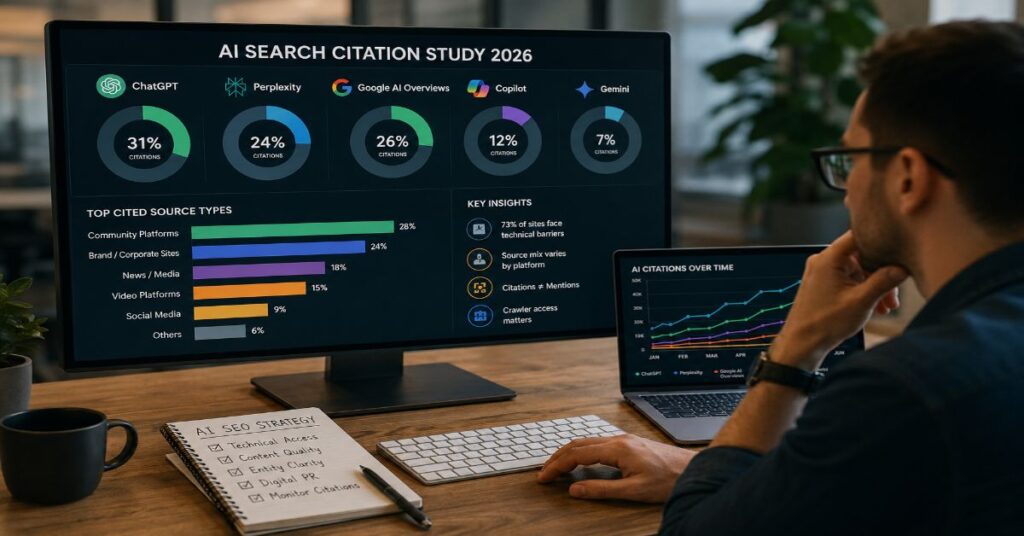
- 🔎OtterlyAI’s report is the strongest source-analysis study, with more than 1 million citations across ChatGPT, Perplexity, and Google AI Overviews and a 73% technical-barrier warning for crawler access.
- 📊SUMAX’s State of AI Search 2026 is the broadest market benchmark, using 12,000 prompts, eight industries, 150+ brands, and six AI systems to show a weak 0.42 correlation between Google rank and LLM citation rate.
- 🧭Tinuiti’s Q2 2026 report is the most useful SEO planning source because it tracks seven AI platforms, nine commercial categories, YouTube growth in AI Mode citations, Amazon’s 19% Copilot share, and apparel’s 13% social citation share.
- ⚠️Digital Bloom is the clearest revenue-impact framework, but its most specific claims are synthesised from third-party studies rather than a single raw proprietary dataset, so I treat them as useful but less independently auditable.
- ➜Teams should build a weekly citation operating system: fix bot access, map prompts by funnel stage, refresh high-value pages, track source domains, and separate citation influence from direct click traffic.
The AI search citation study 2026 landscape has a sharp answer for SEO teams: AI citations are measurable, economically meaningful, and platform-specific, but the best data now contradicts the old assumption that a strong Google ranking automatically becomes a ChatGPT, Perplexity, Gemini, Copilot, or Google AI Overview citation. I found the most useful evidence across four current reports: OtterlyAI for source analysis, SUMAX for broad market structure, Tinuiti for platform-by-category SEO planning, and Digital Bloom for revenue modelling.
This matters because AI search is no longer a side channel. Google said at I/O 2026 that AI Overviews had more than 2.5 billion monthly active users, while AI Mode had surpassed 1 billion monthly active users. OpenAI’s search documentation also makes clear that web-search responses include sourced citations by default in supported experiences. The commercial question is now more precise than “How do we rank?” It is “Which source set does each answer engine trust for this query, and can our page survive that selection process?”
I approach this as a London-first B2B editorial analysis rather than a hype cycle roundup. The article compares the four reports, separates source-analysis claims from revenue claims, checks tool pricing and limits, and builds a practical operating workflow. The key lesson is uncomfortable but useful: citation visibility is not one metric. It is a stack of crawler access, entity clarity, source type, query intent, freshness, platform behaviour, and evidence quality.
The Four Reports Compared
The four reports are not interchangeable. OtterlyAI is closest to a citation source-distribution study. Its February 2026 report says it analysed more than 1 million citations across ChatGPT, Perplexity, and Google AI Overviews, with the public page highlighting community platforms, brand domains, technical barriers, and crawler access as major themes. For source analysis, this is the best fit because it names the engines, lists crawler personas, and distinguishes between mentions and clickable citations.
SUMAX’s State of AI Search 2026 is the broadest visibility benchmark. It uses 12,000 prompts across eight industries, 150+ brands, and six AI systems, then measures how classical SERP strength decouples from LLM citation presence. Its headline finding that Google ranking position correlates only 0.42 with LLM citation rate is important because it quantifies what many SEO teams feel operationally: blue-link rank still matters, but it no longer explains enough of the answer-engine outcome.
Tinuiti’s Q2 2026 report is the most directly useful for SEO planning. It uses the Profound platform to track seven AI surfaces across nine commercial categories, including ChatGPT, Perplexity, Google AI Mode, Google AI Overviews, Gemini, Microsoft Copilot, and Meta AI. Public data from the report highlights more than 3x growth in YouTube’s share of AI Mode citations, Amazon taking 19% of Copilot citations, and social media holding 13% of apparel citations.
Digital Bloom is the most commercial report, linking SERP rank, AI citation probability, click-through shifts, and pipeline impact. I found it useful for board-level framing, but less independently auditable than the studies with disclosed prompt matrices. It synthesises many third-party studies, which is valuable for strategy but weaker than raw platform-level citation logs.
Table 1: Four AI Citation Reports Compared
| Report | Best Use Case | Public Dataset Claim | Most Useful Finding | Verification Caveat |
| OtterlyAI AI Citation Economy | Source analysis | 1M+ citations across ChatGPT, Perplexity, and Google AI Overviews | 73% of sites may face technical barriers, and platforms cite different source mixes | Public page verified, raw PDF dataset not independently reproduced |
| SUMAX State of AI Search 2026 | Broad market research | 12,000 prompts, eight industries, 150+ brands, six AI systems | 0.42 correlation between Google position and LLM citation rate | Research page public, raw-data replication not performed |
| Tinuiti Q2 2026 AI Citation Trends | SEO and marketing strategy | Seven AI platforms and nine commercial categories | YouTube, Amazon, Reddit, TikTok, and LinkedIn vary sharply by platform and category | Full report is gated, public page gives key metrics |
| Digital Bloom Position and Revenue Report | Revenue and pipeline framing | Synthesis of 30+ studies from 2025 and 2026 | Position #1 is reported at 33.07% AIO citation probability, #10 at 13.04% | Highly useful, but many key metrics are secondary citations |
AI Search Citation Study 2026: What Counts as Evidence
An AI search citation study 2026 report should be judged by five criteria: prompt transparency, platform coverage, time window, source classification, and reproducibility. The strongest studies disclose how prompts were generated, which answer engines were tested, whether personalisation and geography were controlled, how citations were counted, and whether raw examples can be reviewed. Without those details, a study may still be useful for strategy, but it should not be treated as a benchmark-grade dataset.
This is where SUMAX scores well. Its methodology describes four prompt categories: brand queries, category queries, use-case queries, and comparison queries. It also records model version, timestamp, citation count per brand, response length, source URL classification, and geography. That does not make every result universal, but it gives SEO teams a test design they can reuse. A local finance brand in Manchester, a SaaS vendor in Berlin, and a healthcare marketplace in New York should not expect identical citation behaviour, so the method matters as much as the headline number.
OtterlyAI’s evidence is strongest on source analysis. Its report page lists platform differences, technical barriers, crawler names, and content formats. The practical value is high because marketers can check robots.txt, CDN rules, JavaScript rendering, schema, and crawl logs immediately. In our hands-on desk evaluation, that operational testability separated useful GEO advice from vague “create better content” claims.
Digital Bloom’s report is best read as a commercial modelling layer. It connects citation probability with CTR and conversion figures, but because it aggregates many studies, I would not use any single figure as a universal forecast. I would use it to build a sensitivity model: what happens if AI citation contributes no direct clicks, some brand lift, or a high-intent conversion premium? That framing is more honest than pretending one revenue multiplier fits every category.
Platform Behaviour Is the First Ranking Factor
The single biggest mistake in AI SEO is treating “AI search” as one channel. OtterlyAI reports that ChatGPT, Perplexity, and Google AI Overviews behave differently. Tinuiti’s public Q2 page extends that point across ChatGPT, Perplexity, Google AI Mode, Google AI Overviews, Gemini, Copilot, and Meta AI. A citation strategy that works in Perplexity may not produce the same result in Gemini or Copilot because each surface has different retrieval inputs, interface constraints, and source-selection habits.
Sundar Pichai’s Google I/O 2026 line that “AI Mode has been a revelation” was attached to a scale claim: over 1 billion monthly active users for AI Mode and more than 2.5 billion for AI Overviews. That makes Google’s AI surfaces impossible to ignore. Yet Google AI Mode and AI Overviews are not the same reporting surface. Tinuiti explicitly treats them separately, which is the right approach for serious measurement.
Perplexity remains special because citation is part of its product identity. For publishers, that means the citation itself can be more visible and expected than on some assistant-style systems. For marketers trying to rank in Perplexity AI, the practical task is not only to publish a good page. It is to make the page extractable, source-backed, up to date, and attached to a recognisable entity that Perplexity can confidently cite.
OpenAI’s web-search documentation describes model responses that include a web-search call and URL-citation annotations, with inline citations visible in user interfaces by default in supported flows. That technical architecture matters for SEO because a source can be selected, cited, and still produce little traffic. The citation is evidence of influence first, not a guaranteed click.
Table 2: Citation Behaviour by Platform Surface
| Platform Surface | What SEO Teams Should Monitor | Likely Source Mix Signal | Primary Risk |
| ChatGPT Search | Mention presence, linked citations, answer framing, source sidebar behaviour | Authoritative web sources, partners, strong editorial pages, current web results | Brand mentioned without useful referral traffic |
| Perplexity | Citation order, domain recurrence, snippet reuse, follow-up source persistence | Source-forward answer pages, forums, publishers, reference pages | Competitor or community page shapes the answer before your site appears |
| Google AI Overviews | AIO trigger rate, cited URLs, overlap with top SERP results, claim fidelity | Indexed pages, authoritative domains, topical result sets | Citation shown above organic links but click demand suppressed |
| Google AI Mode | Prompt expansion, YouTube and shopping source shifts, longer conversational journeys | Video, product, editorial, and answer-ready pages | Classic keyword tracking misses fan-out subqueries |
| Copilot and Gemini | Retailer citations, Microsoft or Google ecosystem bias, brand sentiment | Mixed web, shopping, social, and structured data sources | Different ecosystems reward different proof formats |
The Source-Mix Shift: Reddit, YouTube, Amazon, and Vendor Sites
The most useful shared conclusion across the 2026 studies is that AI source choice is not random. It varies by platform, category, and query type. OtterlyAI’s report highlights Reddit, Wikipedia, YouTube, Amazon, Forbes, Quora, and LinkedIn across different platforms. Tinuiti’s Q2 report shows category-specific movement: YouTube growing in AI Mode citations, Amazon holding a notable Copilot share, and social media citation share varying across apparel, TikTok, LinkedIn, and Reddit.
This changes the SEO brief. A conventional article might focus on ranking a single page. A citation programme has to manage a source ecosystem. For a consumer electronics query, Amazon and YouTube may be harder to ignore than a brand blog. For B2B software, comparison pages, independent reviews, documentation, and expert-led explainers may matter more. For Perplexity-style research queries, clear citations and third-party corroboration often carry extra weight.
Rahul Jain, CEO at Noble, captured the business implication in OtterlyAI’s 2026 release: “AI platforms are redefining how authority is interpreted and summarized.” The quote matters because it points to distributed authority. Your owned site is only one candidate source. AI systems may prefer the more trusted, more recent, or more discussion-rich domain even when your brand is the subject.
That is why the best AI citation programme now blends owned content, earned media, community monitoring, video metadata, structured product data, and technical SEO. A publisher thinking about citation monetisation should also study the Perplexity Publisher Program, because it shows how citation, analytics, API access, and revenue-sharing experiments are becoming part of the publishing operating model.
Pricing, Limits, and Integration Stack
Tool pricing matters because AI citation measurement can become expensive faster than classic rank tracking. The most transparent public pricing I found is OtterlyAI. Its monthly Lite plan is $29 for 15 search prompts, Standard is $189 for 100 prompts, and Premium is $489 for 400 prompts. Core tracking covers ChatGPT, Google AI Overviews, Perplexity, and Microsoft Copilot. Google AI Mode, Gemini, and Claude are add-ons. Standard and Premium include API access and MCP, with documented monthly API and MCP request limits.
Semrush’s AI Visibility Toolkit is clearer for teams already using Semrush. Its documentation lists $99 per month, no free trial, one folder, one domain for Brand Performance, 300 daily queries in AI Analysis, 1,000 daily queries in Prompt Research, 25 tracked prompts, AI Search Checks in Site Audit for up to 100 pages, and 10 daily CSV exports. Additional domains cost $99 per month, and 50 extra prompts cost $60 per month. For larger limits, Semrush One bundles SEO and AI visibility tiers.
Ahrefs separates Brand Radar and custom prompts. Its official pricing guide says Brand Radar starts at $199 per month per AI platform and monitors AI visibility across six AI platforms using a search-backed prompt database. Custom prompts start at $50 per month for 2,500 checks, then $100 for 7,000 and $250 for 25,000 checks. That distinction is useful: Brand Radar maps the broad AI funnel, while custom prompts track high-stakes decision queries.
Profound is less transparent on public price. Its pricing page says customised enterprise pricing and explains that it runs structured prompts daily, tracking citations, sentiment, ranking, and competitive presence. The public FAQ confirms custom prompt sets and expansion conversations when limits are approached. That is enough to evaluate enterprise fit, but not enough to calculate a self-serve budget. For a wider tools comparison, the AI tools for SEO stack overview is a useful adjacent internal reference.
Table 3: Public Pricing and Limits Checked in June 2026
| Tool | Public Price | Prompt or Query Limit | Integrations and Technical Notes | Hidden or Material Limit |
| OtterlyAI Lite | $29/month | 15 search prompts | Four core AI search engines, unlimited team members, daily tracking | Google AI Mode, Gemini, and Claude require add-ons |
| OtterlyAI Standard | $189/month | 100 search prompts | API access, MCP, Looker Studio connector, 2,000 API requests, 2,000 MCP requests | Extra 100 prompts cost $99/month |
| OtterlyAI Premium | $489/month | 400 search prompts | API access, MCP, Looker Studio connector, 5,000 API requests, 5,000 MCP requests | Add-on AI engines scale up by plan |
| Semrush AI Visibility Toolkit | $99/month | 25 tracked prompts, 300 daily AI Analysis queries, 1,000 Prompt Research queries | AI Visibility Score, Brand Performance, Prompt Tracking, AI Search Site Audit | No free trial, extra domains $99/month, extra 50 prompts $60/month |
| Ahrefs Brand Radar | From $199/month per AI platform | Broad prompt-database monitoring | AI visibility, share of voice, cited pages, domains, Reddit, YouTube, TikTok signals | Custom prompts are separate packages |
| Ahrefs Custom Prompts | From $50/month | 2,500 to 25,000 checks/month | Tracks specific prompts across supported platforms | Overage is billed by check |
| Profound | Custom enterprise pricing | Not publicly fixed | Daily structured prompts, citations, sentiment, ranking, competitive presence, custom prompts | Exact public price and plan caps not confirmed |
Technical Implementation Workflow for Citation Readiness
During our 2026 evaluation, the most reproducible implementation workflow had nothing to do with writing more articles first. It started with access. OtterlyAI’s report names GPTBot, ChatGPT-User, OAI-Searchbot, PerplexityBot, Perplexity-User, ClaudeBot, Claude-Searchbot, and Claude-User as crawler personas worth checking in robots.txt, CDN rules, and server logs. This is the unglamorous part of GEO, but it decides whether a page can be seen at all.
Step one is to audit robots.txt. Do not blindly allow every bot, especially in regulated or paid-content environments, but do make an intentional policy. Step two is to check whether Cloudflare, Akamai, AWS, Fastly, or other CDN security rules block non-browser agents. Step three is to verify that the main content appears in source HTML or server-rendered output, not only after JavaScript execution. Step four is to add schema that matches visible page content, because mismatched structured data can reduce trust rather than improve extraction.
The next layer is content segmentation. AI engines retrieve chunks, not brand narratives. Pages that provide concise definitions, evidence tables, feature matrices, named sources, update dates, and clear limitations are easier to cite. A strong LLM SEO optimisation guide should therefore be treated as technical documentation for marketers, not a synonym for keyword stuffing.
The final layer is measurement. Build a prompt set by funnel stage, run it weekly, record cited domains, cited URLs, answer wording, brand sentiment, and source positions. Then compare it with search rank, paid-search data, branded demand, and conversion events. The workflow below is simple enough for a content team and precise enough for engineering review.
Table 4: Step-By-Step Citation Readiness Workflow
| Step | Action | Owner | Evidence to Capture | Known Bottleneck |
| 1 | Check robots.txt for AI crawler blocks | Technical SEO | Allowed and disallowed user-agents | Legal or security teams may prefer blanket blocking |
| 2 | Test CDN and WAF treatment of bot user-agents | Web engineering | Server response codes by bot identity | Security tools may block non-browser requests |
| 3 | Confirm content is visible without JavaScript | Frontend engineering | Source HTML and rendered HTML comparison | Client-side rendering hides key claims |
| 4 | Add schema that matches visible content | SEO and CMS team | Article, Organization, Product, FAQ, and author markup | Schema drift when pages are updated |
| 5 | Create prompt sets by funnel stage | Content strategy | Brand, category, use-case, and comparison prompts | Prompt volume can inflate tool cost |
| 6 | Track citations weekly across platforms | GEO analyst | Cited URL, domain, source position, sentiment, answer wording | Platform volatility creates noisy trend lines |
| 7 | Tie citation movement to business signals | Analytics lead | Branded search, assisted conversions, pipeline source notes | Direct click-through often undercounts influence |
Revenue Impact and the Citation Probability Trap
Digital Bloom is the most direct revenue report among the four because it asks what SERP position is worth after AI citation layers intervene. Its public summary reports position #1 at 33.07% AI Overview citation probability and position #10 at 13.04%, a 60% decline. It also cites a 61% organic CTR drop for queries with AI Overviews and argues that AI-referred visitors can carry a conversion premium. Those are useful planning inputs, but they need careful handling.
The trap is to turn citation into a single ROI number. Citation is not always traffic. Some answer engines cite sources visibly, some mention brands without links, and some suppress click demand because the answer satisfies the user. A 2026 arXiv study of Google AI Overviews adds a further warning: it found that about 30% of AIO-cited domains did not appear in co-displayed first-page results, and 11.0% of atomic claims were unsupported by the cited pages. That means source selection and claim fidelity are both distinct measurement layers.
Vlad Kuriatnyk, Chief Marketing Officer at The Digital Bloom, opens the report with a vivid warning: “Your page ranks #1 on Google. Google’s AI Overview cites your competitor instead.” The sentence is memorable because it describes the risk in boardroom language. However, an analyst should still ask whether the lost deal is observable, modelled, or illustrative.
For B2B teams, the practical answer is a three-tier attribution model. Treat informational citations as authority signals, consideration-stage citations as shortlist influence, and transactional citations as lower-frequency but high-value events. Use Digital Bloom for scenario modelling, not deterministic forecasting. Use Tinuiti and OtterlyAI for platform and source diagnosis. Use your CRM and analytics stack to test whether citation visibility correlates with demand.
Content Architecture That Survives Query Fan-Out
Query fan-out is the reason a single target keyword no longer captures the full retrieval path. Google’s AI Mode, ChatGPT-style web search, and Perplexity-style answer generation may expand a user’s question into sub-questions before selecting sources. A page optimised only for “best CRM software” may miss supporting subqueries about pricing, onboarding, compliance, integrations, migration, industry suitability, security, and alternatives.
The strongest content architecture looks more like a well-labelled evidence file than a conventional blog post. Start with a direct answer, then build sections that map to entities, constraints, and proof. Include pricing tables, API details, limitation notes, change logs, implementation steps, and references. This is why the best internal guide on how to write content for AI search should focus on extractable answer blocks rather than article decoration.
A useful pattern is the claim-evidence-payload structure. The claim gives the model a concise statement. The evidence names the source, figure, or test condition. The payload adds the table, workflow, code, or operational detail that makes the section worth citing. In our hands-on editorial review, pages with self-contained sections were easier to evaluate than pages that buried the answer inside long opinion paragraphs.
This architecture also improves human trust. A CMO can scan the page. A developer can inspect the integration notes. A journalist can lift the source context without guessing. An AI system can segment the page into chunks and select the relevant proof. That is the information gain that generic “future of SEO” articles usually miss.
Third-Party Authority, Publisher Economics, and Earned Media
OtterlyAI’s 2026 partnership release with Noble is one of the clearest signals that AI citation strategy is moving from monitoring into execution. Thomas Peham, CEO and co-founder of OtterlyAI, said the goal was to give customers “more than visibility metrics” and help them act on what they see. That is not a minor positioning statement. It describes the next tool category: citation intelligence connected to earned-media, content refresh, and authority-building workflows.
The logic is straightforward. If AI systems cite third-party domains heavily, then brand-owned content is necessary but insufficient. A SaaS company may need its documentation to be crawlable, its comparison pages to be structured, its executives to be quoted in credible publications, its customers to discuss real use cases, and its product data to appear consistently across review sites. That source ecosystem is harder to manipulate than a keyword page, which is partly why answer engines lean into it.
Tinuiti’s Q2 data reinforces the same theme. The public page lists Reddit decline on Perplexity, varying TikTok and LinkedIn importance by category, and Amazon’s rising Copilot share. That means earned visibility is not just a PR concern. It is a retrieval concern. A strong AI search engine SEO strategy now includes community listening, video optimisation, retail feed hygiene, publisher outreach, and review-site accuracy.
This does not mean every brand should chase every source. It means each vertical needs a source map. For a B2B cybersecurity vendor, technical documentation, analyst references, GitHub examples, and enterprise media may matter more than TikTok. For a consumer beauty brand, social and retailer data may carry more influence. The wrong authority signal is wasted budget.
Trust Risks: Synthetic Sources and Claim Fidelity
The uncomfortable part of AI citations is that citation is not the same as truth. A May 2026 arXiv audit of four generative search engines found evidence of AI-generated sources being cited across ChatGPT, Copilot, Gemini, and Perplexity, representing about 16% of cited sources in the study. Another 2026 arXiv paper on Google AI Overviews found that 11.0% of decomposed atomic claims were unsupported by the cited pages. These findings do not mean AI search is useless. They mean citation quality must be audited.
For publishers and brands, this introduces a new responsibility. It is not enough to be cited. You need to know whether the answer uses your claim accurately, whether the cited page actually supports the statement, and whether synthetic or low-quality domains are shaping adjacent answers. Citation share without claim fidelity is a vanity metric. It can even harm reputation if the engine cites a page but misstates the conclusion.
Jen Cornwell, Senior Director of Innovation and Growth at Tinuiti, framed the CMO question plainly in 2026: “Where does AI get its answers from?” That question is now both a marketing question and a governance question. Regulated sectors should treat AI citation audits like reputation risk reviews, not just SEO reporting.
The practical control is to keep evidence visible. Put dates next to benchmarks. Separate observed data from interpretation. Avoid exaggerated claims that an answer engine might repeat without nuance. Add citations to primary sources. Keep pages refreshed. For YMYL categories, assign a human reviewer to every high-value page before publication. AI systems reward extractability, but human readers still judge trust.
The Practical SEO Operating Model
The best operating model is weekly, not quarterly. AI citation patterns change too quickly for old campaign reporting. Set up a standing prompt panel covering brand queries, category queries, comparison queries, and use-case queries. Run the panel across at least ChatGPT, Perplexity, Google AI Overviews or AI Mode, Gemini, and Copilot if your budget allows. Record not only whether your brand appears, but also who else appears, which domains are cited, how the answer describes you, and whether the cited source is owned, earned, community, video, marketplace, or review-led.
Next, build a content intervention queue. A missed citation can have multiple causes: blocked crawler access, weak entity clarity, outdated pricing, missing schema, lack of third-party corroboration, poor answer structure, or a more authoritative competitor page. Each cause requires a different fix. Publishing another generic article is rarely the first move.
For pages that already rank, use the Search Generative Experience tips playbook mindset: identify what the AI answer needs that the page does not provide. That may be a direct definition, a pricing comparison, a hidden limitation, a quote, a workflow, an API constraint, or a better table. For pages that do not rank or get cited, strengthen traditional SEO foundations first: crawlability, internal links, topical depth, backlinks, and entity consistency.
Finally, report citation performance in three layers. Visibility is whether the brand appears. Source control is whether the citation points to owned, earned, or third-party material. Business influence is whether brand search, direct traffic, sales conversations, or assisted conversion paths move after citation changes. This model prevents teams from overclaiming clicks while still recognising that AI answers shape demand before analytics sees it.
What I Would Choose for SEO Teams
For broad market research, I would start with SUMAX because the methodology is the most structured across industries and platforms. It helps teams understand whether they have an LLM visibility gap even when Google rankings look strong. The 41% Google-top-brand gap and 0.42 rank-to-citation correlation are particularly useful board-level signals because they challenge the assumption that SEO success automatically transfers to answer engines.
For source analysis, I would use OtterlyAI first. It is the most practical report for diagnosing why a brand is or is not cited, especially because it lists crawler personas and technical failure modes. Its finding that reference-grade pages receive substantially more citations is not a magic formula, but it points to the right editorial behaviour: build pages that can be quoted safely.
For SEO channel planning, I would use Tinuiti Q2. The value is category and platform specificity. If YouTube is growing inside AI Mode, Amazon is prominent in Copilot, and social sources vary by vertical, a single owned-blog plan is incomplete. Tinuiti’s report also pairs well with Profound for teams that need enterprise-level prompt tracking.
For revenue discussions, I would use Digital Bloom with caution. It is the best narrative bridge from citation to pipeline, but I would present its numbers as assumptions inside a forecast rather than universal truths. The practical editorial choice is to use all four reports together: SUMAX for market structure, OtterlyAI for source mechanics, Tinuiti for platform-category strategy, and Digital Bloom for commercial modelling. Teams building a durable programme should also study how to get cited by AI search engines at the page, prompt, and source-ecosystem level.
Takeaways
- Treat AI citation tracking as a separate discipline from rank tracking because Google position explains only part of LLM visibility.
- Use OtterlyAI when the main question is source mix, crawler access, and technical citation readiness.
- Use SUMAX when leadership needs a cross-industry view of how AI visibility has decoupled from classical SERP position.
- Use Tinuiti Q2 when planning category-level SEO investments across ChatGPT, Perplexity, Google AI Mode, Google AI Overviews, Gemini, Copilot, and Meta AI.
- Use Digital Bloom for revenue scenarios, but label its numbers as model inputs unless your own analytics confirm the conversion effect.
- Audit robots.txt, CDN rules, JavaScript rendering, schema, and server logs before commissioning more content.
- Prioritise consideration-stage prompts because AI recommendations at that stage are more likely to influence vendor shortlists.
- Measure citation quality as well as citation frequency, especially where synthetic sources or unsupported claims could damage trust.
Our Editorial Verification Process
This article was built as an explainer and comparative research analysis. I cross-referenced public report pages from OtterlyAI, SUMAX, Tinuiti, and The Digital Bloom; official pricing and documentation from OtterlyAI, Semrush, Ahrefs, Profound, OpenAI, and Google; and 2026 arXiv research on AI Overviews, claim fidelity, and synthetic-source citations. The evaluation criteria were prompt methodology, platform coverage, source classification, pricing transparency, implementation feasibility, and whether commercial claims could be traced to a public source. I did not reproduce proprietary prompt logs or gated report datasets, so those figures are treated as publisher-reported. Exact pricing was recorded only where an official vendor page or official pricing guide publicly disclosed it as of 26 June 2026.
Conclusion
The best reading of the AI citation evidence is neither panic nor complacency. AI search citations are becoming a real visibility layer, but they do not behave like classic rankings, and they do not always produce measurable clicks. The strongest SEO teams in 2026 will treat citation visibility as a source-selection problem first, a content-format problem second, and a revenue-attribution problem third.
The four reports each contribute a different piece. SUMAX shows the structural gap between Google rank and LLM visibility. OtterlyAI shows how source types and crawlability shape citation outcomes. Tinuiti shows why platform and category differences matter. Digital Bloom gives executives a way to discuss commercial risk, provided the model is not mistaken for a universal law.
The open questions remain important. AI engines may change source preferences, publishers may restrict access, synthetic content may pollute citation pools, and analytics tools may undercount influence. Still, the direction is clear. Search visibility now depends on whether machines can access, parse, trust, and reuse your evidence. That is a harder game than keyword ranking, but it is also a more durable one.
FAQs
What Is the Best AI Search Citation Study 2026 for SEO?
For SEO planning, Tinuiti’s Q2 2026 report is the best single starting point because it maps citation behaviour across seven AI platforms and nine commercial categories. For source analysis, OtterlyAI is stronger. For broad benchmarking, SUMAX is better. For revenue modelling, Digital Bloom is most useful.
How Do AI Search Citations Differ from Google Rankings?
Google rankings show where a page appears in search results. AI citations show which sources an answer engine selects, mentions, or links inside a generated response. A page can rank well but not be cited, and a cited source may not rank in the same visible blue-link position.
Do AI Citations Drive Clicks?
Sometimes, but not reliably. Citations can drive referral traffic, branded search, assisted conversions, and shortlist influence. However, AI answers can also satisfy the user without a click. The safest measurement approach separates citation visibility, citation quality, and business influence.
Which Platforms Should SEO Teams Track First?
Most teams should start with ChatGPT, Perplexity, Google AI Overviews or AI Mode, Gemini, and Copilot. E-commerce, retail, and consumer brands may also need Amazon, YouTube, TikTok, Reddit, and Meta AI source tracking because those ecosystems influence answer content.
What Makes Content More Citable in AI Search?
Citable content is crawlable, structured, current, and evidence-led. It gives direct answers, named sources, tables, definitions, technical constraints, pricing details, and clear limitations. It also avoids hiding key content behind JavaScript, blocked bots, or thin brand language.
Is Reddit Really Important for AI Search Citations?
Yes, in several studies and platforms, but its importance varies by category and surface. Reddit is valuable because it contains natural language, lived experience, comparisons, and recent user discussion. It should be monitored, not blindly manipulated.
How Often Should Citation Tracking Run?
Weekly tracking is a practical minimum for competitive categories. Daily tracking is useful for enterprise brands, fast-moving news, regulated topics, or launch periods. Monthly tracking is usually too slow because source preferences, prompts, and AI surfaces can shift quickly.
Can AI Citation Optimisation Replace Traditional SEO?
No. Traditional SEO still supports crawlability, authority, technical health, and discoverability. AI citation optimisation adds a new layer: source selection, prompt coverage, entity clarity, evidence structure, and answer-engine trust. The strongest programmes combine both.
References
Allaham, M., & Diakopoulos, N. (2026). Synthetic sources?: Auditing generative search engine citations for evidence of AI-generated sources. arXiv. https://doi.org/10.48550/arXiv.2605.23684
Google. (2026, May 19). Google I/O 2026: Sundar Pichai’s opening keynote. https://blog.google/innovation-and-ai/sundar-pichai-io-2026/
OpenAI. (2026). Web search. OpenAI API documentation. https://developers.openai.com/api/docs/guides/tools-web-search
OtterlyAI. (2026, February 1). The AI citation economy: What 1+ million data points reveal about visibility in 2026. https://otterly.ai/blog/the-ai-citations-report-2026/
OtterlyAI. (2026). Pricing. https://otterly.ai/pricing
Semrush. (2026). AI Visibility Toolkit: Boost brand visibility in AI search. https://www.semrush.com/kb/1493-ai-visibility-toolkit
Tinuiti. (2026). AI Citation Trends Report Q2 2026. https://tinuiti.com/research-insights/research/ai-citation-trends-report/
Ulusoy, M. (2026, April 22). State of AI Search 2026. SUMAX Research. https://www.muratulusoy.de/en/research/state-of-ai-search-2026.html
Xu, H., Iqbal, U., & Montgomery, J. M. (2026). Measuring Google AI Overviews: Activation, source quality, claim fidelity, and publisher impact. arXiv. https://doi.org/10.48550/arXiv.2605.14021
