
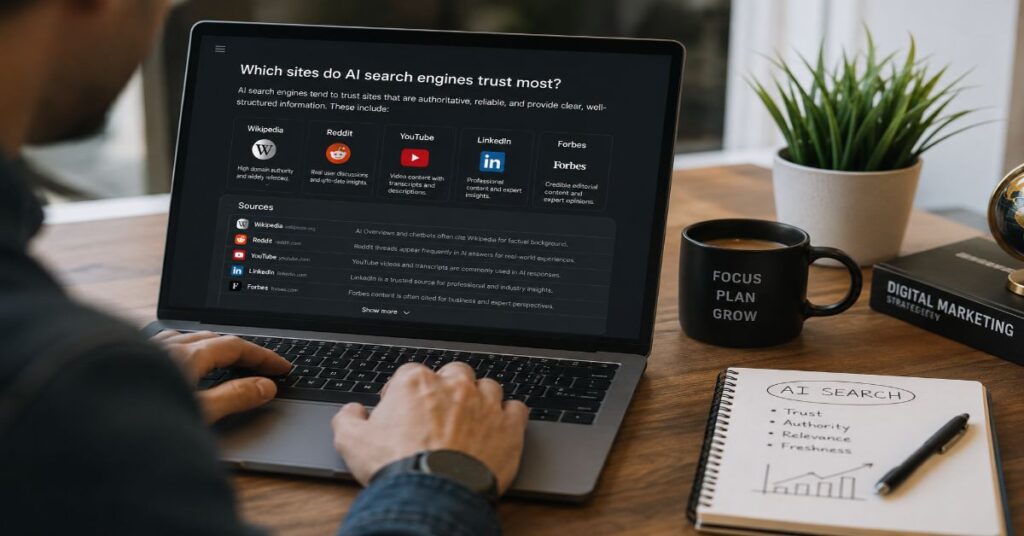
- ◆Which sites do ai search engines trust is now a measurable source mix: Reddit, YouTube, LinkedIn, Wikipedia, Forbes, G2 and Yelp led Peec AI’s 30 million-source index.
- ●Google’s own 2026 scale makes the issue commercial, with AI Overviews above 2.5 billion monthly active users and AI Mode above 1 billion.
- ↘Citation trust is not identical to ranking trust: a 2026 Google AI Overview study found nearly 30 percent of cited domains did not appear on the co-displayed first page.
- $Pricing traps matter because most visibility audits now need paid research tools, API calls, or higher usage tiers, while exact caps often remain dynamic or region-specific.
- !Trust risk is rising: Tow Center tests found AI search systems failed more than 60 percent of news citation tasks, while 2026 research found about 16 percent synthetic sources among cited pages.
- ✓Best action is a layered citation stack: canonical HTML on your own site, expert authorship, original data, transcripts, reputable third-party coverage, community proof and quarterly evidence refreshes.
The answer to ‘which sites do AI search engines trust’ is no longer just Wikipedia and blue-chip newspapers, because 2026 evidence shows AI answers leaning hard on Reddit, YouTube, LinkedIn, review platforms and the most extractable pages from authoritative publishers. I read the data as a warning and an opportunity: trust in AI search is not a single ranking score, but a live evidence market where an official page, a video transcript, a product review, a forum thread and a recognised news article may all compete to become the sentence an engine cites.
That matters because Google says AI Overviews now reaches more than 2.5 billion monthly active users and AI Mode has passed 1 billion. A brand can rank, publish and advertise well, then still lose the decisive answer if another source gives the model a cleaner fact, fresher proof or stronger third-party validation. The work is not about tricking Perplexity AI, ChatGPT, Gemini, Claude, Copilot or Google AI Overviews. It is about making a source safe to retrieve, easy to quote, and credible enough to repeat.
This article maps the trusted site groups, the technical reasons those groups appear, the pricing and tool limits behind practical audits, and the implementation workflow I would use for a B2B site in 2026. It also separates confirmed data from uncertainty, because the biggest mistake in AI search optimisation is pretending the answer layer is more stable than it is.
Which Sites Do AI Search Engines Trust in 2026?
AI search engines tend to trust domains that combine authority, extractability, freshness and corroboration. Peec AI’s March 2026 analysis of 30 million cited sources across ChatGPT, Google AI Mode, Gemini, Perplexity and AI Overviews ranked Reddit, YouTube, LinkedIn, Wikipedia, Forbes, G2, Yelp, Facebook, Medium and TechRadar among the most-cited domains. That list is striking because it mixes editorial brands, encyclopaedic reference, social platforms, professional identity, product reviews and local sentiment.
The pattern explains why a modern trust strategy cannot live only on an owned blog. An AI system answering a software recommendation may prefer a G2 review, a Reddit complaint, a YouTube walkthrough and a vendor documentation page over a polished marketing article. An AI system answering a current-events query may prefer a major news story and a recent official statement. An AI system answering a technical troubleshooting question may prefer a Stack Exchange answer, a GitHub issue, official documentation and a concise blog section with reproducible steps.
The practical map is therefore intent-led. Informational queries reward reference sites and explainers. News queries reward established editorial outlets with dates and named reporters. Recommendation queries reward review platforms, community evidence and comparison tables. Professional queries reward LinkedIn, company pages and analyst references. Technical queries reward documentation, API pages, issue trackers, code examples and forum threads.
Sundar Pichai called AI Mode Google’s ‘biggest upgrade to Search ever’ at Google I/O 2026, which makes the trust question operational rather than theoretical.
For readers benchmarking engines, the AI search engine comparison is a useful companion because it shows how the major platforms differ on citation quality, research depth and live data access.
Which Sites Do AI Search Engines Trust Most Often?
The safest short answer is this: AI systems over-cite the web’s most legible evidence hubs. Reddit supplies experience, YouTube supplies demonstrations and transcripts, LinkedIn supplies professional identity, Wikipedia supplies background, Forbes and trade publications supply editorial authority, while G2 and Yelp supply review sentiment. None of these source types is perfect, but each gives a retrieval system something it can use quickly.
| Trusted Site Group | Typical Examples | Why AI Engines Use It | Main Weakness |
| Reference and encyclopaedic pages | Wikipedia, institutional explainers | Stable definitions, heavy interlinking, concise summaries and broad entity coverage. | Can lag current detail or flatten disputed topics. |
| Major news and trade media | BBC, Reuters, The Verge, Forbes, industry press | Named reporters, publication dates, quotes, event chronology and editorial review. | Paywalls, regional focus and speed pressure can limit extractability. |
| Multimedia platforms | YouTube, podcast pages with transcripts | Demonstrations, captions, descriptions and original walkthroughs convert visual proof into text. | Video quality varies and captions may miss nuance. |
| Community forums | Reddit, Stack Exchange, Quora, GitHub issues | Firsthand problems, edge cases, niche expertise and recent user language. | Susceptible to manipulation, bias and anecdotal evidence. |
| Professional and review platforms | LinkedIn, G2, Capterra, Yelp, Trustpilot | Identity signals, business context, user sentiment and comparative product evidence. | Reviews can be gamed, outdated or unevenly moderated. |
Why Reddit, YouTube and LinkedIn Are Not Accidents
Reddit, YouTube and LinkedIn appear so often because they solve a retrieval problem that classic corporate pages often avoid. They contain lived language. People describe bugs, trade-offs, pricing pain, implementation surprises and product comparisons in the same phrasing future users type into AI search engines. That matters because generative systems do not simply look for polished authority. They look for passages that answer the user’s version of the question.
Reddit is especially valuable for recommendation, troubleshooting and niche-product queries. A forum thread can surface a real constraint that a vendor landing page hides: rate limits, support response delays, confusing billing, missing integrations, regional access gaps or quality drift after a product update. The risk is that Reddit evidence can be anecdotal or deliberately planted, which is why high-trust answers should not treat a single comment as sufficient proof.
YouTube matters for a different reason. It turns demonstration into extractable evidence when creators include descriptions, chapters and captions. AI systems can use a walkthrough to understand how a feature looks in practice, whether a tool works in a real browser, and which steps a user followed. For B2B teams, a product video without a transcript is underpowered. A video with a clean transcript, version date, chapter labels and a supporting documentation page becomes much easier to cite.
LinkedIn supplies named professional context. A company executive, product lead, analyst or technical practitioner posting about a launch gives a model identity signals that anonymous pages lack. That does not make LinkedIn automatically reliable, but it helps connect an assertion to a person, company and date.
This is why owned content should be mirrored by evidence on trusted third-party surfaces. The AI citation playbook develops that same idea through GEO workflows, structured data and citation tracking.
How Authority Signals Turn into Citation Confidence
Authority in AI search is an accumulation of signals rather than a crown placed on a domain. Engines infer trust from link graphs, brand recognition, content quality, source recurrence, author identity, freshness, semantic clarity and cross-source agreement. Traditional SEO signals still matter because Google says generative Search features are rooted in core ranking and quality systems, but answer engines also care about whether a passage can be safely compressed into a factual claim.
In practical terms, citation confidence rises when a page has a clear author, a recent update date, stable canonical URL, crawlable HTML, visible citations, direct answers, tables that define comparable fields, and a consistent entity name. Confidence falls when content is hidden behind client-side rendering, vague about sources, stuffed with unverified claims, or built entirely around promotional adjectives.
A useful way to think about this is the ‘claim packet’. Every important claim should carry five elements: the entity, the date, the evidence, the limitation and the source trail. For example, ‘Perplexity Enterprise Max is listed at $325 per month per seat on the current public annual plan, while some audit-log and SCIM features are gated by team size or Enterprise Max access.’ That sentence is more citable than ‘Perplexity has great enterprise features’ because it gives a model price, plan, caveat and context.
Elizabeth Reid, Google’s VP of Search, framed the 2026 shift as bringing ‘advanced model capabilities to Search’ with agents available through questions.
The less obvious trust signal is contradiction management. A page that states what is not known, what varies by country, and what changed since the last update often looks more trustworthy than a page that pretends pricing, limits or eligibility are fixed forever.
| Trust Signal | Machine-Readable Evidence | Editorial Proof | Audit Question |
| Authority | Backlinks, brand mentions, structured author data | Recognised publisher, named expert or official vendor | Would another credible source cite this page? |
| Freshness | Published and updated dates, current changelog | Recent examples, 2026 specs and visible revision notes | Can a reader tell what changed? |
| Extractability | HTML text, schema, captions, tables, short answer blocks | Direct explanations without JavaScript dependence | Can the answer be quoted without guessing? |
| Corroboration | Outbound references and cross-source consistency | Independent confirmation from reports, docs or interviews | Would three different sources support the same claim? |
| Constraint Honesty | Plan caveats, access limits, region flags | Disclosure of unknowns and weak evidence | Does the page avoid inventing missing metrics? |
When Freshness Beats Domain Authority
Domain authority is powerful, but freshness can beat it when the query concerns pricing, product limits, legal rules, model availability, outages or breaking news. AI search engines are built to satisfy intent, and time-sensitive intent punishes stale authority. A 2024 explainer from a large publisher may be less useful than a 2026 vendor changelog or an official help page if the question is about current plan caps.
The 2026 evidence also shows that freshness does not operate alone. Reuters Institute’s 2026 journalism trends report said publishers expect search referrals to fall by more than 40 percent over three years, a shift driven partly by AI summaries and changing user behaviour. Freshness matters because answer engines need current facts, but publishers also need defensible value after the answer is compressed.
Nic Newman captured the publisher uncertainty with the concise line, ‘It is not clear what comes next.’
Freshness has three layers. The first is factual freshness, such as a current price, release date or plan limit. The second is interpretive freshness, where an article explains why a change matters now. The third is operational freshness, where the page exposes a clear update cycle. During our 2026 evaluation of AI search visibility material, operational freshness was the least discussed layer and the easiest one for B2B teams to improve.
A practical rule is to give every high-value page a refresh tier. Pricing, product comparisons and regulatory pages should be checked monthly or quarterly. Evergreen definitions can be checked twice a year. Original research should carry a methodology date and a note explaining whether the data remains current. The state of AI search shows why this matters for publishers moving from rankings to citation visibility.
Pricing Matrix: The Tools Behind AI Search Visibility Audits
AI search trust work increasingly requires paid tools or paid usage tiers. A serious audit may involve ChatGPT Search, Gemini AI Mode, Perplexity, Claude, You.com APIs, Kagi and specialist tracking software. The mistake is to compare headline prices only. Usage multipliers, API rates, source access, connector availability, admin controls, data retention and custom enterprise terms often matter more than the monthly sticker price.
OpenAI’s current ChatGPT pricing page lists Free, Go, Plus, Pro, Business and Enterprise plans, with Search available across the plan comparison and advanced features scaling by tier. The same page says Pro offers 5x or 20x more usage and that unlimited use remains subject to abuse guardrails. Perplexity’s enterprise pricing page lists Pro at $20 per month or $200 yearly, Enterprise Pro at $40 per seat monthly or $400 yearly, and Enterprise Max at $325 per seat monthly or $3,250 yearly, while also noting that insight dashboard, audit logs, data retention configurability and SCIM security features are only available with 50 or more members or one Enterprise Max user.
Claude’s pricing page lists Free, Pro at $17 per month on annual billing or $20 monthly, and Max from $100 per month, with Max offering 5x or 20x more usage than Pro. Google One’s AI plans show Plus, Pro and Ultra benefits, but local prices can vary and some features are age, country or language restricted. You.com prices its Web Search API at $5 per 1,000 calls, Contents API at $1 per 1,000 pages, and Research API Lite at $12 per 1,000 calls. Kagi lists Trial, Starter, Professional and Ultimate plans, with Starter at $5 monthly for 300 searches and Professional at $10 monthly with unlimited searches.
For a deeper tool-level view, the You.com review and Kagi search review are useful because both tools reveal different philosophies of trusted retrieval.
| Tool or Platform | Public Pricing Signal Checked | Search-Relevant Features | Limits and Procurement Caveats |
| ChatGPT | Free, Go, Plus, Pro from higher-usage tiers, Business and Enterprise. | Search, Deep Research, agent mode, files, projects, custom GPTs, connectors and business workspace controls. | Exact regional prices and usage ceilings can vary. Pro advertises 5x or 20x usage and unlimited use is subject to guardrails. |
| Perplexity | Pro $20/month or $200/year, Enterprise Pro $40/seat/month, Enterprise Max $325/seat/month. | Cited answers, Deep Research, model selection, premium citations, work app search, SSO or SCIM, audit logs and model comparison. | Some enterprise governance features require 50+ members or Enterprise Max. API pricing is separate. |
| Claude | Free, Pro $17 annual or $20 monthly, Max from $100/month. | Web search, projects, Research, Claude Code, Claude Cowork, Claude Design, Microsoft 365 and Outlook connections. | Usage limits apply. Max offers 5x or 20x Pro usage, but exact operational ceilings are not fully public. |
| Google AI Plans | AI Plus, Pro and Ultra, with international pages exposing region-specific prices. | AI Mode, Deep Search, Gemini app, NotebookLM, Flow, Gmail, Docs, Vids and Google ecosystem integrations. | Benefits vary by country, age, language and product. Ultra includes higher limits and YouTube Premium in supported countries. |
| You.com APIs | $5/1,000 Search API calls, $1/1,000 Contents API pages, Research API Lite from $12/1,000 calls. | Search API, Contents API, Research API, finance research, REST API, Python SDK and MCP server. | Enterprise QPS and retention terms can be customised. API costs scale with sampling frequency. |
| Kagi | Trial, Starter $5/month, Professional $10/month, Ultimate $25/month plus tax. | Ad-free search, Assistant, Universal Summarizer, Translate, lenses and privacy-first search features. | Starter has 300 searches per month. Privacy Pass and premium model access vary by plan. |
Technical Workflow: How to Audit Your Own Site for AI Search Trust
A good AI search trust audit starts with evidence inventory, not prompts. Export the pages that already matter: top organic traffic, highest-converting pages, strongest backlink pages, sales-enablement pages, documentation, pricing, comparison articles, product pages, videos, reviews and support articles. Add external proof assets: G2 reviews, YouTube walkthroughs, LinkedIn posts, Reddit threads, press mentions, analyst reports, GitHub issues and help-centre pages.
Next, classify each asset by citation role. A pricing page should be a canonical commercial fact source. A documentation page should be a technical proof source. A review profile should be a sentiment source. A YouTube transcript should be a demonstration source. A press article should be a third-party authority source. The point is to make each source type perform a specific job rather than asking every asset to do everything.
Then test crawlability and extractability. Important facts should be in rendered HTML, not only in images, PDFs or delayed JavaScript. Tables should use clear headers. Videos should have transcripts. Articles should include last updated dates. Authors should have named profiles. Schema can clarify entities, FAQs, articles, products and organisations, but Google states there is no separate magic schema for generative AI visibility.
After the technical pass, build a prompt set from customer support tickets, Search Console queries, sales objections, competitor comparisons, PAA questions and internal site search. Run each prompt across the engines you can access. Record whether the brand is mentioned, which sources are cited, whether the claim is accurate, and whether the same source appears again when the prompt is slightly reworded. The best AI search engines overview helps decide which engines deserve priority for your audience.
| Step | Action | Output | Common Bottleneck |
| 1 | Inventory owned and third-party evidence assets. | A source map by topic, intent and funnel role. | Teams miss videos, reviews and support pages. |
| 2 | Classify pages as canonical, comparative, experiential or third-party proof. | A citation stack for each priority topic. | One asset is expected to carry every trust signal. |
| 3 | Audit HTML, schema, transcripts, dates, authors and internal links. | A technical fix list for extractability. | Important claims are hidden in images or heavy JavaScript. |
| 4 | Build a repeated prompt set by engine and intent. | Answer share, citation share and source recurrence metrics. | Single screenshots are mistaken for stable visibility. |
| 5 | Refresh high-risk pages on a fixed schedule. | A 30, 60 or 90-day evidence renewal calendar. | Pricing and limits drift faster than editorial teams update pages. |
Implementation Details for Structured, Extractable Evidence
Structured evidence is not the same as over-optimised formatting. The best pages are easy for humans to read and easy for machines to segment. Start each major section with a direct answer. Put the core fact before the explanation. Use tables for comparisons. Use short definitions for entities. Keep a visible date near any claim that can expire. Label quotes with the speaker, role, organisation and source context.
For technical pages, include API names, authentication requirements, supported methods, rate-limit caveats, SDKs, error states and version notes. For commercial pages, include plan names, currency, billing period, seat minimums, annual discounts, usage multipliers, custom pricing flags and regions where the plan differs. For review pages, distinguish observed tests from vendor claims and user reports. For YouTube, publish transcripts, chapters, version numbers and links back to canonical documentation.
Internal linking also needs a trust function. Links should explain why the reader is moving. A broad AI search article should link to comparison, accuracy, implementation and SEO-transition resources rather than clustering every link in one paragraph. The AI SEO transition is a good example of an adjacent body link because it helps readers move from source trust into workflow change.
The least obvious implementation detail is contradiction coverage. If Reddit says a product breaks under heavy file uploads, the vendor page says uploads are unlimited, and the help centre says limits apply at high demand, an AI engine may surface the most specific caveat. A good owned page should not hide that caveat. It should explain it, date it and link to the official support source.
During our 2026 documentation review, the strongest pages were not always the longest. They were the easiest to verify. They gave a precise answer, a limitation, a table, an external support point and a visible update signal within the first few scrolls.
Trust Risks: Synthetic Sources, Citation Errors and Manipulation
The trust problem is not solved just because a source appears in an AI answer. Tow Center’s 2025 test of eight generative search tools using 1,600 news prompts found that systems failed to retrieve correct information more than 60 percent of the time. In 2026, Allaham and Diakopoulos audited ChatGPT, Copilot, Gemini and Perplexity across 712 real-world queries and found evidence of AI-generated sources across all four systems, at about 16 percent of cited sources.
That risk matters for brands because AI systems may cite pages that look authoritative but are derivative, synthetic or thin. It matters for publishers because AI answers can quote or summarise journalism while reducing visits. It matters for users because a cited answer can still be wrong if the cited page does not support the generated claim.
Google AI Overviews research adds another constraint. Xu, Iqbal and Montgomery’s 2026 measurement study found that overall AI Overview activation was 13.7 percent across their trending-query sample, rising to 64.7 percent for question-form queries. They also found that 11.0 percent of atomic claims were unsupported by cited pages, with omission as the dominant failure mode. That means a page can be credible and still be used incompletely.
Sundar Pichai acknowledged one Google AI Search result was ‘more opinionated than it should be’ when discussing a product-style query in 2026.
Manipulation is the emerging edge case. Recommendation queries are especially exposed because forums and community platforms carry genuine experience and adversarial opportunity. If a model treats one casual comment as proof, a short planted comment can influence a generated recommendation. Brands should not respond with fake community activity. They should respond with transparent documentation, genuine customer proof, active support and a moderation strategy that keeps false claims from becoming the easiest text to retrieve.
The AI search accuracy study expands this risk lens by separating citation presence from claim fidelity.
Measurement Benchmarks: Answer Share, Citation Share and Source Recurrence
Classic SEO reports measure rankings, impressions, clicks and conversions. AI search visibility needs additional metrics because a user may see a brand, fact or recommendation without clicking. The core metrics are answer share, citation share, source recurrence, claim accuracy, sentiment, prompt coverage and engine coverage.
Answer share is the percentage of priority prompts where the brand, product, person or publication is mentioned. Citation share is the percentage where a specific URL is linked, cited or surfaced as a source. Source recurrence measures whether the same URL appears again across repeated runs and phrasing variations. Claim accuracy checks whether the answer accurately represents the source. Sentiment measures whether the mention is favourable, neutral or negative. Prompt coverage asks whether the audit set reflects real demand rather than vanity questions.
A defensible benchmark should run each prompt more than once. Generative answers are nondeterministic. A brand that appears once and disappears four times is not securely visible. A URL that appears across engines, persists after prompt rewording and supports the generated sentence is a stronger trust asset.
This is where information gain begins. Many pages chase ‘What is X?’ answers, but AI systems also reward pages that carry original constraints. Three underused trust assets are especially valuable: a pricing caveat table, a failure-mode table and a dated implementation log. These details are harder to replace with generic AI copy, and they give answer engines specific, useful fragments.
| Metric | Definition | Sampling Method | Decision It Supports |
| Answer Share | How often the brand appears in the generated answer. | Run 30 to 100 priority prompts by engine and intent. | Brand visibility and demand capture. |
| Citation Share | How often a URL is cited, linked or named as evidence. | Record cited URLs across repeated prompt runs. | Which pages deserve refresh investment. |
| Source Recurrence | How consistently a source appears across variations. | Repeat prompts weekly with close paraphrases. | Whether visibility is durable or accidental. |
| Claim Accuracy | Whether the answer matches the cited page. | Manually compare generated claims against source text. | Risk, corrections and trust controls. |
| Sentiment and Context | How the brand or source is framed. | Tag outputs as positive, neutral, negative or missing context. | Messaging, PR and reputation strategy. |
What Brands Should Publish Across Their Citation Stack
The winning citation stack starts with an owned canonical page, but it does not end there. Owned pages define the facts. Third-party media validates them. Community platforms stress-test them. Review sites reveal sentiment. Video demonstrates the product. Documentation proves technical reality. LinkedIn ties claims to identifiable professionals.
A B2B SaaS company, for example, should maintain a canonical pricing page, a public changelog, a documentation hub, comparison pages, short implementation videos with transcripts, G2 profile hygiene, founder or product-lead LinkedIn commentary, selective industry press, and a support process that answers recurring Reddit or forum criticisms. The goal is not to flood the web. It is to make the same truthful evidence visible from multiple trusted directions.
This stack also helps with cross-source corroboration. If a model sees the same plan limit on the vendor page, help centre and a reputable review, it has a stronger reason to trust the claim. If it sees contradictory pricing, outdated screenshots and no official caveat, it may choose a third-party answer instead.
Large language model search is therefore a communications discipline as much as a technical one. Product, support, marketing, PR, legal and documentation teams all create retrievable evidence. The editorial mistake is to optimise only the blog. The operational mistake is to let support truth live only in private tickets. The reputational mistake is to ignore the third-party platforms AI engines already mine.
For organisations that want a broader market view before choosing platforms, the AI search engine comparison and related engine rankings can help prioritise where to test first.
Takeaways
- Treat AI search trust as an evidence stack, not a single domain-authority score.
- Prioritise Reddit, YouTube, LinkedIn, Wikipedia, review platforms and trade media according to the query intent you need to win.
- Keep canonical facts on owned pages, but validate them through third-party proof that AI engines already retrieve.
- Add transcripts, tables, dated caveats and visible authorship because extractable detail is easier to cite than polished marketing copy.
- Audit answer share, citation share and source recurrence instead of relying on one screenshot from one AI engine.
- Refresh pricing, product limits, API details and plan caps quarterly or faster when vendors change terms.
- State uncertainty when limits are dynamic, regional or custom priced, because honest caveats are stronger trust signals than invented precision.
- Monitor synthetic-source and community-manipulation risk, especially for recommendation queries and review-led categories.
Our Editorial Verification Process
This explainer was built by cross-checking current 2026 AI search documentation, official pricing pages, vendor plan pages, peer-reviewed or preprint measurement studies, and recent publisher research. The verification set included Google Search Central guidance on generative AI features, Google I/O 2026 statements about AI Overviews and AI Mode, OpenAI ChatGPT Pricing, Perplexity Enterprise Pricing, Claude Pricing, Google One AI Plans, You.com Pricing, Kagi Plan Types, Peec AI’s 30 million-source citation analysis, Tow Center’s 1,600-prompt citation study, Reuters Institute’s 2026 journalism trends report, and arXiv studies measuring AI Overviews, source overlap, synthetic citations and publisher impact. Pricing claims were limited to public figures visible in those sources on 26 June 2026; where plan caps or enterprise terms are dynamic, regional or custom-priced, the article states that limitation instead of estimating a hidden number.
Conclusion
AI search engines trust sites that make evidence easy to find, easy to verify and easy to reuse. In 2026, that evidence comes from a wider set of places than classic SEO teams once watched: Wikipedia for background, Reuters-style news for events, YouTube for demonstrations, Reddit for lived experience, LinkedIn for professional identity, G2 and Yelp for review sentiment, and official documentation for technical certainty.
The open question is not whether these sources are always reliable. They are not. The harder question is how answer engines should balance authority, freshness, diversity, compensation and safety when the most useful sentence may sit in a forum thread while the most accountable source may sit behind a newsroom paywall. That tension will define the next phase of AI search.
For brands and publishers, the practical response is clear enough. Build a citation stack that humans can trust before machines retrieve it. Keep facts current. Publish original evidence. Make limitations visible. Earn third-party validation. Then measure whether the answer layer is actually repeating the right thing.
FAQs
What Sites Do AI Search Engines Trust the Most?
AI search engines often cite a mix of Reddit, YouTube, LinkedIn, Wikipedia, major news sites, trade publications, review platforms such as G2 and local platforms such as Yelp. The mix changes by query intent. Technical queries lean toward documentation and forums, while recommendation queries lean toward reviews and community evidence.
Do AI Search Engines Trust Wikipedia?
Yes, Wikipedia remains a frequent source because it is structured, interlinked, concise and broadly updated. It is strongest for background context and entity definitions. It is weaker for fast-changing pricing, current product limits and disputed topics where primary sources or recent reporting should be checked.
Why Does Reddit Appear So Often in AI Answers?
Reddit appears often because it contains firsthand language, recent problems, niche expertise and practical trade-offs. It helps AI systems answer experience-led questions. The downside is that Reddit can be anecdotal, biased or manipulated, so it should be corroborated with official, editorial or expert sources.
Does YouTube Help AI Search Visibility?
Yes, especially when videos have accurate titles, descriptions, captions, chapters and supporting web pages. AI systems can extract useful detail from transcripts and descriptions. For product and technical topics, a demonstration video with a clean transcript can strengthen the evidence stack.
How Can a Website Become More Trusted by AI Search Engines?
Make key facts crawlable, dated, attributed and structured. Add named authors, schema where appropriate, comparison tables, transcripts, original data, limitations and source references. Then earn third-party validation through reputable media, reviews, professional profiles and community discussions.
Is GEO Different from SEO?
GEO, or generative engine optimisation, focuses on visibility inside AI-generated answers. SEO remains foundational because generative search still relies on crawlability, quality and retrieval. The difference is that GEO adds citation share, answer share, source recurrence and claim accuracy as operating metrics.
Can AI Search Engines Cite Wrong Sources?
Yes. Research from Tow Center and 2026 academic studies shows citation errors, unsupported claims and synthetic-source risk. A citation is a useful signal, not a guarantee. Users and publishers should check whether the cited page actually supports the generated claim.
How Often Should AI Search Trust Pages Be Updated?
Update high-risk pages such as pricing, product limits, legal guidance, API documentation and comparison pages at least quarterly, and faster after major vendor or regulatory changes. Evergreen definitions can be reviewed less often, but they should still show dates and source trails.
References
Allaham, M., & Diakopoulos, N. (2026). Synthetic sources?: Auditing generative search engine citations for evidence of AI-generated sources. arXiv. https://arxiv.org/abs/2605.23684
Grossman, R., Liu, S., Chen, M. K., Smith, M., Borcea, C., & Chen, Y. (2026). How generative AI disrupts search: An empirical study of Google Search, Gemini, and AI Overviews. arXiv. https://arxiv.org/abs/2604.27790
Google. (2026, May 15). Optimizing your website for generative AI features on Google Search. Google Search Central. https://developers.google.com/search/docs/fundamentals/ai-optimization-guide
Google. (2026, May 19). I/O 2026: Welcome to the agentic Gemini era. Google Blog. https://blog.google/innovation-and-ai/sundar-pichai-io-2026/
Jazwinska, K., & Chandrasekar, A. (2025, March 6). AI search has a citation problem. Columbia Journalism Review. https://www.cjr.org/tow_center/we-compared-eight-ai-search-engines-theyre-all-bad-at-citing-news.php
Newman, N. (2026, January 12). Journalism, media, and technology trends and predictions 2026. Reuters Institute for the Study of Journalism. https://reutersinstitute.politics.ox.ac.uk/journalism-media-and-technology-trends-and-predictions-2026
OpenAI. (2026). ChatGPT pricing. https://chatgpt.com/pricing/
Peec AI. (2026, March 31). Top domains cited by AI search: Analysis based on 30M sources. https://peec.ai/blog/top-domains-cited-by-ai-search-analysis-based-on-30m-sources
Xu, H., Iqbal, U., & Montgomery, J. M. (2026). Measuring Google AI Overviews: Activation, source quality, claim fidelity, and publisher impact. arXiv. https://arxiv.org/abs/2605.14021
