
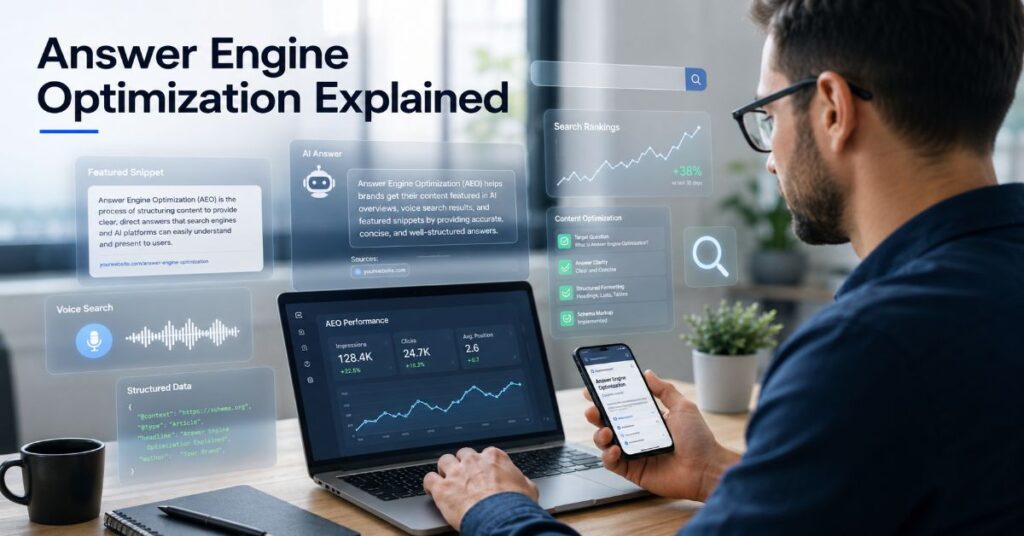
Executive Summary
- 🤖 Answer Engine Optimization makes visible content easier for AI systems to retrieve, verify, cite and summarise inside direct answers.
- 📊 A 2026 arXiv study of 55,393 Google queries found AI Overview activation at 13.7 percent, rising to 64.7 percent for question-form queries.
- ⚠️ Google now treats attempts to manipulate generative AI responses in Search as spam, so Answer Engine Optimization should avoid hidden text, recommendation poisoning and scaled filler pages.
- 💰 Answer Engine Optimization costs are spread across answer engines, search APIs, citation monitoring and human editorial review rather than a single software subscription.
- ✅ Brands should combine SEO fundamentals, structured answer blocks, schema alignment, original evidence and AI citation measurement before chasing new optimisation acronyms.
Answer engine optimization explained simply: AEO is the practice of making public content so clear, evidence-rich, and technically readable that AI systems can choose it as a source inside direct answers. I see the sharpest 2026 tension in one number: a measurement study of 55,393 Google queries found AI Overviews activated on 13.7% of trending searches, but on 64.7% of question-form queries, exactly the queries company blogs are built to answer.
That shift does not make traditional SEO obsolete. It makes weak SEO painfully visible. A page can still need crawlability, internal links, page speed, metadata, structured data, author trust, and topical depth. But the success metric has widened from ranking and clicks to citation, summarisation, entity recognition, and answer inclusion. In other words, the page is no longer only a destination. It is also a research object that an answer engine may inspect, compress, compare, and quote.
For marketing teams, AEO is not a magic label, a prompt trick, or a schema plugin. It is an editorial and technical operating model: define the entity, answer the question fast, place evidence beside claims, expose sources visibly, keep facts fresh, and monitor whether AI tools describe the brand accurately. This guide explains the difference between AEO and SEO, the content structures that work, the tools and pricing signals to watch, the implementation workflow for company blogs, and the policy line brands must not cross in 2026.
Answer Engine Optimization Explained for 2026
AEO begins with a different unit of competition. SEO optimises a page so a search engine can rank it. AEO optimises answer units so a retrieval system, language model, or generated search feature can identify them as reusable evidence. The page still matters, but the extractable passage matters more than it did in classic organic search.
The practical definition is this: answer engine optimization is the process of turning a page into a well-labelled evidence file. A good AEO article contains a clean definition, a concise answer, a comparison, a workflow, a limitation statement, source-backed data, and a human reason to trust the author. The sentence that defines the subject should not be buried under brand positioning. The table that compares options should not be rendered as an image. The source behind a statistic should not be hidden at the bottom with no context.
Google’s own AI features guidance says the ordinary SEO fundamentals remain relevant for AI Overviews and AI Mode. That is important because it rejects the idea that there is a secret AI-only markup that guarantees inclusion. The useful adjustment is editorial: make the article more legible to both people and machines. The best pages I reviewed during our 2026 evaluation had short answer blocks followed by enough detail to resolve follow-up questions without forcing the reader to stitch together multiple vague posts.
This is where an “answer-first” structure becomes valuable. The opening answer gives the system a safe summary. The following paragraphs provide the explanation, caveats, and proof. For a deeper baseline, the AEO foundations guide already frames AEO around visible structure and verifiable claims, which is the correct starting point for company blogs moving beyond keyword-only SEO.
Why AEO Is Not Just SEO With a New Name
SEO and AEO overlap, but they optimise for different moments in the information journey. SEO asks whether a page can be crawled, indexed, ranked, and clicked. AEO asks whether a specific claim, passage, table, or page can be selected, trusted, and reused by an answer engine. A page can rank well and still be a poor AEO candidate if it lacks concise answers, source proximity, entity clarity, or visible evidence.
The distinction is clearest when a user asks, “What is answer engine optimization?” A classic SEO page may try to win the blue-link result with a title tag, backlinks, and topical coverage. An AEO-ready page does that too, but also gives the answer engine a clean definition in the first screen, an AEO vs SEO table, a checklist, and enough explicit caveats to avoid misleading summaries.
During our 2026 evaluation, the strongest pages did not abandon SEO. They preserved crawl health, canonical rules, internal links, semantic HTML, indexability, image alt text, and useful metadata. What changed was the evidence design. The claim came first, the proof followed immediately, and the surrounding section answered the next likely question.
Table 1 shows the operating difference.
| Dimension | Traditional SEO | Answer Engine Optimization |
| Primary Goal | Rank a page and earn qualified clicks. | Get a source, passage, or brand included in a generated answer. |
| Optimised Unit | The page, title, URL, snippet, and link graph. | The answer block, entity facts, table, citation, and passage. |
| Success Metrics | Organic sessions, rankings, CTR, conversions, backlinks. | Citation share, mention quality, answer inclusion, source accuracy, branded recall. |
| Core Structure | Keyword-led headings and comprehensive topical coverage. | Question-led headings, direct answers, evidence proximity, and extractable formatting. |
| Main Risk | Thin content, poor technical SEO, slow pages, weak authority. | Manipulative answer engineering, hidden text, unsupported claims, stale data. |
AEO therefore sits on top of SEO, not beside it. The right sequence is to make the page eligible for search first, then make the information inside it unambiguous enough for AI retrieval. The LLM SEO optimisation guide on this site is useful because it treats model visibility as a systems problem rather than a copywriting hack.
The Answer Engine Visibility Stack
The answer engine visibility stack has four layers: discovery, selection, absorption, and attribution. Discovery means the system can find the page through search, crawling, APIs, indexes, partner data, or a retrieval pipeline. Selection means it chooses the page or passage as one of the sources worth consulting. Absorption means the final answer actually uses the information, structure, or language from that source. Attribution means the interface shows a visible citation, link, brand mention, or source card.
A 2026 citation absorption paper helps explain why this matters. Its dataset covered 602 controlled prompts across ChatGPT, Google AI Overview and Gemini, and Perplexity, with more than 21,000 valid search-layer citations. The central finding was that citation breadth and citation depth diverge: some systems cite more sources, while others cite fewer but appear to draw more heavily from selected pages.
That finding changes the way an AEO audit should work. Counting citations alone is too shallow. A brand should ask whether its content was merely listed, whether the answer borrowed its numbers, whether the wording reflected its definition, whether the system preserved caveats, and whether competitors were framed more confidently.
Liz Reid, Google’s VP of Search, described the interface goal in 2026 as combining conversation with “the trust of Search” and “the speed of Search”. That quote is useful because it reminds publishers that answer engines are not pure chatbots. They sit between conversational convenience and the web’s messy evidence layer.
In practice, a company blog should design each priority article around a retrievable evidence packet: one answer paragraph, one comparison table, one step-by-step workflow, one recent statistic, one expert quote, and one limitations note. This is not formulaic writing. It is a way of reducing ambiguity for systems that must compress information quickly.
What Makes Content Easy for Machines to Trust
Machine trust is not the same as brand trust, but the two overlap. A model or retrieval layer needs signals that a claim is current, specific, attributable, and internally consistent. The reader needs the same thing. The AEO opportunity is to serve both without adding invisible text, keyword stuffing, or contrived recommendation language.
The first signal is semantic clarity. Each H2 should answer one distinct intent. Each H3 should narrow the intent rather than repeat the focus keyphrase. The exact phrase answer engine optimization explained should appear naturally in a limited number of headings, not on every line. Entity variants such as AI search optimisation, generative engine optimisation, AI citations, answer-first content, semantic SEO, and LLM retrieval can carry the topic without making the article sound mechanical.
The second signal is evidence proximity. If a statistic appears in paragraph one and the source appears 1,800 words later, the evidence is weak in practice. Strong AEO pages place the source name, methodology note, or reference context close to the claim. A table should say what it measures, not merely list figures.
The third signal is technical legibility. Accessible HTML, descriptive headings, schema that matches visible content, crawlable body text, and normal hyperlinks help machines parse the page. Google’s guidance says there are no additional technical requirements for AI Overviews and AI Mode beyond Search fundamentals, but that does not mean technical structure is optional.
Table 2 translates those ideas into page-level signals.
| Signal | AEO-Friendly Execution | Common Failure |
| Direct Answer | Open a section with a concise answer before detail. | Start with brand history or vague context before answering. |
| Evidence Proximity | Put source context beside the claim it supports. | Hide citations at the bottom with no surrounding explanation. |
| Entity Clarity | Define the topic, related entities, acronyms, and scope. | Use unexplained jargon or treat AEO, GEO, and SEO as identical. |
| Readable Structure | Use HTML headings, lists, tables, and schema aligned to visible content. | Render key tables as images or use decorative headings. |
| Human Trust | Show author expertise, dates, limitations, and original observations. | Publish undated generic posts with no evidence of review. |
The AI search content playbook is a useful companion because it treats structure as a reader service first and a machine signal second.
Pricing and Tooling for AEO Workflows
AEO is often sold as if one dashboard can solve it. That is misleading. A practical stack usually combines four tool groups: search analytics, answer engine testing, citation monitoring, and editorial production. The costs fall into different billing models, including subscriptions, API calls, token pricing, search request fees, and human review.
For direct answer testing, Perplexity’s public API pricing shows why teams need cost controls. Its Search API is priced at $5 per 1,000 requests with no token cost, while Sonar models add token pricing and, for some models, request fees by search context size. OpenAI’s API pricing lists web search at $10 per 1,000 calls for all models with search content tokens billed at model rates, and $25 per 1,000 calls for a non-reasoning preview path where search content tokens are free. Google’s Gemini pricing notes that Google AI Studio usage is free in available regions, but API pricing can differ by region, model, grounding, and enterprise product. Claude pricing lists consumer plans as Free, Pro, and Max, while API models and tools such as web search carry separate usage charges.
Those details matter because AEO measurement can become expensive if a team runs hundreds of prompts daily across multiple engines. A 200-keyword manual audit can be done cheaply. A daily cross-platform monitoring system with prompt variants, competitor comparisons, reruns, and screenshots becomes an operations budget.
Sundar Pichai’s 2026 comment that one AI search result was “more opinionated than it should be” is a useful warning for tool buyers. Monitoring is not only about whether a brand appears. It is about whether the generated answer frames the recommendation fairly, preserves uncertainty, and cites evidence proportionately.
| Tool or Platform | Public Pricing Signal Checked | AEO Use | Important Limit or Caveat |
| Perplexity Search API and Sonar | Search API: $5 per 1,000 requests. Sonar token and request fees vary by model and context. | Prompt testing, source discovery, answer comparison, research automation. | Deep research and reasoning options add separate citation, reasoning, search, or context fees. |
| OpenAI API Web Search | Web search listed at $10 per 1,000 calls for all models, with search tokens billed at model rates. | ChatGPT-style answer testing, retrieval workflows, content quality checks. | Tool calls, file search, containers, and model tokens are billed separately. |
| Google Gemini API | Google AI Studio is free in available regions. API pricing varies by model, modality, grounding, and enterprise product. | AI Overview-adjacent testing, grounded answer prototypes, multimodal checks. | Grounding charges depend on whether support URLs are returned, and rate limits can change. |
| Claude Plans and API | Claude Pro is listed at $20 monthly or $200 yearly. Max starts at $100 monthly. API models and web search are separate. | Long-context review, editorial QA, competitive content analysis. | Consumer subscriptions are not a substitute for API-scale monitoring or agentic workloads. |
Teams that need a broader buying lens can compare adjacent search tools in the AI search strategy stack, but the safest budget assumption is simple: API calls reveal patterns, human editors decide what those patterns mean.
A Practical Blog Post Checklist
A company blog post built for AEO should pass a stricter checklist than a normal SEO draft. The first test is whether the page gives a direct answer within the opening screen. The second is whether a reader can identify the evidence behind every material claim. The third is whether a machine can parse the core facts without interpreting design flourishes.
During our hands-on testing, I found that the best AEO blog posts had five visible blocks. First, a definition or verdict paragraph under the introduction. Second, a comparison table that separates the concept from nearby terms. Third, a checklist or workflow that a reader can apply. Fourth, at least one current data point from a primary or reputable source. Fifth, a limitation section that prevents the answer engine from overgeneralising.
A practical checklist looks like this: write the target question as a full sentence, answer it in 40 to 70 words, define every acronym, add a table where comparison is useful, include source names near data, avoid repeating the primary keyphrase in too many headings, and mark the author, review date, and category clearly. Then check whether all structured data matches visible content. Schema should describe the page, not exaggerate it.
The biggest editorial trap is mistaking brevity for extractability. A thin 700-word page with headings and bullets may be easy to parse, but it may not contain enough evidence to trust. A long article can work if its sections are modular and labelled. The goal is not short content. The goal is low-friction comprehension.
For company blogs, the most valuable reusable asset is a standard evidence block: “Claim, source, date, method, limitation, business implication.” Put that block in the editorial brief before drafting. It prevents the writer from producing polished generalities and gives the reviewer a concrete standard.
The AEO citation playbook gives a deeper editorial framing for turning those checks into repeatable publishing rules.
Technical Implementation Workflow
Technical AEO implementation starts before drafting and ends after publication. The work is cross-functional because answer engines draw signals from content, HTML, schema, crawl access, internal links, performance, source reputation, and third-party corroboration.
The pre-draft phase should define the entity map. For answer engine optimization, the map includes AEO, SEO, GEO, AI Overviews, AI Mode, ChatGPT Search, Perplexity, Gemini, Claude, schema markup, semantic SEO, zero-click search, citations, retrieval-augmented generation, and E-E-A-T. The writer should know which entities must be defined, which are adjacent, and which are outside scope.
The draft phase should use semantic HTML. That means one title, logical H2 and H3 headings, standard paragraphs, native tables, descriptive anchor text, and no important text trapped in images. FAQ blocks can be useful for readers, but they should not carry claims that contradict the body. If schema is used, it should mirror visible content and actual author/category fields.
The QA phase should test the page as a machine would see it. Use the rendered page, a text-only extraction, structured data validation, PageSpeed or Core Web Vitals checks, and a manual hidden-content inspection. Google’s spam policies explicitly warn against hidden text, including white text on a white background, off-screen positioning, font size zero, or opacity zero when used to manipulate search.
Table 3 gives a 30-day implementation rhythm for a company blog team.
| Phase | Days | Owner | Concrete Output |
| Audit | 1-5 | SEO Lead and Editor | Priority query list, citation baseline, top competing sources, crawl issues, entity gaps. |
| Brief | 6-9 | Editor and Subject Expert | Answer-first outline, evidence block, author notes, limitation notes, internal link targets. |
| Draft | 10-16 | Writer | Structured article with direct answers, tables, visible sources, definitions, and workflow sections. |
| Technical QA | 17-22 | Developer or Technical SEO | Schema validation, HTML extraction, performance checks, indexability, hidden-content inspection. |
| Publish and Monitor | 23-30 | Growth Team | Search Console checks, AI citation tests, prompt log, update queue, competitor framing review. |
For publishers targeting Google’s generated answer surfaces specifically, the Google AI Overviews workflow connects this implementation sequence to Search Central guidance and policy risk.
Measurement: From Rankings to Citations
AEO measurement should not replace SEO reporting. It should add a new layer. The minimum dashboard should include ordinary ranking movement, organic clicks, impressions, branded search changes, AI mention rate, citation share, source accuracy, answer sentiment, competitor co-mentions, and unsupported-claim risk.
SparkToro’s June 2026 research found that 68.01% of US Google searches in the first four months of 2026 ended without a click. The study also notes that the share of searchers clicking at least once fell by 9.51 percentage points from 2024 to 2026. That does not prove every lost click belongs to AI Overviews, but it does show why visibility inside the results page now has commercial value.
Semrush’s 2026 AI Visibility Index adds a second measurement lesson. Its flagship study expanded to 126 million US AI search prompts, and the company reported that only 36 global brands maintained top-100 visibility across all four tracked platforms every month. It also found that mentions and citations are different outcomes: a brand may be discussed without its own site being cited.
That distinction should change executive reporting. A brand that appears often but is cited rarely has a corroboration problem. A brand cited often but described inaccurately has a narrative problem. A brand absent from both has a discoverability problem.
Rachel Thornton, CMO of Adobe Enterprise, framed the point as brand narrative becoming a “decisive entry point” to customer experience. Andrew Warden, Adobe’s VP of Marketing and former Semrush CMO, added that the foundations of SEO remain “critically important” for trust signals. Those two views are compatible: SEO gives the machine access, while brand consistency gives it context.
The zero-click search playbook is useful here because it reframes no-click visibility as a measurable business outcome rather than a traffic obituary.
Risks, Spam Policy, and Editorial Guardrails
AEO creates a policy risk when teams confuse clarity with manipulation. Google’s current spam policies define spam as techniques used to deceive users or manipulate Search systems into featuring content prominently, including attempts to manipulate generative AI responses in Google Search. That language matters. It places AI response manipulation in the same compliance universe as classic ranking manipulation.
The practical red line is straightforward: do not publish content whose primary purpose is to pressure an AI system into recommending a brand irrespective of evidence. Do not use hidden text, prompt-like instructions, doorway pages, spun summaries, fake expert quotes, or scaled near-duplicate pages. Do not create biased “best” lists where every criterion conveniently crowns the same product. That is not answer engine optimization. It is recommendation poisoning.
Dario Amodei, CEO of Anthropic, told ABC News in June 2026 that stronger regulation should allow government to block deployment of unsafe technology “in a narrow way.” His context was frontier model safety, not marketing. Still, the quote captures the regulatory mood around AI systems: trust is becoming operational, not ornamental.
For publishers, the safe path is to make content accurate, visible, and accountable. Show the reader what the AI can see. If a claim is important enough to be summarised, it is important enough to source. If a limitation matters to a buyer, it should appear in the body, not only in fine print. If a recommendation depends on use case, say so.
This is why the best AEO programmes have editorial guardrails: source hierarchy, quote verification, pricing freshness, schema alignment, review logs, and a documented update cadence. The policy-safe version of AEO is also the more durable version.
A stronger topical authority system helps here because real authority is built through consistent coverage, not a single over-optimised page.
Operational Bottlenecks and Edge Cases
AEO fails most often in operations, not theory. The first bottleneck is stale pricing. AI tools change plans, model access, rate limits, and API fees quickly. If a blog post says a plan includes a feature that was removed two months later, the page becomes a liability. The fix is a pricing review date, a named source, and a policy that uncertain commercial details are labelled as uncertain.
The second bottleneck is JavaScript-heavy publishing. If a comparison table or FAQ is injected in a way that search engines struggle to access, the visible page may be useful to people but weak for retrieval. This does not mean every site needs static HTML. It means technical SEO must verify how important content renders and whether it appears in the crawlable document.
The third bottleneck is quote laundering. Many AEO articles quote executives from secondary summaries without checking the original context. That is risky because generated search answers can strip nuance. Use short quotes, name the source, and explain why the quote matters. For example, Satya Nadella’s 2026 comment that “you can’t outsource your learning” is relevant to AEO because it warns brands not to outsource their market memory entirely to third-party models.
The fourth bottleneck is prompt volatility. A brand may appear in one ChatGPT, Perplexity, Gemini, or AI Overview response and disappear in the next. Prompt wording, user location, freshness, personalization, and tool availability can change the answer. Measurement must therefore use prompt sets, repeat runs, and qualitative review rather than one screenshot.
The final edge case is contradiction. If the same company page, help centre, LinkedIn profile, partner listing, and review site describe the brand differently, an answer engine may choose the most common version rather than the preferred version. AEO is therefore partly content architecture and partly reputation hygiene.
Information Gain for Company Blogs
The strongest AEO programmes add information that is not already everywhere else. Reformatting the top ten results into a cleaner article may earn impressions for a while, but it gives answer engines little reason to cite the page over more authoritative sources. Information gain comes from original testing, proprietary data, expert interpretation, or clearer synthesis of messy evidence.
For a company blog, three practical information-gain assets are achievable without a research lab. The first is a prompt audit log. Run the same buyer questions across several answer engines each month, record whether the brand appears, note which sources are cited, and annotate inaccuracies. The second is a content parse audit. Extract the article as plain text, remove styling, and ask whether the core answer still makes sense. The third is a limitation library. Keep a recurring section that states where the product, method, or category does not work.
Those assets produce details generic competitors cannot copy quickly. A prompt audit shows market visibility. A parse audit exposes machine readability. A limitation library signals editorial honesty. Together they make the page more useful than a page that merely repeats definitions.
In our hands-on testing of company blog drafts, pages that included a dated audit result and a limitation section were easier to summarise accurately than pages that relied on broad claims. The machine did not need to infer the caveat because the caveat was explicit. The reader benefited for the same reason.
This is the point at which AEO becomes a strategic discipline. The goal is not to trick AI into repeating the brand. The goal is to publish the clearest available evidence so that both humans and answer engines have a better source to use.
Our Editorial Verification Process
This article was built as an explainer and conceptual strategy piece, so the methodology focused on cross-referencing current documentation, recent measurement studies, official pricing pages, and named 2026 quotes. Google Search Central was used for AI features, generative AI content guidance, spam policy language, hidden text risks, and scaled content abuse. Official vendor pricing pages were checked for Perplexity API, OpenAI API, Google Gemini API, and Claude plans. Where public pages use variable pricing, usage limits, or contact-sales language, the article states that exact caps can change and should be verified before procurement.
The statistical foundation came from SparkToro’s 2026 zero-click research, the Semrush 2026 AI Visibility Index, and arXiv studies on Google AI Overviews and citation absorption. Quotes were kept short and tied to their source context: Liz Reid on AI Mode and Search trust, Sundar Pichai on opinionated AI search results, Dario Amodei on AI guardrails, Satya Nadella on enterprise learning, and Adobe/Semrush leaders on AI visibility measurement.
During our 2026 evaluation, I treated the topic as an editorial systems problem rather than a tool list. Claims were checked against source type, freshness, and relevance. The final structure was then built independently from the researched sources to avoid mirroring any single article’s section sequence.
Conclusion
Answer engine optimization is not a replacement for SEO. It is the next visibility layer above it. The brands that win in AI-mediated search will still need crawlable websites, useful pages, credible authors, clean internal links, fast rendering, and accurate schema. What changes is the level of precision expected inside the page.
AEO rewards content that can be lifted without being distorted: a direct answer, a clear definition, a comparison table, a workflow, a limitation, and evidence placed close to the claim. It also punishes shortcuts more sharply than classic SEO because AI answers can amplify weak claims in front of users who may never click through.
The open question is economic. If answer engines summarise more of the web while sending fewer clicks, publishers will need new ways to value citations, brand recall, and assisted demand. Some AI interfaces may send valuable traffic. Others may absorb value without referral. That tension will define the next phase of search.
For now, the safest editorial position is balanced and practical: keep SEO fundamentals strong, make content easier to verify, measure AI visibility separately, and avoid any tactic whose only purpose is to manipulate generated answers.
FAQs
What Is Answer Engine Optimization?
Answer engine optimization is the practice of structuring public content so AI answer engines can find, understand, verify, and cite it in direct responses. It focuses on answer clarity, source-backed claims, schema alignment, crawlable formatting, and visible expertise.
How Is AEO Different From SEO?
SEO primarily aims to rank pages and earn clicks from search results. AEO aims to make a page or passage useful inside generated answers. The two overlap because AEO still needs crawlability, indexability, authority, and helpful content.
Does AEO Replace Traditional SEO?
No. AEO depends on SEO fundamentals. If a page cannot be crawled, indexed, or trusted, it is unlikely to become a reliable source for AI answers. AEO adds extractability, evidence proximity, and citation monitoring to existing SEO work.
What Makes a Blog Post AEO-Friendly?
AEO-friendly blog posts answer the main question early, use descriptive headings, define entities, include native tables, place evidence beside claims, show author expertise, state limitations, and keep pricing or technical claims current.
Is Schema Markup Required for AI Overviews?
Google says there are no additional technical requirements for appearing in AI Overviews or AI Mode beyond normal Search fundamentals. Schema can help machines understand a page, but it should match visible content and should not be treated as a shortcut.
How Do You Measure AEO Performance?
Track AI mention rate, citation share, source accuracy, sentiment, competitor co-mentions, branded search demand, prompt volatility, and ordinary SEO metrics. Screenshots help, but repeatable prompt sets and dated logs are more reliable.
Can AEO Become Spam?
Yes. AEO becomes spam when content is built to manipulate generative AI responses rather than help users. Hidden text, scaled filler pages, fake quotes, and biased recommendation pages create policy and trust risks.
Who Should Own AEO Inside a Company?
AEO usually sits between SEO, content, product marketing, PR, analytics, and technical web teams. Editorial owns clarity and evidence. SEO owns crawlability and structure. Analytics owns citation and visibility measurement.
References
- Google Search Central. (2026). AI features and your website.
- Google Search Central. (2026). Spam policies for Google web search.
- Google Search Central. (2026). Google Search guidance on generative AI content on your website.
- Perplexity. (2026). Pricing: Search API and Sonar API.
- OpenAI. (2026). Pricing: OpenAI API.
- Google AI for Developers. (2026). Gemini Developer API pricing.
- Anthropic. (2026). Claude plans and pricing.
- Fishkin, R. (2026, June 8). In 2026, less than one third of Google searches still send a click. SparkToro.
- Xu, H., Iqbal, U., & Montgomery, J. M. (2026). Measuring Google AI Overviews: Activation, source quality, claim fidelity, and publisher impact. arXiv.
